
Funding Faith
Pushpay (ASX:PPH, NZX.PPH) is a software developer that acts as a ‘digital middleman,’ offering payment and engagement solutions for churches and its congregants. The company is also a market leader, having captured over half of the top 100 churches in the US and is largely well-received with ratings of 4.5 out of 5 stars in various software review sites.

Source: Company Website
Going forward, we believe that Pushpay is well positioned to deliver strong growth as more Churches embrace mobile, and with the company’s recently revealed strategy (at the July AGM and 1Q19 filing) of focussing on medium and large churches, as it seeks to scale up and become more profitable.
Before giving out our verdict, we take a look at the company’s history, as well as its business case:
Company Overview
Pushpay (ASX:PPH) is a Redmond, Washington State, USA-based mobile payments app developer that allows mobile commerce for its “merchants” (read: churches) as well as providing tools to engage with customers (read: congregants), predominantly targeting three markets: the Faith-based Sector; Non-Profit Organisations and Enterprises. Pushpay is also listed on the NZX main board stock exchange under the same ticker code (NZX.PPH).
Originally, the company’s headquarters were located in Auckland New Zealand and was founded in February 2011 by Kiwis Chris Heaslip (below left) and Eliot Crowther (below right) in February 2011. Note thought that Mr Crowther has left the company, having sold all of his 9.03% stake for ~NZ$100 million and left his Sales and Directorship last 31 July citing “family reasons”.

Image Credit: National Business Review
Pushpay is based around a service that allows users to make direct payments to registered companies and organisations on their smartphones with CEO Chris Heaslip noting that there isn’t a real app for “automated payment” for “generosity”.
In his Keynote address at the “Summit One Day” event last 16 August, he explained the story of the company’s founding and noted that though the Church sector was at the forefront of technology historically, from funding hospitals to the printing press, it has fallen way behind in current technologies.
There apparently was an opportunity in the space considering that many people were anecdotally wanting to give before the “bucket” (or collection plates) came down the aisle and pre-empt it with just a simple tap of their smartphones.
Mr Heaslip expressed this idea about making it easy to give as “buying a song” on a smartphone, citing his “lightbulb” moment when he used the music app Shazam in the parking lot outside of his church back in 2011.
There was also some who were devout Christians and wanting to give regularly but unable to attend services due to the hustle and bustle of modern life, thus making an automated “giving” system very attractive.

Source: 17 July 2018 Company Presentation
No doubt he was right about people wanting to “leverage technology for generosity” as the company has made significant strides since then and has expanded from its desktop and mobile app presence to include various advancements in tech from the classic Visa and MasterCard payments to include Event Registration, 3D Touch, echurch Apps, Pushpay Fastpay and Virtual Terminal/Envelope Giving.

Source: 18 June 2018 Company Presentation
It has also integrated well with the various tools used in churches from Church Community Builder, a church management software that tracks its congregation’s involvement, to the latest addition (April 2018) QuickBooks, an accounting software developed by Intuit (NASDAQ.INTU). Pushpay continues to devote R&D efforts towards making it easy for Churches to integrate their offerings with legacy systems.
Pushpay generates revenues from a dual revenue model where it earns a small fee from the donations (processing fees) as well as a monthly subscription fee for using the system.
The company has also moved from its test base with large churches in the founders’ home country to expand in Australia and more recently (and importantly) to the USA which is home to over 340,000 churches with over US$123 billion worth of payments per year.
Note that Pushpay does a whopping 97% of its businesses in North America and has already captured a sizable portion of the megachurches (~2,000 or more people in average weekend attendance). According to the latest filing (01 August 2018), the company has captured 14 of the top 20 churches and 55 of the top 100 with more on the way. The graphic below illustrates Pushpay’s presence across North America:
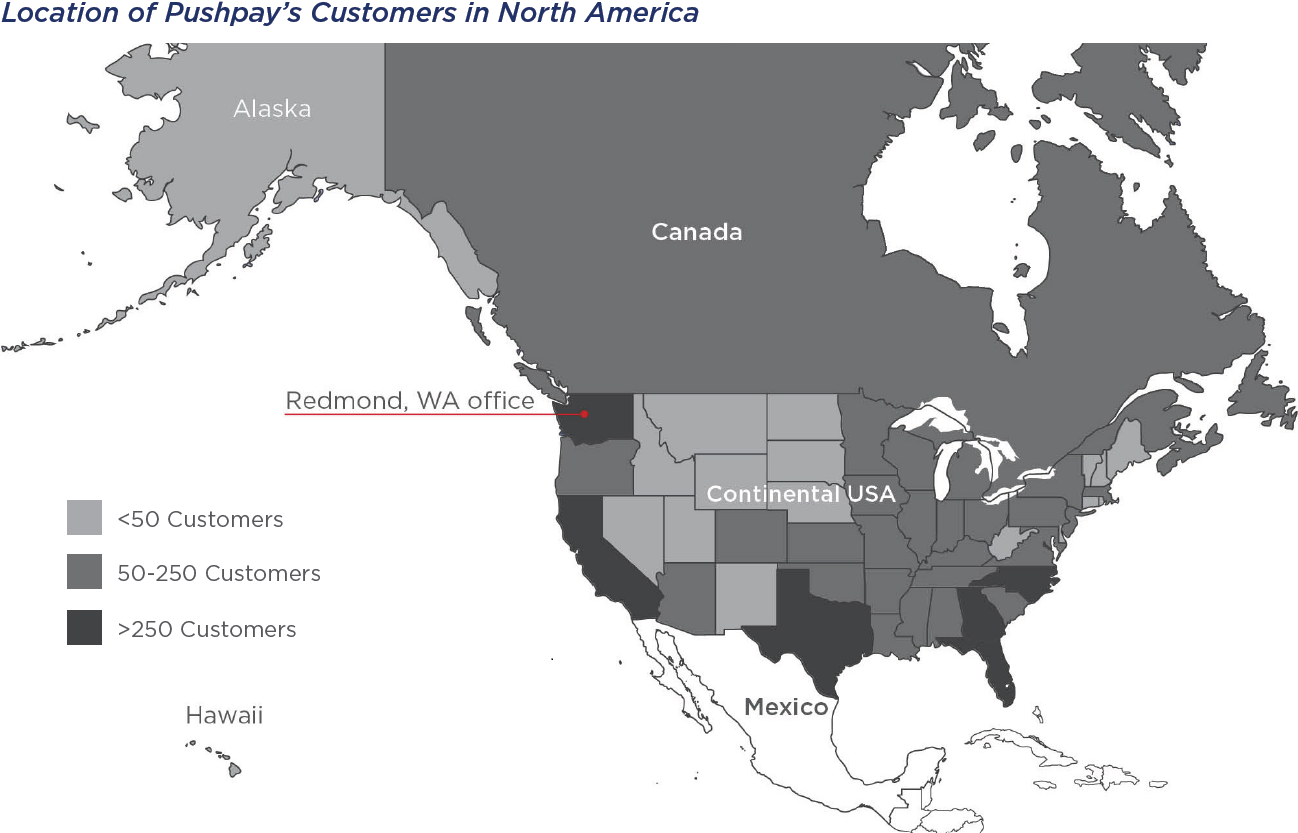
Source: 17 July 2018 Company Presentation
With such rapid gains in a relatively short amount of time, proving the clear need for the offerings, Pushpay is looking to increase the focus on more profitable segments of the faith-based market. Management are targeting largely the Medium and Large churches which comprise 34% of the total market but an outsized 93% of all revenue potential:
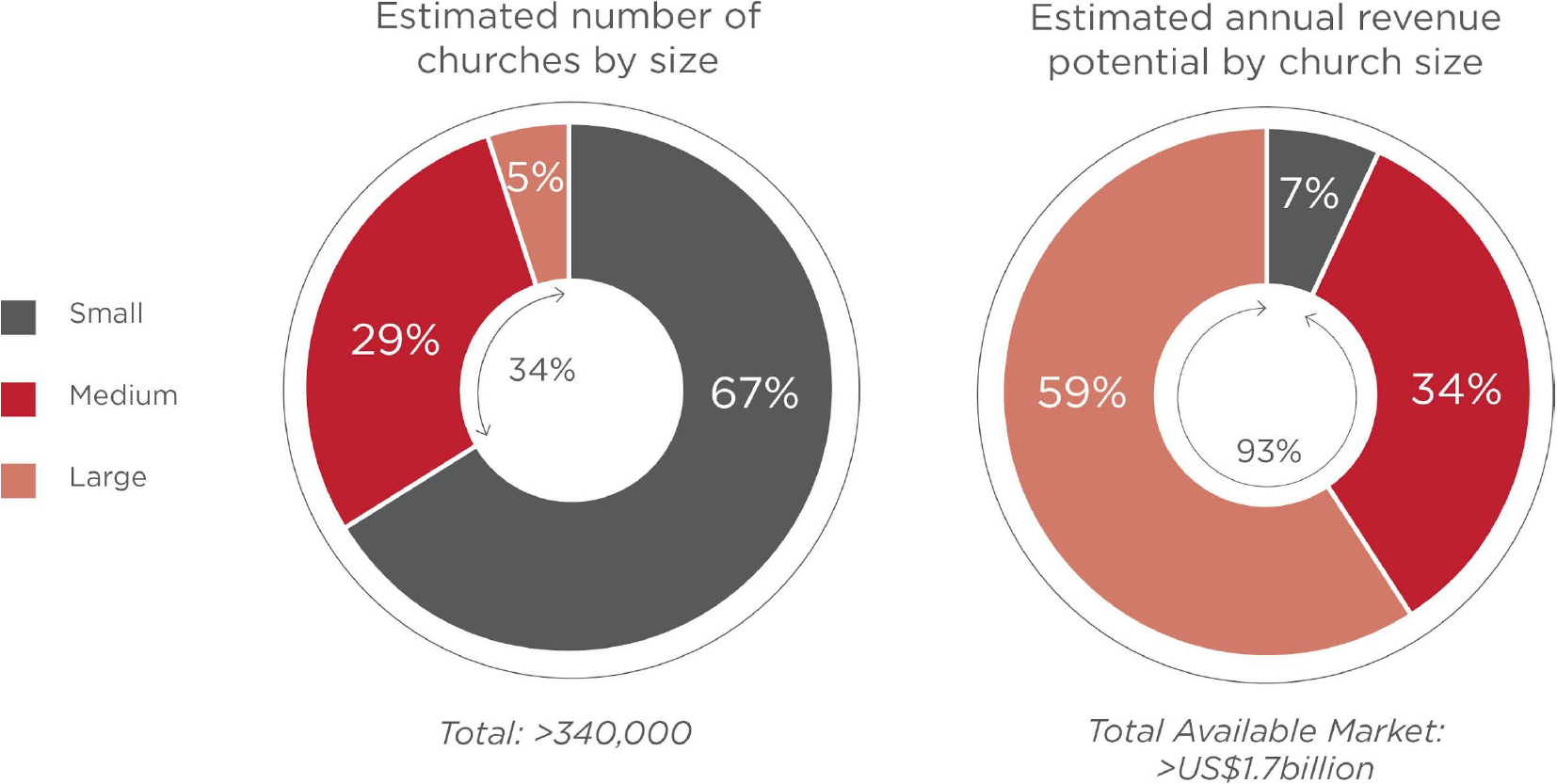
Source: 17 July 2018 Company Presentation
Targeting the medium and large churches would also be more profitable considering better management, lower churn-rate, higher survivability and higher revenue growth potential from pseudo-network-like effects. So far, as at 30 June, the company’s customer profile of medium and large churches now covers 52.4% (1Q18: 45%) of the customer base.
We believe that the company has the capability to capture a larger percentage of the market going forward
as, referencing the graphic below, it has a very attractive offering from the merchant-level (Churches) to the end-user through building up a healthy mix of payment solutions and other salient activities (analytics and engagement):

Source: 17 July 2018 Company Presentation
This should give the company a clear competitive advantage as its offerings embed deeper into a customer’s day-to-day operations and also makes switching costs exceedingly high as other rivals either don’t target the faith-based sector or don’t offer a “full suite” engagement model.
1Q19 Operational Update
Moving on down, to the latest numbers, Pushpay’s 1Q19 update indicate continued momentum across all metrics with revenues up circa US$7.5 million to US$21.4 million (+52.6% yoy) beating guidance of between US$20.5 million and US$22.0 million for the quarter. Other metrics tracked are summarised below:

Source: 01 August 2018 Company Filing
Aside from the improvements in key metrics, there were some notable improvements with the Medium and Large customers, seeing a larger proportion of Annualised Committed Monthly Revenue (ACMR) at 87.2% (1Q18: 82.8%) implying a larger portion of recurring revenues coming from more profitable customers. This also reflects the aforementioned increase in exposure to the larger customers noted in the previous section.
This improvement in operational metrics do bode well for the company, however, the departure of key sales executives is of some concern. The latest being Mr James Maiocco, the Chief Business Development Officer, who only took on the role in September 2016, has with the company noting he will not be replaced.
Departures in the Sales and Business Development personnel indicate a potential speedbump in the near term:
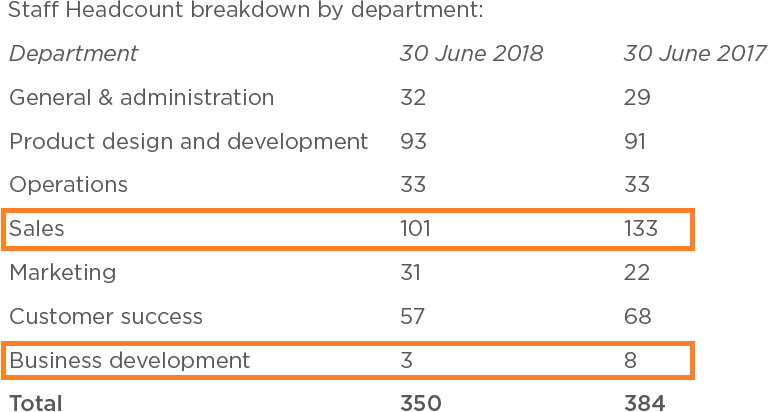
Source: 01 August 2018 Company Filing
It’s quite concerning that the ‘mini-Exodus’ in the salesforce was waved away and only saw a one-liner in the filing without providing an actual explanation. Departures in the salesforce aren’t normally an issue due to high turnover in the department across all industries, but at this stage of growth for the company, it should warrant a few discussion points at least.
Referencing anecdotes from Glassdoor.com, an anonymous employee review site, most of the grievances came from the salesforce citing issues with the “quick pivot” or ‘in the trenches’ decision making (understandable due to the company’s early stage of growth) to other nonsensical comments such as pastors not having business knowledge or an ability to recognise opportunities.
But giving the company, the benefit of the doubt, this turnover could reflect the shift in the company strategy which focusses mostly on medium and large churches which doesn’t require large number of account executives while also an increased focus in the US could mean “rightsizing” in the Australasian operations.
Also, looking at the company’s staff vacancies, most of the new listings are in Sales and Marketing while all of which are based in the US.
We believe that the company can also sustain a cost advantage on the tech side as it mainly uses tech talent for its R&D from New Zealand. This creates a sizable cost advantage on development as the average software engineer salary in NZ costs around NZ$66,284/annum (~US$44.21k) whereas if they employed the same programmer in the US, it would cost around NZ$149,934k (~US$100k), or more than double. The company benefits from keeping core functions inside the company without paying unnecessary premiums.
Management also maintained revenue guidance of between US$21.8 million and US$23.3 million for the 2Q19 (end 30 September 2018) and reiterated the cash flow breakeven target by end of calendar year 2018. We await confirmation of the details in the interim filings this 07 November.
Also, at the recent 1Q19 filing, management noted that they are opting out of a US listing, which had been previously mooted. This is also as they believe that existing capital and cash resources, will be sufficient to reach cash flow breakeven prior to the end of calendar year 2018.
Turning to the charts and on the daily a bullish crossover developed in August. This is where the 50 day moving average (green line) crosses above the 20 day moving average. Prices have though weakened of late, with dynamic support provided by the 200 day moving average at $3.61. Support below here exists at $3.45.

On the monthly, an uptrend since April 2017 has stalled this year, with the shares probing support around the 78.6% Fibonacci retracement at $3.64. The next few months are set to be pivotal with a target on the upside being the all-time high of $4.30. A failure to hold current support could see a deeper move back to the 61.8% Fibonacci retracement at $3.13

Investment Conclusion
Overall, Pushpay has a compelling investment case as it has recognised a clear opportunity in the e-pay market targeting the oft-neglected “faith sector”.
Admittedly, the idea of using mobile as an avenue for payments isn’t new and can easily be replicated. However, the fact that the company has expanded its offerings to fully engage with this niche covering almost all of the business-side for Churches from payments to analytics and congregant engagement, make it significantly more resilient against competitors.
We also like the company’s business model where it has a mix of solid recurring revenues with a high degree of operating leverage where once it scales up to a certain level, it profits will expand exponentially.
However, despite these positives, we recognise the large level of risk with the departure of two key executives along with a ‘mini-Exodus’ of salespeople which could provide a significant “speedbump” in its growth pace. While the lack of earnings visibility in the near term indicate a high degree of risk.
We thus believe it prudent for Members to adopt a wait-and-see approach until we see greater clarity on both top- and bottom-lines.
We are issuing a Traffic Light alert on Pushpay (ASX:PPH, NZX:PPH).

