

- The US just ran its first coordinated currency intervention since 2011 – and routed it through a back door specifically built to hide what it was doing.
- Records on Wall Street this week weren’t just about earnings strength. They were about a bond market getting quietly defended.
- Thursday’s US trading broke a bunch of rules – what does that mean for the markets?
- China’s building a gold pricing hub in Hong Kong to break a 100-year-old duopoly. We think it’s one reason $5,000 is still the H2 target.
- Copper hit fresh records on Comex and the LME in the same session the dollar rose. That rarely happens – and it tells you something the headlines missed.
The fatLITE is the weekly read. Membership is the position.
The Verdict
Washington spent this week working to weaken its own currency, and the reason is more to do with the bond market than with trade. On Monday, the US Treasury and the Bank of Japan sold dollars and bought yen in the first coordinated action of its kind since 2011. By Tuesday, the mechanism was in the public spotlight. The Treasury funded the yen purchases by selling euros through the New York Federal Reserve rather than selling dollars outright, which spares Washington the awkwardness of visibly abandoning a strong-dollar policy while producing much the same effect once those euros are eventually recycled. With federal debt approaching $40 trillion, the interest bill on the long end now dwarfs the cost of the war, and rising oil prices had been pushing yields the wrong way.
Equity markets took the intervention as liquidity and priced it so. The S&P 500 ran from 7,600 to a record 7,736 by Tuesday before easing back to 7,709 by Thursday’s close. The Dow set records early in the week. Europe did the same work with less drama. Down Under, the ASX200 was also back at record levels – we dive into the details in The Local section later in today’s correspondence.

US bond yields ended up round-tripping. The US 10-year fell from 4.68% to 4.61% across Monday and Tuesday as crude dropped, and the 30-year from 5.23% to 5.17%. Fed September rate-hike odds decayed from 64.5% on Monday to 54.9% by Wednesday. The dollar index drifted from 99.9 to 99.7. The commodity complex moved with more conviction. Brent fell early from $83.60 to $78.45 in two sessions as Strait of Hormuz diplomacy resumed, and gold posted its best session since February on Wednesday with a +3.75% advance to $4,308, breaking the downtrend that had capped it since the February highs.
Then Thursday took the permission slip back. Oil reversed, Brent +3% to $82 on reports Iran was reviewing a bill barring hostile vessels from the Strait. The 10-year rose +5bps to 4.66%, which leaves it around 2bps below where it started the week and undoes almost all of the rally that equities had spent three sessions capitalising on. The dollar index gained +0.3% back to just under 100. US equities fell. However, against all of that, copper set record highs on both Comex and the LME, the latter above $14,100 a tonne, and gold held $4,300 without flinching on Thursday. Two dollar-sensitive commodities made or held their highs on the one session this week when the dollar rose, and that is informative. The bond rally round-tripped and the oil move round-tripped; gold and copper kept what the intervention gave them.
The Calls
Plaza Accord – Redux?
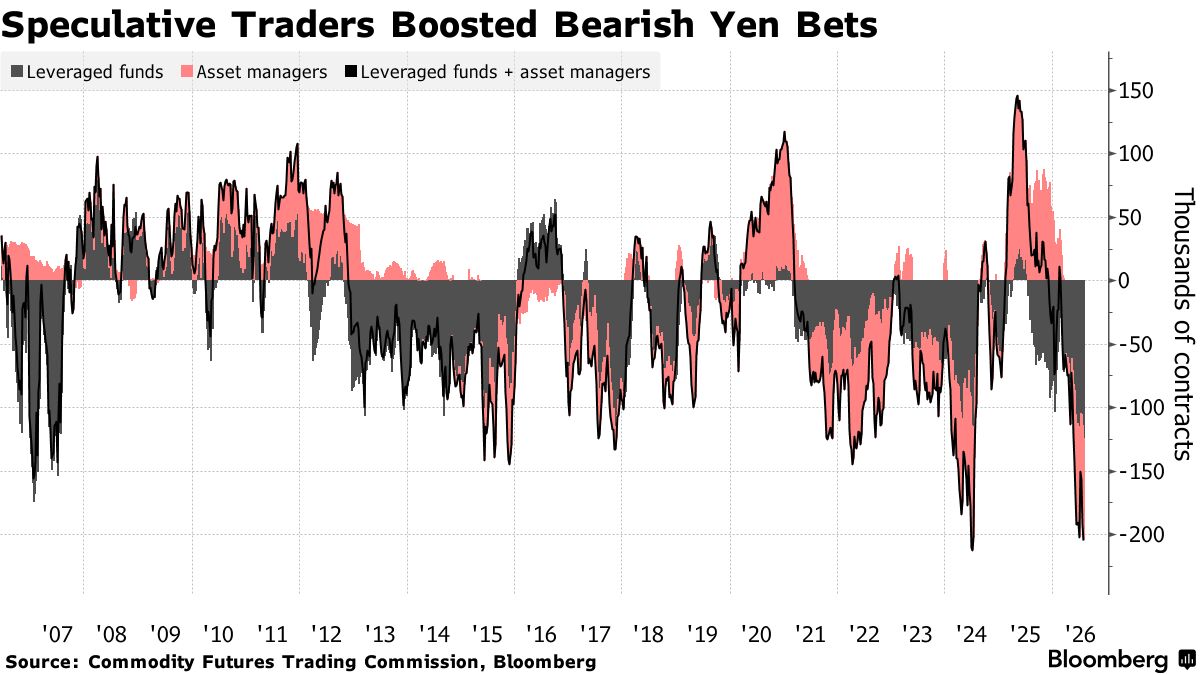
The US dollar is the master variable, and this week it acquired a motive. Monday and Tuesday established the mechanism, including CFTC data showing asset manager and leveraged fund net short yen positioning at its largest since 2024 as of 28 July, with hedge fund bearishness near the most extreme since 2007. That is a crowded trade standing directly in front of two central banks that have signalled their intent, which is how central banks warn short sellers to move. Thursday established the motive. Rather than currency policy, it was bond market defence. The uptrend in the dollar index that has run since early 2026 is broken, and the next material support sits near 98.
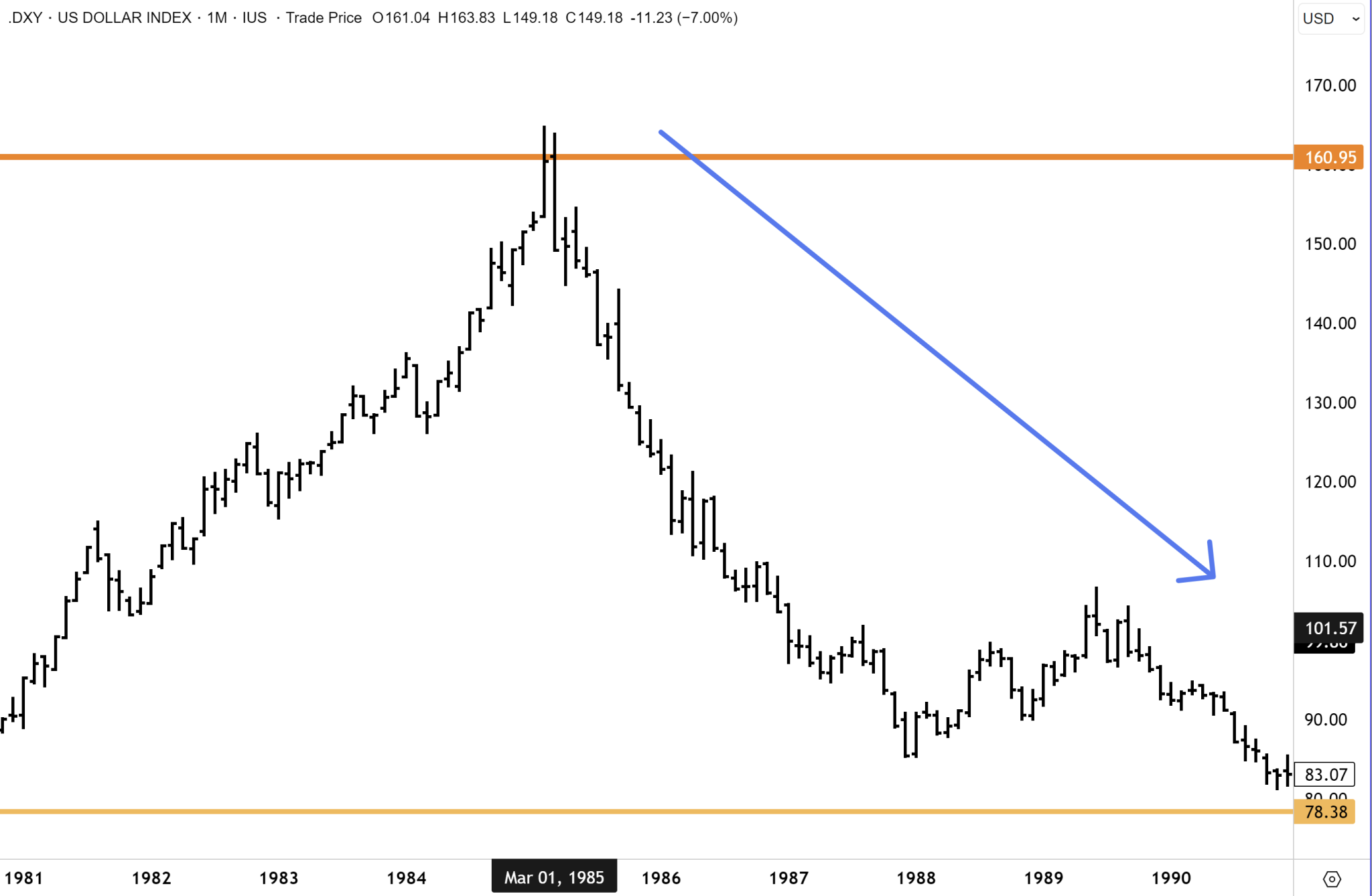

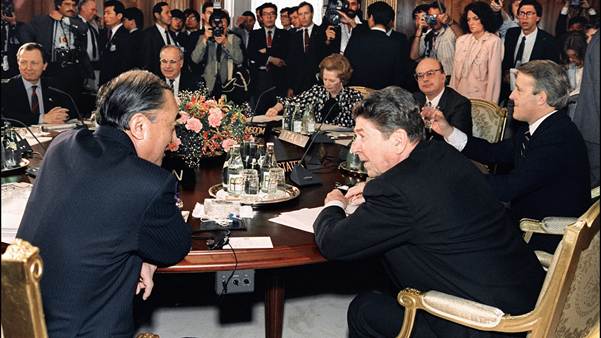
The last time the US intervened in this manner was eleven years ago, back in 2011. The most famous occasion occurred back in 1985 when the Plaza Accord was reached, where multiple central banks and the Fed co-ordinated intervention to lower the dollar – which worked spectacularly.
We would treat further coordinated intervention as the catalyst that accelerates the move. Locally, the clearest expression is the Australian dollar, which broke its own downtrend and held above US70c all week, and beyond that the entire resources complex, which is priced in the greenback, which is being deliberately weakened.
Net short positions on the yen among asset managers and leveraged funds climbed to their largest levels since 2024 as of July 28, according to Commodity Futures Trading Commission data released Friday. Hedge funds’ bearish yen views remained near the most since 2007. I believe this positioning and recent central bank intervention set the yen up for a bullish reversal.
Coordinated intervention has, in my view, changed the near-term risk-reward for betting against the yen. A stronger yen needs fundamentals to support the currency, but Japan’s private economy is in good shape with the corporate sector doing well. GDP is growing at a decent clip, and ROI for Japanese companies is rising across the board. I also expect additional rate hikes to materialise soon, with the Bank of Japan shifting to a more hawkish disposition.
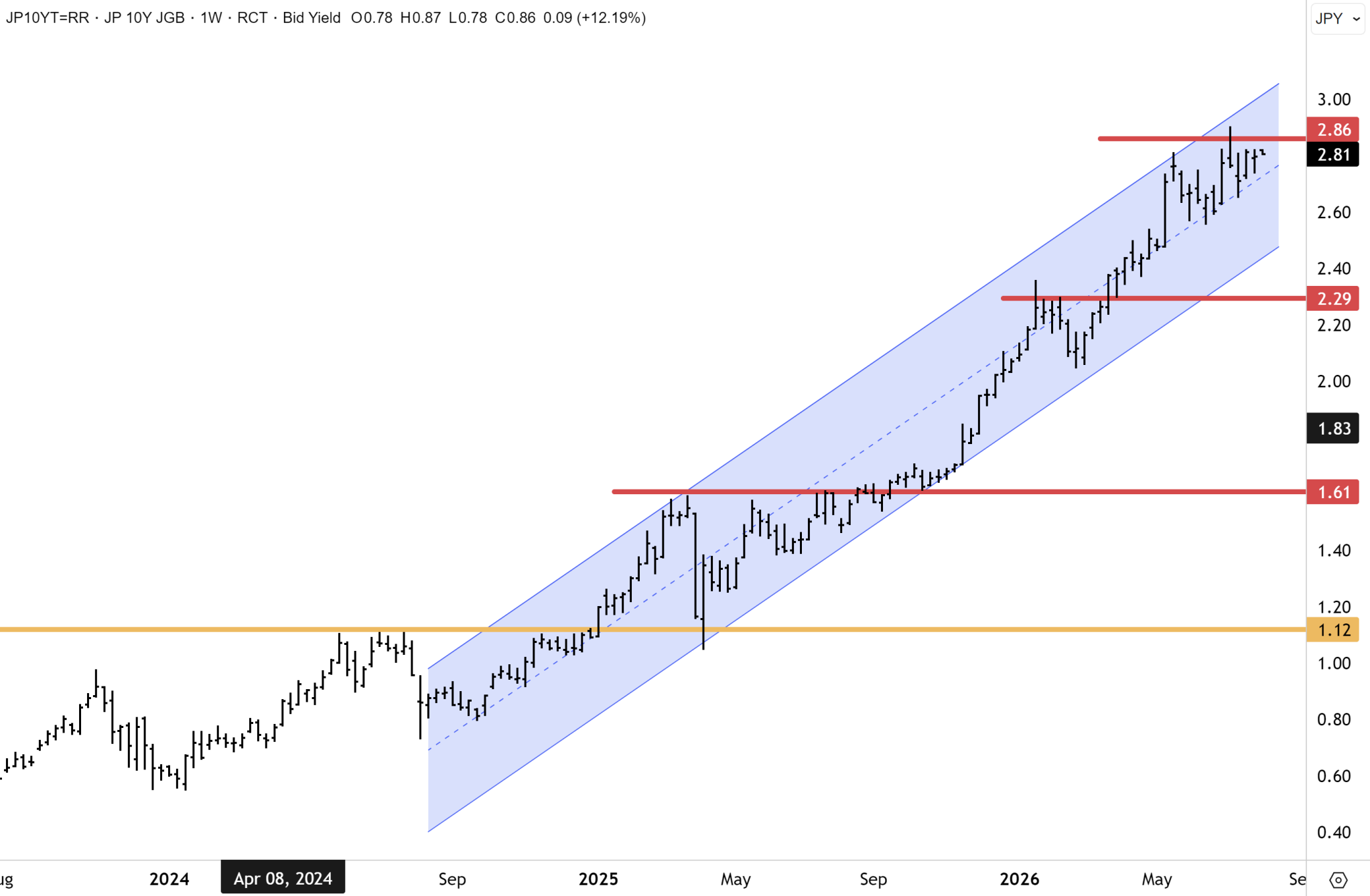
Higher Japanese interest rates will narrow the differential with the US and underpin the currency. The 10yr JGB yield has risen sharply in recent years – but this is a positive outcome and signals a “return to monetary policy normalisation” for Japan’s economy.
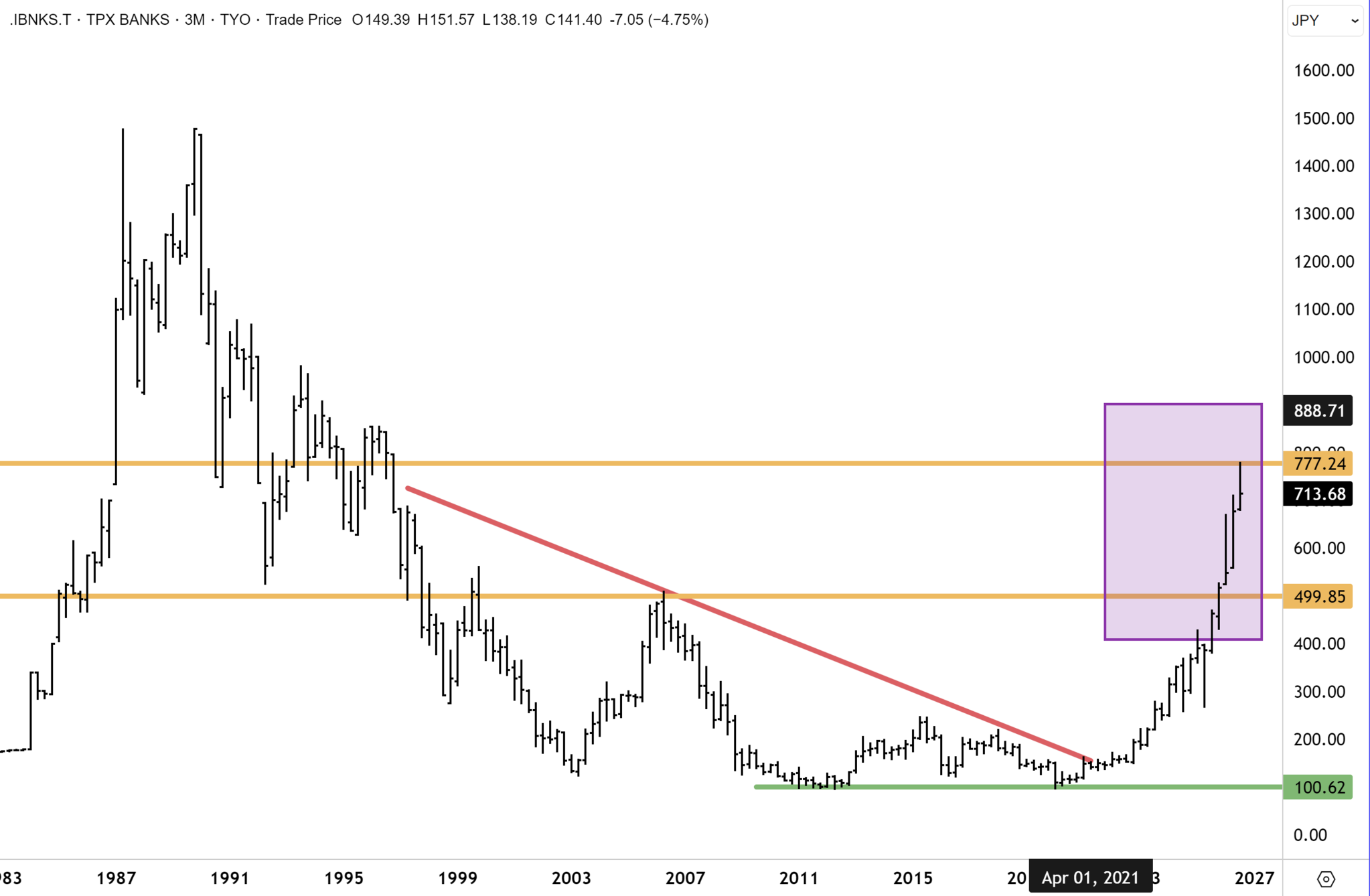
The TOPIX bank index has corrected but remains in a well-defined longer-term bull market.
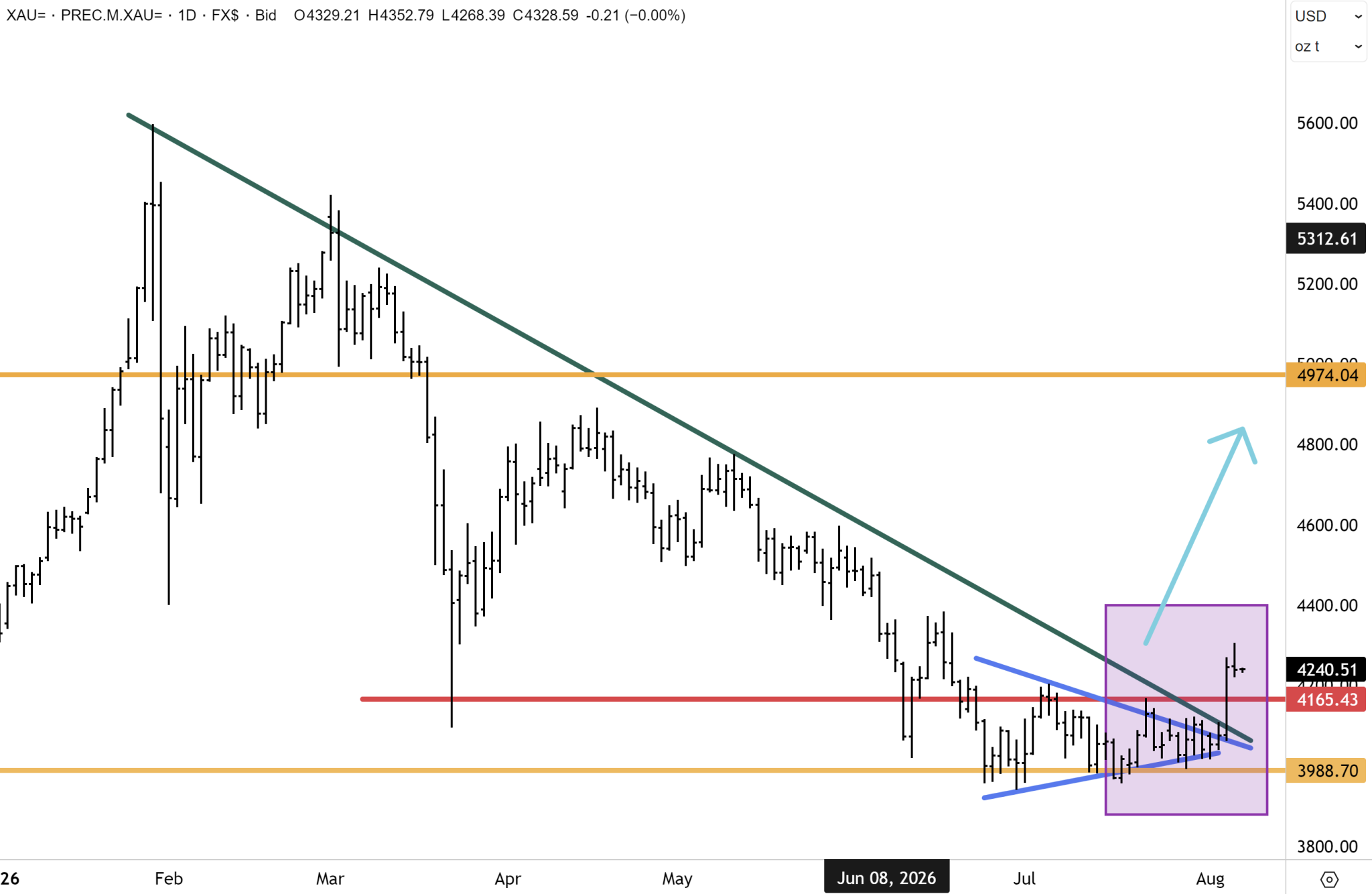
Gold was back in the spotlight. On Monday it was consolidating near $4,100 with an inflection anticipated but not confirmed. By Wednesday it had broken the February downtrend and closed at $4,308, its highest since June, with silver +4% to $62 alongside it. The move has a structural component as well as a monetary one: China is establishing a physical spot gold pricing hub in Hong Kong, a third centre intended to price the metal outside the London and New York duopoly. The near-term objective is $4,400, and we retain $5,000 as the second-half target.
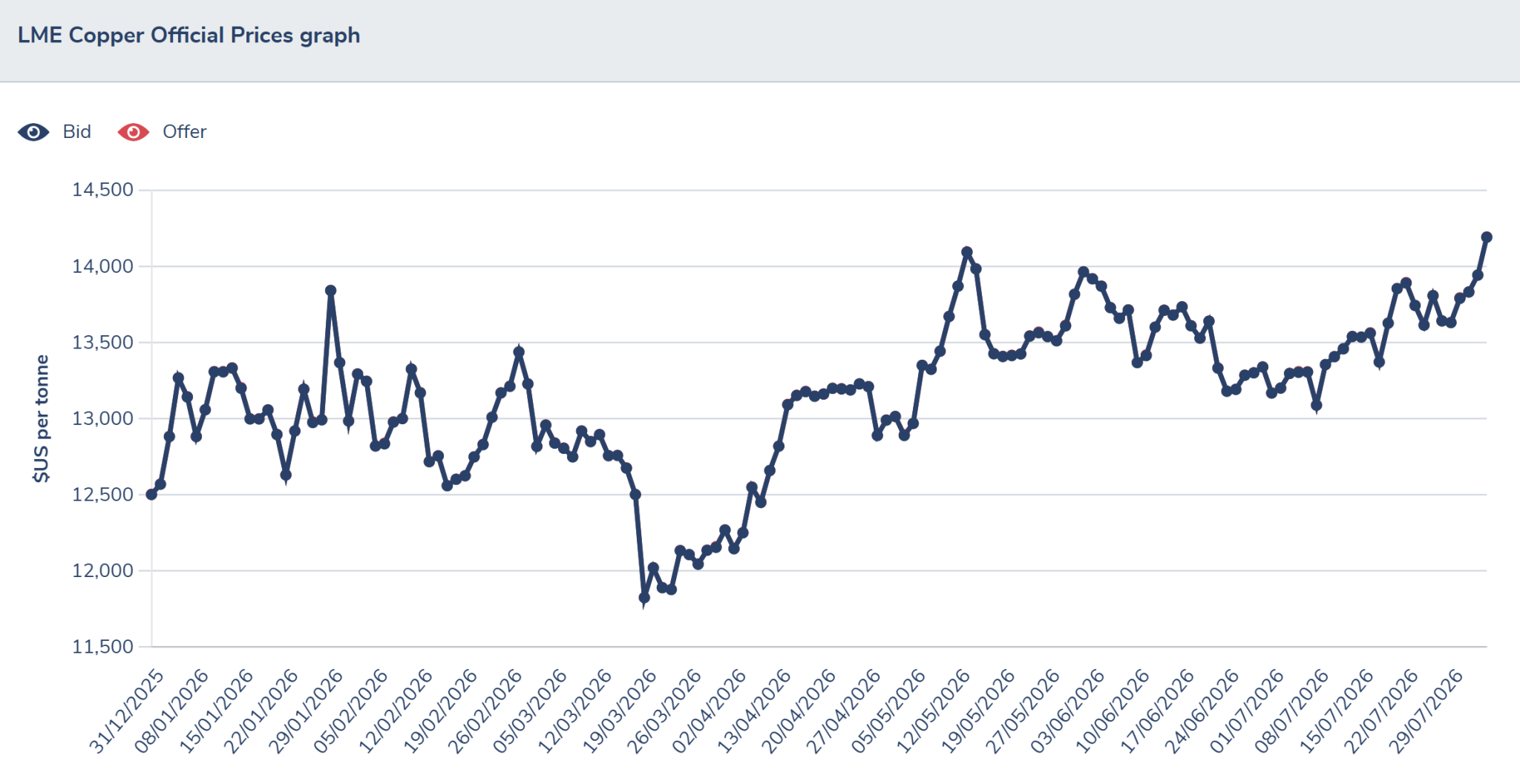
Copper is another conviction and the one where the case moved fast this week. Comex and the LME both set records on Thursday after several months of consolidation, with LME copper above $14,100 a tonne, and they did it on a session when the dollar rose and equities fell. The demand case is well understood by now. Data centres require large amounts of copper, the energy transition continues, while existing mines supply faces hurdles, new mines take fifteen years or more to develop, and the arithmetic pushes majors toward acquiring other operators rather than greenfield.
Meanwhile, the US earnings engine is running strong. Some 304 S&P 500 companies reported through the prior Friday with aggregate growth of 29.3% and 85.2% beating estimates against a long-run average of 67.5%, in what is described as the seventh consecutive quarter of growth. Microsoft’s result was an important one, helping demonstrate that a Mag 7 balance sheet can monetise AI capital expenditure at scale. Goldman Sachs noted SPX call volumes reaching an all-time high as investors rebuilt upside exposure after July’s technology liquidation, which is unusual: options markets are normally used to hedge downside. We would not, however, present the monetisation question as settled, because Thursday tested it immediately.
The Local
The domestic macro is quiet and pointing one way. Services PMI reached a six-month high of 53.6, June household spending beat at +0.8% against +0.2% expected with the annual pace at +6%, and trimmed mean CPI recently undershot the Reserve Bank’s own forecast. Next week’s meeting is firmly priced as a hold, and we see no reason to argue with that.
The ASX 200 gained solidly across the week, setting fresh records and remaining firmly higher for the week at lunchtime on Friday, despite a slight dip on the day. The rotation notable. Monday was defensive, with utilities +2.1% leading and nine of eleven sectors higher. Tuesday was broad risk-on, ten of eleven advancing, technology +3.9% and healthcare +2.4%. Wednesday was narrow and directional: only six of eleven sectors gained, materials surged +3.6% with the gold sub-index +6.4%, and energy -2.2%, utilities -1.6% and the banks -0.4% supplied the capital. Thursday brought materials +1.1% and financials +0.45% together, which are the two heavyweights – when they move up together, the benchmark will follow most of the time.
Gold miners rallied. Evolution Mining (ASX: EVN) added +6.3% and +3.8% across the same two sessions, with Newmont (ASX: NCM), Regis Resources (ASX: RRL), Genesis Minerals (ASX: GMD) and Vault Minerals (ASX: VAU) merger pair all participating. St Barbara (ASX: SBM) is a high-torque play, and it delivered on both fundamentals and the chart. Disclosure: All our Funds, our house account, myself/wife/family all individually own shares in St Barbara.
Copper names tracked the metal higher, including Capstone Copper (ASX: CSC), Sandfire Resources (ASX: SFR) and 29Metals (ASX: 29M), and Global X Copper Miners (ASX: WIRE). UK-listed Glencore confirmed plans for an ASX secondary listing targeting October 2026, alongside a first-half result showing group adjusted EBITDA +86% to $10.1 billion, marketing earnings +142% and a $1 billion special distribution with a $500 million buyback. A diversified major with genuine marketing optionality listing locally is a material addition to the investable universe here and should be on the calendar now rather than in October.
Among the banks, we remain on the unfashionable side and are holders rather than sellers. National Australia Bank’s (ASX: NAB) business lending posted a solid update.
Report Spotlight
Capstone Copper (TSX: CS; ASX: CSC) – BUY
Capstone posted a seventh straight record quarter for adjusted EBITDA. Revenue rose 36% to US$739.7m, adjusted EBITDA hit a record US$354m, and net debt fell 8.6%. Mantoverde ran 13% above design capacity at a record-low cost of US$1.97/lb, offsetting cost inflation elsewhere. Realised copper prices nearly doubled year-on-year to US$6.22/lb. Management is actively hedging diesel and acid exposure while advancing Mantoverde Optimized, the newly approved Pyrite Augmentation project, and Santo Domingo toward a sanctioning decision later this year. Guidance is unchanged.
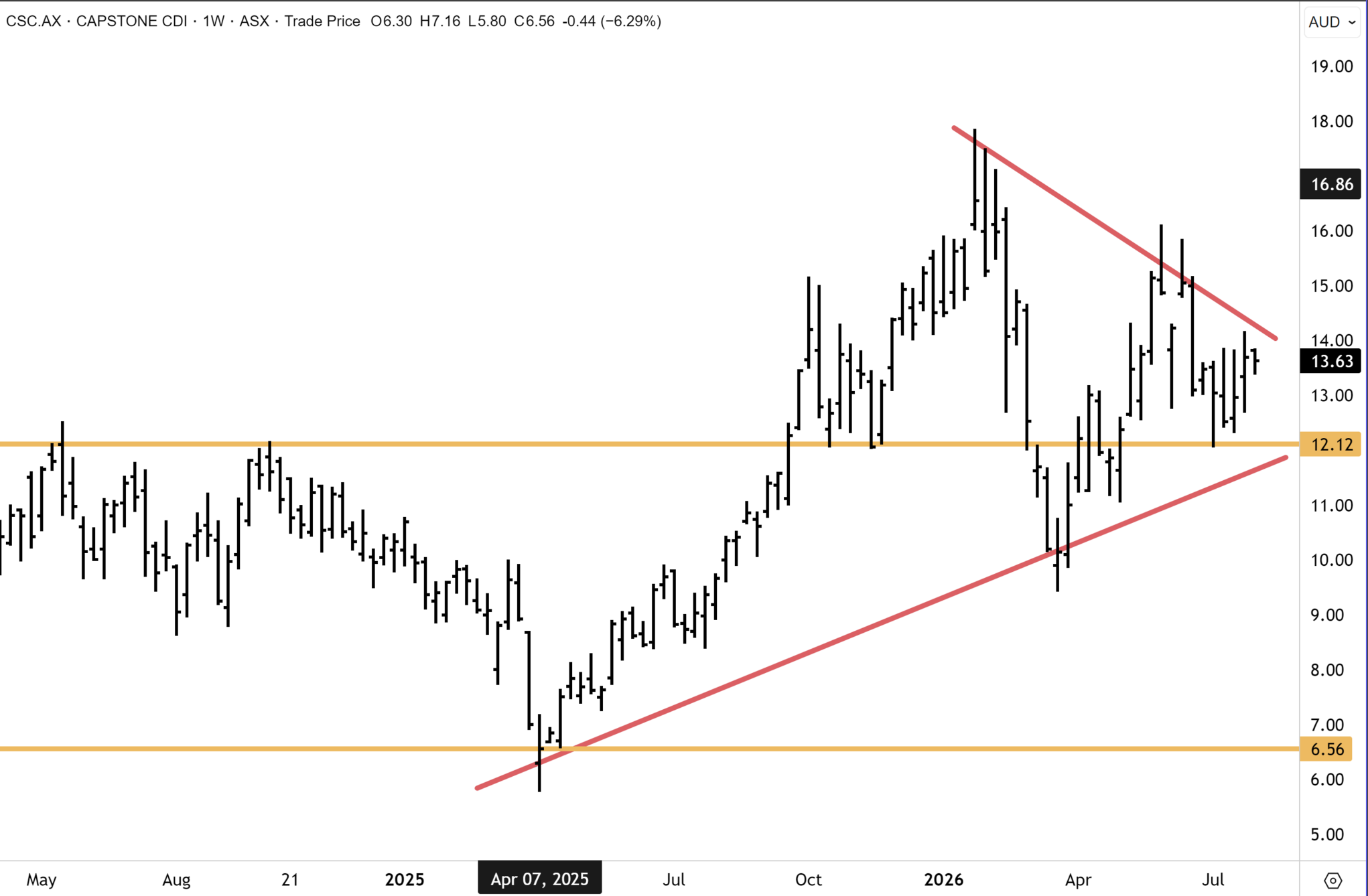
Since our last technical update around 7 weeks ago, Capstone Copper has constructively consolidated above key support at $12 and below the primary downtrend that has been in place since the record highs. We anticipate a topside breakout above the downtrend is nearing, and resistance now intersects at $14. We have confidence that Capstone will soon retest the record highs around $18, and potentially within the coming year given our bullish outlook for copper.
Everything in this fatLITE is the surface. The full reports, macro commentary, model portfolio, and buy recommendations are members-only. Try it with our 30-day money-back guarantee.
Have a great weekend.
Carpe Diem
Angus

