
A Low Bar
Shares of National Australia Bank (ASX:NAB) have lagged over the past year, as the broader sector has faced headwinds from slowing activity, increased regulatory costs and in the crosshairs of the Royal Commission. The latter has highlighted many cases of bad behaviour across the industry. While these are likely to be found in any industry, to have a spotlight shined on the behaviour leaves a sour taste and has dampened investor sentiment. Nonetheless, there is a relatively low bar that has been set for NAB on the valuation front, providing some scope for a positive re-rating going forward.
The latest scalp to be claimed at NAB from findings at the Royal Commission has been the head of Consumer Banking and Wealth, Andrew Hagger. Mr Hagger stepped down (following COO Anthony Cahill out the door) after saying that he would “take accountability for what has occurred on my watch, and accept that alongside successes were failures, including instances where we did not act with the pace required.” Mr Hagger displayed humility in deciding to depart and his wording; but had clearly felt considerable pressure from the commission.
NAB has rejected any prospect from the Royal Commission of any criminal activity across its business and has also rebuked the review for its negative assessment of NAB’s corporate culture. The bank responded with a 30-page submission that accepts mistakes have been made, but it has learnt from its errors and sought to make amends with customers.
Mr Hagger will be replaced by former NSW Premier Mike Baird, who is now being touted as a potential next CEO.
He will be Chief Customer Officer, Consumer Banking. NAB has joined others in the industry, by saying earlier in the year that it will sell its wealth management business, MLC.
It is expected to fetch somewhere around $3 billion or more, but the impact from the Royal Commission may depress pricing. NAB said they are considering a “broad range of exit options,” which will include a demerger and IPO or a trade sale. The JB Were and nabtrade wealth management businesses are being retained and were reportedly described by Mr Thorburn as “excellent businesses and platforms, and we are going to invest in them.”
Mr Baird has been with NAB since April 2017 as Chief Customer Office, Corporate and Institutional Banking. Retail banking has long been a path to the Chief Executive role at banks, but it will take some time for Mr Baird to demonstrate whether he has the chops to transfer his political talent successfully to such a high-profile role in banking. He has been tasked with taking a lead in setting NAB’s “reputation agenda” by CEO Andrew Thorburn.
Mr Thorburn has been in the CEO role since August 2014 and depending on future findings from the Royal Commission is slated to remain in the role for at least another 18 months to two years.
There were a few other executive changes outlined in yesterday’s ASX filing, but the above were the most notable.
There have been significant changes at the executive level since 2014; during a cathartic period for NAB. There has been positive traction in the underlying business though and NAB is in a lot better shape than it was earlier.
3Q Trading Update
NAB provided an upbeat assessment with a third quarter trading statement. CEO Andrew Thorburn noted that ‘notwithstanding a challenging operating environment, financial performance in 3Q18 has been sound. Revenue is up, despite elevated wholesale funding costs, while asset quality and balance sheet metrics remain strong.’
NAB reported that unaudited cash earnings slipped 3% to $1.65 billion, reflecting higher investment spend and credit impairment charges, but this was slightly ahead of market expectations. Management flagged ‘additional provisions’ when it reports second half results in November, and the CEO also remarking that “The Royal Commission is challenging us with its focus on where we have let customers down.” Expenses rose 2% due to the higher investment spending, higher compliance costs and increased depreciation and amortisation.
Investors were more focussed on a 1% lift in revenues, which contrasted to declines reported by CBA. NAB it seems is making headway in business volumes with SME’s (smaller to medium enterprises), which has mitigated the impact of weaker net interest margins, and as home lending remains intensely competitive. Credit quality remained sound:
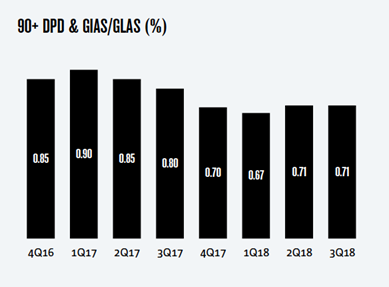
Source: NAB (ASX:NAB)
NAB did disappoint with a dip in the common equity tier 1 ratio to 9.7%. However, this should lift as the management continues to ‘simplify’ the bank’s footprint. Part of this includes the divestment of the MLC wealth business, which we view as the right call, given the increased scrutiny coming out of the Royal Commission.
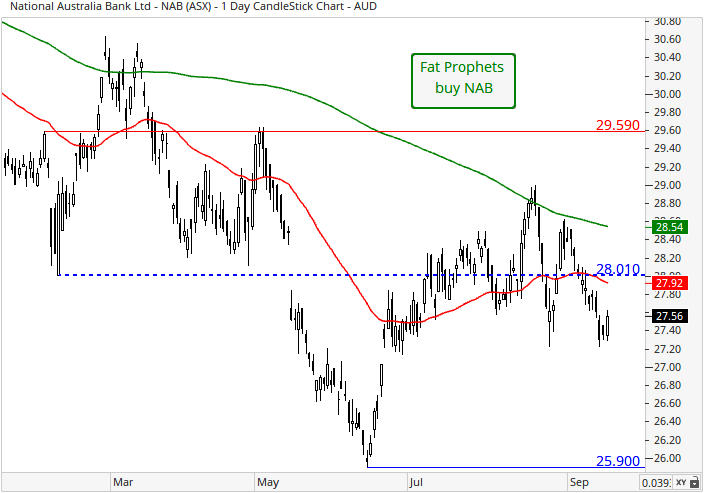
Turning to the technical picture and the daily chart, the bearish moving average crossover present since November 2017 is suggestive of momentum to favour the downside. This is when the 50-day moving average (red line) crosses below the 200-day moving average (green line). Support at the February intra-month low of $28.01 has also given way. For the short-term technical outlook to improve, a decisive break above the 200-day moving average (green line) of $28.54 is required. Should this positive development evolve, then medium-term momentum would shift back in favour of the bull-camp.

On the monthly chart, downside support is expected at the 78.6% Fibonacci retracement of $26.02 as represented by the thin-blue set of retracements, should the bears remain in control over the near-term. It is important that the bulls defend this level, and a consolidation unfolds over the medium-term. Should this occur, then this would encourage a period of price-stabilisation to evolve, and thus ease the recent weakness in share price.
If this favourable scenario was to evolve, then from a probability standpoint, a gradual ascent towards resistance evident between $34.09 and $34.79 is deemed viable. This is made up of the May 2017 high and the 78.6% Fibonacci retracement (red set of retracements) respectively. Overall, the series of higher lows and higher highs are characteristics of a dominant long-term uptrend in place, and thus would likely steer the prevailing direction of National Australia Bank.
Summary
NAB, along with peers, has underperformed over the past year, battered by several headwinds such as the bank levy, increase in regulatory oversight and the Royal Commission weighing on sentiment. NAB has also earlier been the ‘ugly duckling’ of the big banks, but strides to transform the business (i.e. the demerger of the UK Clydesdale Bank) have been made and we believe the bank is slowly developing the platform to lift its cash return on equity from current levels. The divestment of the MLC business is the right move in our view, especially with the prospects of increased scrutiny and costs in the wake of the Royal Commission.
Looking at the valuation, NAB shares trade on 14.3 times the average FY18 earnings estimate, dropping to 12.6 times the following year. The projected dividend yield over the same time frame expands from 6.3% to 7.2%. The FY18 price to book value multiple is modest at 1.6 times.
NAB (ASX:NAB) will remain held in the Fat Prophets Portfolio. For Members without exposure and a medium-term time frame, we recommend the stock as a buy.
Disclosure: NAB (ASX:NAB) is held in the Fat Prophets Concentrated Australian Share and Australian Share account portfolios.

