
More care needed
The aged-care sector came under some pressure on Monday after PM Scott Morrison announced yet another Royal Commission. Morrison said his decision was triggered in part by the scandal at the Oakden nursing home in Australia. He claimed that he could no longer ignore the alarming number of aged care operators “flouting the law and putting lives at risk”. It is worth pointing out that the Oakden facility was actually government run, and closed a year ago.
The resulting sell-off in the aged care sector following the announcement was indeed a vicious one, with shares in Estia Health closing the session down 18.6%. Investors also exited peers Japara, Regis, and Aveo, with the combined loss in market capitalisation approaching $500 million. Investors have braced for significant scrutiny into the sector from the government, and with public feeling set to be whipped up further by last night’s ABC Four Corners programme.
The scathing market reaction indicates that investors are concerned that the Royal Commission, and associated findings, will have an impact on sentiment for some time. The damage though has certainly been done to Estia’s share price, although the company may even benefit from reform, and higher government funding, as one of the better operators in the space. With the dust settling it was also interesting to note that Estia regained some ground today, with the shares up around 4% as of this writing.
More value has emerged in Estia, but there will likely be further sentiment headwinds in the months ahead. For now, we maintain a hold recommendation on the stock.
An emotive subject
The aged care sector has been in the spotlight in the past, with sentiment stoked by various current affair programmes, and the Four Corners exposé on Monday night. Any evidence of neglect also naturally causes angst as many of us will end up in one of these homes, and/or have relatives that are already there. And with a growing population, the need will only rise – a recent PWC report estimated that an additional 226,000 residential aged care places will be required by 2040 at a cost of just under $30 billion.

Source: PWC
Scott Morrison has said that he expected the inquiry to reveal ‘bruising information’ about people in care, and some ‘real mistreatment.’ There is however some irony here with successive governments reducing residential care funding by around $3 billion according to some estimates.
The severity of the selling yesterday also marked an important difference between this RC and the one into the banks and financial services sectors. The calls for the latter had been brewing for some time, and when it was confirmed, there was an element of inevitability. While the aged care sector has been under the spotlight (and in particular, media scrutiny), with a full-scale Royal Commission surprised investors.
Industry CEOs have put on a brave face, at least initially. Estia’s Norah Barlow released a statement that the company welcomed “scrutiny of the sector and any measures that would help not only ensure the safety and quality care of its residents but also provide a sustainable sector for all those in aged care”. She went on that Estia “looks forward to engaging in the consultation with government on the terms of reference for the commission”.
The attention will be coming in spades, and clearly as the ABC’s investigation has highlighted some shocking instances of mistreatment and neglect. This has ranged from physical abuse to the serving of food regarded as not fit for human consumption.
As we have seen with the banking and financial services sector an outcome from the commission will no doubt be tighter regulation. The government (which has been reduced funding to the sector) will also have to shoulder some burden, however, with around a third of operators already unprofitable, and likely to go out of business if costs rise further (and hence Ms Barlow’s reference to providing for a ‘sustainable sector). While not making excuses, the reality is that many staff operating in the sector are at/near minimum wage, so it may not be completely fair (and not-withstanding the extreme examples of mistreatment) to expect five-star exemplary care where resources are stretched, and working conditions themselves are tough.
Something will certainly need to be done, and simply tightening up quality, greater regulation, closing down the worse centres, will do little to solve the real problem.
There is already a shortage of aged-care spaces, and the PWC report projects that this will rise to 226,060 by 2040 just to keep pace with population growth. This as it projects that the number of people aged 70 years or over in Australia will grow to almost 3.5 million by 2025 (a 50% increase on the number in 2014).

Source: PWC
The prospect of sector consolidation, and better funding might provide some longer-term gain for the likes of Estia Health, which is now one of the better run operators, and has been investing in facilities. Demand also is only going to rise. Nearer term there is likely be some pain sentiment wise in the lead up to the commission, and as it gets underway.
As shown in the FY18 numbers, Estia has made tremendous financial progress over the past 12 months, with total operating revenues up 4.3% to $547.05 million.
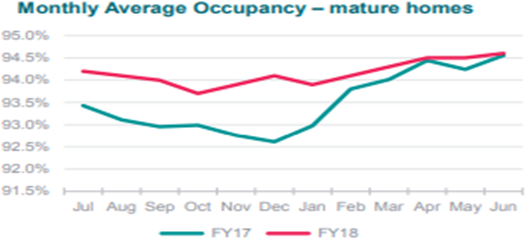
An investment in the product (which faltered under previous management) has also seen occupancy rates lift.
These came in at a Full-Year average of 94.2% for mature homes, and some way from the 92.5% in December 2016 (and 10 homes even reporting occupancy rates well below 90%). Every bit of improvement in occupancy rates counts, as management estimates sensitivity to be substantial, with a 0.1% movement in rates impacting EBITDA by $560,000.00.
Source: Estia Health
With occupancy levels ratcheting higher, the company has also set its sights on continuing growth, having recently launched 2 new homes with Queensland’s Twin Waters which has a capacity of 114 and opened last September while the Kogarah’s (NSW) 72 space structure opened March 2018. The Kogarah home already boasts a 100% occupancy while the larger Twin Waters Home has hit 84% (breakeven at May 2018: ~73%) with incoming residents on the way. Estia has a pipeline of 5 more and split between the same 2 states with an expected capacity of 585 and all set to open as soon as 2H19 and as late as the 2H20.

Source: Estia Health
On the cost side, labour costs have ticked up, but bearing down on these could have negative consequences (and also, we are some way from where robots can provide efficient aged care services). However, improved procurement and operational costs are providing efficiencies, and non-wage costs, as a percentage of revenues, fell by 100 basis points to 16.8%. This allowed for robust EBITDA Margins of 16.5%. Net margins of 7.52% were well above the sector average of 6.1% placing the company comfortably above the 75th percentile (3.1%). Management are forecasting mid-single digit percentage growth in FY19 EBITDA based on existing portfolio of homes.
Estia has also maintained a solid balance sheet having continued to reduce leverage. Net debt fell to $63.8 million at FY18 end and has come a long way from peak 2016 levels of $223.7 million. The company also has a $330 million loan facilities out to 2020 which gives a large amount of financial flexibility for the refurbishment and development of existing homes.
The result highlighted the tremendous improvement under Ms Barlow’s tenure which has stabilised the company as well as set the building blocks for sustainable earnings growth going forward. We have no concerns over management continuity with her retirement in November. Her successor, Mr Ian Thorley, has had extensive experience in C-level roles across various large private hospitals and aged care companies not to mention his active involvement and significant contribution in Estia’s turnaround as the COO and Deputy CEO. It may however be a baptism of fire as he fronts up at the Royal Commission.
Turning to the charts, and the technical picture has deteriorated following further following the announcement of the Royal Commission. Prices have dipped further below both the 50 day (red line) and 200 day (green line) moving averages. Support at this year’s low of $3.09 has also given way decisively, although the buttress at $2.35 has held amongst the sell-off. A move back above the 50-day moving average, and downward trend-line around $3.08 would be needed to improve the technical picture.

On the monthly, the share price touched an all-time low of $2.06 in September 2016 to form a ‘bullish doji’ candlestick formation. Positively, the highest price of this candle of $3.41 was surpassed in October 2017. This was a bullish development and signalled a medium-term upward shift in momentum. Prices are currently below this level, and a move back above here is needed to improve the outlook. Support at $2.85 failed to hold, and that at $2.40 is now being probed (although a mild bounce has been seen today). At best the technical picture is likely to undergo a protracted period of consolidation.

Summary
The sell-off in the aged care sector following PM Scott Morrison’s announcement of yet another Royal Commission has been felt heavily by Estia Health. Investors have braced for significant scrutiny into the sector from the government, and with public feeling set to be whipped up further by last night’s ABC Four Corners programme.
The scathing market reaction indicates that investors are concerned that the Royal Commission, and associated findings, will have an impact on sentiment for some time. The damage though has certainly been done to Estia’s share price, although the company may even benefit from reform, and higher government funding, as one of the better operators in the space. With the dust settling it was also interesting to note that Estia regained some ground today.
Value has emerged in Estia which are now trading on a FY19 earnings multiple of approximately 17 times, with a projected yield of 5.6%. However, the technical picture has clearly deteriorated further in the wake of the announcement of a Royal Commission into the sector, and with the shares set to undergo a period of consolidation we maintain a hold on the stock.
Disclosure: Estia is held in the Fat Prophets Concentrated Australian, and Small & Mid-cap managed account portfolios.

