
Fat Prophets take a loss
Integrated pet care player, Greencross (ASX:GXL) has had quite a tough year having reported a substantial drop in profits as the vet business saw lower visitation and higher costs. We also expect pressure from lower consumer spending down the road. The final nail in the proverbial coffin is that the company will be removed from the ASX 200 index which weighed on the shares in the near-term, recognising this, we take the opportunity to cut our losses and SELL the stock.
What’s New?
In our last coverage of the stock back in May (FAT-AUS-873) we covered a Trading Update where management provided a heads-up that profits will take a hit due to an expected $16 to $20 million non-cash impairment from a mix of project costs, redundancies and other one-offs.
Following that, the shares continued to come under pressure with the FY18 results out and indeed showing pressure on the bottomline. Another clincher was that the S&P Dow Jones Indices changes announced at the close of last week showed that Greencross (ASX:GXL) will be removed from the S&P/ASX 200 index by 24 September 2018. This will likely weigh heavily on the shares as institutional funds trim the company out of their respective portfolios. Unsurprisingly, the shares are now trading at 5-year lows

Source: 07 September 2018 S&P Dow Jones Indices Filing
Before moving on, we’ll take a brief look at results for the FY18:
FY18 Results Review
At first glance, with the company reporting a statutory profit of $20.7 million which is a substantial 50.9% year-on-year drop, would indicate that the results were significantly disappointing. However, it’s not as straightforward, in fact the company’s results are more aptly described as “mixed” instead of purely bad.
Revenues across the board were up with some units reporting double-digit growth leading to group level revenues expanding 7.5% year-on-year to $878.7 million. Moreover, the increased focus on higher margin private label brands (for retail) and increased demand for specialist medical petcare have pushed gross margins up 90 basis points to 56.3% and up 9.2% year-on-year to $494.75 million.
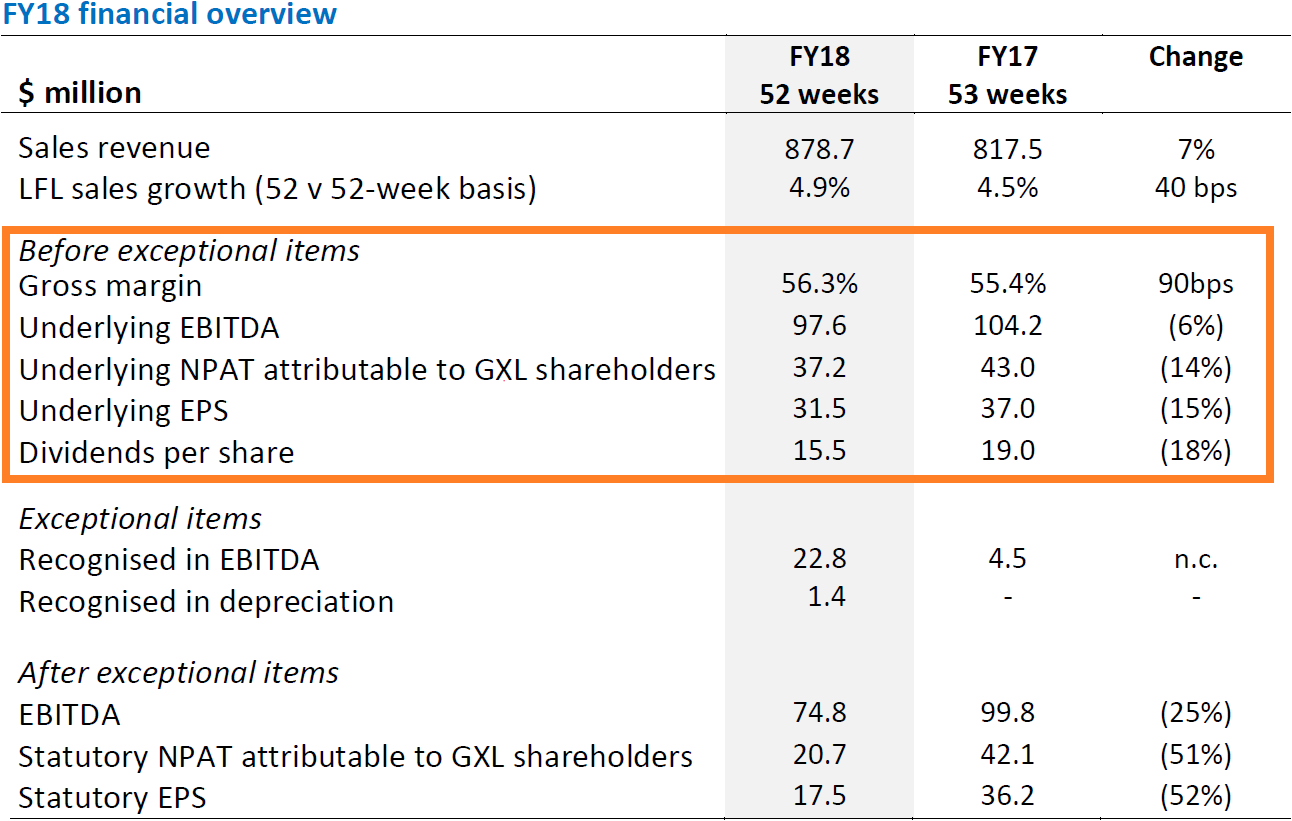
Source: 20 August 2018
On the other hand, the company’s “integrated petcare model” featuring in-store clinics proved to be its undoing, as these seemingly cannibalised sales from their standalone clinics which reported substantial drops in visitations. As such, the Vet segment saw underlying EBITDA fall by 17% year-on-year to $24.6 million.
Other factors that weighed heavily on the result were ‘immature’ in-store clinics which, according to management, have a “short-term” negative impact. Others include losses from higher labour costs of $1.3 million in the Animal Referral Hospital joint venture and a $1.8 million impact from start-up losses in new emergency clinics.
Operating Expenses also surged higher at group level, up 18.6% or by $65.6 million to $418.8 million due to the “immature” clinic rollouts, the Joint Venture and a one-off $19.8 million from IT projects and other impairment costs.
Upon closer inspection though, we believe that it is likely that the New CEO, Simon Hickey coming onboard has used this opportunity to write down asset values early in his tenure and to start FY19 on a clean slate. In fact, underlying NPAT is only down 14% year-on-year to $37.19 million versus Statutory NPAT which was down a substantial 50.9% to $20.66 million.
Going forward though, management has provided a positive outlook for FY19 with an expected 8% growth in group revenue and targeting cost savings of between $10 and $13 million, with $5.8 million having already been realised as at 20 August 2018.
However, we believe that headwinds are likely to come around from depressed consumer spending. The ongoing falls in Sydney and Melbourne home prices have reversed the wealth effect from years of price increases, while snail-paced wage growth also weighs down on consumer confidence.
We’re already seeing initial signs that consumers have started to tighten their belts, with data from the Australian Bureau of Statistics showing that retail sales in July were flat at 0.3% – its weakest results since March – dragged down by lower sales in apparel (-2%), department store goods (-1.9%) and household goods (-1.2%).
We believe that with the company’s execution being lacklustre, makes it incredibly difficult to “fight the tide” and despite that many see their pets as part of the family; that doesn’t mean that luxuries for pets is immune to budget cuts.

Summary
Looking closely at Greencross’s FY18 results, these were mixed with some areas doing well (private label & specialist petcare) while others (vet services) were weak. With external headwinds coming in from reduced consumer confidence and spending, and expected further downward pressure on the shares from index rebalancing, we believe it’s time to move on.

We recommend that Members SELL their holdings in Greencross (ASX:GXL).
Fat Prophets will cease coverage of Greencross (ASX:GXL) immediately.

