
Fat Prophets Take Profits
India’s economy, and its markets, have had quite a solid run, having outpaced other Emerging and Developed Markets. However, there are rising risks in the near term from both domestic and external sources. In light of that, we believe this presents an opportunity to de-risk the portfolio and deploy profits elsewhere, thus we recommend Members SELL their holdings in The Fidelity India Fund (ASX:FIF).
What’s New
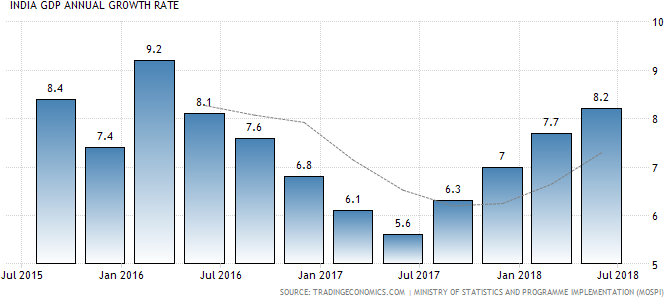
Since our last update of the Fidelity India Fund back in April, (FAT-AUS-870) India’s economy has been chugging along nicely. GDP expanded at a faster than expected (7.6%) pace of 8.2% for the First Quarter of Fiscal 2019 (April 2018 – March 2019) (1Q19). This was India’s best quarterly growth rate in more than 2 years and the fastest rate for large economies globally.
Source: Ministry of Statistics and Programme Implementation, Trading Economics
A closer look at the breakdown of the growth drivers show that that the primary driver was the high Private Consumption up 8.6% year-on-year compared to last year’s 6.7% and provided a larger contribution of 4.7 percentage points of total GDP growth (4Q18:3.7ppt). This was as the effects of demonetisation that started in late 2016 (4Q17) had mostly dissipated.
The surge in Private Consumption was so strong that it also managed to offset the slowdown in both Government Spending (7.6% vs 16.8%) and Capital Formation – a way to measure investment – which slowed from 14.9% last quarter to 8.6%. To be fair, there was a low base-year, in effect boosting year-on-year growth (and distorting the comparatives) mainly with demonetisation having depressed GDP growth to a four-year low of 5.6% in the year-ago quarter. It was nevertheless a positive result.
Moving on, we were on the mark with our expectations about spending and GDP growth making a comeback, thus validating our Hold thesis during the bumpy post-demonetisation events. However, we believe that there are rising risk factors from twin deficits both from “within” and “without” that may detract from India’s investment performance in the near term.
The investment issues are “whether recent strong GDP growth will remain sustainable” and “whether it will be sufficient to draw in Foreign Investment when, globally, there are rising fears of Emerging Markets (EM) contagion”?
First, we note some deterioration in the Fiscal side with the Government budget deficit widening to ₹1.1 trillion (~A$21.39bln) in July from ₹835 billion in the previous month which is its highest July deficit in history and up 76% year-on-year.
This is also higher than the original 3.3% deficit target with a 3.42% result and prompted rating agencies like Moody’s to issue a warning that they may adjust their ratings review from the current “Baa2” with a stable outlook downwards. This may lead to capital flight and further depress the already weak currency. Furthermore, a fall in the rupee would balloon the cost of servicing external debt, adding further pressure on the budget.
The other “twin” is from the external side. This is considering that India is a net importer, with a weaker currency likely to have a material economic impact. The graphic below show’s India’s Trade Balance from 2002 to Present:

Source: India Macro Advisors, Ministry of Commerce, Reserve Bank of India
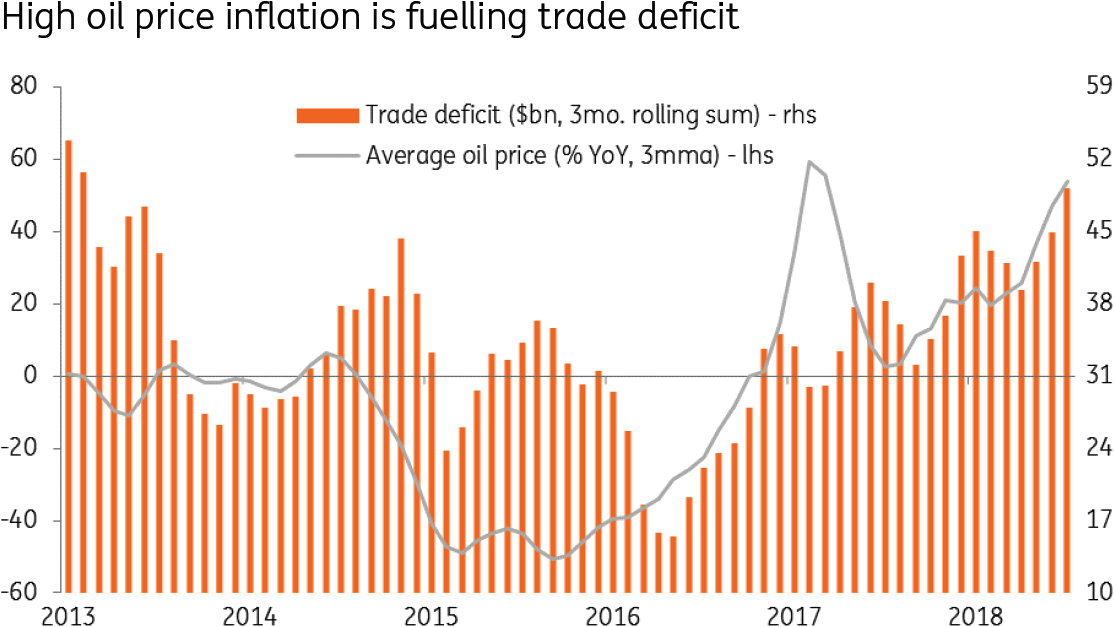
The key concern is that the Trade Deficit has hit a 5-year high and now amounts to a staggering US$18 billion in July (~₹1.3tln) from June’s $16.6 billion. This also marks some concerning trends with a much higher result compared to consensus (~$15.7bln) and import growth outpacing export growth for the second consecutive month. Imports grew by 29% year-on-year in July, while export growth was up 14% year-on-year.
So why was this the case? The graphic below shows that rising oil prices, worsened by a stronger dollar, were a significant culprit. Oil Imports in July surged 58% year-on-year and as noted, were the main driver of the deficit.
Source: ING Group, with Bloomberg and CEIC Data
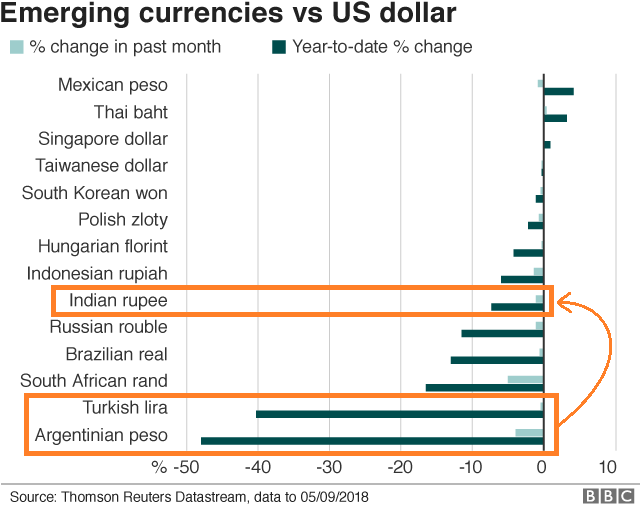
Considering that India is largely an import-reliant and emerging economy, we expect to see increased sensitivity to global shocks. Note that, as the deficit widens, India would need to finance spending with inflows of foreign money but the global fears of EM contagion, from Turkey to Argentina amongst others, could weigh heavily on sentiment and likewise investment inflows.
A look at the graphic below showcases the current weakness of EM currencies against the dollar which does not bode well for trade reliant economies:
Source: BBC with Reuters Data
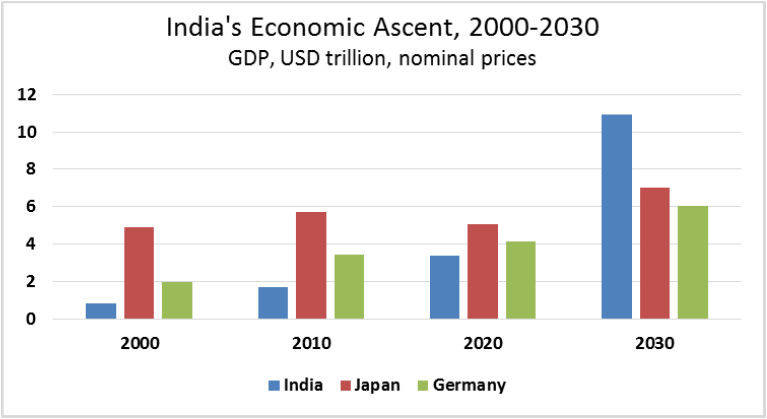
Nevertheless, we are cognisant that these issues are primarily short term in nature and note that India retains a structurally sound economy with very attractive growth prospects. In fact, we’ve elaborated on this in our other India reports (FAT-UK-742) with various institutions forecasting India’s growth potential to be the largest economy in the Commonwealth, and surpassing the UK.
Source: IHS Markit
Moving on to the Fund side and referencing the benchmark, India has performed significantly well over the last few years with cumulative returns outpacing the EM stock and the world as defined by the ACWI (All Country World Index).
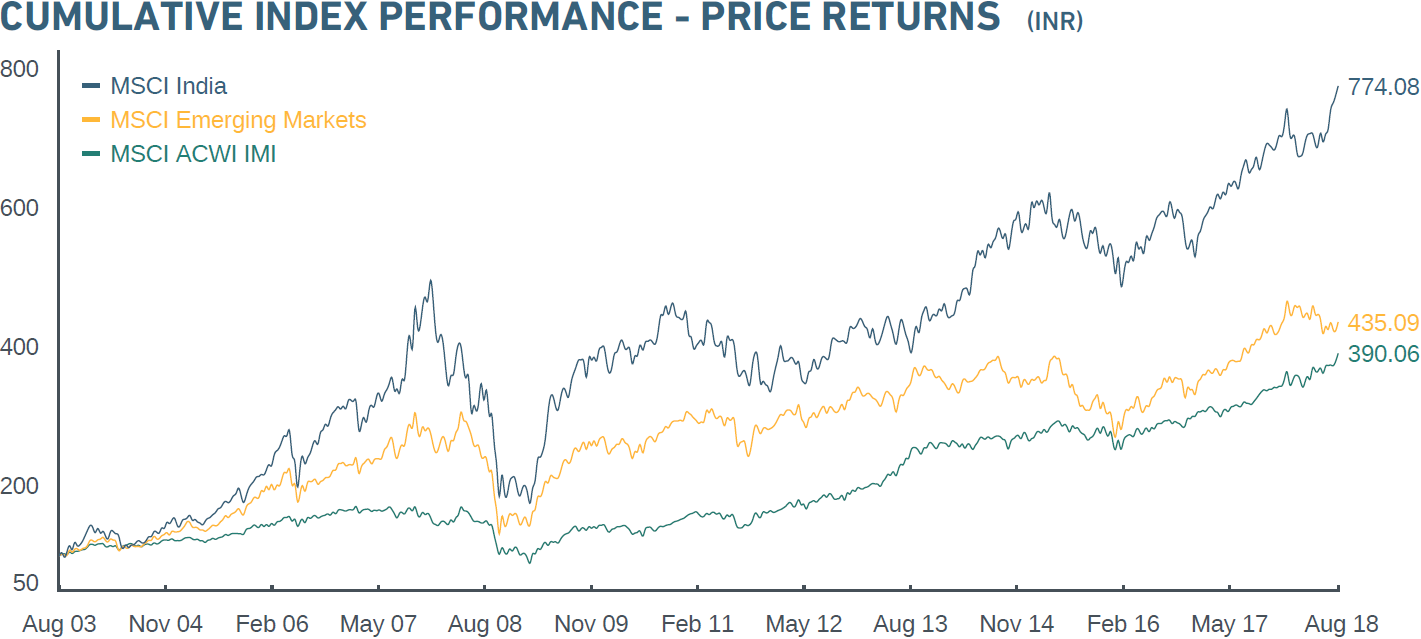
Source: MSCI Inc.
The Fund’s performance has benefited from the “best of both worlds” strategy where it’s both benchmark-aware while retaining the capability to overweight positions in certain sectors which the Fund Manager believes will outperform. Such a system has allowed it to generate excess returns versus the benchmark as illustrated below:
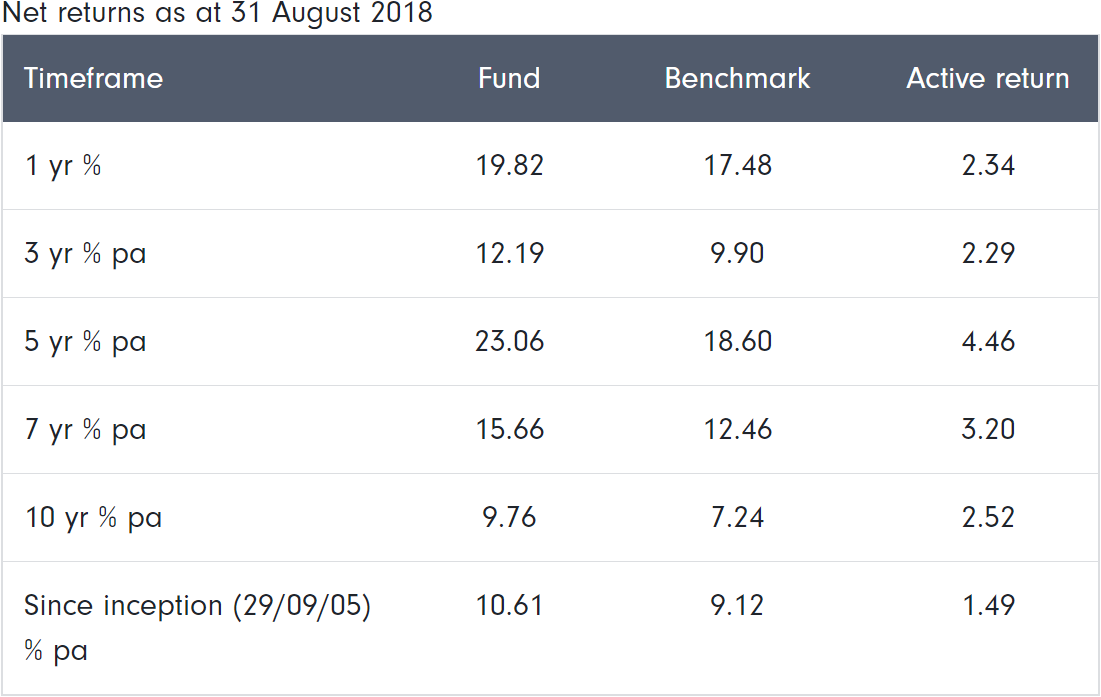
Source: Fidelity (ASX:FIF) Website
However, before risks escalate further we believe it prudent to take the opportunity to make an exit and book profits ahead of a potential rerating and to put the profits earned in more lucrative and/or less risky assets. After all, to quote John Maynard Keynes, “successful investing is anticipating the anticipations of others”.
Summary
Though India’s economy in the 1Q19 (April – June 2018) grew at a faster than expected pace of 8.2% with the help of strong consumer spending, we believe it best to take profit and exit the broader fund as risks in Emerging Markets mount.
While we note that India remains highly attractive as an investment in the long term, the near term could well be bumpy while there are more lucrative opportunities elsewhere.
As such, we recommend Members to SELL their entire position in Fidelity India Fund (ASX:FIF) and we will cease coverage immediately.

