
Rome wasn’t built in a day
Amidst plenty of action in the telco sector in the past week, shares in Vocus Communications’ (ASX:VOC) have also got a lift with a strong full year result. Full year revenue and underlying earnings were both in line with revised guidance given in February. Underlying net profit after tax was 16% lower at $127.1 million, but was weighed down by higher depreciation and amortistation costs after an extensive capital investment programme.
Net profit came in a $61 million, a stark turnaround from the loss of $1.465 billion the year earlier. We believe that the numbers validate our decision to ‘re-enter’ Vocus this year, backing the turnaround under new management. We continue to rate Vocus as a high risk buy for Members without exposure.
Full year results
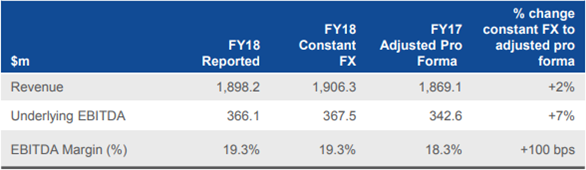
Underlying earnings before interest, tax, depreciation and amortisation (EBITDA) grew 7% to $360.4 million, while revenues rose 4% to $1.898 billion, with the company taking a bigger share of the government and enterprise market. The outlook was also bolstered, with management forecasting 2019 underlying EBITDA of between $350 million and $370 million.
Source: Investor Presentation
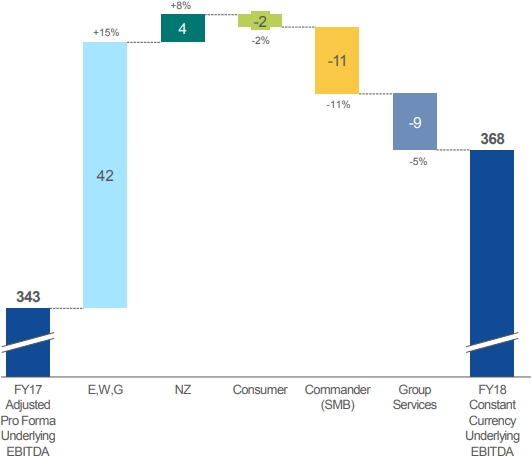
Looking at the divisions, the Enterprise, Government, and Wholesale business performed strongly during the year, with revenue growth of 11%, underpinned by the demand for fibre and ethernet products. Strong operating leverage was also apparent with earnings for the business ahead by 15%.
Management see much further earnings growth on the horizon, with the company’s market share (outside Western Australia) relatively small compared to the value of its fibre and infrastructure assets. Construction of the 4,600km Australia Singapore cable (ASC) was also completed in June, with 2.5Tbps of capacity already sold to a major global customer. Sales activity is set to ramp up, and the ASC will also drive cross selling opportunities for domestic fibre assets.
The company also had a win with the Australian government awarding a contract for the construction an international sub-marine cable between Solomon Islands, Papua New Guinea and Australia (the Coral Sea Cable), and a domestic cable network with the Solomon Islands. This will give international future earnings growth a big boost.
Source: Investor Presentation
The New Zealand unit saw earnings growth of 8%, which outstripped top-line gains of 4%, and with growth across all segments. Process automation and efficient network cost management saw EBITDA margins lift almost 17%. Looking ahead there is also room to grow, with Vocus (ASX:VOC) having a low market share relative to network assets.
As with other telcos, the move to the NBN has caused disruption and competition. However, Vocus’ consumer business was steady (revenues up 1%, earnings down 2%), as it transitions to a lower cost, digitally led sales and service model, with a refreshed ‘dodo’ brand.
The company’s SME offering, Commander, underperformed as turnover fell some 15%, and earnings 11%. Management attributes this to a lack of focus, a skew towards legacy voice and data products, and no marketing investment. This is something that is being addressed with some urgency.
Overall, we believe that the new management team assembled around CEO Kevin Russell are off to a good start with these results. Particularly, as they have been left with the remnants of an overly ambitious acquisition programme under previous management. Indeed, this (along with a overextended valuation) was part of the reason we previously recommended selling the shares at $7.75 (March 2016).
Rome wasn’t built in a day, and we believe management have laid out a realistic roadmap to restore shareholder value. Vocus plans to double revenue from the core Australian and New Zealand infrastructure businesses over the next five years. We certainly have confidence here with former Optus executive Kevin Russell at the helm. He led the turnaround of Hutchison UK from a £900 million loss to a £100 million profit over four years in 2010. He has set his sights on a “two to three year turnaround,” and has eliminated short-term incentives for the executive team.
A burgeoning debt load was one of our precious concerns aw well, and improvements have already been made on this front.
Net debt of $1 billion at year end was ahead of guidance, and despite a period of heavy capital investment. Currently the net leverage ratio is 2.73 times, well below a covenant threshold of 3.75 times. Gearing and interest cover are comfortable at 30% and 8.9 times respectively.
A period of strong capex in 2019 (including the ASC) means that there is no room for a dividend yet. We expect this to change in the future, and as debt is paid down (cash conversion came in at 88% this year), and as capital expenditure plateaus.
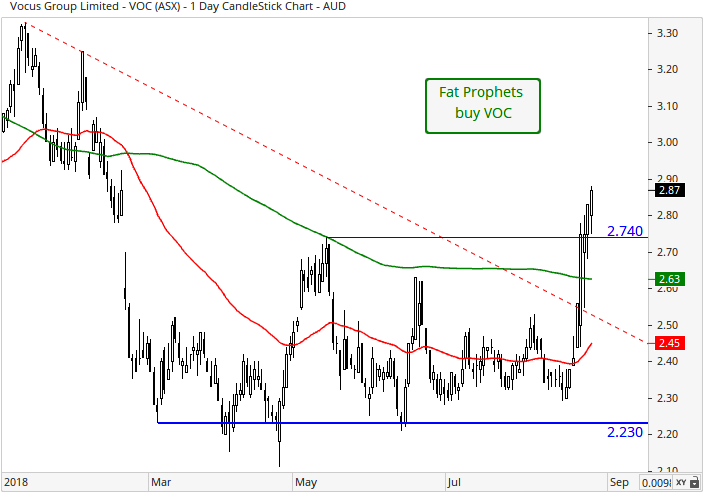
Turning to the charts, and on the daily, the outlook has improved with prices moving above both the 50 (red line) and 200 (green line) day moving averages. Prices have also broken above the downward sloping dotted trend line, and the May high of $2.74. A sustained break above the 50-day moving average would shift momentum back in favour of the bull-camp.
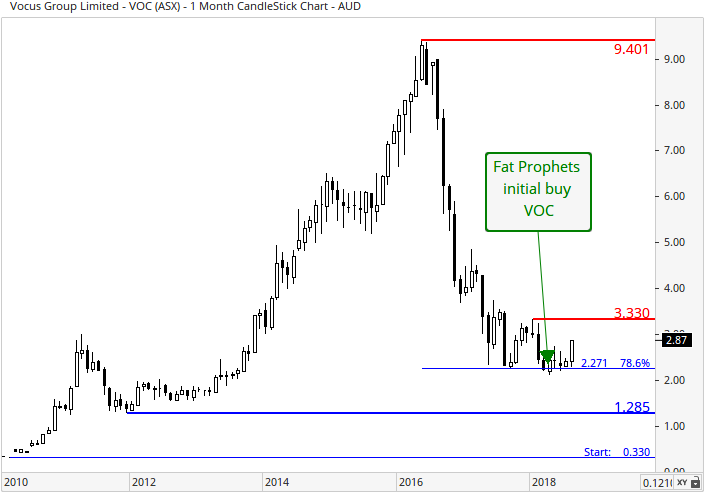
With reference to the monthly chart, prices have respected support sighted at the 78.6% Fibonacci retracement of $2.27. In order for a definitive bullish rotation to evolve, a sustained break above overhead resistance evident at the January high of $3.33 (as marked by the horizontal red line) is required.
Summary
Amidst plenty of action in the telco sector in the past week, shares in Vocus Communications’ (ASX:VOC) have also got a lift with a strong full year result. Full year revenue and underlying earnings were both in line with revised guidance given in February. Underlying net profit after tax was 16% lower at $127.1 million, but was weighed down by higher depreciation and amortistation costs after an extensive capital investment programme.
Net profit came in a $61 million, a stark turnaround from the loss of $1.465 billion the year earlier. We believe that the numbers validate our decision to ‘re-enter’ Vocus this year, backing the turnaround under new management.
Rome wasn’t built in a day, and we believe management have laid out a realistic roadmap to restore shareholder value. Vocus plans to double revenue from the core Australian and New Zealand infrastructure businesses over the next five years.
Accordingly, we continue to recommend Vocus (ASX:VOC) as a high risk buy to Members without exposure.
Disclosure: Vocus (ASX:VOC) is held in the Concentrated Australian Shares and Small/Mid-cap managed account portfolios.

