
Fat Prophets take some profits
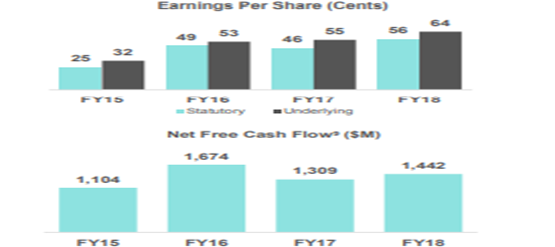
Qantas has continued a trend of the last few years, releasing full year numbers which were impressive on a number of counts. The airline delivered a 15% increase in annual profit after tax to $980 million. Net free cash flows rose 10% to $1.44 billion. Higher earnings are flowing back to shareholders with a 10 cent per share dividend and a $332 million on market share buyback programme.
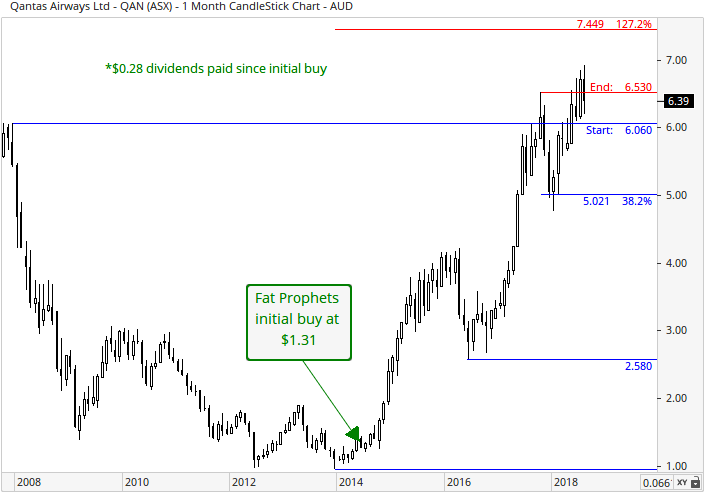
Qantas shares have performed impressively since we backed the turnaround story in August 2014 at around $1.30. While the ‘consensus’ is still very positive, we are coming to the view that the earnings cycle for the airline may be peaking. With the low hanging fruit gone, and with also higher fuel costs coming onto the horizon as hedges expire, we are issuing a take profits recommendation. We recommend that Members sell half their holdings in Qantas. This represents a gain of over 400% on our initial recommendation.
Source: Qantas (ASX:QAN) Investor Presentation
Full year results
At the results call last week, management confirmed that earnings have certainly leapt for the Flying Kangaroo over the past year. The company reported a record underlying profit in fiscal 2018 of $1.6 billon. This was 14% higher than last year, and 5% ahead of the previous record profit in 2016.
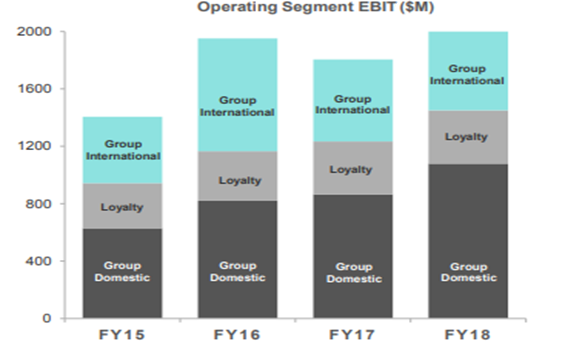
The result came from a robust divisional performance across the board. Domestically, Qantas/Jetstar saw a 25% increase in underlying earnings to $1.1 billion. This came on the back of robust demand and expanding share of both the SME and leisure market. Competing selectively on price has also been a boon – Alan Joyce notes that more than 24 million passengers flew Jetstar last year for less than $100.
Source: Qantas (ASX:QAN) Investor Presentation
On the international side Qantas also performed, with earnings up 7% to $399 million as capacity expanded by 4% and planes were fuller – the load factor rose to 84%. The introduction of new routes has also been on the mark, with the new Perth-London channel gaining the highest rating service on the network. We have previously said that while the international airline sector remains intensely competitive, Qantas’ offering (with a modern fleet and successful route adjustments) would provide a definitive boost.
At the Loyalty business, Qantas also delivered another record profit at $372 million, up 1%. The draw of the Qantas Points has also been pivotal in expanding the list of program partners. Frequent flyer program members now total 12.3 million. Several years ago, we suggested the unit might be up for divestment, but it looks to be here to stay with management planning further expansion into financial services in FY19.
A successful cost-out program has been a hallmark of the turnaround of Qantas over the past four years (with costs taken out in the right places), and this has continued. Transformation benefits came in at $463 million versus a target of above $400 million.
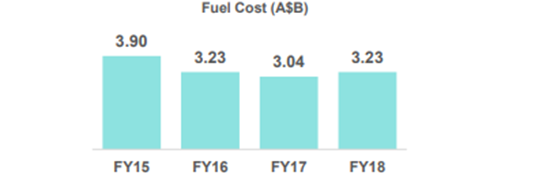
On the downside Qantas has not been immune to rising oil prices, with the company’s fuel bill up by almost $200 million in FY18. Management are expecting an increase of another $690 million in FY19 to $3.92 billion.
CEO Alan Joyce said the company ‘should’ be able to recover rising fuel costs in the domestic market, and ‘substantially’ so in the international market. We however note that (notwithstanding the strong result outlined above) the latter remains highly competitive (the airline itself expects international market capacity to rise 4% in 1H19). Given our view on rising global inflationary pressures, we do not see high jet fuel prices as a problem that will go away.
It is also worth pointing out that the fuel bill is rising significantly despite 87% of costs hedged for the first half of FY19 (and 73% hedged for the whole of FY19).
The airline is focusing on efficiency measures to reduce fuel consumption (a 1% impact), but we believe these will prove minimal in context.
Source: Qantas (ASX:QAN) Investor Presentation
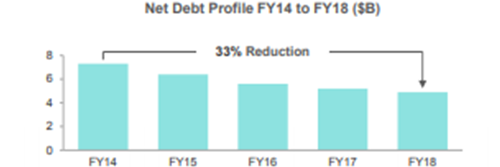
From a balance sheet perspective, Qantas remains in good shape, with net debt of $4.9 billion at the lower end of management’s range (and also after $1.97 billion of capex in FY18). Return on invested capital was also above target. Shareholders have not been forgotten, with a fully franked dividend of 10 cents per share, together with an on-market buyback of up to $332 million. We do however believe that further out the level of growth in shareholder returns may be moderated by rising fuel costs. As an aside, we also note that Qantas has used up the last of its tax losses.
Source: Qantas (ASX:QAN) Investor Presentation
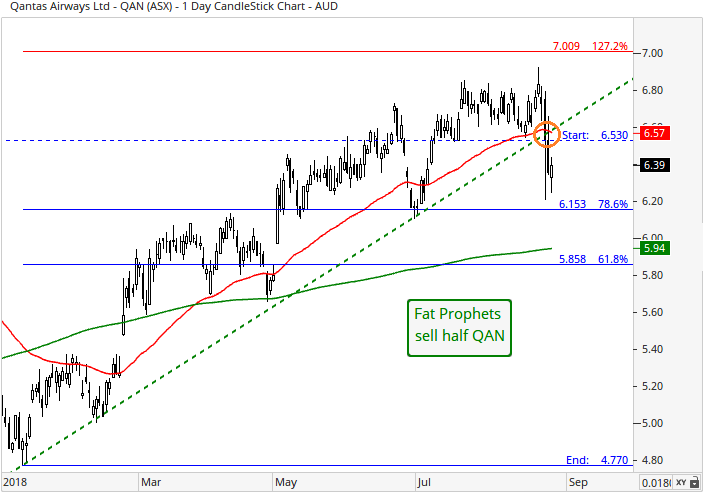
Turning to the charts, and on the daily, the technical picture has suffered a setback. Prices have dipped below the 50-day moving average (red line) and the upward sloping trend line (green dotted line). The 78.6% Fib retracement at $6.15 is now looming as support and needs to hold to avert a move further south to the 61.8% Fib retracement at $5.86.
With reference to the monthly chart, support was respected at the 38.2% Fibonacci retracement of $5.02 (blue set of retracements) in January, which is deemed positive price-action. Our previous theory that a resumption of the broader uptrend would likely follow has since played out, with resistance at $6.00 surpassed. Resistance sighted at the October 2017 high of $6.53 has however held firm, with the move from here now evenly poised.
Summary
Qantas has continued a trend of the last few years, releasing full year numbers which were impressive on a number of counts. The airline delivered a 15% increase in annual profit after tax to $980 million. Net free cash flows rose 10% to $1.44 billion. Higher earnings are flowing back to shareholders with a 10 cent per share dividend and a $332 million on market share buyback programme.
Qantas shares have performed impressively since we backed the turnaround story in August 2014 at around $1.30. While the ‘consensus’ is still very positive, we are coming to the view that the earnings cycle for the airline may be peaking. With the low hanging fruit gone, and with also higher fuel costs coming onto the horizon as hedges expire, we are issuing a take profits recommendation. We recommend that Members sell half their holdings in Qantas. This represents a gain of over 400% on our initial recommendation.

