
Good first half
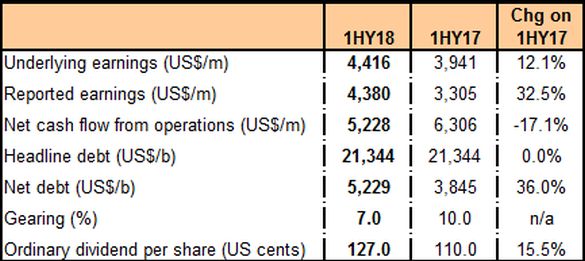
Higher commodity prices and an improved operational performance for the first half delivered strong tailwinds for Rio Tinto’s 30 June 2018 first half result. Rio Tinto (ASX:RIO) reported a higher underlying profit for the half, albeit a tad below consensus. The cost of doing business in the first half rose on higher activity levels and cost pressures. An easing in net cash flow from operations, and a pick-up in capital spending had a negative impact on the balance sheet. The balance sheet did however remain very robust at 30 June 2018. The star for the first half was the dividend, setting an interim record, while the share buy-back programme was topped up. The following table shows a summary of the company’s key financial data for the first half to 30 June 2018:
Source: Rio Tinto (ASX:RIO)
Commenting on the result, the company’s Chief Executive Jean-Sébastien Jacques stated, “We have reported another strong set of results.” We agree with Mr Jacques’ view of the results. The markets were a little disappointed however in that underlying earnings and the dividend per share outcomes both fell short of consensus, which were pegged at US$4.5b and US141 cents per share respectively.
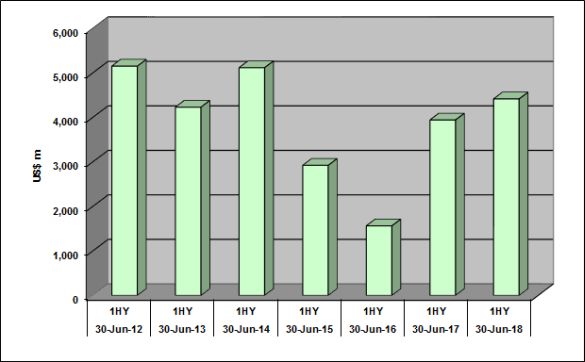
Rio Tinto’s underlying earnings for the first half rose by 12.1% on the corresponding half in 2017, to US$4.4 billion.
The following chart shows first half underlying earnings:
Source: Rio Tinto (ASX:RIO)
Driving the underlying net earnings result was an improvement in the underlying earnings before interest taxation depreciation and amortisation (EBITDA) line. Overall, we are pleased with the first half result, which in our view establishes a platform for Rio Tinto to report a robust full year result. The company will report its full year result for 2018 in February 2019.
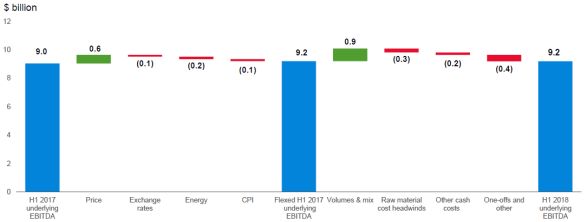
At the underlying EBITDA line, Rio Tinto posted a 68% increase on the first half 2017, to US$9.0 billion.
The following waterfall chart shows the factors that influenced the EBITDA result for the first half 2018 (in US Dollars):
Source: Rio Tinto (ASX:RIO)
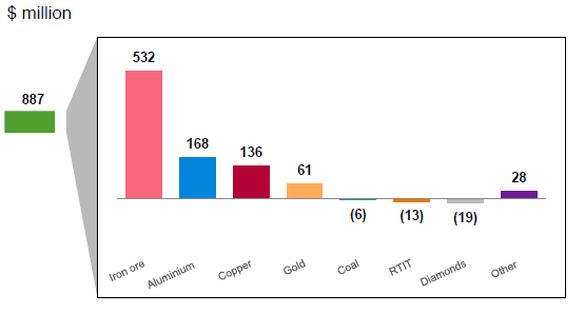
As Members can see from the above chart, the two major drivers behind the better first half EBITDA result were a positive price variance and volumes and mix variance. The price variance was a positive US$604 million compared to a positive US$2.7 billion from a year earlier. The volumes variance was a positive US$887 million compared to US$300 million from a year earlier.
Breaking down the pricing variance, aluminium was the big contributor to the outcome for the half. The following chart shows the contribution to the positive pricing variance by Rio Tinto’s commodity offerings (in US Dollars):
Source: Rio Tinto (ASX:RIO)
The negative turn-around commodity compared to the first half 2017 was iron ore, following the reporting of a US$2.1 billion negative pricing impact, to negative US$550 million. For the first half 2018, Rio Tinto reported a US$57.90 per wet metric tonne iron ore price, representing a 9.2% fall on the price result from a year earlier. Aluminium was for once the biggest contributor, adding US$113 million from the year earlier result, to positive US$557 million. Rio Tinto reported a 18% lift in the aluminium price compared to the first half 2017, to US$2,209 per tonne.
Operational volumes made a positive contribution as reviewed above, with the following chart showing the contributions made by Rio Tinto’s commodity offerings (in US Dollars, RTIT – Rio Tinto iron and titanium):
Source: Rio Tinto (ASX:RIO)
We reviewed Rio Tinto’s operational result in FAT-AUS-885. We expected the operational result would have a positive impact on the first half financial result. Predictably, iron ore was the major contributor adding US$532 million for the first half 2018 compared to negative US$67 million from a year earlier.
Going forward we have a moderately positive pricing outlook across Rio Tinto’s commodity offering.
We premise our view on mooted and actual initiation of government infrastructure programmes globally, that are likely to play a greater role in stimulating commodity demand. A stronger US Dollar, on the US repairing its negative global trade in-balance via imposing tariffs, will be a headwind for commodity prices. The advent of higher global inflation could also push commodity prices higher in the latter part of the year.
Operating costs for the first half moved higher, with a US$500 million negative impact. This move compares unfavourably with the positive US$300 million reported in the same half from a year earlier.
Saving initiatives in the first half of 2018 delivered US$500 million of savings with cost headwinds partially offsetting the savings by US$200 million. Rio Tinto is targeting productivity gains of US$1.1 billion over 2017 and 2018. Including the 2017 gains and the first half 2018 gains, the total sits at US$700 million. Rio Tinto expects to hit its US$1.1 billion target.
Net cash flow from operations remained high for the first half but did fall compared to the year earlier result.
Rio Tinto reported a 17.1% fall in its free operating cash flow, to US$5.2 billion. A higher taxation cash payment of US$2.3 billion compared to US$1.1 billion was a factor in the fall. Rio Tinto remains focussed on ensuring net cash from its operations can support future operations, capital needs and dividends.
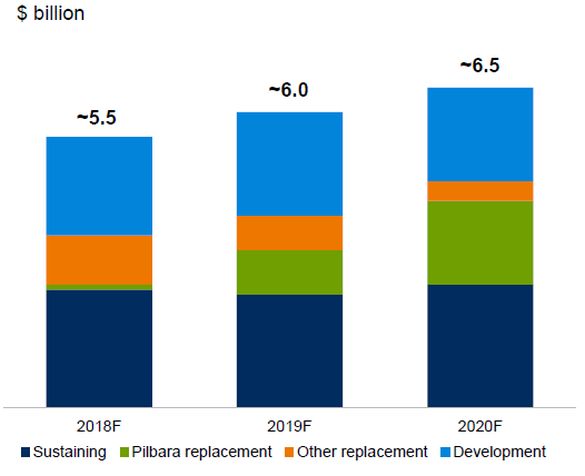
On the capital front for the first half, Rio Tinto released the purse strings just a little, with the reporting of a rise in capital spending. Capital spending increased by 34% on the first half 2017, to US$2.4 billion. The following chart shows the company’s annual capital spending forecasts (in US Dollars):
Source: Rio Tinto (ASX:RIO)
We have not been concerned with capital profile, as Rio Tinto’s portfolio consists’ of long life assets with significant upside development potential. The advantage of owning such assets include development that can occur at a time of the company’s choosing, at a lower capital spend than a new mine with a speedier development time.We are pleased with the change in the company’s capital spending pattern as we believe development is the life blood of future value generation. Rio Tinto indicated that it remains on track to meet its US$5.5 billion 2018 capital spend forecast.
Rio Tinto has supplemented its cash flows through a major programme of asset sales. For the first half Rio Tinto disposed of US$5.0 billion in assets. These disposals continue to feed into the quality of the balance sheet, although net debt did rise for the half. Net debt at 30 June 2018 rose to US$5.2 billion from US$3.8 billion from a year earlier.
The reported net gearing ratio of 10% is below Rio Tinto’s target of 20% to 30%.
We note the company has an undemanding debt maturity profile at 30 June 2018. Despite the very modest regearing in the first half, Rio Tinto’s balance sheet remains in top shape.
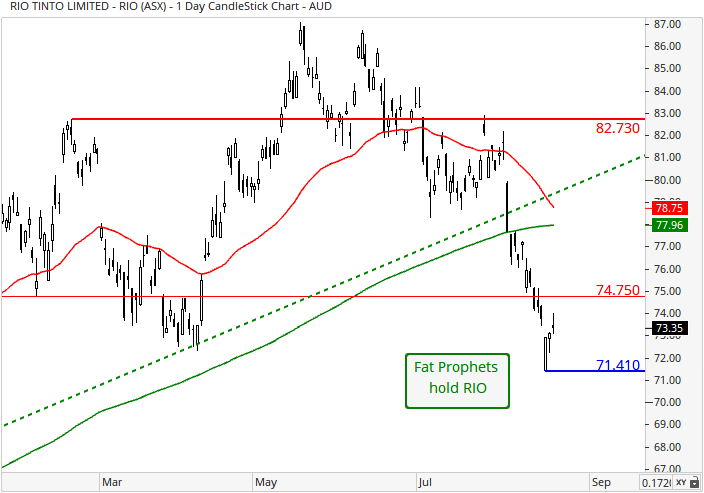
Turning to the daily chart, initial support at the 50-day moving average (red line) of $78.75, and trend-line support around $79.00 (dashed green line) have given way. The share price of Rio Tinto has also dipped below both the 50 (red line) and 200 (green line) day moving averages, which signal’s medium-term momentum has tilted in favour of the bear-camp. A move back above these levels is needed to bolster the near-term outlook.
A record interim dividend of US127 cents per share for the half to 30 June 2018 was declared.
This compares favourably with the US110 cents per share declared for the first half 2017.
A further US$1.0 billion was added to the share buy-back programme. We support share buy-backs as these benefit all shareholders over time.
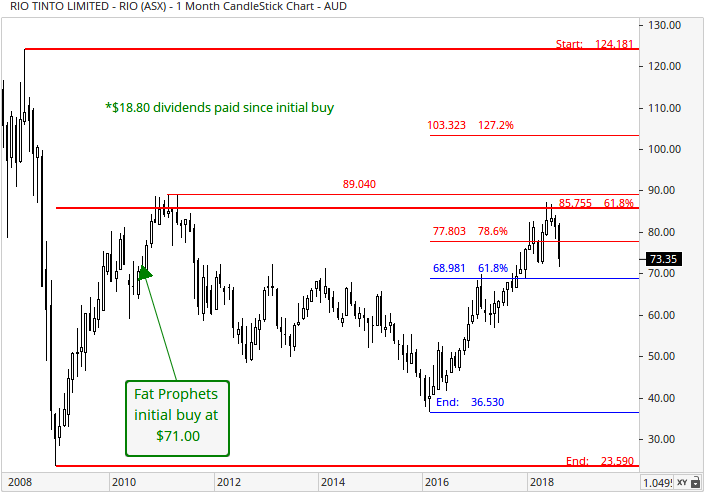
With reference to the monthly chart, resistance was respected at the 61.8% Fibonacci retracement (thin-red set of retracements) of $68.98 in February 2017. This led to a short-term correction to unfold until May 2017, at which point it appeared to have terminated. Near-term a move back above the 78.6% Fibonacci retracement at $77.80 would be positive. Moving forward, we would then expect prices to gravitate towards a band of resistance evident between $85.76 and $89.04. This is made up of the long-term 61.8% Fibonacci retracement (solid-red set of retracements) and the February 2011 resistance level respectively. A definitive clearance of this price range would likely boost upward momentum and result in a gradual ascent towards the next resistance range sighted between $102.65 and $103.32. This consists of the long-term 78.6% Fibonacci retracement (solid-red set of retracements) and the 127.2% Fibonacci extension respectively.
Rio Tinto (ASX:RIO) first half received a boost from firmer commodity prices on the back of what was a good operational result. The company continued to utilise its strong cash flow to sustain its robust balance sheet. Rio Tinto may now, from a position of financial strength, use its ample cash flow to seek growth through both brown and greenfield opportunities. Rio Tinto’s stable of tier 1 assets, we believe, can advance shareholder value across all commodity price cycles. We note the higher capital spending in the first half.
Better commodity prices over the past 12 months has pushed Rio Tinto’s share price higher over the same time. The first half result reflects the higher commodity prices.
We will for the time being maintain our Hold recommendation for Rio Tinto (ASX:RIO).
Disclosure: Rio Tinto (ASX:RIO) is held within the Fat Prophets Concentrated Australian Share, Concentrated UK Share and Mining & Resources managed account portfolios.

