
A Brighter Outlook
Market conditions in Asia are starting to look brighter with recent news flow and economic data pointing towards an improving environment. First, we look at the geopolitical side which has been a significant source of concern in the region and follow that with a broad review of the economic data recently released. Considering the overall picture, we retain a bullish view on the Asian region, and maintain our BUY recommendation for Members without exposure on the Platinum Asia Fund (ASX:PAF).
Starting off from the geopolitical side, the largest development in the Asian region is the unprecedented summit between North Korea and the US held at the Shangri-La Hotel in Singapore. As of this writing, the proceedings in the meeting were unknown except for the fact that Kim Jong Un and Donald Trump will face each one-on-one with translators but no advisors or aides today.
At this juncture, it is way too early to tell how things will unfold but if a breakthrough is achieved, this will significantly ease geopolitical concerns and embolden business activity in the region.

Image Credit: Associated Press Wong Maye-E and Manuel Balce Ceneta
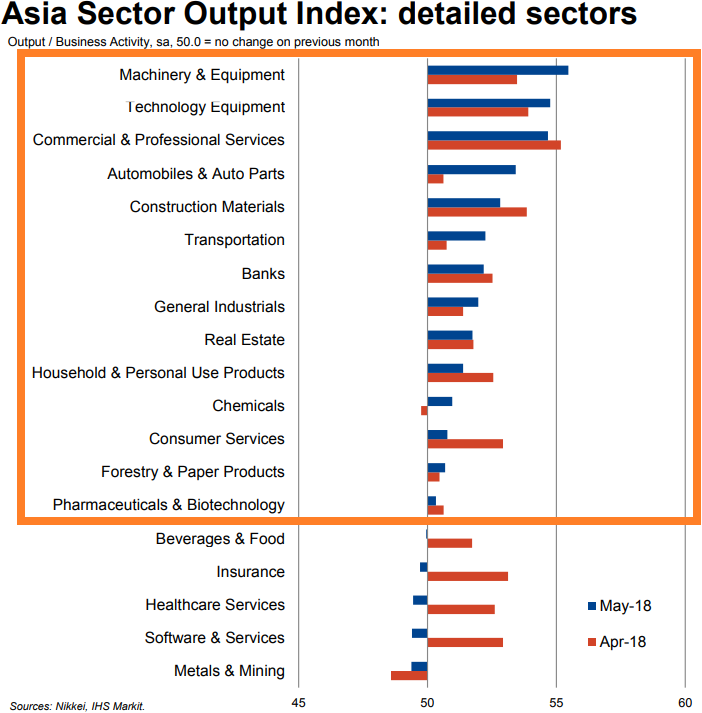
Moving on to the metrics and some of the latest data from IHS Markit shows that most of Asia’s business sectors remained strong in May 2018 as shown in the graphic below and ranked based on the latest data points:
Source: IHS Markit, Nikkei
According to IHS Markit, the Machinery & Equipment sector was the strongest-performing sector during May, as output growth quickened to the sharpest pace since July 2014 as it benefitted from increased capital expenditures. This was followed by Technology Equipment as business activity rose at the most marked pace since the start of the year. Despite softening from April’s recent-high, sharp growth was also evident in the Commercial & Professional services sector.
Meanwhile, the latest upturn in Automobiles & Auto Parts output was solid and quickened to the fastest pace in 2018 so far, reflecting the increased spending on vehicles on the back of easier credit for many Asian countries as well as rising incomes. Construction Materials also registered a solid rise in output.
The other segments also carried on positive momentum a few of the remainder (unboxed segment) such as Food & Beverage, Insurance through to Metals & Mining saw a contraction in activity, though were all marginal. Some sectors will likely continue to exhibit a subdued performance due to trade concerns abound though we believe this will likely improve over time as we do not expect a full blown trade war to develop.
Though these estimates represent the aggregate growth across sectors in the region, there are material individual differences across countries. We briefly provide an update on the countries with sizable representation in the Platinum Asia Fund (ASX:PAF).
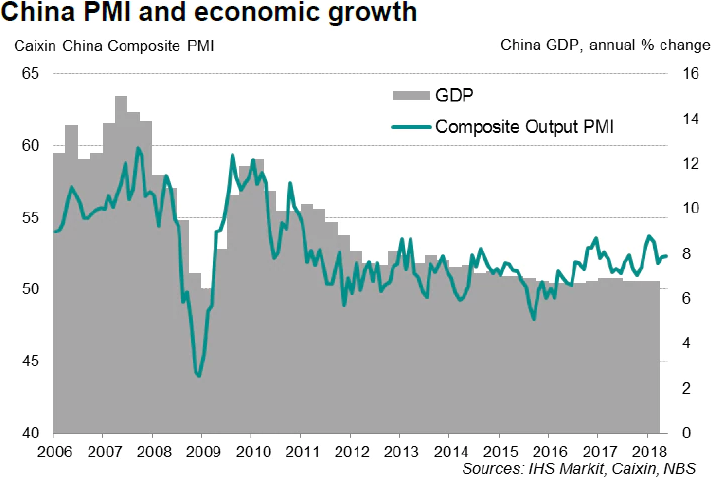
Starting with China which is still the region’s and the world’s largest growth engine. Recent data in China remains strong showing steady momentum and the economy being increasingly driven by domestic demand, further reflecting the shift in tone with the government’s consumption-based economic growth policies.
Composite PMI data showed that the economy is steadily churning along with a reading of 52.3 in May, which is slightly higher than the average PMI reading so far this year at 52.7 which was also up from 51.9 in 2017 and represents the strongest start to a year since 2011.
Source: IHS Markit, Caixin, National Bureau of Statistics
Going forward, China maintains an attractive outlook based on New Business Inflows which grew at a fast clip, while Business Confidence has ticked up. Backlogs of work also continue to accumulate on the back of robust domestic demand.
Another metric that we believe is very telling is the increased copper imports which are up a solid 17% year-on-year in the January-March period. Since China is the largest consumer of copper in the world and buying up circa 50% of the world’s supply this is normally a leading indicator and its increased consumption implies stronger manufacturing activity down the line.
In India, March quarter GDP growth accelerated to its highest in 2 years at 7.7% compared to last year’s 6.1% and this marks the tail end effects of the demonetisation programme implemented in 2016. Credit growth has also reaccelerated to 12.1% p.a. in the March quarter, marking its highest level in the last 3 years.
As covered by our Asian equities team, the banking sector’s increased focus on growing its retail business amidst a highly unbanked population has led to high credit growth. Private sector banks are increasingly becoming a highly important fixture in the economy with its market share rising from 6% to 31% in just 3 years and far outpacing the growth of their state-owned peers. That data is highly relevant considering the sizable holdings the fund has in private sector Indian banks.
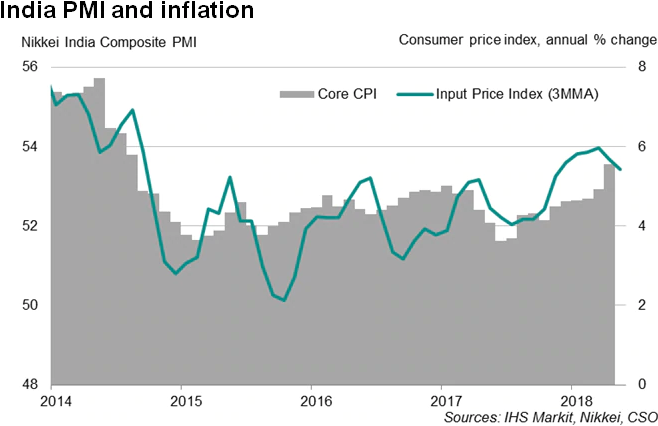
That aside, a surprise move from the Reserve Bank of India took place in the June meeting and for the first time in almost 4 and a 1/2 years the Monetary Policy Committee raised benchmark rates ahead of the August meeting as expected. The rate was raised by 25 basis points to 6.25% in a unanimous vote as a response to rising inflation.
Source: IHS Markit, Nikkei, Central Statistics Office
Business activity in both Manufacturing and Service sectors slowed in May at 51.2 and 49.6, respectively from 51.6 and 51.4 in the previous month. Though demand remains stable (growing in some sectors), the major drag to business activity was from the aforementioned higher input inflation due to higher fuel costs and increased caution to prevent the build-up of expensive inventory.
We maintain our positive outlook on India, as GDP did accelerate and the economic data released in the next few months will therefore be crucial. We will monitor this closely for clues as to the next policy move. The next points we will be closely monitoring are price pressures, especially oil prices, while the upcoming June PMI date, published in early July, will provide strong signals on 2Q GDP growth and inflation trends.
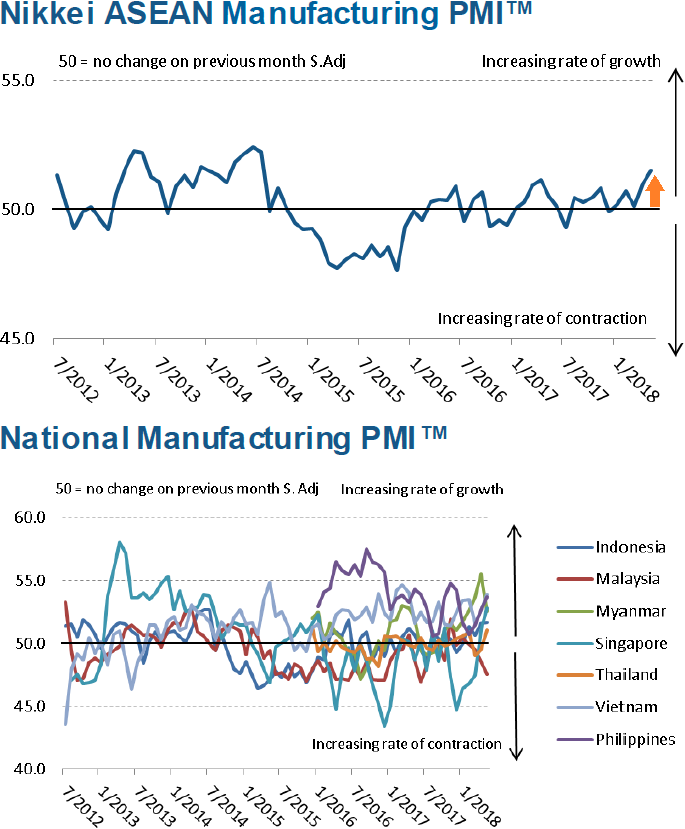
Finally, in Southeast Asia (ASEAN) 1Q numbers shows that the region expanded robustly having benefited from solid domestic demand and accommodative monetary conditions. The region’s economy expanded 5.4%, up slightly from last month’s preliminary estimate of 5.3% and the previous quarter’s figure of 5.3%.
Business activity trends across the entire ASEAN were also strong with manufacturing PMI data rising for the 5th consecutive month at 51.5 to mark its highest level since July 2014. This is reflected in the graphic below:
Source: IHS Markit
The outlook for the ASEAN is increasingly bright on the back of robust and improving demand conditions. We believe this will likely continue going forward as orders continue to pile up though the biggest obstacle so far is inflation which has made inputs more expensive and put profits under pressure. That said, we will continue to monitor developments in the region as well as domestic economic activity as the key to address inflationary concerns.
The Platinum Asia Fund (ASX:PAF) has a flexible mandate, which allows it to short stocks, and is very much an active Fund which can deviate significantly from its benchmark. The Fund has an impressive track record of outperformance over the medium-term and this, in our view, in part reflects its flexible mandate.
Accordingly, the Platinum Asia Fund will remain firmly held in the Fat Prophets Global Funds Portfolio and for Members without exposure we recommend it as a buy.
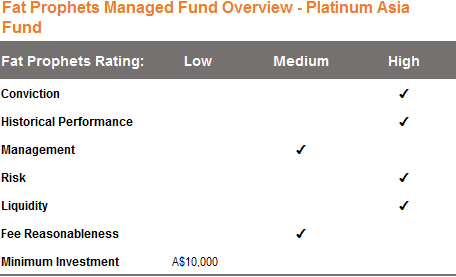
Fund Details
The Platinum Asia Fund (ASX:PAF) is an actively managed equity fund. The objective of the Fund is to provide capital growth over the long-term through searching out undervalued listed (and occasionally unlisted) investments in the Asian region. Investors in the Fund can expect the portfolio to contain listed companies based in China, Hong Kong, Taiwan, South Korea, Malaysia, Singapore, India, Thailand, Indonesia, Philippines, Sri Lanka, Pakistan and Vietnam. The Manager suggests the Fund is appropriate for investors with a minimum time horizon of 5 years or more.
The Fund is managed by Joseph Lai who has been with Platinum since April 2004, and previously worked for Morgan Stanley in their Equities Research Department. After starting at Platinum, he worked on Greater China equities and has been co-manager of the Asia Fund since 2011.
Platinum Asia (ASX:PAF) holds investments in the Asian region, with the portfolio ideally consisting of 75 to 150 securities that the Manager believes to be undervalued by the market. Cash may be held when undervalued securities cannot be found, and Platinum Asia may also short sell securities. The Fund’s management expense is 1.35% per annum for C class shares (standard fee option) and 1.10% for P class shares (performance fee option). This includes GST, administration and investment costs. There is also a buy/sell spread of 0.5%.
The minimum investment is A$10,000.
Applications and withdrawals may be made every Sydney business day.
The Platinum Asia Fund (ASX:PAF) is an open-ended investment trust, and should not be confused with Platinum Asia Investments, a listed investment company (LIC) on the ASX. Platinum Asia Investments is the listed version of the Platinum Asia Fund.
Performance
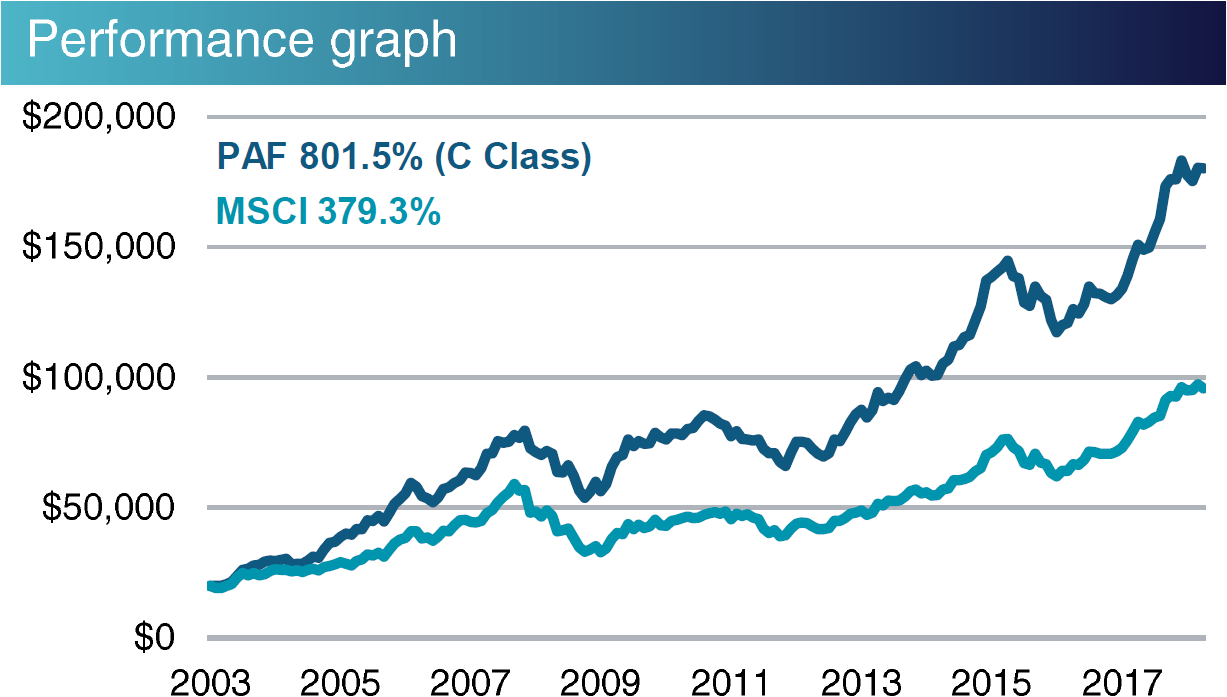
The Platinum Asia Fund (ASX:PAF) maintains an impressive track record of outperformance over the benchmark in the medium-term; reflecting its flexible mandate.

Source: Platinum Asia (ASX:PAF) Website
Based on the most recent portfolio manager’s recent commentary, the fund’s performance was largely driven by the economic developments in China which saw some issues partly from the ongoing financial reforms there.
Despite that, the overall economy, as we noted in the preceding sections above, showed strength which in turn led to stronger equity performances and specifically in sectors that serve the burgeoning Chinese middle-class consumers and Healthcare and Pharmaceutical stocks. Secondary contributors came from other Financials from across the Asian region. However, ongoing weakness in Philippine and South Korean equities detracted from performance.
This is evident with the fund’s short-term 3-month return (C Class) providing somewhat muted returns, though this was still a markedly better performance compared to the benchmark (MSCI Asia ex Japan). As discussed in the previous section, it seems that the continuing strength and prospects in Asian economies can sustain asset prices.
Over a 1-year period, the Fund displays a much better showing with a substantial outperformance relative to the benchmark due to their substantial positioning in China and India which both reported robust economic data as of late. We also note that the fund’s sector positioning is benefiting from improving fundamentals and that has supported performance versus the style (value or growth) agnostic weightings of its benchmark.
However, over the 2- and 3-year periods, the relative underperformance to the benchmark was a result of the Fund’s higher cash position at the time, which hovered above 12% (14 – 18%) , dragging on returns though we believe that the prudent positioning as of late will lead to better performances down the road.
Over the longer term, on a 5-year and 10-year basis, the Fund continues to outperform the benchmark, with the Fund returning 13.8%, and 9.8% respectively per annum, while the benchmark delivered 13.2% and 7.4% over the same periods. Beyond the 10-year period, the Fund continues to outperform with a 15.5% per annum return since inception versus the benchmark’s 10.8% return per annum. This is reflected in the chart below:
Source: Platinum Asia (ASX:PAF)
Moving on to the Fund’s current positioning, we note that it maintains a highly diverse portfolio across the Asian region, though with a substantial difference in weighting relative to the benchmark and that reflects the fund’s mandate of finding undervalued opportunities.
As of May 2018, compared to the benchmark, the Fund is significantly underweight Taiwan (-11.3%), South Korea (7.8%), and Hong Kong (-5.8%) while having a substantially overweight position in mainland China (+14.3%). The fund tracks India quite closely with only a marginal differential (-0.3%). The fund also has a much smaller weighting in smaller ASEAN economies at 8.7% versus the benchmark’s 12.9%.
With a high cash holding (~15.0%), the Fund is maintaining a defensive position as a cushion following economic restructuring in other parts of the world, especially in a low growth environment and increasing volatility in global markets. Nevertheless, as Asia’s economic figures are improving, we expect the Fund Manager to deploy more capital to take advantage of opportunities.

Source: Platinum Asia (ASX:PAF)
Since our last coverage of the Fund in January 2018 (FAT-AUS-856) the Fund has shifted around its weightings in various regions with the most notable change seen increasing its cash position to 15% (+400 bps) as well as increasing its position in Hong Kong by 250 basis points to 5.8%. The rest saw reduced weightings to various degrees likely reflecting profit-taking efforts or the impact of weaker equity performance such as in the Philippines and South Korea.
The Fund also continues to reduce its exposure in the ASEAN region, moving from 14.4% (Oct 2017) to 11.0% (Dec 2017) and is now at an even smaller 8.7% weighting. That is a material underweight to the benchmark’s 12.9%. Though they did not explicitly provide commentary, we surmise that it is likely due to profit-taking activity given the strong run up in prices in the region and historically high valuations.
Top 10 Holdings & Industry Exposure
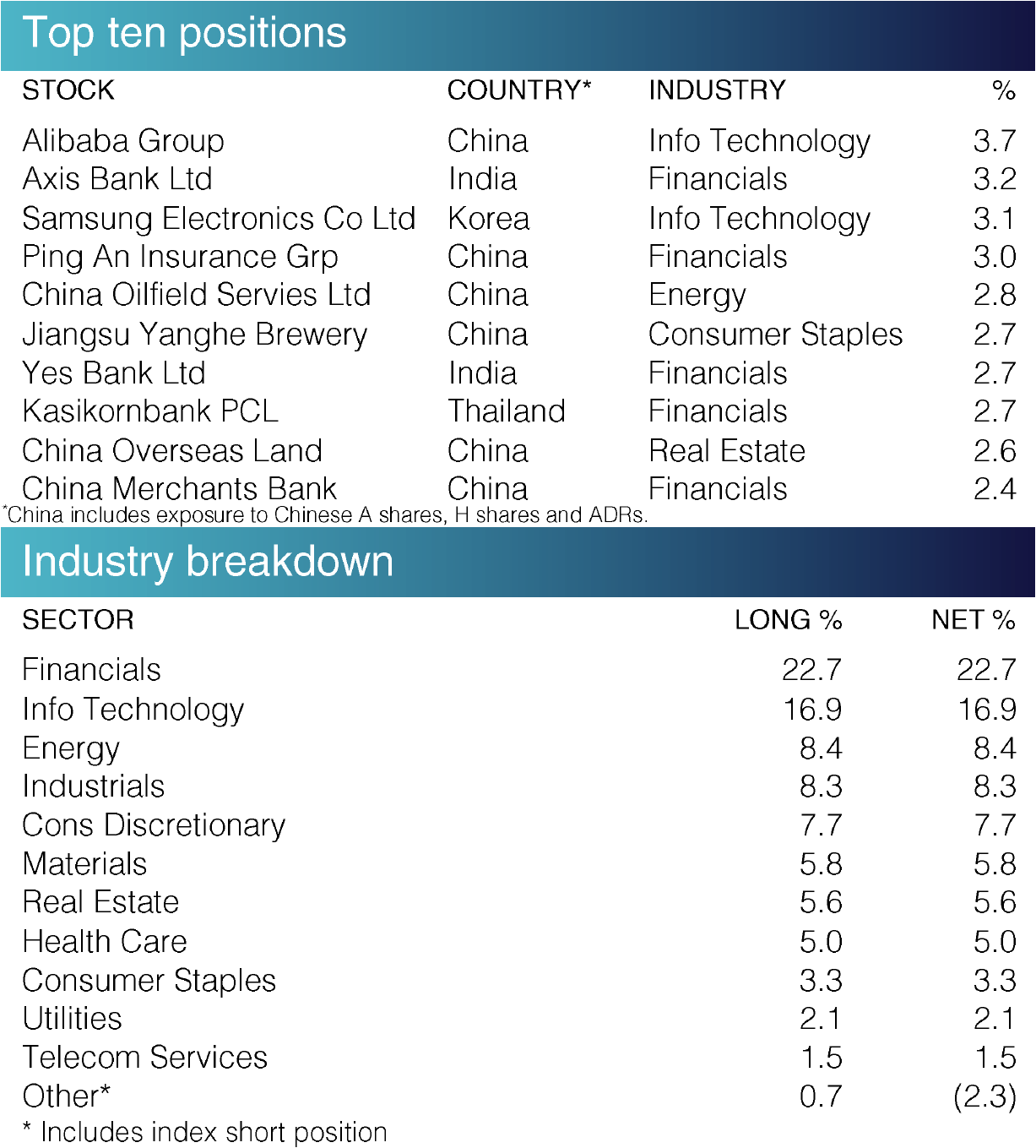
Looking at the Fund’s top holdings & sector exposure, the manager notes that while some of the companies with strong market positions and robust growth are undervalued by the market, the Fund is well exposed to these positions.
Source: Platinum Asia (ASX:PAF)
Moving on to industry exposure, the fund shows substantial differences with the underlying benchmark. The most notable being the very large underweighting in IT. We believe this substantial difference is the result of the investing style (value vs growth) due to the fact that many stocks in the IT sector have much higher valuations whereas the fund seeks to build positions in undervalued opportunities.
We also note that the fund now has an overweight position in the Health Care sector at 5% of the fund (vs 2.8% for the index) and likely the result of the sector benefitting from an aging population and above average profit growth. The sector is also benefitting from faster approvals for new drugs and the rising incidence of diabetes, with only 15% of diabetes cases are being treated, compared to over 50% in developed countries.
The fund also has a larger position in Energy at 8.4% (vs 4.6% index). We believe these to be quality large cap holdings in general, with strong exposure to the Asian thematic on which we remain bullish.
Summary
The latest news flow for the Asian region looks bright with an historic summit underway in Singapore which may lead to an easing of tensions in region and bolder sentiment. That aside, other economic data as of late also point towards improving conditions though there are inflationary concerns that may detract from growth. Over the long-term we remain positive on Asia’s investment story, with a rising and affluent middle class setting the stage for a large ‘demographic dividend’.
While growth in Asia will not be without its challenges, we believe that improvements in key countries like India as well as emerging markets including Indonesia, Thailand, Vietnam, and the Philippines will drive investment performance and opportunities for the Fund.
In reviewing fund options to gain a broad exposure to an Asian thematic, we view the Platinum Asia Fund as a strong play.
Accordingly, the Platinum Asia (ASX:PAF) Fund will remain firmly held in the Fat Prophets Global Funds Portfolio and for Members without exposure we recommend it as a buy.
Disclosure: Interests associated with Fat Prophets declare a holding in Platinum Asia Fund (ASX:PAF), Baidu, Tencent and Samsung Electronics.

