
Getting to the Meat of the Matter
The release of full year results last month confirmed that it has been a tough year for beef provider, Australian Agricultural Company (ASX:AAC). The company reported a statutory EBIT loss of $128.0 million, with a mix of headwinds from increased competition, reduced volumes & increased input costs whilst also incurring one-off costs from an unprofitable abattoir. All in all, though the results were broadly in line with the preliminary result ranges outlined in April and were met with some relief by the market. With a positive underlying thematic better times are likely ahead in our view, and we maintain a Hold on the stock.
What’s New?
In our previous coverage back in early April (FAT-AUS-868) the company provided a trading update where it flagged one-off non-cash charges of around $60 million to 65 million in relation to its loss-making Livingstone Beef processing facility. The company also noted that this would end with a statutory EBITDA loss estimated between $30 million and $40 million.
That aside, we also provided a brief commentary on the ongoing changes at the top with Mr Hugh Killen taking over as the new CEO and Managing Director while also noting his change in strategy to focus back on cattle sales in the interim and clean up inefficiencies from the branded beef operations.
Since that point, the most recent developments were some new additions to the executive suite and the natural result of new management. This is reflected in the top brass hires that were announced to the public in 22 May 2018 and shown in the graphic below:

Source: Australian Agricultural Company (ASX:AAC) 23 May 2018 Company Presentation
These new executives are expected to aide Mr Killen on shifting the strategic agenda and bring the company back to profitability. Of note, Ms Anna Speer, former CEO of AuctionsPlus, will be mainly responsible for the operational issues considering her depth of experience in disruptive marketplaces which the company is currently finding itself in on the back of increased US exports and rising cost pressures.
Mr Nigel Simonsz, on the other hand, will take a different focus and work on improving the flow of financial information to management, with more informed and speedier decision making.
This was then followed by the company’s FY18 results which will be the main focus of today’s report.
FY18 Results Review
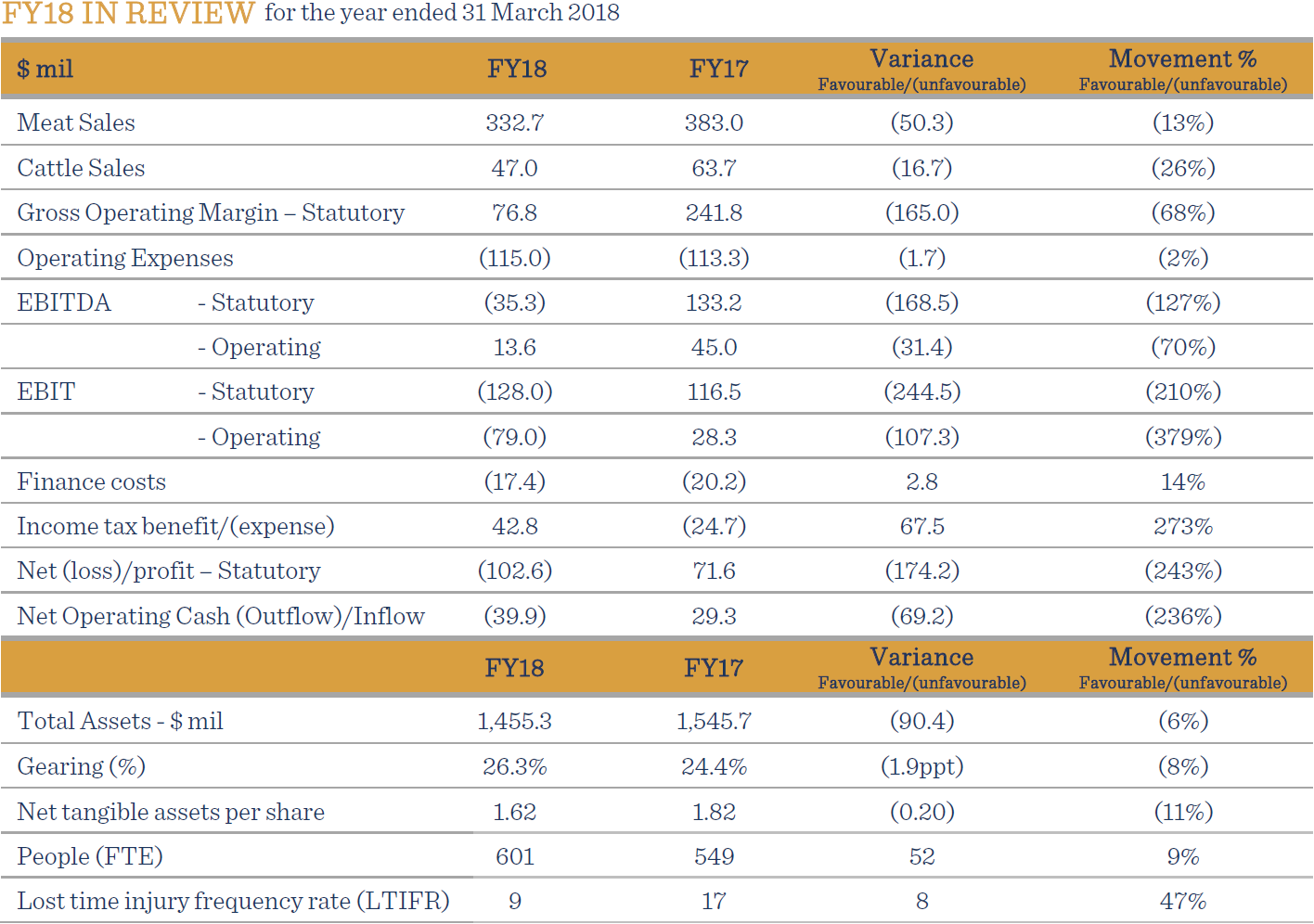
Starting from the top and as we’ve noted above, the increased influx of US cattle exports has caused some earnings headwinds, while unfavourable weather has a led to a dry spell and slowed down cattle production due to higher feed prices. As such, sales fell 15% year-on-year to $379.68 million.
Breaking it down, the Branded Beef (meat sales)saw a larger nominal drop of $50.38 million due to lower volumes sold in the Premium (-34% yoy) and Livingstone Brand (-16%) segments to $63.7 million and $92.1 million respectively. The Luxury brand segment on the other hand only inched up 1% year-on-year to $12.5 million – its significantly smaller size failed to offset the declines.
Management notes that the lower volumes of the Premium and Livingstone brand were the result of their strategic decision to reduce purchases of externally supplied cattle and focus on internally generated beef sources to realise better margins. This view was reemphasised by Mr Killen with the statement:
“Realising this value will come from aligning and activating our assets to work together efficiently, to produce and deliver our brands at scale. Management is keenly focused on maximising the efficiency and productivity of each asset through robust financial and capital management.”
We agree with this direction and going forward, we believe that the branded beef segment will see increasing returns as it scales up along with the growth of the herd.
Source: Australian Agricultural Company (ASX:AAC) 23 May 2018 Company Filing
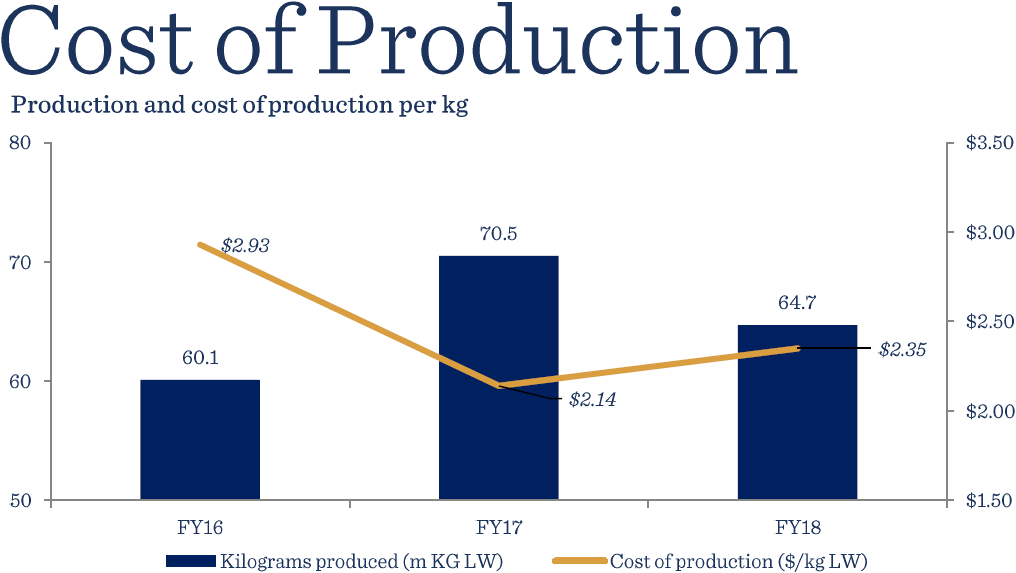
The Cattle Segment on the other hand reported a much more dramatic drop, down 26% year-on-year to $47 million as the company reported lower volumes with 13.2 million kg Live Animal Weight (LW) down by 4.8 million kg LW year-on-year. As noted above, this reflects the impact of unfavourable weather with fewer cattle reaching the target weight for sale as evidenced by kg produced at 64.7 million kg LW versus last year’s 70.5 million kg LW. This also includes the company’s investment in building up the herd to supply its internal beef production.
Moving on to the cost side, the unfavourable weather and lower volume produced has resulted in a higher average cost of production, which went up 10% year-on-year to $2.35/kg LW and includes live-stock attrition. Going forward, we expect that as weather conditions normalise and herd headcount scales back up, the average cost of production should fall.
This is reflected in the graphic below:
Source: Australian Agricultural Company (ASX:AAC) 23 May 2018 Company Presentation
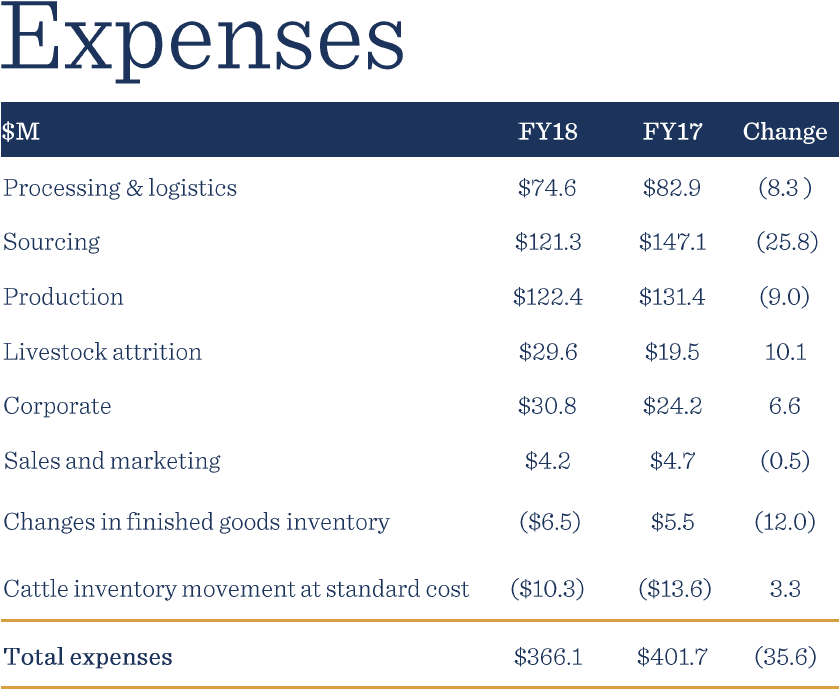
Operating expenses on the other hand showed some improvement falling some 8.9% year-on-year to $366.1 million. Breaking it down, the largest impact are Sourcing costs which fell 17.5% to $121.3 million and reflects the reduced volume purchases of externally supplied cattle. This was then followed by lower Processing & Logistics costs which fell 23.3% year-on-year to $74.6 million and mainly due to lower Branded Beef volumes.
These improvements were partially offset by the Livestock Attrition costs which increased 28.4% year-on-year to $29.6 million due to bad weather and majority of which (~83.2%) took place in the 1H18. Another detractor was higher Corporate expenses which increased 18.5% year-on-year to $30.8 million and reflects the hiring of new talent, though note that FY17 costs were also unusually higher due to one-off income.
Source: Australian Agricultural Company (ASX:AAC) 23 May 2018 Company Presentation
Onwards to the bottom line, Statutory EBIT moved to a loss of $128.0 million compared to the positive $116.5 million result in the year ago period. According to management, the lower volumes in the Branded Beef segment were a significant contributor to the reversal.
However, upon closer inspection we see that the Livingstone Beef Abattoir resulted in a higher than expected non-cash one-off charge of $74.9 million, more than the announced $60-$65 million write-off announced in April.
Management explains that this was the result of their decision to suspend operations leading to a much higher one-off non-cash impairment of $69.5 million with respect to buildings, improvements, plant and equipment and an additional $5.4 million provision recorded for an onerous contract with a gas supplier.
However, this suspension is not a full closure of abattoir operations. Management expect to resume operations as the cycle recovers. with a minimal pick up in costs.
Overall, the company reported a statutory Net Loss of $102.6 million with a Loss Per Share of A17.4 cents.
Going forward, with the strategic review done and the “bleeding” from the Livingstone Beef Abattoir stemmed, management has announced a new strategy to focus more on increased process efficiencies to improve profitability and simplify the supply chain for its Branded Beef segment. This is planned to take place in the Calendar years of 2018-2019 and management expects growth to accelerate by 2020 with higher volumes of Luxury brand beef.
The ride however is unlikely to be smooth with Mr Killen noting:
“We have taken decisive action to stem the losses confronting the business and are focusing on ensuring the Company is on an even-footing from which to realise its strong potential for growth” he added further that “over the next 12 months, we will be particularly focused on maintaining our robust balance sheet and prudent debt coverage ratios and optimising our supply chain.”
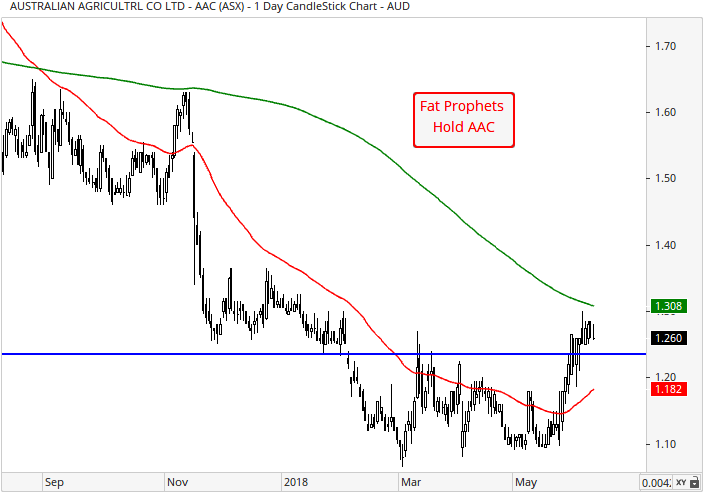
Turning to the technical picture, and on the daily chart, the bearish moving average crossover present since August last year has been suggestive of momentum favouring the downside. This is when the 50-day moving average (red line) crosses below the 200-day moving average (green line). More encouragingly there has been a move back above previous support at the April 2016 low of $1.24. A sustained move upwards from this level would improve the outlook.
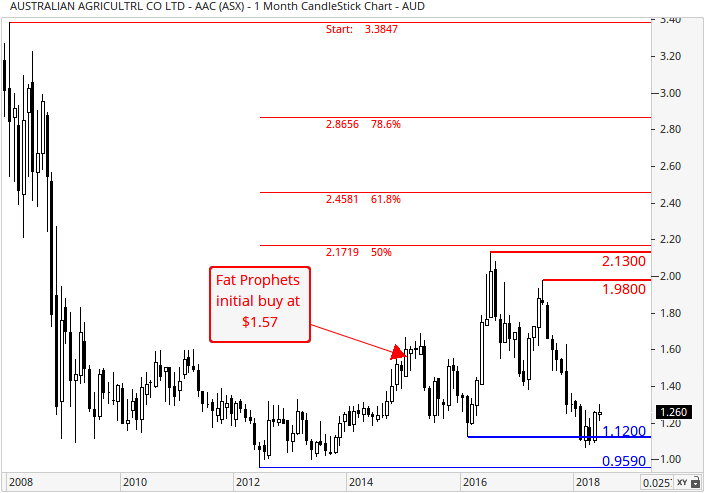
On the monthly chart, the shares have retreated to support around $1.12 being the February 2016 low (horizontal solid-blue line). This level has been defended to date which is important. A further period of price-stabilisation would ease the brunt of the share price weakness seen over the past two years.
Summary
With the results in, it is quite evident that Australian Agriculture had a tough Fiscal 2018 with headwinds from external sources as well as problems at the top. However new management has taken the long-term view and made the strategic changes that will support the business whilst stemming the bleeding from the unprofitable Livingstone Abattoir.
Amongst our recommendations in the sector, Australian Agricultural Company (ASX:AAC) has been our most disappointing, but we remain positive on the underlying thematic. W
e are also confident that the company’s shift towards a vertically integrated and higher margin business model will pay off.
We maintain our HOLD rating on the stock.

