
Special Report – Cryptocurrency Update
After peaking in Mid-December, Bitcoin along with many of the larger cryptocurrencies seemingly have fallen out of favour amidst an increasingly restrictive regulatory environment while many market participants (exchanges, coins) are facing issues of their own. Today we provide an update on the sector, having covered it a few times previously and we take a look at the latest developments, and whether our view has changed.
Recap
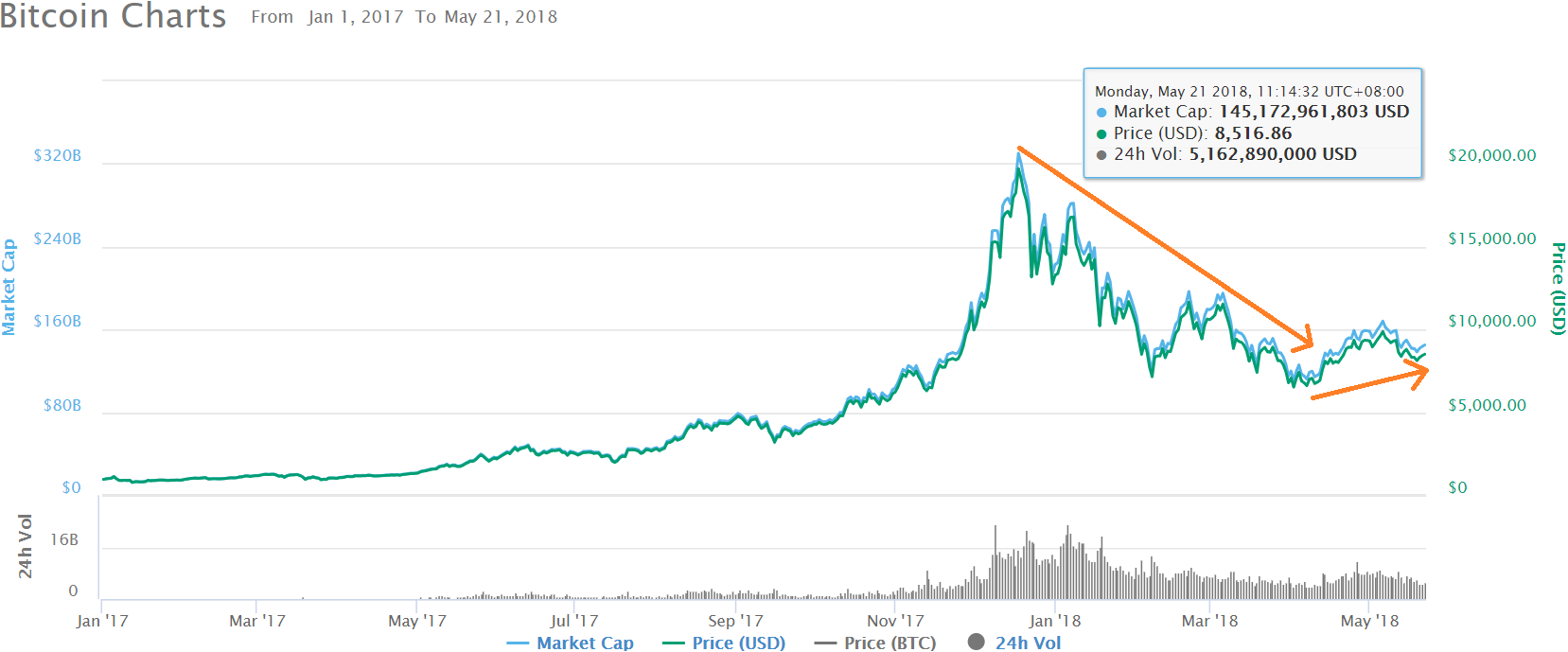
It’s been more than 5 months since our last look at the cryptocurrency market (FAT-AUS-851) and considering its fast-paced nature a lot of things has changed since. A quick look at the Bitcoin (BTC) chart below shows tremendous change from December:
Source: Retrieved 21 May 2018 from coinmarketcap.com
In our last coverage back in December, Bitcoin moved up to over $11,630 and continued to climb to peak at $19,711.40, falling just shy of the $20,000 level. At the time, we were noting the manic levels of sentiment as news of random individuals (pole dancing instructor, Dee Heath comes to mind) becoming instant experts and providing commentary and advice on the “emerging asset class” (Emphasis on the quote-unquote marks).
It was also around this time where many novice speculators were reverse mortgaging their houses or taking loans to get in on the game with barely any research/analysis on the underlying technology or even taking a look at history to draw out similar patterns (Tulipomania, South Sea Bubble et al) in investor psychology.
Then in there were also announcements from institutions like the Chicago Mercantile Exchange (CME) and Chicago Board Options Exchange (CBOE) that they will allow trading of Bitcoin Futures in their respective exchanges. To Bitcoin supporters, many of them saw that this was one of the early points of validation for their investment case.
However, much like our call in the December report that just because Bitcoin gets a stamp of approval from regulators or the government doesn’t automatically lend credence to its claims. In fact, there was historical precedent in the form of the South Sea Company which had a royal charter but ended up like all bubbles and left many so called investors in the red.
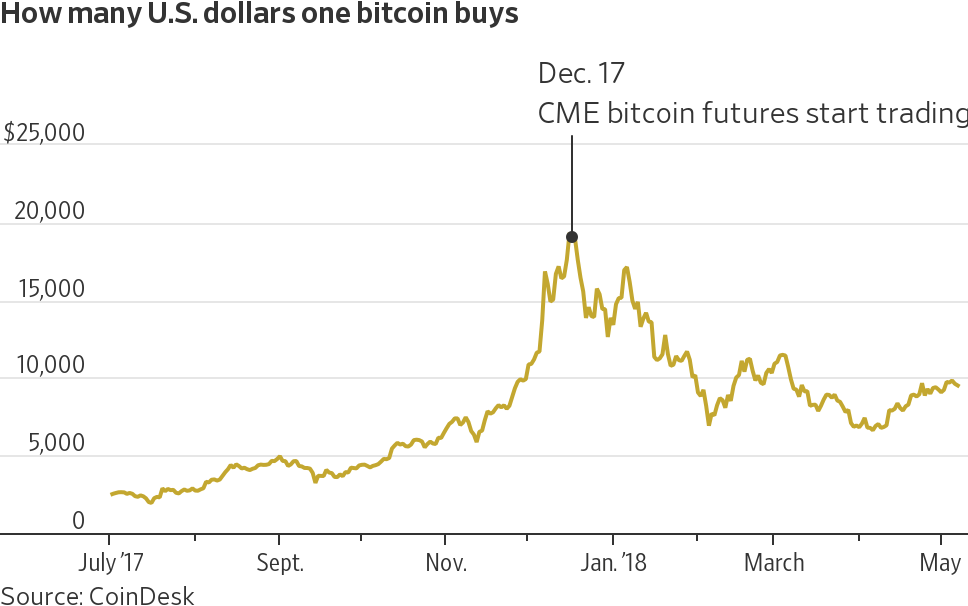
And much like history, it played out a similar way as seen in the graphic below:
Source: CoinDesk
Following its listing in the CME exchange, Bitcoin prices began to descend. As much of the “smart money” (institutional investors and the like) took the opportunity to short Bitcoin as having listed in formal exchanges made it easier for investors to bet against the “currency”.
Furthermore, this view is supported by a recent research note from the Federal Reserve Bank of San Francisco that creating a futures market on an asset that was never traded as such before leads to downward pressure on its prices give the access it allows to short the asset. The San Francisco Fed also added that “once derivatives markets become sufficiently deep … short-selling pressure from pessimists leads to a sharp decline in value”.
What’s New
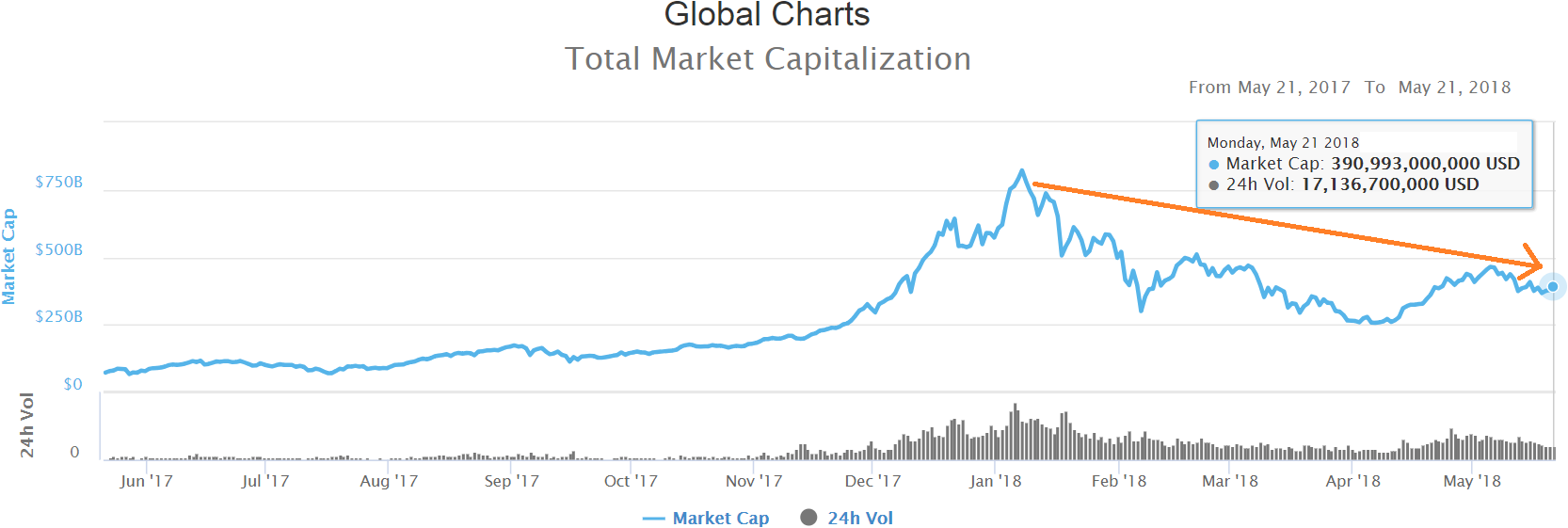
Since then and at the start of 2018, Bitcoin and other cryptocurrencies, which followed suit, have drifted downwards and lost a collective $219.89 billion or circa 36% since the start of the year. The chart below captures the price action of the entire market year-to-date and highlights the weakening near sentiment on the “asset class”:
Source: Retrieved 21 May 2018 from coinmarketcap.com
This then begs the question “what other events could’ve further weakened the market sentiment?”
There were a mix of regulatory issues like the Reserve Bank of India prohibiting its constituent organisation from dealing with crypto currencies to the tightening of South Korea’s regulation in order to combat money laundering. We also saw effects of Social Media companies like Facebook banning cryptocurrency advertisements due to many being fronts for scams.
That aside, there’s also an ongoing issue with one the world’s largest cryptocurrency exchanges with the US Commodity Futures Trading Commission. The Bitfinex Exchange and the Tether coin – which is popular because for its alleged claim that it’s pegged to the US dollar – are under fire as both entities received a subpoena last December to investigate the relationship between the two companies and whether Tether truly has the dollars in reserve to back its tokens otherwise they will be unable to provide the actual returns expected by investors.
So far, what has been revealed by media sources is that the audits by Friedman LLP were inconclusive and that Tether previously refused to disclose the actual dollars it has in reserve. Furthermore, both companies haven’t disclosed headquarter location or management position but Bloomberg has reported that both companies share a CEO.
Finally, Bitfinex has announced it has cut ties with Friedman LLP in late January and announced the statement: “We confirm that the relationship with Friedman is dissolved. Given the excruciatingly detailed procedures Friedman was undertaking for the relatively simple balance sheet of Tether, it became clear that an audit would be unattainable in a reasonable time frame. As Tether is the first company in the space to undergo this process and pursue this level of transparency, there is no precedent set to guide the process nor any benchmark against which to measure its success.”
The only notable development post that is an announcement from Bitfinex Exchange last week that outlined a new KYC (Know Your Client) policy that it is now complying with US FATCA (Foreign Account Tax Compliance Act) laws. No doubt a by-product of its ongoing issues with US regulators. We also see quite an irony here that Bitfinex operating out of secrecy and in tax havens and failing to audit its own Tether coin but now wants to audit its own customers.
Combined, these irregularities are quite suspicious in our view and do not dissuade concerns about its legitimacy. If such issues occur in the largest exchanges, then what more with the smaller exchanges which do not have the resources afforded for larger firms? Overtime and since our initial look at the sector last September 2017, we are increasingly seeing more issues cropping up in the space and making it harder to see a bullish side of the crypto argument.
With those salient updates out of the way, we look at the most recent developments across the world in May. We are seeing an increasing trend with governments across the world taking a serious look at the blockchain technology and its applications across a broader spectrum and not just purely in speculating with digital currencies.
First off, the Australian government has allocated approximately A$700,000 of its budget to research blockchain applications in government securities. While in Russia President Putin has asked the central bank to assess risks and the necessity of incorporation blockchain technologies for use in the banking sector. However, as of now, it seems that Russia might be ways off as it still needs to make amendments to its own civil code about digital currency.
The Norwegians are also looking into incorporating digital currency due to declining cash usage and as an independent back up solution for electronic payment systems. In fact, a comment from the Norges Bank Governor Øystein Olsen: “A decline in cash usage has prompted us to think about whether at some future date a number of new attributes that are important for ensuring an efficient and robust payment system and confidence in the monetary system will be needed.”
And much similar to Norway, Sweden’s Riksbank and the Federal Council of the Government of Switzerland are both considering state-backed digital versions of their currencies, the “e-krona” and “e-franc”, respectively. Germany has a different approach as it announced via its second-largest stock exchange, the Börse Stuttgart, that it would launch a zero-fee cryptocurrency trading app called “Bison” and the big four coins (Bitcoin, Ethereum, Ripple, and Litecoin) will be traded there and more still on the way.
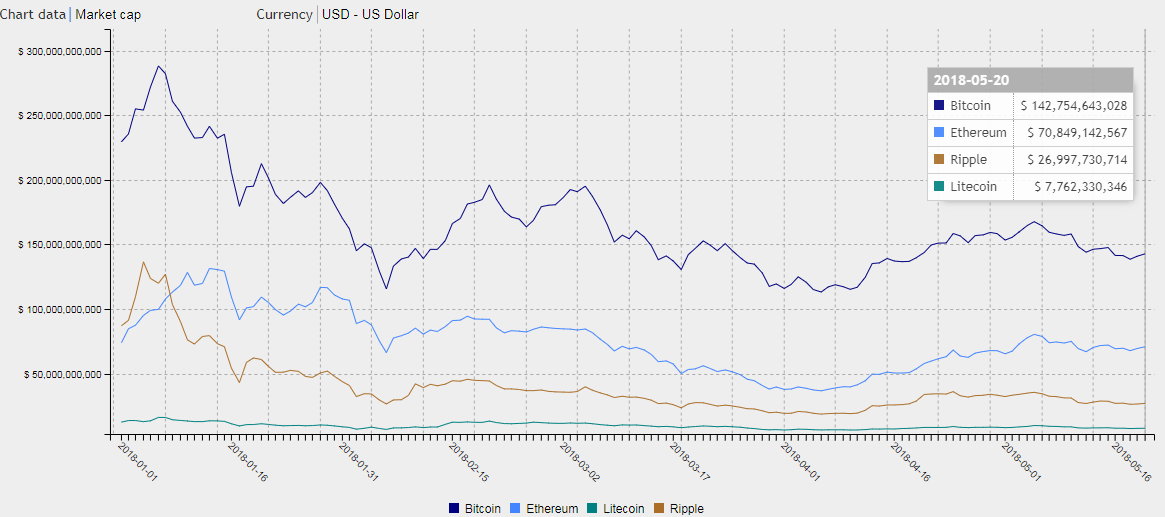
There was also a blockchain event in New York last week dubbed the “Blockchain Week NYC” which failed to prop up cryptocurrency prices given the lingering regulatory concerns and increasing likelihood of state-backed alternatives which we view in better light. In fact, over the last week, the big four coins yielded the following returns:
Bitcoin (BTC) is down 2.4%, Ethereum (ETH) is flat, Ripple (XRP-USD) dropped 3.6%, and Litecoin (LTC) fell 3.5%.
Source: Retrieved 21 May 2018 from cryptocurrencychart.com
Out of all these news titbits, one thing is certain that given the scope and decentralised nature of Bitcoin and Cryptocurrencies, it has become increasingly hard to pinpoint short term price catalysts. This is also worsened by the fact that cryptocurrencies are highly volatile making attempts at pinpointing the short-term catalyst a moot point. We are even willing to wager that the prices of cryptocurrencies covered in this report will be drastically different from the point of publication to the moment the member is reading this text.
In addition to aforementioned issues, we also believe that the drastic fall from the start of the year has wiped out enough small speculators from adding more undue demand and has gradually reduced interest for the average Joe to speculate on the crypto markets.
A quick proxy, though non-scientific in anyway, approach is to do a Google Trends analysis on search behaviour as this is quite telling what the average Joe is thinking. Following its peak in 17 December when Bitcoin price was close to $20,000 interest has been dissipating and barely makes over 1/8 of the volume in their peak. The same is true for alternative search topics such “Cryptocurrency” and “Ethereum”.

Source: Retrieved 21 May 2018 from Google Trends
We even tested this on other coins and we find that the pattern is consistent with speculative interest in cryptocurrencies fading away. We don’t believe interest is entirely gone, though waiting on a catalyst is even a bigger uncertainty and as of this juncture, we believe that given current interest, cryptos are unlikely to reach their former peaks in the near term.
That’s why we believe a more prudent approach is to look at companies that profit or seek to profit from the underlying trends in blockchain technology and would be appropriate alternative exposures to Bitcoin. We also share a similar view with the Oracle of Omaha, Warren Buffett that cryptocurrencies, unlike stocks, bonds, real estate, don’t constitute as real investments.
Mr Buffett chimed in an interview stating that “If you buy something like a farm, an apartment house or an interest in a business and look to the asset itself to determine whether you’ve done something — what the farm produces, what the business earns … it’s a perfectly satisfactory investment” and that “you look at the investment itself to deliver the return to you.”
In our view, and much like our previous special report on the topic, we take a look at the following companies that are set to benefit from underlying trends/developments in Blockchain Technology:
DigitalX
First off is DigitalX (ASX: DCC). We briefly covered his stock before as part of our review in crypto miners and alternatives. The company has operations in Perth and New York while focussing on ICO (Initial Coin Offering) Advisory Services much like an investment bank but for cryptocurrencies as well as Blockchain Consulting Services which involve security and software development for blockchain developers.
The company has also recently ventured into Investment Management and specialising in Cryptoasset Fund Management. The fund will invest predominantly (~75%) in the top 10 cryptocurrencies and weighted by market capitalisation capped at 20% (likely BTC) while the remaining 25% of the funds will towards special trading opportunities including ICOs.

The company’s price performance also parallels with the movements of the broader cryptocurrency market owing to its business entirely revolving around the asset.
The company also recently released its 9M 2018 results covering April-December 2017. The company has generated US$3.14 million in fees mostly from ICO Advisory Business and generated its maiden operating cash profit of US$1.34 million for the 9M period.
Nvidia
Next up is graphics processing unit (GPU), Nvidia (NASDAQ: NVDA). We also covered the company in our crypto miners and alternatives special report. We believe the company is not a direct exposure to the cryptocurrency considering its diverse market exposure from gaming to data centres, autonomous driving systems, professional visualisation, supercomputing, and a slew of applications centring around artificial intelligence.
That said, the company’s price chart performance is more resilient (comparatively speaking) given the diversity of the markets it serves. This is evidenced by the chart below:
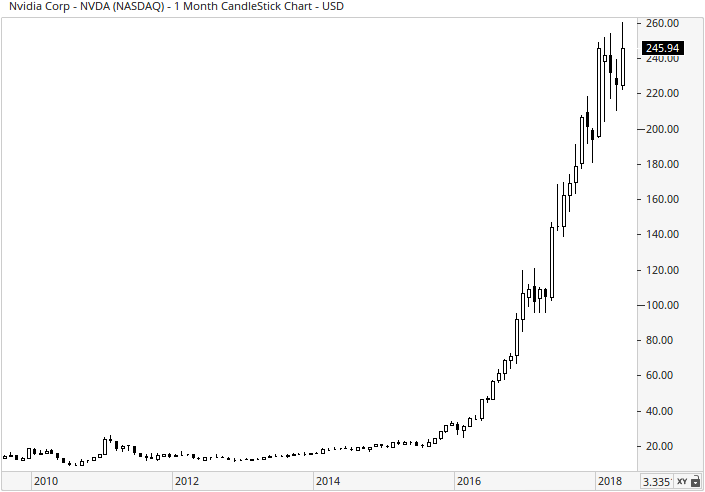
The company recently announced its 1Q19 earnings results showcasing that it’s powering well ahead of expectations. Revenues surged over 66% year-on-year to US$3.2 billion while net income more than doubled (+145% yoy) to $1.2 billion.
According to management, a large portion of this was due to strong demand for its Data Centre services making tremendous strides (+71% yoy) while sales of High End GPUs for gaming (+68% yoy) and crypto specific use (~$289 mln) hit record levels. Note that some miners buy GPUs used for gaming instead of the specialised product.
That said, the company’s exposure to the cryptocurrency market is still sizable with consensus (and company) estimates falling between 10% and 15% of total revenues. However, as we’ve noted above, the weakening market (and interest) in cryptocurrency as of late has made the company adjust guidance in the 2Q19 where crypto-specific revenues are expected to drop by ~66% of its 1Q19 levels though this could be offset by gains in gaming specific use as the weakening cryptocurrency market has normalised GPU prices.
For individual picks, we find Nvidia to be the most resilient of the bunch considering its branding power and diverse market it serves, however, the valuations are currently prohibitive (~42.4 or 51.13x P/E).
Advanced Micro Devices
Next, another GPU player and Nvidia’s closest rival, Advanced Micro Devices (NASDAQ:AMD). The company’s product line is similar to Nvidia but has a different approach which results in it having a slightly higher risk level considering that it prioritises low- and mid- tier GPUs which don’t have the same margins as the premium segment while competing on price.
The company has a higher exposure to crypto miners (~25% in revenues) than Nvidia making it quite sensitive to the vagaries of the cryptocurrencies. This is easily reflected in the chart below:

With the recent trends in GPU price normalisation, things don’t look to well for AMD given that it’s already undercutting many of its rivals to generate volume. That said, as supply of GPUs increase in the market, we expect it to become increasingly difficult for AMD to compete while its valuations are exorbitant (~160x P/E) making it even a harder pick over Nvidia, comparatively speaking.
iShares Semiconductor ETF
For Members who are seeking a broader exposure to semiconductors and the like with a splash of cryptocurrency exposure, the best alternative in our view would be the iShares Semiconductor ETF (NASDAQ: SOXX). The chart below illustrates the ETFs price movements to date:
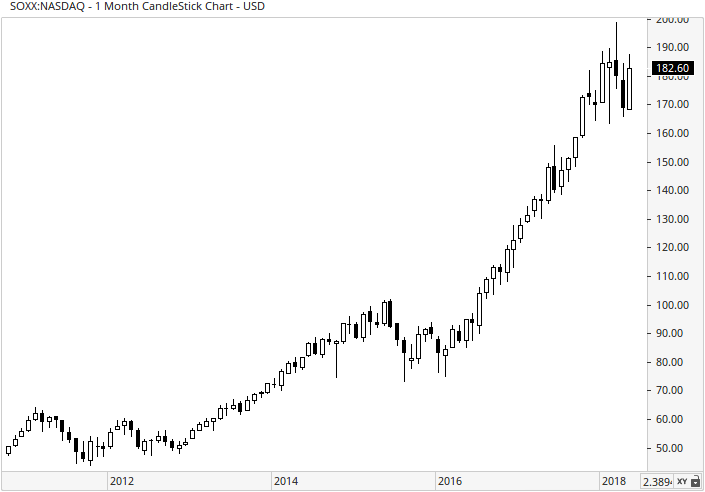
This ETF covers some 30 names based on the PHLX SOX Semiconductor Sector Index which are predominantly based in the US. The fund charges a reasonable expense ratio of 0.46% considering that its entire portfolio is composed of higher growth, though cyclical companies. Note that in light of that fact, it may be more volatile than other broader based ETFs. NVIDIA and AMD are also included in the ETF’s holdings.
Conclusion
So far, our caution against starting a position in cryptocurrencies has paid off considering that prices have been drifting downwards amidst headwinds on an external basis (regulatory et al). That said, we believe that, for Members, it is a more prudent strategy to at least consider listed investment alternatives as we still don’t view cryptocurrencies as sound investments on account of it not being a productive asset nor having any underlying value.
We believe this is best summarised by Warren Buffett with a quote “When you’re buying non-productive assets, all you’re counting on is the next person is going to pay you more because they’re even more excited about another next person coming along.”
We are not issuing a recommendation on the purchase of any cryptocurrencies, or companies in the space, at this juncture. However, we will monitor the industry for buying opportunities which may stack up on a risk/reward basis.

