
Righting the Ship
Although the waters in which private health insurer Medibank Private (ASX:MPL) sail continue to be somewhat choppy, management appear to have ‘righted the ship’ over the past 18 months or so. We were pleased with the first half results, which showed solid improvement in operating profit from the core health insurance operations. A more recent brief update indicates that stability has continued in the March quarter.
Affordability remains a headwind for the industry, but Medibank is mitigating this through cost-out initiatives.
We believe there is more scope for privatisation productivity gains and the company’s ahm brand has been winning market share in the more ‘affordable’ segment of the market opportunity.
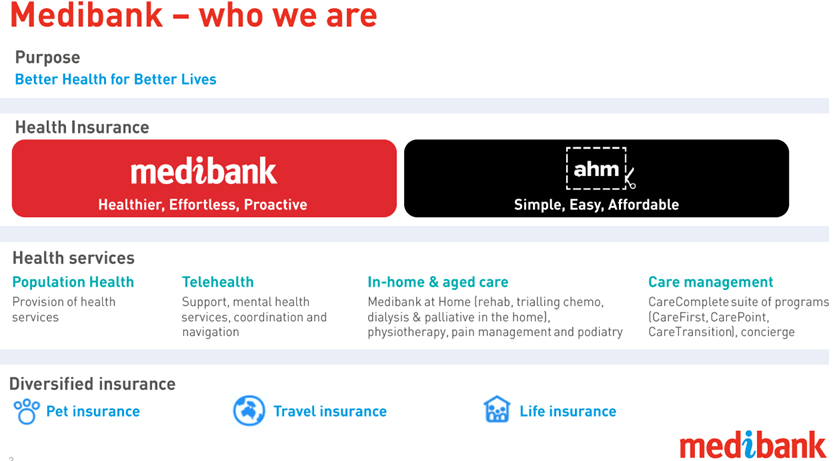
Source: Medibank (ASX:MPL) May 2018 presentation
In the six months ended 31 December 2017 the ahm brand posted a 14% year-on-year increase in policyholders to 340,000, while the premium Medibank brand saw policyholders slip by 10,300 or 3.5%. Total policyholder number losses slowed, declining about 4,200 to approximately 1.772 million, compared to a 18,100 reduction in policyholders in the comparable six-month period a year earlier and more sharply a year before that.
Positively, at a recent presentation at the beginning of May, the company stated the group had “pleasingly seen stable policyholder numbers in the March quarter”.
The company also said it had seen a continued period of soft hospital utilisation and that is expected to continue through the second half, “albeit the benefit will be somewhat offset by lower receipts from the risk equalisation pool”.
Given the environment, a close eye needs to be kept on costs and improving productivity at the group. The recent update stated the business is on track to deliver $20 million of productivity savings for the fiscal year and that full year management expenses are anticipated to be below those posted in FY17.
Customer dissatisfaction remained an issue for Medibank (ASX:MPL) when it posted its results back in February with its net promotor score (NPS) negative, although it was better than major peers and improved versus the peer average. The NPS measures how likely it is a customer will recommend a brand to others. Another relative positive was that Medibank’s percentage of complaints shrank to 26.1% of the market in the first half of the fiscal year, meeting CEO Craig Drummond’s target of getting complaints below market share. Medibank’s market share was approximately 26.8% at the end of December 2017. To put in perspective the scale of the improvement on that front, consider that in the September 2016 quarter the compliant share was a whopping 60.7%.
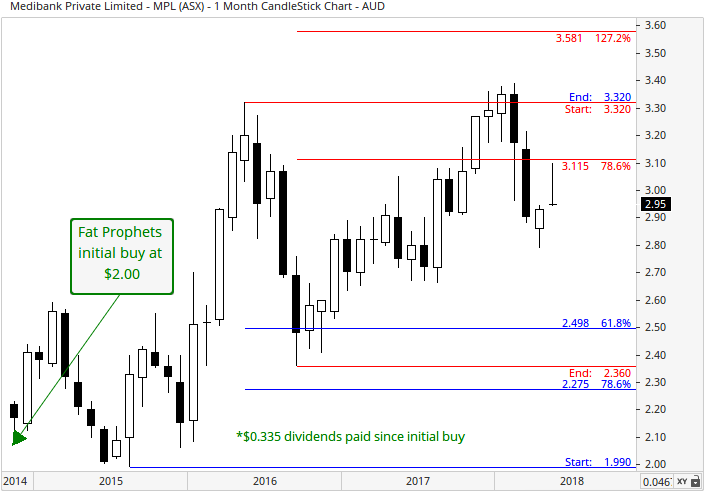
1H18 review
Briefly recapping Medibank’s key first half numbers, and group 1H18 net profit after tax (NPAT) increased 5.9% year-on-year to $245.6 million, as solid results from the core health insurance operations more than offset lower net investment income and higher income tax expense.
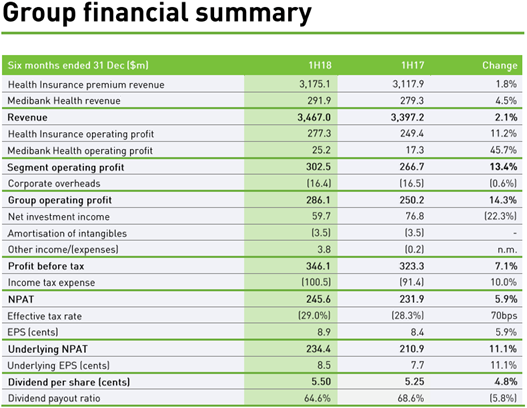
Source: Medibank (ASX:MPL) February 2018 presentation
Medibank Health Insurance premiums increased 1.8% year-on-year to $3,175.1 million. Industry growth continues to slow, reflecting “the challenging affordability conditions being experienced.” While this is modest growth, we expect inflationary pressures to flow through long-term and the company raised premiums by 3.88% from 1 April 2018.
Management expenses dipped 1.9% to $273.2 million, resulting in the MER (management expense ratio) falling 30 basis points to 8.6%. Higher depreciation and amortisation charges were more than offset by a 3.4% decline in operating expenses. The cost out story continues to support the bottom line, as IT and call centre services in the core business have been streamlined. This is necessary due to the affordability challenges of private health care insurance for many Australians.
The segment operating profit margin came in at 8.7%, up 70 basis points from a year earlier. Health insurance operating profit came in at $277.3 million, up 11.2% from 1H17. After allowing for a claims provision release of $33.8 million, the adjusted operating profit in 1H18 of $243.5 million marked a 4.0% increase on the comparable 1H17 adjusted operating profit.
The smaller Medibank Health business posted revenue growth of 4.5% to $291.9 million. The division seeks to cut the costs of healthcare by going to patients at home and is an area that management are looking for bolt-on acquisitions in, although they will likely be small.
Medibank Health operating profit surged 45.7% to $25.2 million.
This was driven by the higher revenues, an improvement in operating performance across the segment, the acquisition of HealthStrong and a larger contribution from the group’s diversified insurance business. The operating profit margin for the segment improved 2.4 percentage points to 8.6%.
Group investment income was materially lower, falling 22.3% to $59.7 million. This was driven by lower returns from equity and debt instruments, along with a
“more defensive portfolio position”.
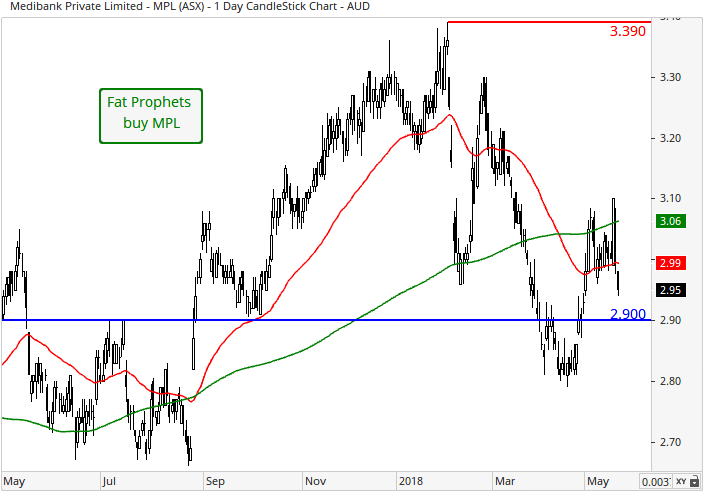
Summary
Medibank (ASX:MPL) shares are trading on approximately 18x forecast FY18 earnings, with a projected yield of 4.3%.
Although the waters in which private health insurer Medibank Private sail continue to be somewhat choppy, management appear to have ‘righted the ship’ over the past 18 months or so. We were pleased with the first half results, which showed solid improvement in operating profit from the core health insurance operations. A more recent brief update indicates that stability has continued in the March quarter.
The Federal Court’s dismissal of proceedings taken by the ACCC against the company last year for alleged misconduct towards customers was a positive for Medibank shares (ASX:MPL). The ACCC returned to court in mid-May to appeal the court’s decision, but investors seem relatively confident in a benign outcome with Medibank shares little changed over the past couple of weeks.
Positively, after stabilising the business management have said the current year will see growth back on the agenda. Chief executive Craig Drummond stated, “2018 marks a step change for Medibank. We are now positioning for growth which will allow us to leverage our scale to build the core business and transform into a broader health services company. Our progress means we are now in a position to pursue new initiatives, continue to invest in our chronic disease management programs and expand our in the home programs”.
While it hasn’t all been smooth sailing, we believe the company’s strong market position and solid long-term thematic of an aging and growing population needing healthcare coverage, will see it navigate the challenges such as regulatory changes adequately and continue to deliver decent results for shareholders.
We continue to recommend the stock as a Buy for Members with no exposure.

