
Adjusting to change
A trading update released by integrated pet care player Greencross (ASX:GXL) resulted in the shares being sold off sharply. The update featured an earnings downgrade as the veterinary division’s performance failed to deliver the expected improvement during the recent quarter, along with some other items. The company also flagged that it now expects to recognise non-cash impairments to the tune of between $16 million to $20 million in its full year results.
While the update was clearly negative and unwelcomed by the market, the reaction appears to have been overdone to the downside in our view.
The impact on EBITDA from labour cost related to the strategic review of IT projects are short-term costs that could lead to benefits down the road, and the bulk of impairments appear to be largely a ‘clearing of the decks’.
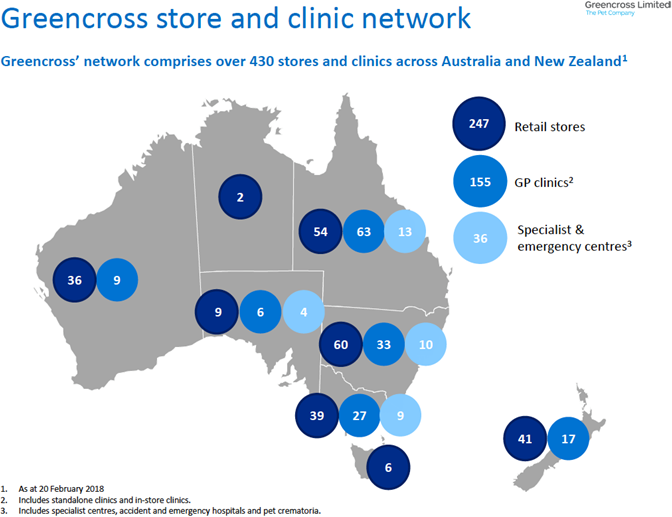
Like-for-like sales in much of the business are still relatively healthy and we continue to like the company’s prospects for reasonable earnings growth through optimising its store and clinic network, along with fleshing out its omni-channel development. Increased penetration of its private label would be supportive.
Source: Greencross (ASX:GXL)
At the same time the sector has a tailwind as pet-care spending continues to increase in Australia (where it is amongst the highest in the world). In addition, some Greencross services require a physical location (i.e. GP, specialist and emergency care, grooming etc.) and are therefore defensive against online competition.
Although the trading update was negative, the initial reaction to it was overdone in our view and the shares have since stabilised and recouped some of the lost value.
The new CEO of Greencross, Simon Hickey, looks to be clearing the decks somewhat and moving quickly to position the company optimally to face changes in the market and the competitive threat from Amazon’s expansion into Australia.
Mr Hickey previously served with Qantas Airways in Chief Executive roles with Campus Living Villages, Qantas International & Freight, and Qantas Loyalty and assumed the CEO role of Greencross in early March 2018.
He has announced an immediate strategic review of the company with the objective to slice off $10 million to $13 million in annual operating expenses.
The review is expected to be complete by 1 July 2018, and areas targeted will include “back office efficiencies” and a “tightening of professional fee discounting policies in the vet business.”
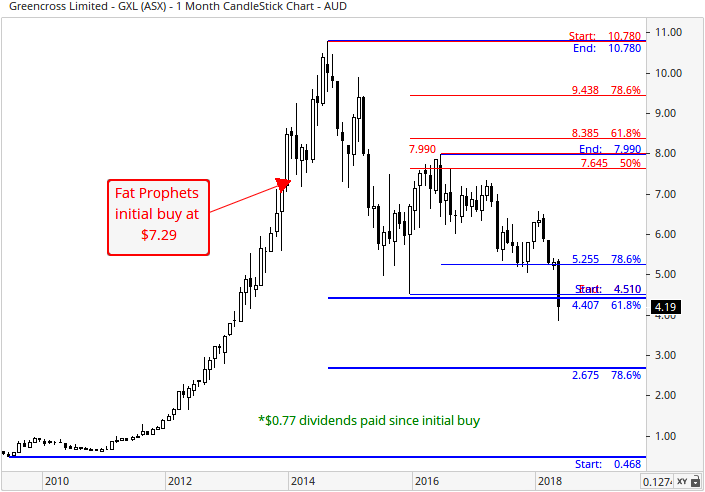
Greencross (ASX:GXL) will remain held in the Fat Prophets portfolio.
Trading Update – Key points
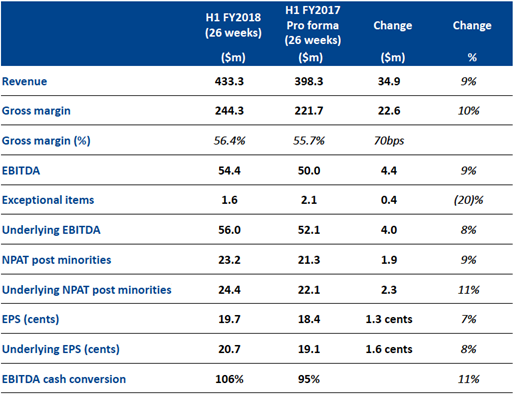
Covering the key points of the update in some more detail, Greencross now expects to generate underlying EBITDA (earnings before interest, tax, depreciation and amortisation) of between $97 million and $100 million.
That falls short of market expectations, and at the top end of the range would be flat with the result for FY17. That implies a relatively soft second half as 1H18 EBITDA came in at $54.4 million, up 9% from a year earlier.
Source: Greencross (ASX:GXL)
The trading update reported total sales growth of 9.0% and group like-for-like sales growth of 4.5%. The company said retail trading has remained robust, but the veterinary business failed to deliver the forecast uplift in second half activity through to week 42.
New Zealand like-for-like sales growth was 4.2%, while Australian retail like-for-like sales growth came in at 4.3% with a stable gross margin “despite an increasingly competitive consumer environment.”
Veterinary sales growth was 4.9%, but this fell short of management’s (and the market’s) expectations. Within the veterinary segment the performance was mixed, with in-store clinics and the specialist and emergency centres doing good business, but the standalone GP clinics struggling due to lower visits. In-store clinics posted double-digit like-for-like sales growth and the specialist and emergency centres delivered high single digit like-for-like sales growth. On the other hand, like-for-like sales growth at the standalone GP clinics have declined 2.8% as visit numbers fell 4.0%.
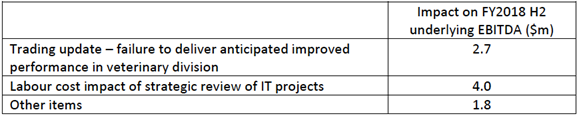
To address the weakness in the standalone clinics, Greencross put in place several measures to increase visitation, including enhanced retail cross referral programs, more focus on Healthy Pets Plus (HPP) membership, and campaigns targeted at certain market segments. The company reports that vet visits in the GP clinics have “stabilised” but the full benefits from the measures aren’t likely to be realised until the next fiscal year. Accordingly, the slower than expected growth in like-for-like sales across the broader veterinary segment account for about $2.7 million of the downward revision in underlying earnings.
Source: Greencross (ASX:GXL)
Another material impact on second half EBITDA stems from costs associated with the company’s strategic review, with an additional $4.0 million in labour costs to be expensed during that period.
Given shifting industry structure, the Board has rethought some capital-intensive projects and instead focus on strengthening the relationship with customers and the profitability of the existing network. Greencross CEO Mr Hickey stated, “We will continue to backfill veterinary and other services into retail stores in strong catchments and to grow our footprint where we identify synergies with our existing network. However, going forward our immediate focus will shift more towards integrating technology into our existing offering in areas including omni-channel development, digital assets and data analytics, optimising our store and clinic footprint and improving the customer experience”.
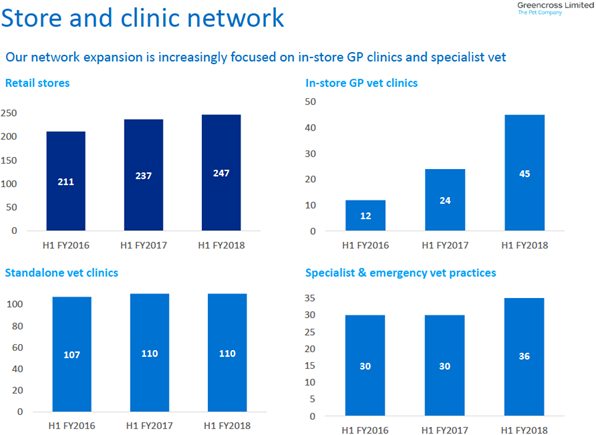
We view the strategy of co-locating vet clinics into retail stores positively, as having both vet and retail in single sites allows both businesses to cross-sell to each other’s customers while saving on costs. Management earlier said they were targeting a 60% conversion to co-location stores in the long-term, although this number may be revised downwards after the strategic review. Nonetheless, there is likely still a long runway for this strategy; as at the time of the interim results the penetration was still relatively low (~18.2% for in-store GP vet clinics).
Source: Greencross (ASX:GXL)
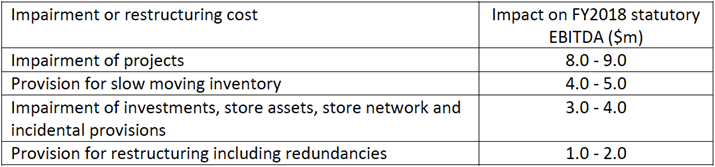
Moving on, it is not unusual for incoming senior management to undertake a ‘clearing of the decks’ and the flagged non-cash impairments of $16 million to $20 million relate to the following items:
Source: Greencross (ASX:GXL)
The raft of impairments will rebase accounting earnings lower, likely resulting in an acceleration in statutory earnings growth in FY19.
Summary
While the trading update was negative, we view the subsequent sell-off as having been overly harsh. The core of the business is strong, and overall like-for-like growth remained robust even in what was a challenging period for Greencross.
Like-for-like sales in much of the business are still relatively healthy and we continue to like the company’s prospects for reasonable earnings growth through optimising its store and clinic network, along with fleshing out its omni-channel development. Increased penetration of its private label would be supportive. At the same time the sector has a tailwind as pet-care spending continues to increase in Australia (where it is amongst the highest in the world). In addition, some Greencross services require a physical location (i.e. GP, specialist and emergency care, grooming etc.) and are therefore defensive against online competition.
In that context, the valuation appears undemanding with the shares trading on 12.4 times forecast FY18 earnings, with a projected yield of 4.3%.
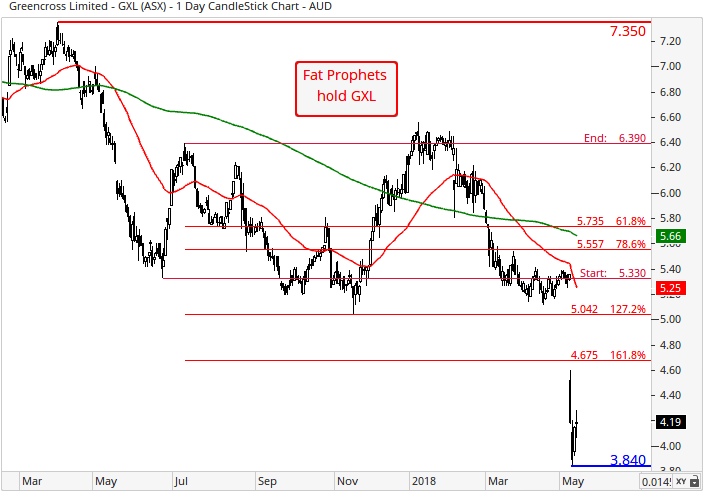
Greencross (ASX:GXL) will remain held in the Fat Prophets Portfolio.

