
Realigning the Steaks
Australia’s largest beef and cattle producer, Australian Agricultural Company (ASX:AAC), unveiled a negative update last week that points to 2018 ending on a rather sour note, with turnaround efforts taking longer than anticipated. This saw the shares drop away in the days subsequent, before gaining some composure. We however maintain our hold view given that turnarounds take time and we are confident that in the longer run, the company’s shift towards a vertically integrated and higher margin business model will pay off.
What’s New?
Since our last coverage on the beef producer in November (FAT-AUS-849), in addition to the trading update, there have been a number of developments with respect to key executive roles.
In late December, 4 months after the departure of former CEO Jason Strong, the Board finally announced that they had selected Hugh Killen (pictured below) as the new Managing Director and CEO, with his appointment taking effect on 01 February 2018. The former CEO’s abrupt departure had un-nerved investors, and a filling of the leadership vacuum has not as yet invigorated sentiment.

Source: Hugh Killen; Twitter
Mr Killen’s previous role in the company was in a consulting capacity where he was responsible for some high-level operations and finance functions as the President and Chief Commercial Officer, a position held since last June. Further back, he has extensive experience in Global Finance with his long tenure (~27 years) in banking and forex related roles at Westpac amongst other financial institutions.
An interesting titbit is that Mr Killen also had a background in farming with his family having pastoral assets in NSQ and the Northern Territory. With that said, Chairman Donald McGauchie provided a vote of confidence stating that Mr Killen is “the best executive that we engaged through our search process and we’re confident in his ability to drive company strategy to achieve the best commercial outcome for AACo. His background as a pastoralist and having spent his formative years in the agricultural sector has made his transition from the finance industry seamless”.
We also view Mr Killen’s appointment positively, given his extensive experience of running international operations (Westpac Global Head of fixed income, currency and commodities business) and given the company’s direction towards global expansion and its sensitivity to global markets. A prudent move in our view.
Mr Killen will head the previous CEO’s efforts to turn the company into a vertically integrated and premium beef focussed business. He will be compensated on a fixed $600,000-year fixed salary, plus cash bonuses and deferred equity rights which could be worth up to $450,000 a year.
CEO aside, in January the company lost another CFO candidate, Mr Scott Pebble, who was acting as temporary CFO having taken the helm on an “acting basis” since the departure of Andrew Slatter last year January 2017. Mr Pebble has opted out of the race given his acceptance of a permanent role outside the company. In the interim, management has announced that they along with a global executive search firm will continue to look for a replacement CFO.
Unsurprisingly, these string of changes at the top has worried investors and likewise caused the shares to perform rather dismally over a rolling 12-month basis (-27.5%) compared to the ASX200 index which only fell circa 1.0% over the same time period. This was also impacted by the revelation in the company’s latest trading update.
Trading Update
Moving on to the trading update and as at 04 April 2017, the company announced that management is downgrading their earlier earnings forecast. Losses are also being borne in relation to the relatively new Livingstone Beef processing plant near Darwin. That said, a weaker financial performance had already been telegraphed to the market in November with the interim results release, as evidenced by the graphic below.

Source: Australian Agricultural Company (ASX:AAC) 17 November 2017 Company Presentation
A look at the graphic above already shows that the company, in the interim period, experienced headwinds with increasing competition which led to pricing pressures on the commodity beef end. This was also worsened by rising prices of inputs and a stronger AU$ relative to the US$ causing the company’s exports to lose out in some markets.
All in all, this resulted in a slightly disappointing Statutory Net Loss of $37.67 million compared to last year’s profit of $47.88 million and a net loss per share of 6.46 cents compared to last year’s EPS of 8.98 cents.
Moving back to the latest update and management have stated that operating EBITDA will slide to between $12 and $16 million compared to the previous year’s $45 million.
Note that this calculation is different from Statutory results as it measures the cattle component of cost of goods sold at standard price as opposed to utilising a market price, which is subject to volatility. In fact, Statutory EBITDA is expected to be a loss of between $30 and $40 million and compares unfavourably to the previous year’s (FY17) EBITDA profit of $133.2 million.
Further down the profit and loss, the bottom-line is also expected take an additional hit with a significant item loss in the range of $60-65 million relating to the 3-year old Livingstone Beef abattoir (pictured below). Management notes that this impairment (non-cash) will appear below the EBITDA line and is related to an “onerous contract provision” with a gas supplier to the plant.
While the abattoir’s specific EBITDA loss contribution would be between $18-22 million compared to last year’s $12.5 million – note that this is the first time the company is disclosing such information publicly.
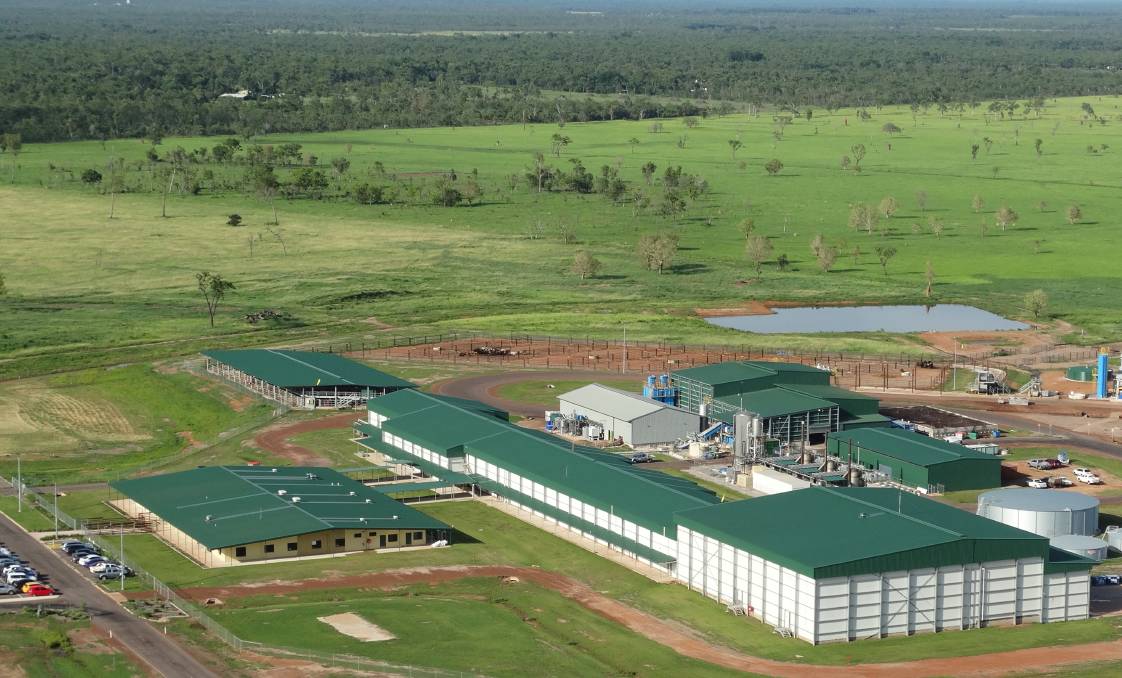
Source: Australian Agricultural Company (ASX:AAC)
The expected losses are also expected to bleed to cash with an estimated negative operating cash flow of circa $42 million and an expected net debt of $348 million. With such negatives brought to light, we appreciate management’s candour and forthrightness with bringing issues to the fore while at the same time looking forward to solutions. On the positive side, there will be a revaluation adjustment of $32 to $36 million relating to the company’s property portfolio.
The new CEO Mr Killen noted that the company is currently undertaking a comprehensive operational review on diagnosing issues with the business model he inherited from the previous administration and has also tapped Deloitte to assist them in the “investigation”. He also noted that a thorough update on the investigation will be included in next month’s Annual Results figures.
A side effect of this investigation also includes shifting back to cattle sales as opposed to the current focus on branded beef sales. Mr Killen notes that the recent underperformance of branded products was due to “reliance on external service providers in the later stages of the value chain and its level of exposure to commodity beef price fluctuations”.
We view this measure positively as simplifying a more direct “cattle sale” model could generate the cash flow needed in the interim while slowly clearing up the inefficiencies in the current “premium beef” model.
That said, management has provided estimates that implementing this model would boost earnings by over $5 million per annum in both Operating EBITDA and Operating Cash flow, from one-off timing benefits.
That aside, the Wagyu supply chain (Luxury and Prestige) is expected to deliver continued strong performance given high margins and revenue growth. This is as the company formally launches the Wylarah and Westholme brands in untapped markets before the end of calendar 2018.
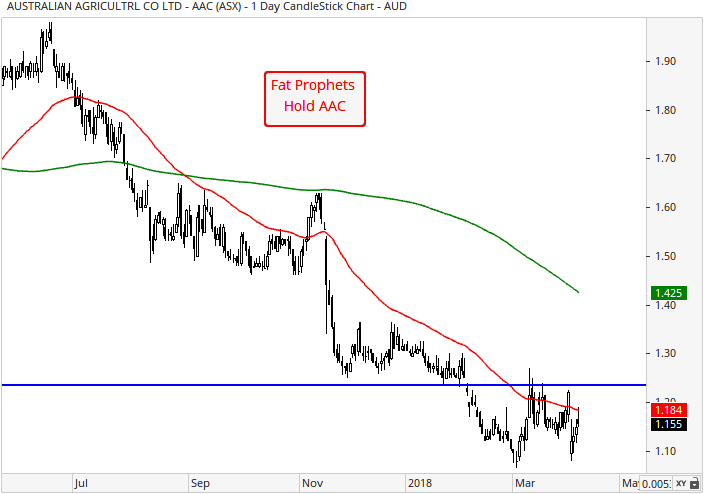
Turning to the technical picture, and on the daily chart, the bearish moving average crossover present since August last year is suggestive of momentum to favour the downside. This is when the 50-day moving average (red line) crosses below the 200-day moving average (green line). Support at the April 2016 low of $1.24 has also given way which has damaged the technical picture. A sustained move is now needed above this resistance level to improve the outlook.
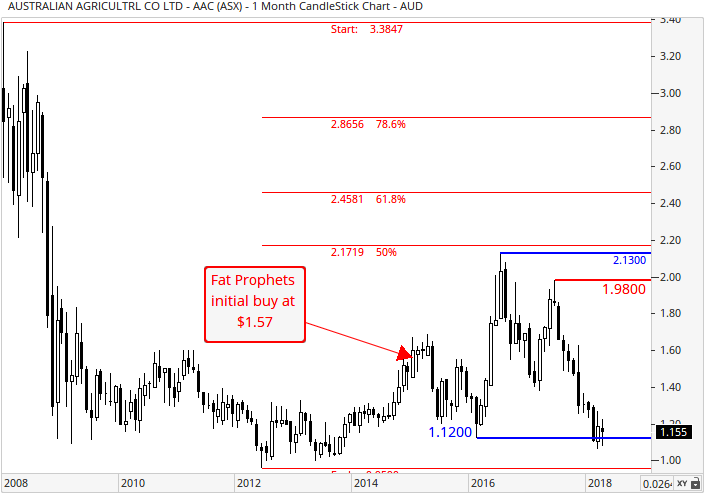
On the monthly chart, the shares have retreated to support around $1.12 being the February 2016 low (horizontal solid-blue line). It is important that the bulls defend this level, and a consolidation unfolds over the medium-term. Should this occur, then this would encourage a period of price-stabilisation to evolve, and thus ease the brunt of the share price weakness seen over the past year.
Summary
Australian Agricultural Company (ASX:AAC) has had a tough few months, facing headwinds from external sources as well as problems at the top. However, the new CEO Mr Hugh Killen is proving to be quite capable, having disclosed the issues currently plaguing the company whilst provide a pragmatic stopgap measure.
With the company’s Annual Results set to be released next month we will be keenly looking at the “thorough updates” promised by management and the initiatives to be undertaken. Amongst our recommendations in the sector, Australian Agricultural Company (ASX:AAC) has been our most disappointing, but we remain positive on the underlying thematic. We maintain our HOLD rating on the stock.

