
Time to Make Friends
Japanese shares have been trading upwards since last week with the Nikkei 225 Stock Index up 3.4% to near 22,000 level as investor fears eased with the release of positive developments on the trade front and lower tensions on the Korean peninsula. That news was further supported by a good batch of economic data from GDP to labour data. This has reinforced our view on the Platinum Japan Fund (ASX:PJF) and as such we upgrade the recommendation back to BUY.
First off, the most important development in the geopolitical sphere was the surprise announcement last Thursday by President Donald Trump that he would meet with North Korea’s Kim Jong-un by May. This breakthrough was a major de-escalation following the torrent of missile tests last year and could lead to possible denuclearisation. Part and parcel of this summit is that Mr Kim will refrain from further missile tests, which is not a stretch given that North Korea hasn’t conducted a missile test since last November.

Image Credit: Associated Press: Wong Maye and Pablo Martinez Monsivais
Another key development last week was the import tariffs on steel set at 25% and 10% on aluminium which are set to take effect in 15 days. It seems to us that this move by Trump is a classic negotiation tactic as he seems to have left the door open for negotiation with the statement that they “will offer relief from steel and aluminium tariffs to countries that treat us fairly on trade.”
In fact, since that announcement, he has exempted Canada and Mexico contingent on renegotiating a favourable resolution to the NAFTA (North American Free Trade Agreement) issue while also exempting Australia given the “close defence ties”. Ultimately, we believe that this will be settle amicably and Japan’s Economy, Trade and Industry Minister Hiroshige Seko has already met with US Trade Representative Lighthizer for a possible exemption for Japanese producers.
So much for geopolitics. On to the most recent batch of economic updates and this month started with a plethora of positive data points supporting Japan’s longest stretch of economic expansion in 28 years.
First, the latest GDP data showed that Japan’s economy in the October-December quarter grew at an annualised rate of 1.6% outpacing consensus expectations of 0.9% annualised GDP growth and marking its 8th consecutive quarter of growth.
According to the data from the government, this was driven by faster than expected capital expenditure activities as Japan Inc. ramped up spending on automation as well as information technology with a 1% increase from the previous quarter, beating preliminary calculations of 0.7%.
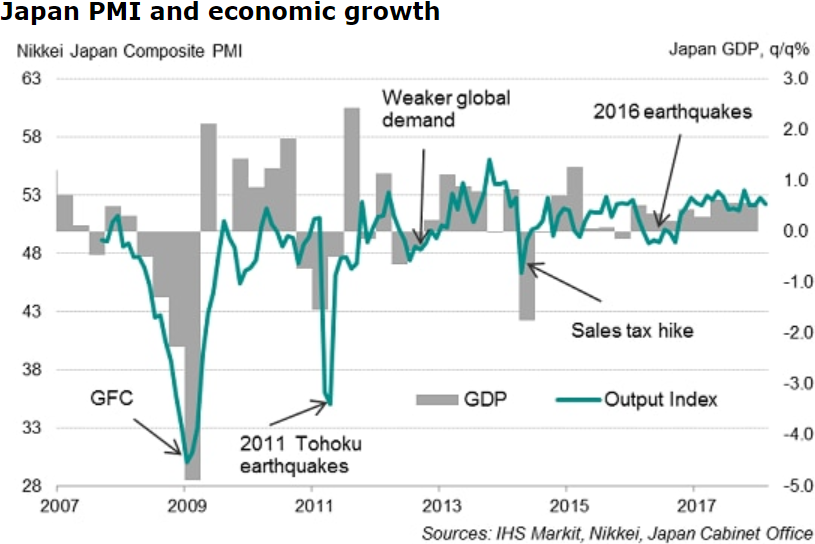
Source: IHS Markit
Furthermore, private consumption – which accounts for some 60% of GDP – came in at a positive 0.5% versus the previous quarter’s 0.6% contraction, likely a side-effect of the strong economy and record low unemployment rates.
On that note, the unemployment rate in Japan dropped 30 basis points from the previous quarter to 2.4%, representing its lowest rate since March 1993 and this is set to tighten even more, as job vacancies hit its highest on record as shown by the New Job Offers-to-Applicant ratio at 2.34 times. Numerous firms have complained of running at high capacity levels with a further rise in backlogs of work – all positive prospects with wages expected to rise.
The Composite PMI (Purchasing Managers Index) data remained strong at 52.2 in February with the manufacturing sector continuing to drive most of the business activity as New Orders hit a 19th consecutive month of increase in February. The trends of both service and manufacturing PMIs are captured in the graphic below.

Source: IHS Markit
Going forward, with all the positive prospects continuing to trickle in, business confidence has picked up with the IHS Markit Business Outlook survey showing that firms are more optimistic about profits amid the inflows of new business.
The Bank of Japan (BoJ) will maintain its accommodative policies with the BoJ Governor Kuroda’s statement there’s no need to conduct another comprehensive assessment and that there will be no significant changes to be made with its monetary easing stance for the time being. This is reflected in the BoJ’s interest rate decision last week with the short-term rates still at -0.1%.
We believe the alleged cronyism scandal linked to the sale of state-owned land is unlikely to rock the boat too much. Japan’s Finance Minister Taro Aso, who is a stalwart ally of Prime Minister Shinzo Abe since his election in 2012, has become embroiled because of a scandal involving a controversial land sale and allegations that documents were falsified. There is nothing like a good scandal to test the market.
Abe’s deputy since he took office in December 2012, he is seen as a key backer of the Abenomics program. Japan’s government said on Monday that the names of Prime Minister Shinzo Abe, his wife and his finance minister were deleted from documents at the heart of a land scandal that erupted last year. Finance Minister Taro Aso apologized and said, “an internal investigation was ongoing” as opposition lawmakers called for him to resign. He admitted that staff in his department tampered with the documents, but said all the blame rests with one of his subordinates who resigned last week. Abe also sought to limit the damage.
The Prime Minister said yesterday that “we’ll continue the investigation to get to the bottom of why this happened — I want Finance Minister Aso to take responsibility for that. This situation has shaken public trust in the whole administration, and as its head, I feel responsibility and deeply apologize to the people.”
This will probably all blow over, with Abe being one of the most popular Prime Minister’s in Japan in decades. The yen strengthened and the Nikkei Futures are pointing to a drop of around 0.5% today.
On a two-year weekly chart, the Nikkei has risen consistently within a trend channel since early 2016. The correction that hit markets in early February proved to be deeper for the Nikkei after heavy resistance at the top of the channel brought on a swift correction with the index ‘testing the base” following a 15% sell off. What was notable is that the Nikkei held important support levels whilst a battling several headwinds such as the stronger yen and political disruption.
Foreign investors have significantly deleveraged in Japan, with capital outflows at record levels in recent weeks. This is positive and paves the way for the next upward leg in the Nikkei. If the Nikkei can “hold the line” above 21,000, then that would be consistent with the upward trend remaining in place and provide targets back above 24,000 in the months ahead.
Combined with the improving dynamics in Japan’s economy and the easing tensions in the Far East geopolitics, not to mention the attractive valuations in Japanese equities, we thus upgrade our view on the Platinum Japan Fund (ASX:PJF) from Hold to Buy.
Fund Overview
As a reminder, Platinum is a well-established Australian‑based manager, specialising in international equities. The Platinum Japan Fund’s investment objective is to provide capital growth over the long-term through searching out undervalued listed (and unlisted) investments in the Japanese and Korean region.
The Fund has kept pace with a robust rally in Japanese equities, and has an impressive record of outperformance over a long time period, gaining circa 15.0% per annum over the last 10 years.
However, it should be noted that the Fund is suitable for investors seeking a truly active investment exposure to Japan, as its relatively flexible mandate (which includes the ability to short stocks) can result in returns which are significantly different from the benchmark Japanese market index.
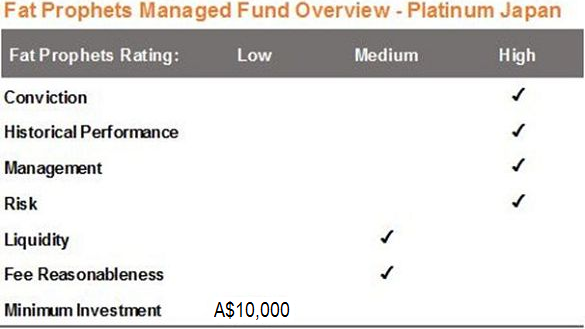
Fund Overview
Leadership & Management
The Fund’s portfolio manager is Scott Gilchrist (BEng (Hons)), who has over 15 years’ investment experience serving Platinum Asset Management and has been managing the Platinum Japan Fund since December 2014. While there is an element of key person risk with the fund, the investment managers at Platinum have an excellent reputation which bolsters our positive view here.
Investment Approach
Platinum’s central aim is to achieve positive absolute returns for Investors. The investment objective of Platinum Japan is to provide capital growth over the long-term through searching out undervalued listed (and unlisted) investments in companies in Japan and Korea.
Platinum (ASX:PJF) has an independent style of investment management, driven by a thematic stock picking approach. In our view, the Fund has sound investment logic, and we are attracted to the value driven approach of the Fund.
Portfolio Structure
The Portfolio itself reflects the Fund’s strategy. The portfolio usually holds between 40 to 80 securities, and cash may be held when undervalued securities cannot be found. Furthermore, the portfolio will typically have 50% or more in net equity exposure.
Given the focus of the Fund is Japan, the proportion of Korean securities in the portfolio is limited to a maximum of 25% of the value of the portfolio at the time of investment. The Fund may invest in companies not listed in Japan or Korea, when their predominant business is conducted in Japan or Korea.
As a consequence of the investment strategy, the portfolio has been built up from a series of excellent individual stock selections, rather than from a predetermined asset allocation.
This makes the fund very ‘benchmark unaware’, which has been reflected in investment weightings considerably different to the MSCI Japan Index, and reflected in relative performance.
Realised Return
The Platinum Japan Fund (ASX:PJF) has repeatedly outperformed against its benchmark and continues to its impressive track record. From inception in 1998 the fund’s Class C shares (original recommendation) has performed strongly, generating a return of 15.4% per annum to 28 February 2018, net of fees and in Australian dollars. This compares to the MSCI Japan Index which has returned 3.0% per annum over the comparable period.
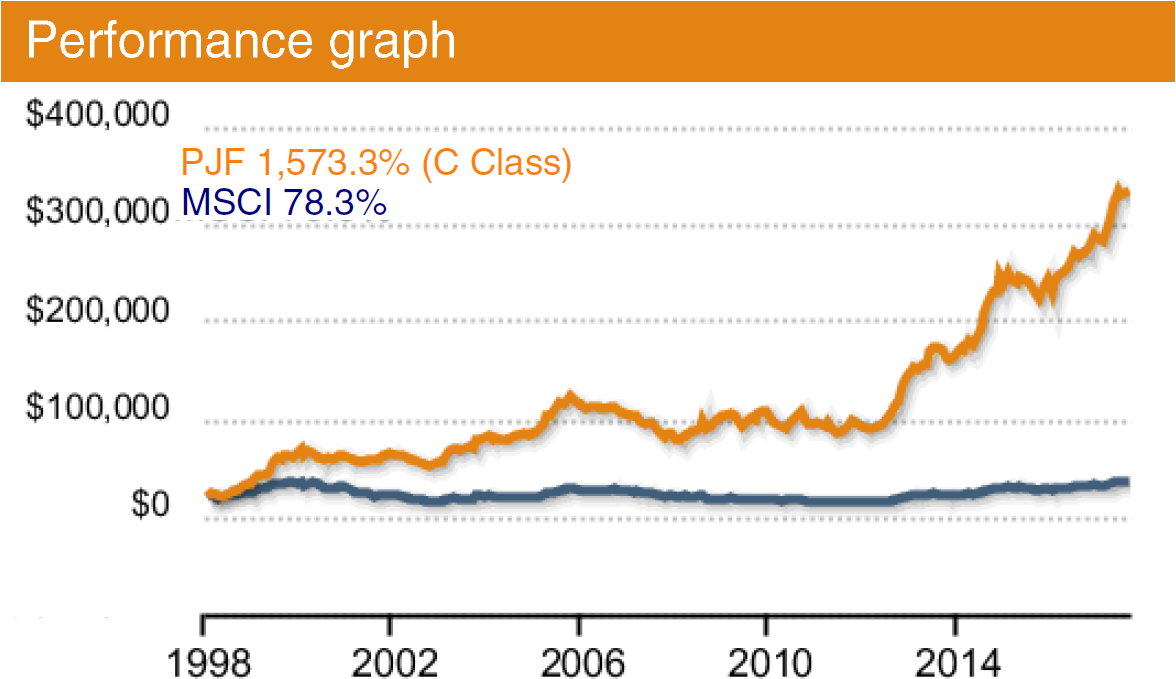
Source: Platinum Japan (ASX:PJF)
It is also worth noting that this outperformance over the index is consistent across all reported time periods, although we don’t expect this to always be the case, especially over the shorter term 1-month and 3-month time frames.

Source: Platinum Japan (ASX:PJF)
Regarding more recent performance (1- and 3- month) and the fund is tracking behind the benchmark mainly due to the significant differences in the fund’s sector allocation. The fund has a significantly higher exposure to the Information Technology (IT) sector which has experienced some volatility relative to sectors that are benefitting from the global economic recovery such as Industrials (i.e. semiconductors), consumer discretionary and materials sectors (chemical producers).
Distributions are paid annually on June 30th. The latest distribution was 27.0295c and based on the 28 June 2016 entry price of $4.28 the fund was trading on a yield of 6.32%.
Fee Structure
The Management Expense Ratio for the fund is 1.54% per annum, which includes GST, administration costs and investment costs.
The only additional cost is the buy-sell spread occurred when buying or selling units, which is 0.2% of the Net Asset Value unit price. There are no establishment, contribution or withdrawal fees and no adviser service fees (i.e. trailing commissions).
There is a minimum initial investment of A/NZ$10,000 with the option for implementing a Regular Investment Plan in A/NZ$5,000 plus A/NZ$200 on monthly/quarterly basis.
Application and withdrawals can be made every Sydney business day.
Fund Positioning
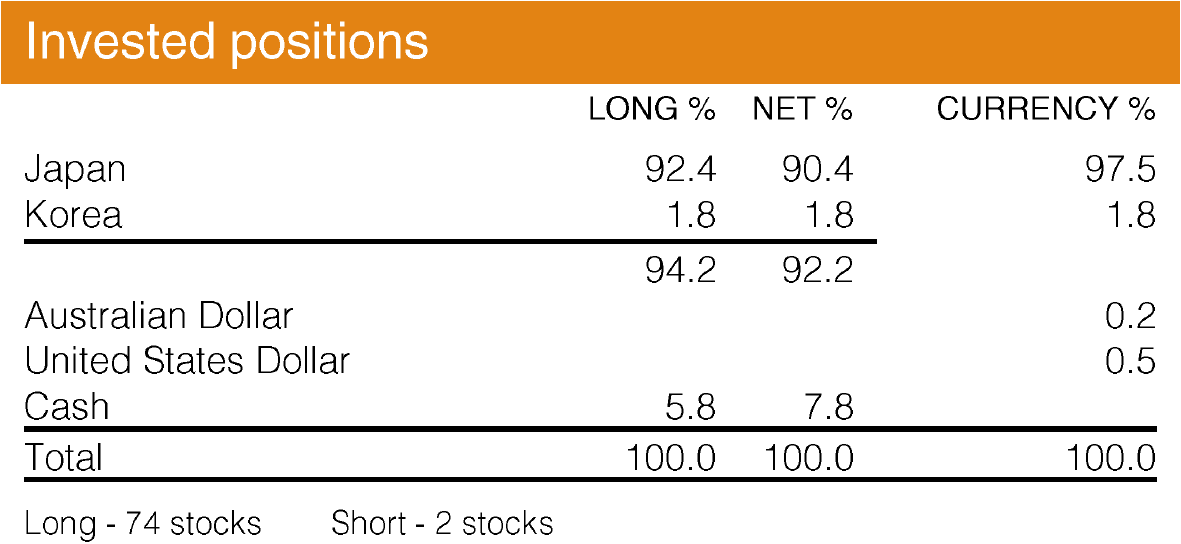
Since our last coverage back in October (updating September numbers), the fund manager has significantly reduced the currency exposure in US$ from 28.4% to 0.5%. Currency exposure aside, the fund has added 5 more positions since our last coverage but at smaller chunks since the cash position has increased by 90 basis points.
In terms of regional exposure, the fund has slightly reduced exposure to the Korean peninsula, having trimmed it by 20 basis points. We believe that this is likely due to price movement stemming from fears with North Korea’s sabre rattling as opposed to an actual reduction in allocation.
Source: Platinum Japan (ASX:PJF)
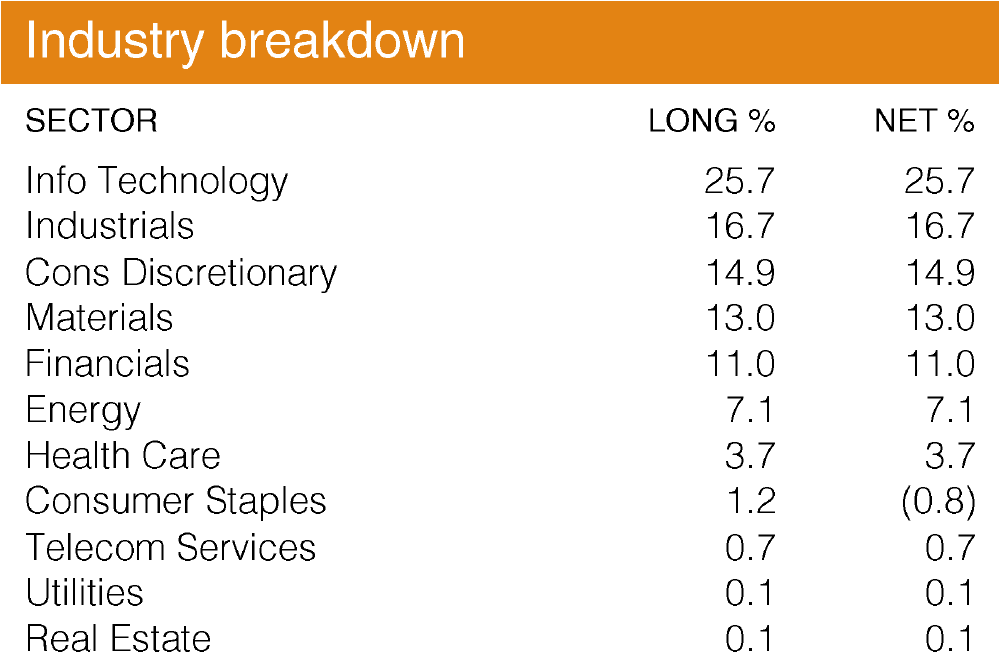
Since our last coverage back in October, the fund manager has rebalanced exposure to the different sectors with the most prominent change in Telecom which has been substantially reduced from 5.3% to 0.7%. The fund is also significantly underweight this sector relative to the index at 4.2%. The fund has also reduced exposures in IT (-150 bps), Industrials (50 bpts) and in Health Care (-30 bps).
The fund manager has substantially increased weightings in Materials (+260 bps) and Financials (+210 bps). Overall exposure to the top 4 sectors amounted to 70.3% implying a greater concentration relative to the index, where they comprise about 61.3%.
Source: Platinum Japan (ASX:PJF)
Another notable difference with the index is the fund’s underweighting of the consumer sector as in consumer staples, the fund has a short position equivalent to -0.8% versus the index which has a 7.6% weighting. The fund is also underweight against discretionary with a -560 basis point difference.
The fund’s overweight exposure (+1,270 bps) to the IT sector is explained in the December quarterly filing, saying that Japan is well placed in potentially lucrative technologies including: (i) Quantum Computing, (ii) Machine Learning, (iii) Advanced Driver-Assistance Systems and (iv) Robotics (a view shared by our Asian Equities team) (v) electric vehicles and even (vi) Blockchain among many other innovations.
Top 10 Holdings
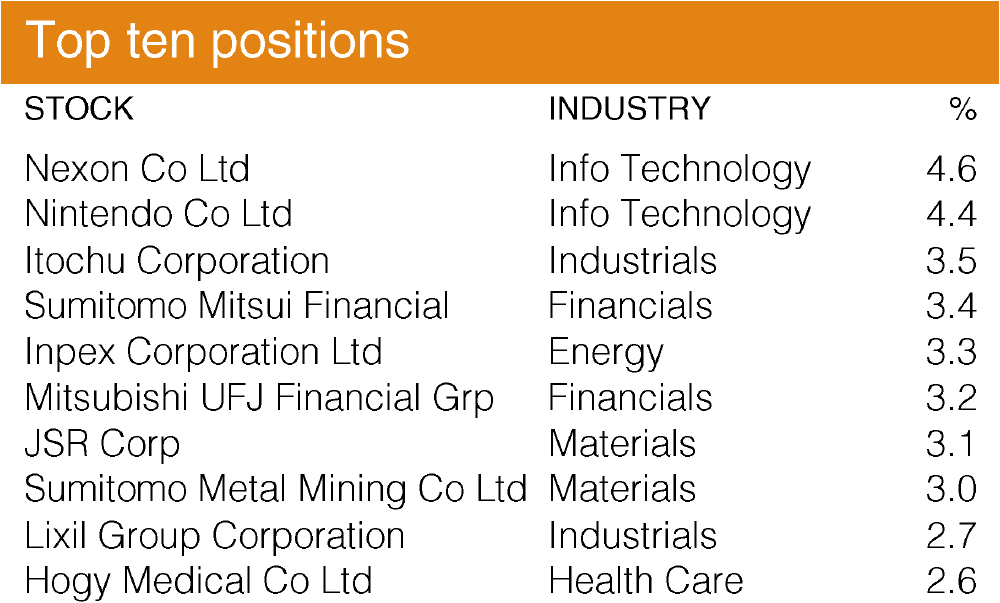
Moving on to specific holdings, despite the fund being overweight in some sectors relative to the index, the fund remains fairly diversified with no single investment exceeding 5% of the total fund value. Below we see the fund’s top 10 positions.
Source: Platinum Japan (ASX:PJF)
Looking at some individual positions we focus this report with a brief discussion of multinational consumer electronics and software giant Nintendo, which occupies the 2nd slot. The recent success of its Pokémon franchise as well as the launch of its new Switch console has attracted attention pushing up its share price and proving to be a solid pick in the fund.
Nintendo is enjoying a renaissance as the Switch console has sold well worldwide. Since launching in March 2017, the Switch console has sold 3,802,910 in domestic Japan sales alone and substantially outperforming PS4’s 1,143,542 in the same market over the same time period. Notably this factors in substantial shortages of the console with factories unable to keep up with demand.
At the global level, the latest tally only covers up to 31 December 2017 as per their filing and has already passed their annual (end March 2018) target of 14 million with 14.86 million in just 9 months of sales. Software has also exceeded management expectations with 52.57 million units sold.
In its first year on the market, the Switch was bolstered by The Legend of Zelda: Breath of the Wild, Super Mario Odyssey, Mario Kart 8 Deluxe, and Splatoon 2, which are some of the best-selling games of 2017.
Going forward, management has expressed a 20-million-unit target for FY2019 and to support this has confirmed an attractive game line up with titles such as: Super Smash Bros, Crash Bandicoot, Dark Souls Remastered Edition, Okami, Mario Tennis and the indie classic “Undertale”.
As of this writing, however, the Pokémon franchise has yet to release an RPG title on the Switch console but is currently making waves in the blogosphere.
This sort of behaviour normally precedes an announcement as evidenced by previous releases. The Pokémon franchise is not to be underestimated as it is the second bestselling franchise in gaming history having sold over 300 million software units at the end of 2017, and is pipped only by Mario with circa 529 million. Note that Mario precedes Pokémon by 15 years with its original release back in 1981.
Summary
Recent developments on the trade and geopolitical front are improving with President Donald Trump agreeing to negotiate on tariff terms and a possible summit this May with North Korea’s Kim Jong-un. Furthermore, Japan’s economy continues to strengthen as the resurgence in demand for its products and services provide more impetus, with GDP likely expanding for a 9th consecutive quarter.
The outlook for Japan is therefore strong, with the economy being driven by a combination of cyclical improvements in global demand, increased confidence in Japan’s place in the global manufacturing complex, surging inbound tourism, the upcoming 2020 Tokyo Olympics that will support consumer demand from tourists, and expansionary fiscal policy set to provide further growth.
Against this backdrop, we believe that the Japanese stock market is going to be one of the better performing stock markets this year.
Platinum Japan Fund (ASX:PJF) has been a strong performer for us to date since first being recommended, and with Japan’s economy set to improve even further, we upgrade our rating from Hold to Buy.
Disclosure: Interests associated with Fat Prophets declare a holding Platinum Japan (ASX:PJF).

