
Reaching for the cloud
The Australian-listed shares of Spark New Zealand (SPK:NZX, SPK:ASX) have drifted downwards over the past year and the reporting of the company’s interim results hasn’t changed that, with net profit experiencing a slight 3.4% decline from a year earlier, although the dividend was maintained. However, with the transformation plan having further to run, along with solid traction in mobile, digitisation and cloud offerings we remain positive on the investment case, with the dividend supportive.
1H18 highlights – Currency in NZ Dollars unless noted otherwise
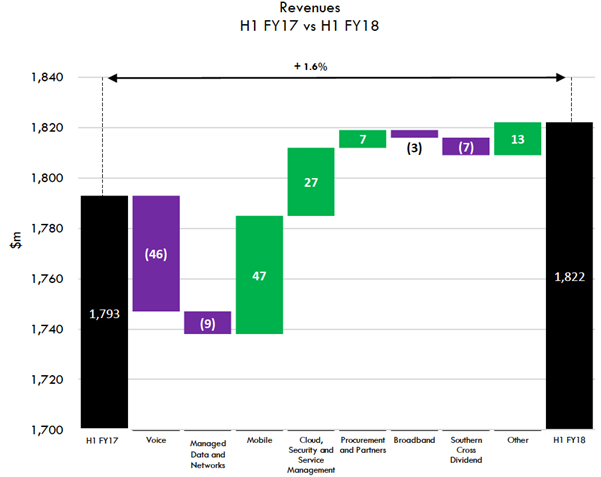
Total operating revenues ticked upwards, rising $29 million, or 1.6% year-on-year to $1.822 billion. The key drivers of growth were in Mobile and Cloud, security & service management services and growth associated with the acquisitions of Ubiquity and Digital Island, partially offset by declines in the legacy Voice business and Managed data & networks revenue. This was an extension of expected trends, as management has been migrating wholesale customers away from traditional products towards higher margin products.
Source: Spark (SPK:ASX)
Mobile, cloud, security and service management revenues accounted for 44.8% of total revenues, representing an increase of 5.3 percentage points over the past two years. Mobile revenue growth was driven by a 6.0% increase in high margin service revenues on the back of higher ARPU (average revenue per user) and connections, along with demand for premium services. Cloud, security and service management growth is being driven by demand for “as-a-service” products – an industry-wide trend.
There was an acceleration in the rate of decline across voice, managed data and networks due to adoption of ‘naked’ broadband plans, migration of customers from traditional managed data products to lower priced fibre alternatives and increased churn from wholesale and Spark PSTN offerings.
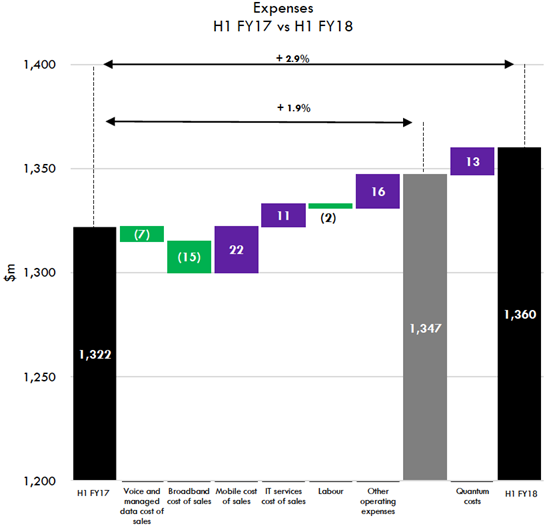
Operating expenses increased 2.9% year-on-year to $1.358 billion, with costs increases to support top line growth and the implementation of the Quantum programme ($13m) with associated non-recurring costs. Excluding the Quantum programme costs, operating expenses increased 1.9% from 1H17.
Voice, managed data and network costs declined $7 million, or 5.8% on ongoing reductions in voice connections. Broadband cost of sales fell $15 million, or 6.7% on a reduction in access costs due to the ongoing adoption of wireless broadband, partially offset by regulated increases in wholesale access charges for both fibre and copper.
Mobile costs increased $22 million, or 9.9% on higher demand for premium devices and adoption of value added services, partially offset by lower commissions following the ‘insourcing’ of Spark retail stores. IT services cost of sales increased 5.1% ($11m) along with the growth in higher margin cloud and security products revenues. Other expenses lifted $16 million, or 19.8% in support of key marketing campaigns and product launches.
Source: Spark (SPK:ASX)
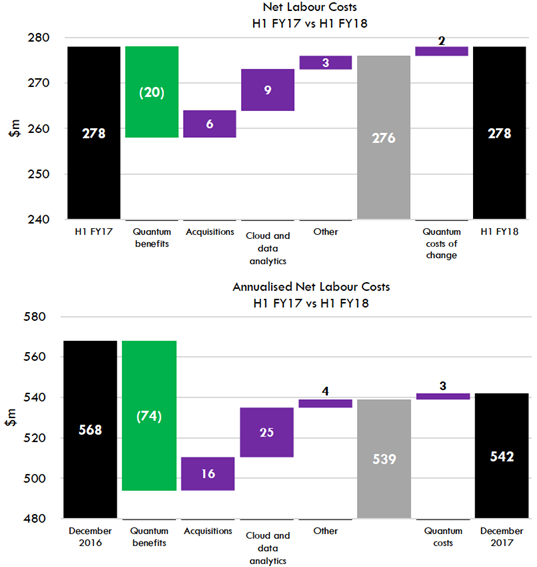
Labour costs were managed well, falling a marginal $2 million, supported by $20 million in gross benefits from the Quantum programme
offset by labour costs associated with supporting cloud and data analytics growth and acquisitions, including the insourcing of retail stores. The $74 million in annualised gross benefits of the Quantum programme are weighted towards the second half of FY18.
Source: Spark (SPK:ASX)
Reported EBITDA slipped 1.7% year-on-year to $463 million as the EBITDA margin contracted 0.9 percentage points to 25.4%. Excluding the $13 million associated with the Quantum programme, EBITDA would have increased $5 million year-on-year to $476 million.

Source: Spark (SPK:ASX)
Depreciation and amortisation, interest and tax expenses were relatively flat across the two periods so net earnings after tax fell $6 million, or 3.4% to $172 million. That was slightly below the consensus estimate. Earnings per share of 9.4 cents were down 3.1% from 1H17. Spark declared a 12.5 cents per share dividend, flat with a year ago. That was comprised of an ordinary dividend of 11.0 cents and special dividend of 1.5 cents, both to be 75% imputed.
Spark (SPK:ASX) bumped up its capital expenditure materially in 1H18, but this was partly due to timing of some of its key projects and full year spending is expected to remain within the 11%-12% target for FY18. Capital expenditure rose 17% year-on-year to $262 million in 1H18 and was 14.4% of operating revenue in the half year.
Looking at the key Home, Mobile and Business segment and operating revenue ticked up 1.5% to $1,034 million, driven by an 8.8% increase in mobile revenues and a 4.4% increase in ARPU. Operating expenses edged up 1.0% to $614 million. EBITDA increased 2.2% to $420 million as the EBITDA margin edged up 30 basis points to 40.6%. Spark’s Netflix-like offering, Lightbox, has reached 300,000 subscribers. We expect Spark’s differentiated offerings (Spotify premium and Lightbox) to be a key factor in winning and keeping market share from competitors Vodafone and 2degrees.
Spark Digital revenues increased 3.1% to $633 million, driven by strong growth in cloud, security and service management revenue. Operating expenses grew 4.1%. EBITDA edged up just 0.6% to $179 million, as the EBITDA margin compressed 70 basis points to 28.3%. We believe that there is significant growth in this space as management notes that most of the NZ market hasn’t utilised cloud services yet.
In terms of strategic priorities, for Spark these are wireless technologies, using its multi-brand strategy to better serve the growing price-sensitive part of the market and becoming the lowest cost operator through simplification, automation and digitisation.
Positively, total mobile ARPU returned to growth for the first time in two years, up 1.8% from the prior year. The launch of the unlimited mobile data plan encouraged pay-monthly customers to upgrade and the growth of the online-only Skinny Direct service helped improve prepaid ARPU by 7.0% year-on-year. The wireless broadband product is in 104,000 premises a little more than a year after launch and is delivering around $46 million of annualised gross reduction in broadband access costs. Spark is targeting 125,000 wireless customers by the end of the financial year. The 4.5G technology is now live in 30 locations improving network speed and capacity to meet exponential growth in data.
The migration from copper to fibre continues and the company has around 45% of broadband customers on the new technology, staying on track to be mostly ex-copper by 2020. That improves both the customer experience and reducing the cost to serve.
The Skinny brand is making traction serving price-sensitive customers and its net promoter score (NPS) is up 9 points from a year ago. The Skinny Direct customer base tripled year-on-year.
The Quantum Programme commenced in the second half of fiscal 2017 and has now delivered an annualised gross reduction in operating expenses of $74 million, with gross benefits tilted towards 2H18 and beyond. There will be further investment in the programme in 2H18 and FY19 to seek more service and cost improvements.
Outlook
At this juncture, Spark (SPK:ASX) has maintained its guidance for EBITDA to be flat to 2% higher year-on-year for FY18 excluding the net gain from the sale of Mayoral Drive carpark. The full year dividend guidance was also reaffirmed, at 25.0 cents.
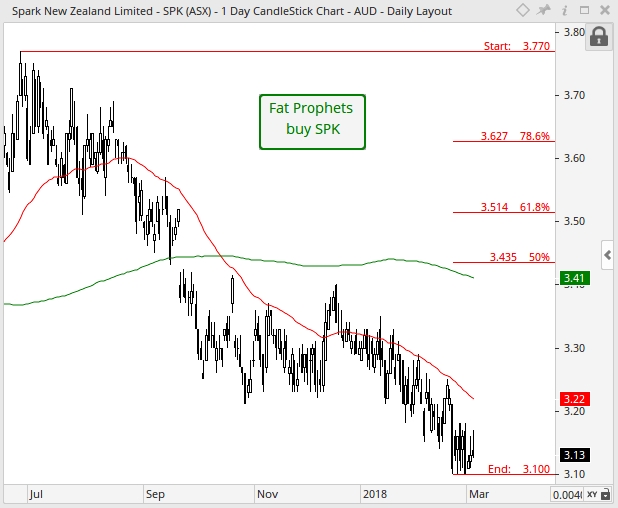
Turning to the daily chart, a zone of resistance is expected between the $3.41 and $3.44 region. This is made up of the 200-day moving average (green line) and the 50% Fibonacci retracement respectively. A sustained break above this price range would swing medium-term momentum north. If this scenario was to evolve, then the stage is set for further gains to unwind over the longer time horizon.
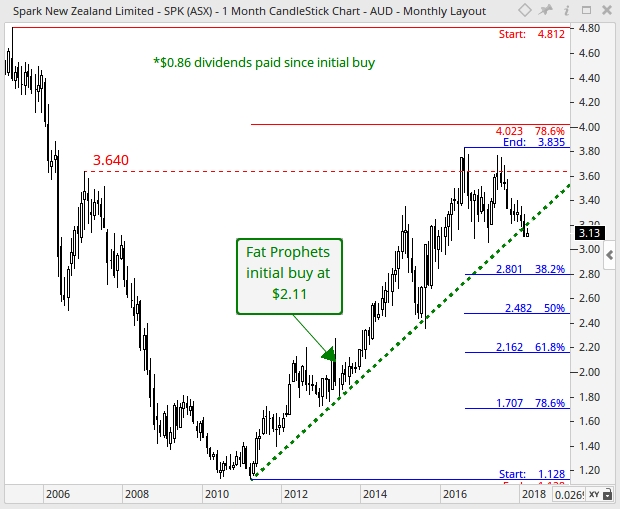
With reference to the monthly chart, the long-term uptrend line of $3.19 (upward sloping green dashed-line) was breached in February. For this reason, a continuation of the current correction towards the 38.2% Fibonacci retracement of $2.80 (blue set of retracements) could potentially be on the cards. For the long-term technical outlook to improve, prices need to reclaim or trade above the aforementioned uptrend line. Should this favourable scenario unfold, then this would increase the probability of an eventual challenge of resistance situated between $3.64 and $3.84. This is made up of the January 2007 (horizontal dashed-red line) and August 2016 high respectively.
Summary
Although investors were somewhat underwhelmed with Spark’s interim results there were plenty of bright spots and the company is delivering on its strategic initiatives. The company’s transformation plans have further to run in our view, with the benefits to earnings expected towards the back-end of the project.
Spark’s differentiated offerings in the Mobile and Broadband spaces support market share growth, as do its cloud offerings.
From a valuation perspective Spark (SPK:ASX) trades on a FY18 earnings multiple of 15.5 times and offers an appealing forecast dividend yield of 7.3%.
We retain our Buy rating on Spark New Zealand (SPK:NZX, SPK:ASX) for Members with no exposure, and with a medium to long-term investment horizon.
Disclosure: Spark New Zealand (SPK:NZX, SPK:ASX) is held in the Fat Prophets Global Opportunities, Australian Share Income, Concentrated Australian Share and Small/Mid-Cap Models.

