
Digitally charged
Australia’s largest newspaper publisher Fairfax Media (ASX:FXJ) reported half-year numbers last week with earnings impacted by impairment charges and restructuring costs related to the spinoff of Domain Group last November 2017. Nevertheless, the company is making good progress on the digital front in line with the secular trends where readers and advertisers are increasingly shifting to this medium.
The market responded warmly to the announcement with management also announcing an acceleration of the company’s cost out plan, with immediate action being taken in New Zealand, and the potential for further synergistic alliances in Australia.
First Half Results 2018
Starting from the headline numbers, Fairfax Media (ASX:FXJ) for the first half of 2018 (1H18) generated statutory revenues of $877.09 million, down by 3.9% year-on-year as the ongoing headwinds in the print media space continue to buffet performance. Adjusted revenues were 3.3% lower to $873.17 million.
The company though has also decided to close or sell off 28 NZ newspapers which will cut about 60 staff. This comes as no surprise as such trends have been developing since the rise of the internet and readers opt for cheaper online content, while advertisers increasingly on global internet platforms such as Facebook and Google.
We have also noted previously that there would be knock-on consequences of the New Zealand Competition’s decision to block a merger between Fairfax’s NZ arm and NZME. In doing so, the NZ regulator has failed to acknowledge the dramatic changes in the media landscape, and Fairfax has responded in kind.
On that note, we believe that the company is making good progress in the digital front as subscriptions to the Australian Metro mastheads, the Sydney Morning Herald, the Age and the Australian Financial Review, increased by circa 50,000 to more than 283,000 by the end of the 1H. Consequently, net paid digital subscriptions for the above recorded their strongest uplift in four years.
Elsewhere, steaming video service Stan (a JV with Nine) , also saw an 83% increase in subscription revenue, and now has an active subscriber base of 930,000.
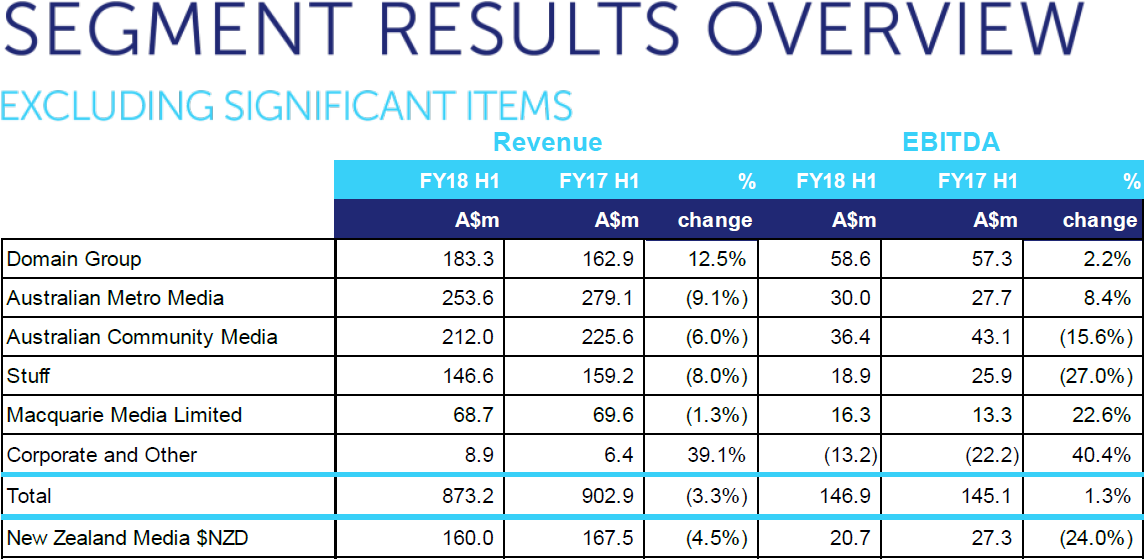
Fairfax Media’s various business performances are summarised in the graphic below:
Source: 21 February 2018 Company Presentation
Management’s ongoing focus for non-digital operations continues to be in cost reductions to improve profitability. Though still, the declines in print advertising revenues and circulation offset the impact.
On that note, the Australian Metro Media business reported lower advertising (-15% yoy) and circulation (-3.9%) revenues leading to total revenue declines of 9.1% year-on-year. Though cost rationalisations and replacing complex legacy systems with newer fit-for-purpose, agile, flexible and lower cost publishing technology has led to cost savings of 11.3% year-on-year improving EBITDA by 8% to $30.0 million. This has also improved EBITDA margins by 190 basis points to 11.8%.
The Australian Community Media business, with its more niche offerings, saw a harsher half-on-half performance with circulation down by a substantial 11.0% and advertising down by 9.2%. Though this was offset by solid performance in Fairfax Marketing Services (which delivers full digital marketing to regional clients) up 10.8% and Digital Revenues up 20% causing total revenues to only decline by 6%.
Cost improvement initiatives are still in the early stages as the company only recently closed down 6 Community titles and 1 specialty magazine which will be reflected in cost savings in the second half. Given that, we still saw expenses improvements of 6.6% to $151.4 million. Though the lower revenues still impacted EBITDA which fell 15.6% to $36.4 million.
On another significant note, CEO Greg Hywood also signalled that Fairfax would collaborate “with News Corp Australia to seek industry-wide efficiencies in printing and distribution.” He went on that “We will take advantage of opportunities arising from media consolidation as and when it occurs,” He added “We have progressed our recent positive discussions with News Corp Australia to seek industry-wide efficiencies in printing and distribution. We have had successful collaborations around shared trucking and printing titles for News in Queensland. Building on this collaboration, we have appointed advisers to pursue deeper strategic opportunities.”
This is also not surprising that the two competitors are working together further given the changes in the industry which are affecting both companies. This is also why we see value in the print side (along with the brand leverage into digital), where little is being ascribed by the market.
Next up is the Stuff business which is the company’s NZ focussed brand. The business is making solid progress in the digital front with revenues growing 32.8% year-on-year to $24.2 million as both Stuff Fibre and Neighbourly brands (which management remain committed to) reported continued improvements. These are summarised in the graphic below.
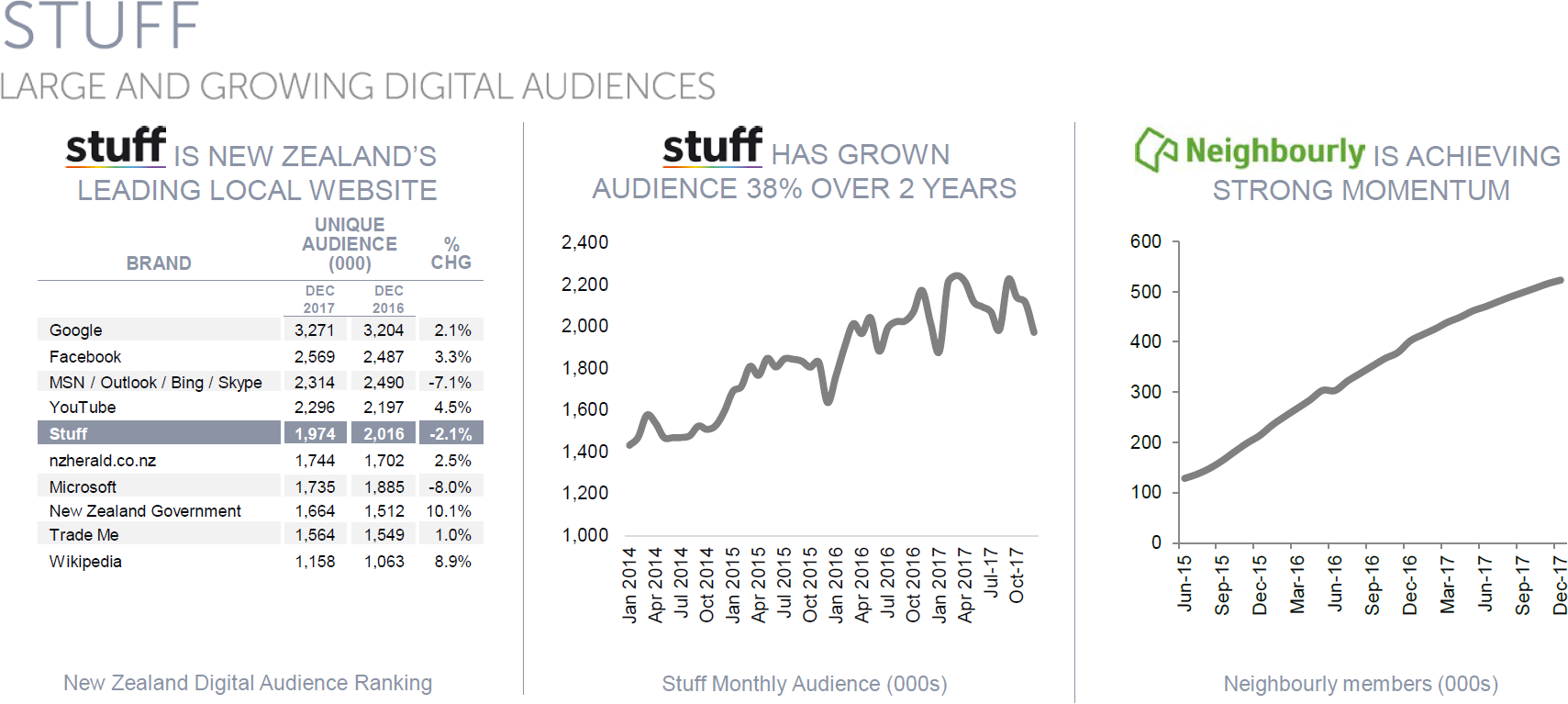
Source: 21 February 2018 Company Presentation
However, the legacy print business continues to suffer with advertising (-14.9% yoy) and circulation revenues declining offsetting the improvements. Total revenues likewise declined 4.6% year-on-year to $158.3 million.
This segment nevertheless continued to seek cost saving measures leading to underlying cost improvements of 5% year-on-year though EBITDA declined by 24% year-on-year to $20.7 million. This was as Fairfax had to recalculate a one-off estimated $3.6 million provision for the Holidays Act recalculation and additional investment in Stuff Fibre of $1.5 million.
Finally, we take a brief look at the Domain Group which is still 60% owned by Fairfax Media We covered the release of Domain’s interim numbers as its first standalone filing following the demerger in last week’s report.
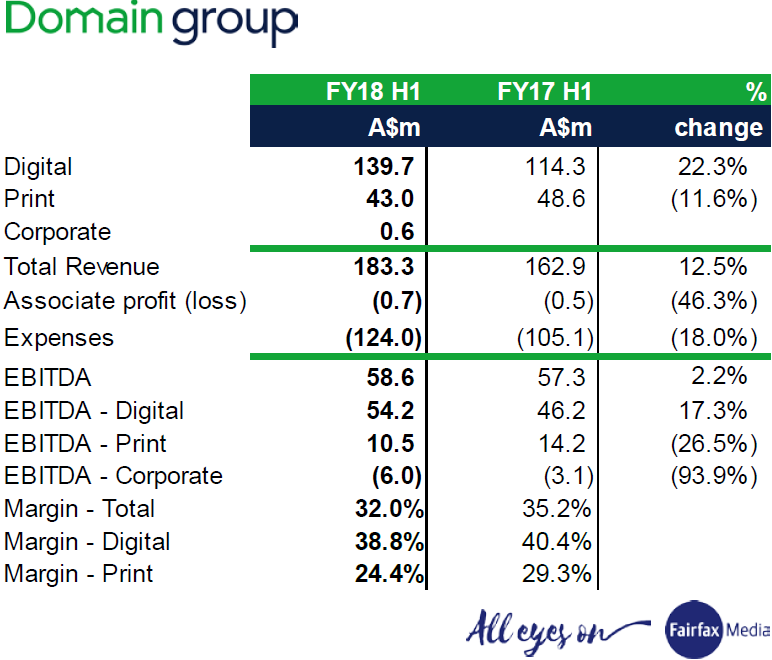
As noted, Domain continues to report strong core digital revenue growth from residential, developers & commercial customers with digital revenues up 22.3% while print revenues remained weak declining 11.6%. These are summarised in the graphic below.
Source: 21 February 2018 Company Presentation
Given that this business is still in its growth phase, expenses naturally are on the rise up 18% year-on-year due to higher digital expenses (+26%) from increased investments in staff, workspace and new transactions businesses but were offset by lower print expenses (-5%). EBITDA improved of 2.2% to $58.6 million as it includes separation costs and investments in early stage businesses Oneflare and Homepass.
Given Domain Group’s track record to date and the potential growth opportunities in the digital space (and despite the departure of CEO Anthony Catalano), we continue to view this business positively and also provided a separate BUY recommendation on the stock.
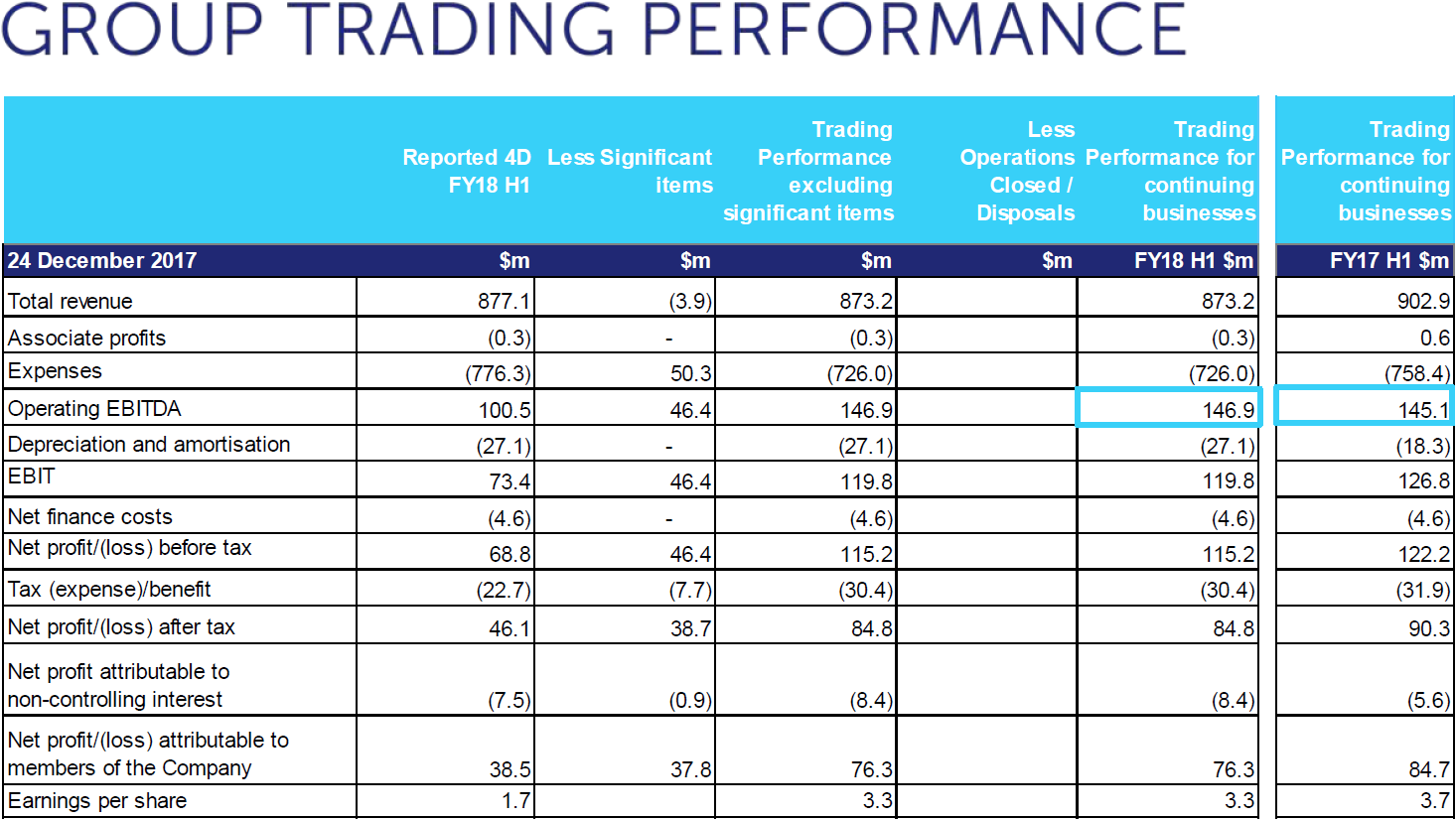
Moving on back to Fairfax’s group level performance, adjusted operating expenses improved 4.3% to $726 million following the company’s ongoing cost and efficiency focus, notwithstanding continued investment in growth initiatives at Domain and Stuff.
Source: 21 February 2018 Company Presentation
This led to underlying EBITDA of $146.9 million up 1.2% year-on-year though underlying EBIT was lower by 5.5% to $119.79 million. The company’s net profit of $76.3 million was down 9.9% year-on-year, with earnings per share of A3.3 cents. The profit drop was due to impairment charges and restructuring costs related to the spinoff of the Domain Group last November 2017.
Current Trading Environment & Outlook
The company also provided a trading update covering trading in the first seven weeks of 2H18 and revenues remained under pressure down circa 4%-5% year-on-year. According to management, Domain Group remains a strong performer with digital revenue growth up 21% and total revenue growth was 11%. Other publishing business were broadly in line with 1H18.
On the cost side, the group continues to implement cost savings measures while the Domain Group is expected to see costs rise around 17%-18% from FY17’s reported costs of $206 million.
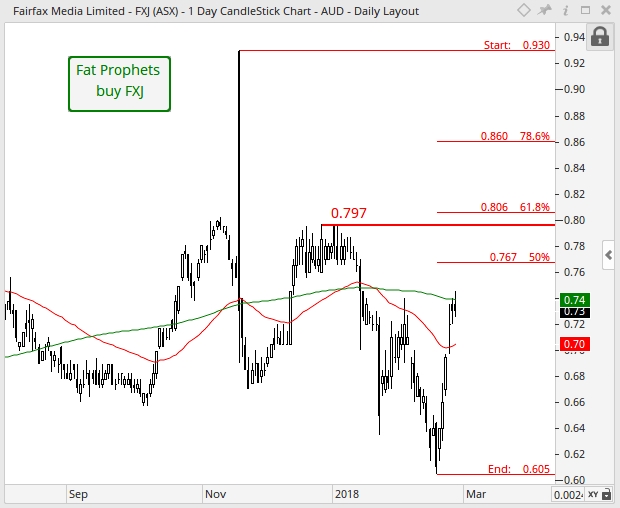
Turning to the charts, and with reference to the daily, prices are in flirtation-mode with overhead dynamic resistance evident at the 200-day moving average (green line) of $0.74. In order for the short-term technical outlook to improve, a sustained break above this indicator is required. Should this favourable scenario unfold, then medium-term momentum would once again shift in favour of the bull-camp. In-turn, an upward rotation in share price towards the next band of resistance sighted between $0.77 and $0.81 would likely be on the agenda. This is made up of the 50% and 61.8% Fibonacci retracement levels respectively, as represented by the red set of retracements.
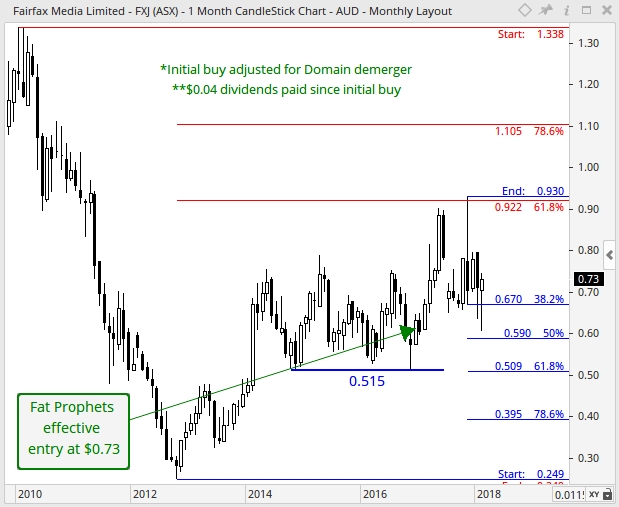
On the monthly chart, resistance was respected at the 61.8% Fibonacci retracement of $0.92 as represented by the red set of retracements in November 2017. This has led to a short-term correction to evolve, and should this continue, support is indicated at the 50% Fibonacci retracement of $0.59, followed by an additional layer sighted at the $0.50/$0.52 region. This is made up of structural support (horizontal solid-blue line) and the 61.8% Fibonacci retracement (blue set of retracements) respectively. In the grand scheme of things, the broader uptrend remains in play, despite the softness in price-action that has been apparent of late. For this reason, we would categorise the recent period of weakness as being healthy. Therefore, once this pause in trend is complete, we expect the longer-term bulls to reassert upward pressure, and thus steer the prevailing direction of Fairfax.
Summary
Australia’s largest newspaper publisher Fairfax Media (ASX:FXJ) recently reported half-year performance with profits taking a hit. Though at first glance we would think this is a consequence of prevailing headwinds in print media with declining revenues as readers and advertisers shift to digital however, most of the decline were due to impairment charges and restructuring costs related to the spinoff of the Domain Group last November 2017.
With Fairfax Media’s shares currently trading at 13.1 times FY18 earnings and 1.94 times book value with a prospective dividend yield of 3.8%, we remain favourably disposed to an investment in the company as the company’s publishing assets are still in good shape, with the company’s focus on digital publishing, cost and efficiencies, and new revenue opportunities helping them to remain profitable.
Accordingly, Fairfax Media (ASX:FXJ) will remain firmly held in the Fat Prophets portfolio, and for Members with no current exposure to the company’s shares, we recommend the stock as a High Conviction buy.
Disclosure: Fairfax (ASX:FXJ) is held in the Global Contrarian Fund (ASX: FPC), as well as the Fat Prophets Concentrated Australian and Small/Mid-cap managed account portfolios.

