
When Declining Ads and Audiences Collide
Broadcaster Prime Media (ASX:PRT) released interim numbers last Friday showcasing that it continues to face a structurally challenging market with declining audiences and tighter margins. Today, we take a closer look at those results and weigh in on the best move forward.
Recap
There have been numerous developments since our last coverage of Prime Media (FAT-AUS-823), including expectations of existing media rules being relaxed, and a strong FY17 result which saw Prime’s share price rally to a 52-week high in August.
That seemed short-lived, however, as management subsequently guided for a lower FY18 outlook (NPAT to fall 25-30% year on year) causing the share price to drift back down to the 0.28-0.30 levels. Sentiment has remained downbeat following the release of the company’s interim numbers last Friday.
1H18 Interim Results (ended 31 December 2017)
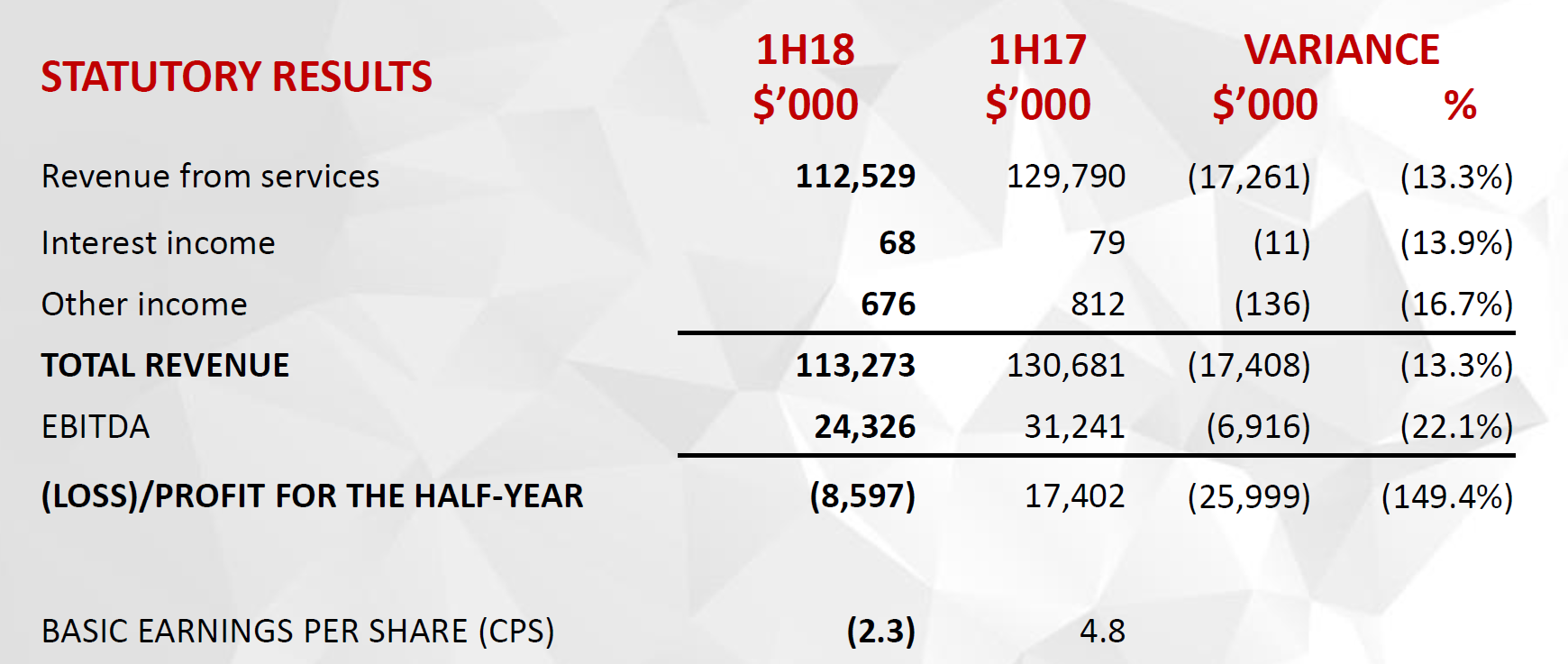
Starting from the headline numbers, for the first half of 2018 (1H18) Prime Media reported revenue of $113.27 million which was lower by circa $17.41 million or 13.3% compared to the previous corresponding period. Management noted that this difference was primarily the result of last year having a higher base due to it including the one-off advertising revenue arising from the 2016 Olympic Games television broadcasts. Looking at the data from 2 years ago (without the Olympic Games broadcast), the decline is 6.6%.
On the positive side, Prime Media (ASX:PRT) still maintains the lead in terms of market share as noted by CEO Ian Audsley stating that “during the reporting period Prime maintained an industry-leading national revenue share of 41.8% for the half year, albeit at a level less than the prior year” and that this estimate covers New South Wales and Victoria. Comparing this metric to last year, this is in fact lower by 290 basis points though we believe that last year’s Olympic Games had a significant draw in audiences.
Source: 19 February 2018 Company Presentation
Moving on, Prime Media’s gross profit margins improved in 1H18 by 130 basis points to 44.6%. A closer look shows that this was caused by the company’s new spectrum licensing framework which was implemented in 01 July 2017. However, the lower revenues still led to lower gross profits which fell 10.7% year-on-year to $50.52 million.
Going forward though, it seems that the operational conditions for the media sector are likely to become increasingly difficult, with margins set to tighten on the back of declining audiences and advertising revenues, versus increasing content costs.
As such we already see impact of this in operating expenses which increased 2.8% year-on-year to $30.93 million. Most of the increase (~66.7%) was due to higher broadcasting and transmission costs which went up $563k year-on-year, or 3.1%. This was then followed by higher administrative and marketing expenses of $7.12 million which increased 4.9% year-on-year.
The difficulties in the sector has also lead to management reporting a one-off non-cash impairment of television broadcast licences of $31.02 million to reflect the ongoing decline of regional free-to-air television advertising markets and increasing programming costs. Combined, this led to an operating loss of $11.43 million compared to last year’s $26.48 million profit.
However, adjusting of this one-off (and subsequent deferred tax liabilities), “core” earnings should amount to $14.01 million, though this is still lower (-21.1%) compared to last year’s adjusted core earnings of $17.75 million.
Management has also provided some commentary on this matter, noting that they will suspend dividend payments in the near term to focus any surplus funds to reduce interest bearing debt and strengthen the company’s financial position.
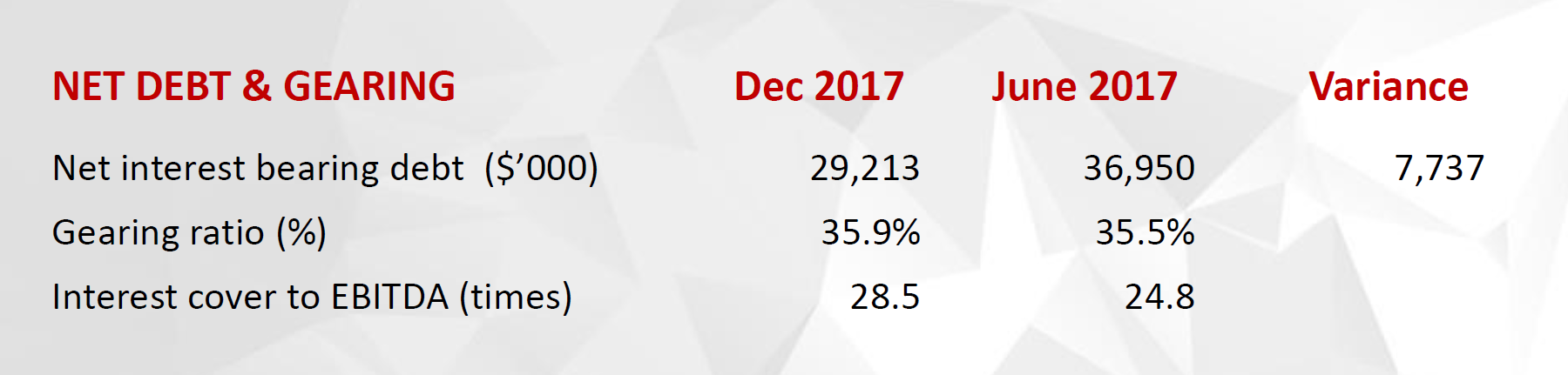
In fact, net interest-bearing debt this time around has been reduced by $7.74 million compared to June 2017, to $29.21 million at 31 December 2017. This reduction in debt led to finance costs improving (lower) by 38.5% year-on-year to $861k. The prudent levels of gearing, and high interest cover give us a strong degree of confidence about Prime’s financial stability, and ability to weather current headwinds.
Source: 19 February 2018 Company Presentation
Moving on back to operational results, the one-off impairment charge led to a tax benefit of $3.73 million for the interim period as it released a deferred tax liability of $9.31 million arising from the impairment charge. Factoring all of the above, Prime Media (ASX:PRT) reported a consolidated loss after tax attributable to the members of $8.597 million which represents a decrease of circa $26 million or 149.4% year-on-year.
Outlook 2018
Going forward, the outlook for the rest of FY2018 seems a tad bleak as CEO Ian Audsley notes that “the group’s full year result was [sic] likely to be between 25% and 30% below the prior year. The current trading conditions suggest that Prime will be at the bottom end of that guidance”.
These estimates even factor in key sporting broadcasts in the 2H, covering the Winter Olympics and the Commonwealth Games.
In our view, their estimates are likely influenced by the downbeat local retail sentiment which heavily impacts the local advertising market.
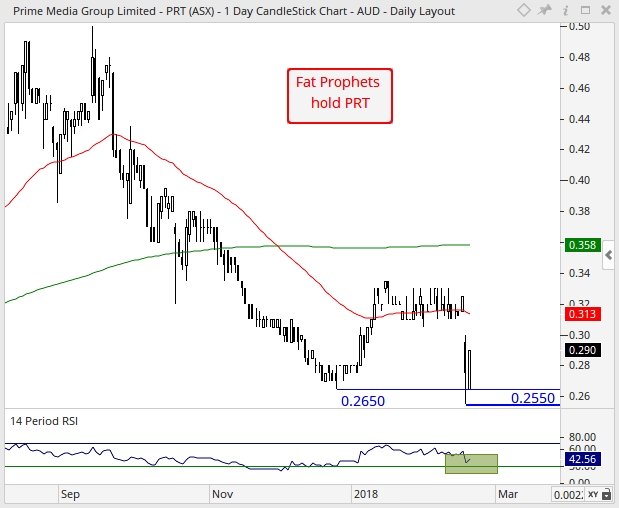
Turning to the charts, and on the daily, the bearish moving average crossover present since November 2017 is suggestive of momentum to favour the downside (where the 50-day moving average red line crosses below the 200-day moving average green line). Positively, the relative strength index (RSI) is within range of oversold territory, which is an indication of short-term downward momentum to be on the exhaustion trail. Overall, in order for upward momentum to step up a notch, a sustained break above the 200-day moving average (green line) of $0.36 as dynamic resistance is required. Should this favourable scenario unfold, then this would greatly improve the short-term technical landscape.
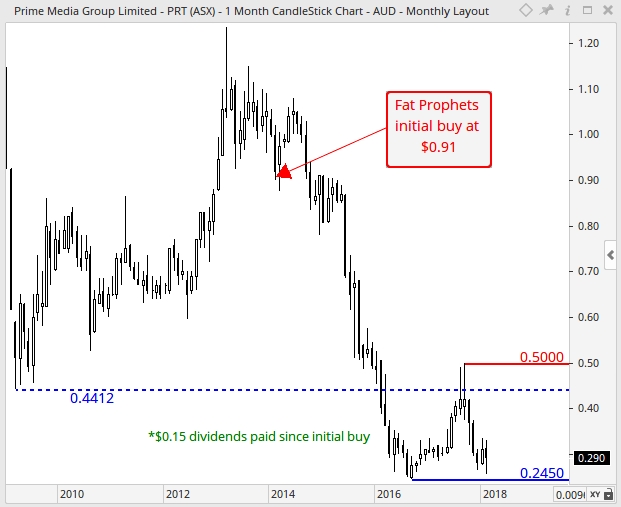
With reference to the monthly chart, the long-term downtrend remains largely at play. In order for the broader technical outlook to strengthen, a decisive break above overhead resistance located at the September 2017 high of $0.50 (as shown by the horizontal red line) is required. Should this occur, then momentum would be confirmed to have rotated upwards. This in-turn, could very well be the precursor to further gains over the longer-term horizon.
Summary
On a valuation front, Prime Media (ASX:PRT) shares are trading at a Forecasted FY18 Price/Earnings ratio of 4 times. This would imply a high level of market fear over Prime’s financial position and operating outlook. Given a high degree of interest cover, and falling debt, we do not believe that such a low valuation is completely warranted. We will continue to monitor developments going forward with an expected trading update to be provided in April 2018.
In the meantime, Prime Media (ASX:PRT) will remain held in the Fat Prophets portfolio.

