
Climbing the wall of worry
Westpac shares have been trending in an upward trajectory year-to-date, staging a recovery from its decline in the fourth quarter of 2021. Investors were relatively encouraged by the bank’s first quarter update and the growing probability of a rate tightening cycle from the Reserve Bank of Australia in the second half of calendar 2022 has added support. In New Zealand, where Westpac has a significant business, the Reserve Bank of New Zealand is already well down the path of rate tightening, with likely many more rate hikes to come over the remainder of the year. These developments should help alleviate some of the margin pressure for Westpac and its peers, though we still expect a contraction of some degree in 2022.
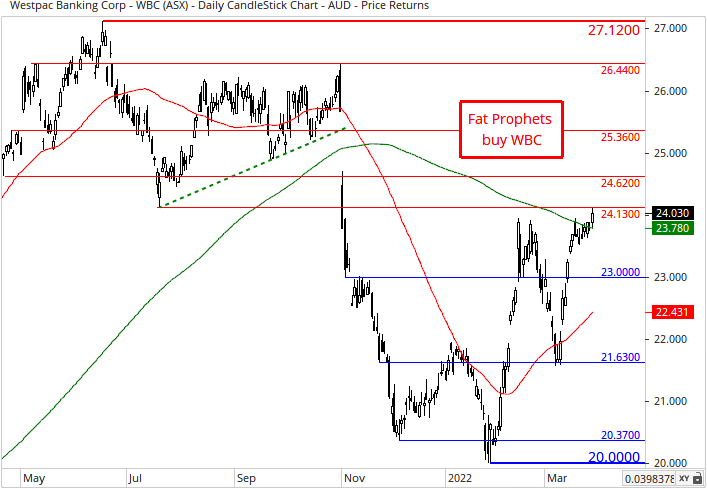
There have already been positive developments for Westpac and peers in a slight steepening of the yield, curve which will reverse headwinds to tailwinds going forward should the pattern continue.
Westpac management had a positive outlook on the Australian economy when it released its quarterly results back in early February (the first of the big banks to do so), saying lending stress on borrowers was lower than pre-pandemic. Naturally, the stress on borrowers will differ widely, with those more recently stepping onto the mortgage ladder at inflated prices and with huge mortgages the more vulnerable to being squeezed as inflation climbs and mortgage rate hikes to come are imposed. Overall, though, some significant financial buffers were accumulated over the course of the pandemic, stress on Westpac and peers mortgage books is from a low base and capital positions are strong.
Westpac continues to make progress with its cost-out initiatives and reaffirmed its $8 billion expenses target by FY24. Westpac shares lagged the banking sector in 2021 due to several problematic issues but we see the stock playing some catch up this year as progress is made on costs and other issues like AUSTRAC violations from 2020 fade. The common equity tier 1 (CET1) ratio was strong at 12.20% at the end of December 2021, little changed from the 12.32% at the end of September. The current off-market share buy-back ($3.5 billion) was estimated to reduce the CET1 by 79 basis points when it was announced as completed in mid-February. Approximately 167.5 million Westpac shares were repurchased, representing 4.6% of issued capital.

Source: Westpac
Westpac’s 1Q22 update reported an unaudited statutory net profit of $1.815 billion for the December 2021 quarter, up 80% on the quarterly average for 2H21, which will be the basis for the key metrics discussed below and mostly excluding notable items. The more closely followed cash earnings were up 74% to $1.58 billion but excluding notable items were flattish with a marginal 1% increase. Nonetheless, that topped market expectations due to higher revenue than expected and the cost cutting undertaken.
Over the quarter, total loans inched up 0.7% with growth across Australian mortgages, lending to institutions, and in New Zealand. This was partly offset by a reduction in loans from the sale of the wholesale vehicle dealer book and the appreciation of the Australian dollar versus the New Zealand dollar. A 5% in average interest earning assets was supported by growth in gross loans and liquid assets (to support the rundown in the Committed Liquidity Facility). Net-interest income increased 2% to $4,182 million.
Non-interest income was down 6% to $929 million, mostly due to the sale of the General Insurance and Lenders Mortgage Insurance businesses in 2021. That was partly offset by a higher contribution from banking, and the financial markets business. Total operating income (revenue) was effectively flat against the 2H21 quarterly average. There is no question though that Westpac’s momentum is lagging CBA and NAB by a significant margin and there is a lot of improvement that can be made down the track.
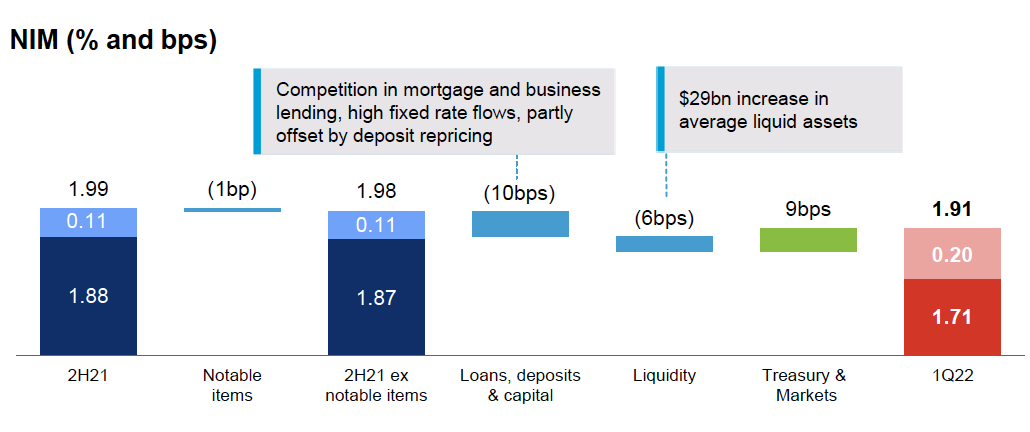
Net interest margin (NIM) contracted 8 basis points to 1.91% on the tough competition in the mortgage market (with more loans being made at fixed rates, lower margin for the banks) and business lending and a significant increase in average liquid assets – the latter should largely be complete by the end of the quarter and we expect pressure to ease in the second half but an expansion is not likely to be on the cards until FY23.
Source: Westpac
Expenses, excluding notable items were down a substantial 7%, or $191 million to $2.66 billion as the bank reduced headcount by more than 1,100 despite further investment in ongoing programs to improve risk management. Westpac has pledged to cut annual costs to $8 billion by FY24, which won’t be an easy task and one the market is discounting currently.

Source: Westpac
Meanwhile, asset quality improved on most credit metrics, with stressed assets as a proportion of total committed exposures (TCE) down 21 basis points to 1.15% and mortgage delinquencies falling. Still, Westpac took the cautious route and increased provisions by $551 contributing to an overall impairment charge of $118 million for 1Q22.

Summary
After being unhappy with Westpac’s FY21 results, with a return to higher dividends and a $3.5 billion share buyback overshadowed by a sharp contraction in NIM in the second half and elevated expenses, the bar was lowered. This can be seen in the more positive reaction to the 1Q22 update, where NIM was still under considerable pressure but the shares have since re-rated upwards as the results exceeded muted expectations.
The capital position is strong, with plenty of surplus franking credits and we see a steepening yield curve ahead with this set to benefit Westpac’s solid retail franchise. Credit growth demand should be robust and credit quality remains benign. We see more scope for increased capital returns on the horizon over the next year or so. We expect the discount to other banks to narrow with even modest improvement to come from key metrics.
We recommend Westpac shares as a buy to Members without exposure.
Disclosure: Interests associated with Fat Prophets hold shares in Westpac.

