
When the market gives
Bank of Queensland (ASX:BOQ) shares have corrected materially over the past six weeks or so with this driven by several factors, being a mixture of stock-specific and sector pressure. The ME Bank acquisition was well-timed in our view and undertaken at an attractive price, with a strategic appeal. We remain positive on the medium-term outlook and view this weakness as a buying opportunity.
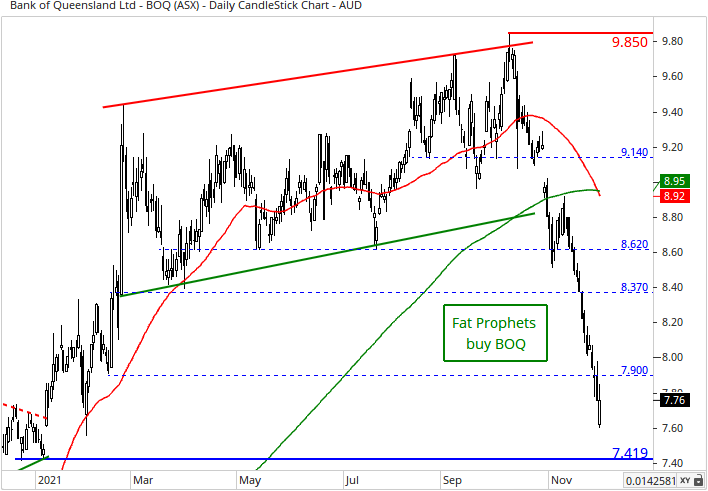
We believe several factors are behind the recent correction in Bank of Queensland (ASX:BOQ) shares. Despite delivering a solid FY21 result in October, the shares fell as traders fretted about management guiding towards net interest margin (NIM) falling by 5 to 7 basis points in FY22 due to the inclusion of ME Bank for a full 12 months in 2022. More generally the banking sector has faced NIM pressure – depending on some individual characteristics for the different banks – due to the persistent ultra-low interest rate environment, intensifying price competition in the home loans market, some switching to lower margin fixed-rate loans and higher levels of liquid asset balances.
We expect FY22 to be the nadir for NIM for Bank of Queensland and it, along with peers, will benefit from steepening yield curves over time. We see it as only a matter of time for inflation and how much more materially we will see it flow through.
There was likely some profit-taking for Bank of Queensland (ASX:BOQ), and peers, as well given a strong performance leading up to mid-October and we note the payment of its final dividend. For Bank of Queensland’s case, there is likely some jitters about the integration of ME Bank, given the size of the acquisition. While there are always risks to these transactions, we are content to give CEO George Frazis the benefit of the doubt given his track record and experience. Early updates on the integration have been encouraging.
As noted in prior coverage, we view the acquisition favourably as it should generate material synergies as well as provide BOQ with greater geographical diversity outside of Queensland. BOQ expects annualised pre-tax synergies of between $70 million to $80 million from ME Bank and for it to bolster cash EPS in the low double-digit to mid-teens accretive.
The combined group broadly doubles the retail bank, while also increasing exposure to business customers, making it more leveraged to higher demand for loans as Australia’s reopening gathers traction. The combined entity should generate meaningful earnings growth going forward, along with higher dividends that translate to a very appealing future dividend yield at current share price levels.
Loss provision releases have scope to grow, with Bank of Queensland (ASX:BOQ) having (understandably) been conservative in this early stage of its transition. We see scope for market share gains for the core as the digitalisation continues, along with new initiatives and returning ME Bank to system growth levels by the end of FY22. For the current year, expenses are anticipated to grow about 3% on an underlying basis, but the bank is still forecasting ‘jaws’ (income growing faster than expenses) of at least 2%.
Recap of FY21 headline numbers
Net interest income rose 14%, to $1,128 million, helped by the acquisition of ME Bank. Excluding ME Bank (on the books for a couple of months during FY21), net interest income still rose an impressive 6%, to $1,050 million, driven by housing loans growing faster than system, at 1.7x. Net interest margin (NIM) rose slightly, by 1 basis point, to 1.92% due to the lower NIM of ME Bank. If ME Bank is excluded, then NIM rose 4 basis points to 1.95% as generally lower funding costs and deposit mix partially offset competition and the impact of low interest rates.
Non-interest income increased 2%, to $130 million, due to the 2-month contribution from ME Bank, which offset lower insurance and trading income. Total income was up 13%, to $1,258 million or 5%, to $1,175 million excluding the contribution from ME Bank.
Operating expenses were impacted by the acquisition of ME Bank, rising 12% to $684 million. Technology projects including the new Digital Bank and higher business volumes were the main culprits. Underlying expenses were up a more modest 1.5%. The bank released provisions in this result, resulting in $21 million in provision “income” during the period. Credit quality trends were positive.
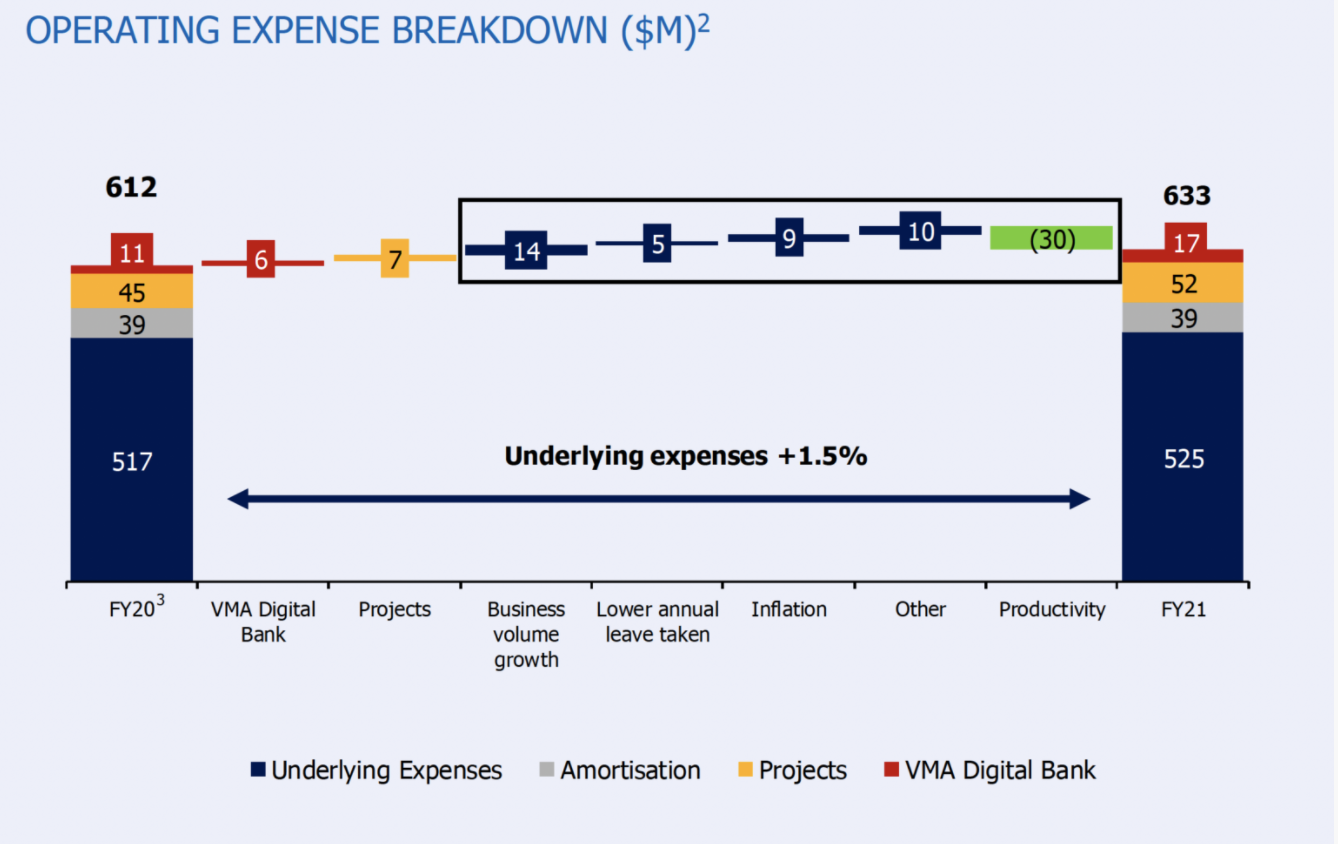
Source: Bank of Queensland (ASX:BOQ)
Overall, cash earnings after tax rose 83% to $412 million, with cash earnings per share of 74.7 cents, up 51% due to the new shares issued to acquire ME Bank. The return on average tangible equity increased by 3.3 percentage points to 10.2%.
Bank of Queensland’s common equity tier one (CET1) ratio of 9.8% remained above its target range of 9.0-9.5%. The bank declared a final dividend of 22 cents per share, for a total of 39 cents in dividends in 2021.
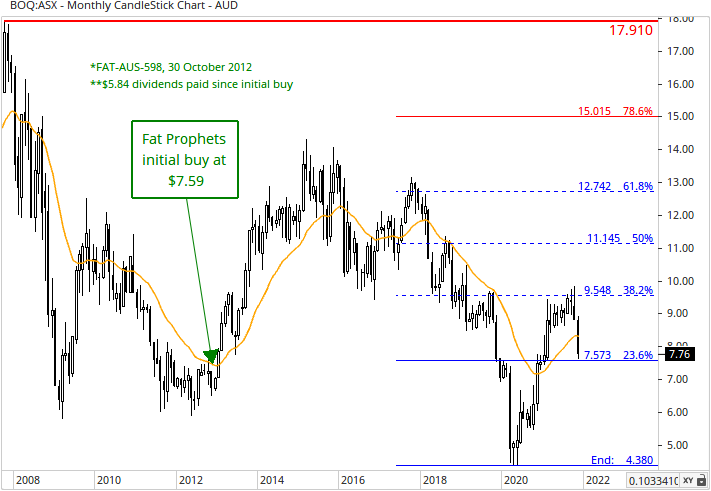
Summary
We view the recent weakness in BOQ shares as an opportunity for patient investors. The FY21 results were solid and although the shares were pressured by guidance on NIM, we see FY22 as likely the nadir for the metric. Its increased scale and journey along the transformation path should see it a strong beneficiary as the Australian economic reopening gathers traction.
In addition to the material synergies from the ME Bank acquisition, there is also likely to be further provision releases as the Australian economy rebounds. Over the longer term, rises in interest rates will likely flow through to increased margins and net interest income.
We recommend Bank of Queensland (ASX:BOQ) shares as a Buy for Members without exposure.
Disclosure: Interests associated with Fat Prophets declare a holding in Bank of Queensland (ASX:BOQ).

