
A critical but competitive industry
Shares of the key listed Australian Telco’s have been a mixed bag over the past year. The Covid-19 pandemic, both in Australia and overseas, saw traffic on networks surge as people adapted to working and studying from home, used networks to download and view news and entertainment content, ordered goods online and connected with family and friends remotely amid social distancing restrictions.
This helped the industry weather the pandemic better than many, although there were certainly some headwinds. Telstra for example saw high-margin roaming revenue evaporate and the broader sector saw already intense competition intensify as they competed for customers at a time when many had understandable concerns about their finances. The Telco’s rolled out some support measures which would have crimped margins but helped build a little customer loyalty in some instances.
Nonetheless, the industry continues to face structural challenges with competition in mobile remaining cut-throat and data expectations from customers having risen (unlimited mobile plans are now popular) to consume vast amounts of data from the likes of video streaming and downloading and playing video games online. It is understandable then that the key industry players are increasingly wanting so-called OTT (over-the-top) providers like Netflix to sharing the wealth being created. There does not seem to be any consensus yet though on how this could be achieved, with the Telco’s bearing the cost of the commodisation of data.
5G is a huge opportunity for the industry but comes at a large upfront cost with billions in capital expenditure to build out the networks, with new equipment (and Huawei in the doghouse), the backhaul of fibre and spectrum costs, with a couple of spectrum auctions on the calendar this year. Australians have been early adopters of 5G though, boding well for those Telco’s that play their hand well. This is as after upfront costs, 5G networks should have lower cost per byte delivered and there will be new business opportunities utilising the technology arise.
5G-capable handsets have become more common and are available at a wider range of price points, helping boost migration to the new technology. Apple’s 5G-capable iPhone 12 models are reportedly seeing strong uptake globally. In Australia, 5G connections are expected to grow to around 50-60% of total connections by 2025. Total mobile connections are only anticipated to grow slightly as Covid-19 has interrupted migration and market penetration is already high.
Over the medium-term, 5G should unlock substantial new monetisation opportunities and customers are generally willing to pay more for new levels of service (Telstra introduced a surcharge) and 5G promises to bring exciting new ways for companies to differentiate their products and services. As the new ‘G’ is progressively rolled out we expect it to help on the ARPU (average revenue per user) front.
While some opportunities are still further on the horizon in our view (i.e. commercialised autonomous vehicles), others are here now or just around the corner. Gaming is one example and pure cloud gaming isn’t far away from being as good as other offers, so one can start a game at home (good for broadband sales) and then play on the commute using 5G. There are many other 5G vertical application opportunities in AR/VR, healthcare, smart factories/cities, IoT (Internet of Things), M2M (machine-to-machine) and consumer devices to name a few. The pandemic has driven home the necessity of a digital presence for businesses.
Turning to the Australian players under our coverage briefly and Vocus Group (VOC) has been the strongest performer over the past year and handily outperformed the ASX200 (AXJO), with a near 30% gain.
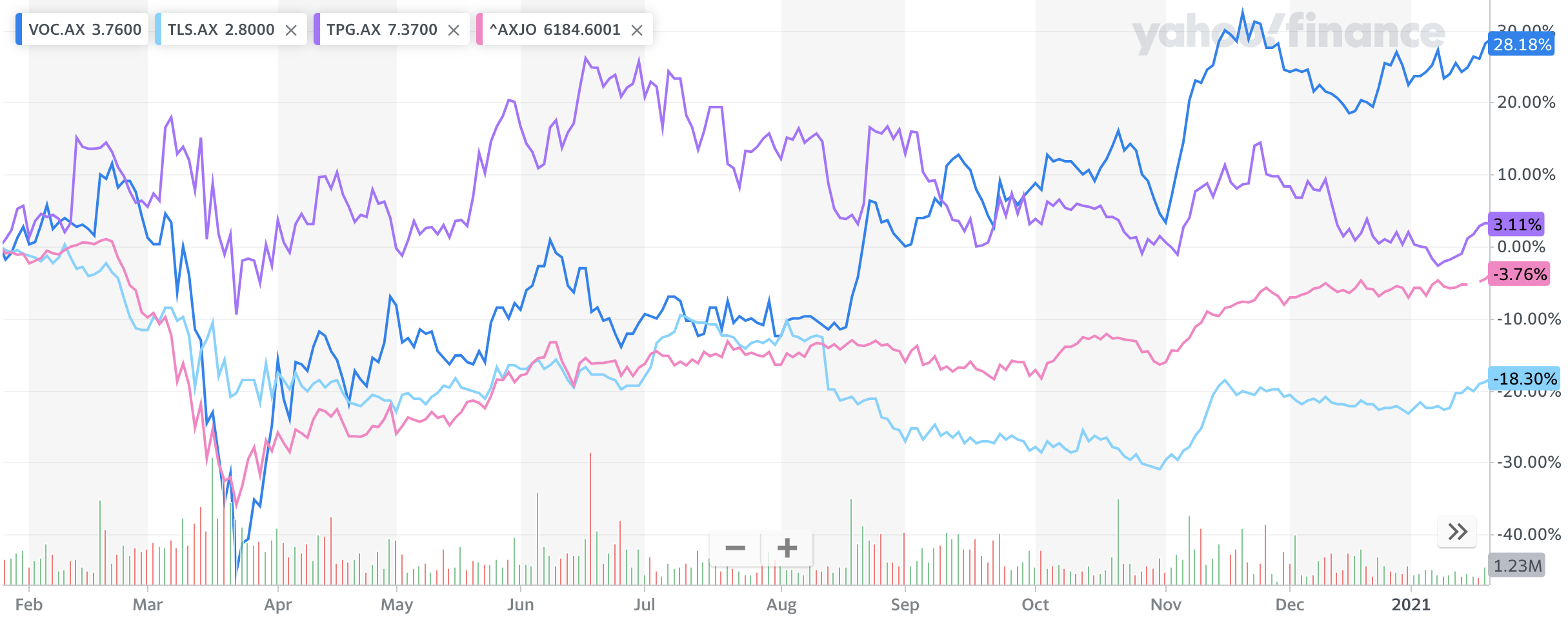
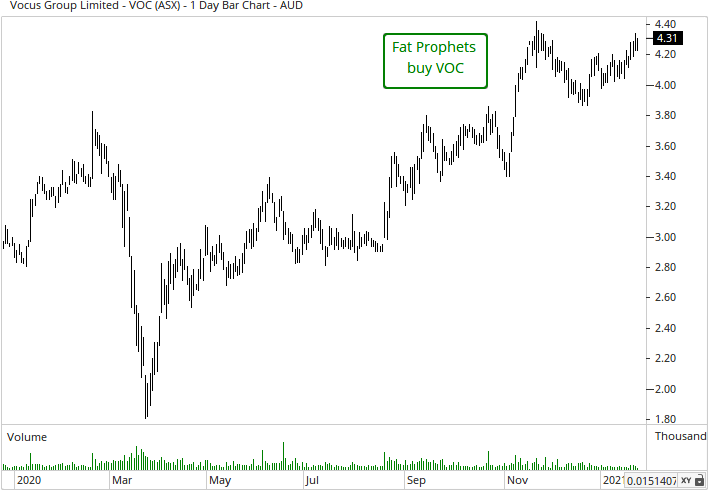
The turnaround at the company has made good progress over the past few years, and recent operational and financial updates have been positive overall, leading to the upward re-rating of the shares.
The executive team has been rightsized and an update in the final quarter of 2020 noted a solid start to fiscal 2021 across its three key divisions. There was growth across revenue, margin, and EBITDA in Vocus Network Services (VNS). The division has been winning business and management referred to a strong pipeline of opportunities.
As we noted in prior coverage, the Retail business is steadily improving with management reporting the Consumer segment is on track to return to growth before the end of FY21 and cash collections have been strong. Bundling of energy, broadband, and mobile for customers has saw decent uptake.
In the New Zealand segment, the Stuff Fibre acquisition was fully integrated ahead of plan and Vocus announced in November it had appointed financial advisers (Goldman, Jarden and Craigs) to pursue an Initial Public Offering (IPO) of Vocus New Zealand. The IPO is expected to be undertaken before the end of FY21, subject to prevailing market conditions. Further details are due when the company reports half year results next month. The Board believes that a successful IPO of Vocus New Zealand would provide greater flexibility in the balance sheet and free up capital for Vocus to bolster the VNS business. It is a solid business that should attract significant interest in the current ultra-low interest rate environment, especially given a track record of organic growth.
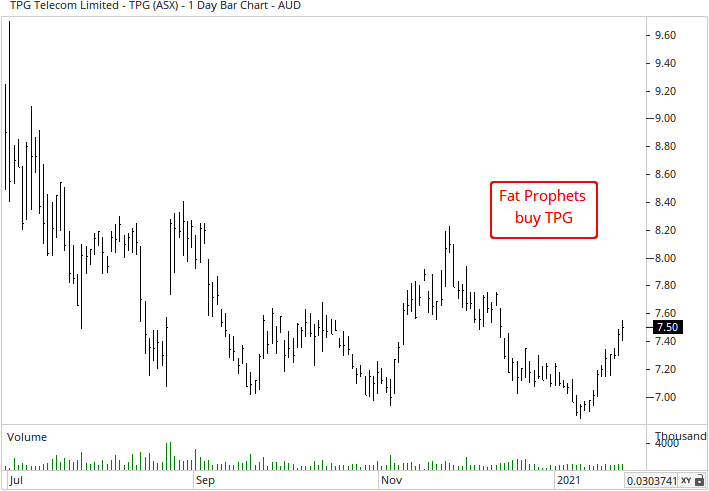
TPG Telecom has drifted sideways over the past year and there have been no major announcements from the company in recent months. We noted in coverage last September that TPG Telecom that the mega-merger with Vodafone Hutchinson Australia was a long time coming but has the scope for significant synergies and scale benefits.
Combined TPG and Vodafone have been gaining market share in the NBN market and with expanded spectrum offerings can begin marketing new products to customers as well.
A 5G rollout was a key element to the merger and one that required a combination of the two companies to gather traction. The company noted that more than 1,200 sites are currently in planning across the major cities and a standalone network capability is being developed, with a goal of 85% population coverage across the biggest 6 cities by the end of 2021.
We believe that the investment case was bolstered by the ‘merger of equals.’ TPG’s previous growth plans will be accelerated, as it leverages Vodafone’s existing infrastructure. The transaction has combined Australia’s No.2 Broadband Player and the No.3 Mobile Operator. There are plenty of synergy cross-selling opportunities available and we expect to hear more detailed progress on this in the next financial report.
TPG Telecom’s first half results were somewhat ‘messy’ after the merger with some significant headwinds and many moving parts. We expect to begin to see synergies more meaningfully flowing through going forward, as the two companies tighten their integration.
We believe that the investment case for TPG has been de-risked by the ‘merger of equals.’ Particularly as TPG’s previous growth plans will be accelerated, as it leverages Vodafone’s existing infrastructure. ‘Cleaner’ results going forward will be appreciated and help analysts build models, improving the market understanding of the combined business.
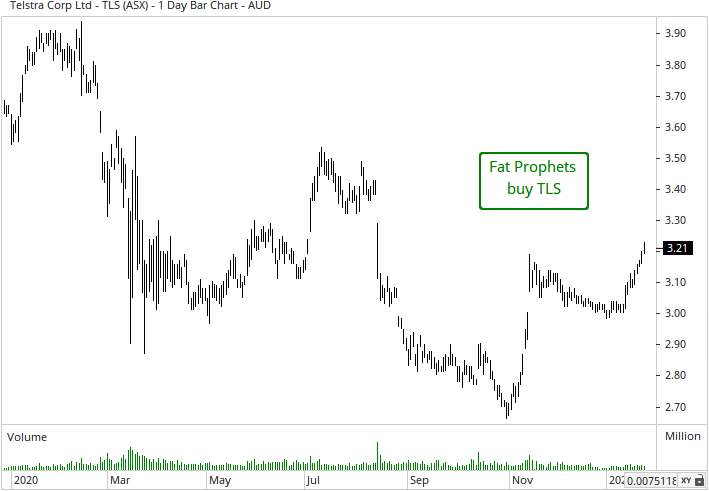
Finally, Telstra’s share price performance has recently been lacklustre, with the earnings hole from the NBN rollout and intense ARPU pressure in mobile crimping earnings. However, we believe low expectations can be exceeded going forward, supporting a re-rating. Telstra’s scale bode well for continued leadership as it rolls out 5G and we expect a gradual improvement in earnings power for the mobile business on more rational behaviour in the industry. Telstra has considerable scope to monetise its infrastructure business and cash flows should continue to be strong, defending the dividend, which remains attractive (FY21; 4.8%) in this environment. Telstra will also continue to push ahead with taking costs out of the business, a necessity for the telco giant.
Telstra struck a deal with Uniti Group last December, with the latter company acquiring Telstra Velocity, a fibre-to-the-premises (FTTP) network for total consideration of $140 million, which included an upfront payment of $85 million. This was clearly non-core for Telstra and a continuation of a strategy earlier outlined by Telstra.
At the Investor Day last November, Telstra announced it was advanced in its plans to split its Infrastructure business into three, dubbed InfraCo Towers, InfraCo Fixed and ServeCo. Tower assets have been highly valued by investors around the world and the InfraCo business will own over 5,500 mobile towers. Comparable companies in Europe and America trade at over 20 times EBITDA. With an estimated $200 million in EBITDA for the business, we believe there is upward optionality from a transaction related to these assets.
InfraCo Fixed will own and operate assets like fibre, subsea cables, ducts, data centres and exchanges. The ServeCo business will house all the other ‘active’ parts of Telstra’s network not fitting in the other businesses, including spectrum. Strong group free cash flow helps reduce risk on the dividend front, even if EBITDA is falling short in the near-term.
Shares of the key listed Australian Telco’s have been a mixed bag over the past year and we view current valuations as appealing for patient investors. We have buy ratings on Telstra, TPG Telecom and Vocus.
Disclosure: Interests associated with Fat Prophets hold shares in Vocus, Telstra and TPG Telecom

