
Rise of the Populists: A Fragile Union
European stocks as represented by the STOXX Europe 600 snapped a losing streak Monday as Angela Merkel party got the support required to form a coalition. That was partially offset by the General Elections in Italy which indicate a hung (divided) parliament with the leading rival parties reeking of strong anti-EU sentiment. Ultimately though, we maintain a positive view for the Eurozone given its strong economic momentum and as such we maintain our BUY recommendation on the Platinum Europe Fund (PLA001AU).
In our previous coverage (FAT-AUS-844), we noted that the region has been plagued with political headwinds from Catalonia looking to secede while Germany was hit with a disunited government.
Recent developments in Germany show that some positives have developed as the political stalemate of over five months has ended with the result of the Social Democrat referendum announced Sunday, showing that two-thirds or 239,604 members voted in favour of a new alliance with the centre-right. This implies that Chancellor Angela Merkel is set for a fourth term by Mid-March. Still, they’re not out of the woods yet as they have to face looming challenges from: the EU budget talks, immigration and refugee issues, the Brexit, and French reforms for the EU.
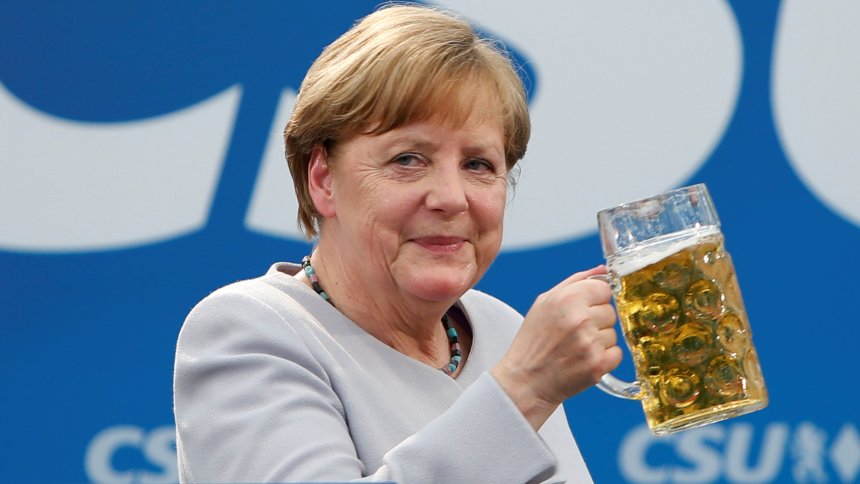
Image Credit: Reuters
It seems that the populism wave has hit Europe’s 4th largest economy with the latest estimates in the polls indicating a hung parliament with no clear majority. As of the latest tally (0900 GMT) out of 315 seats, the Senate is led by the 5-Star Movement under the young 31-year old Mr Luigi Di Maio (picture below right) with 36.5% followed by the radical right-wing League party with 17.8% of the seats.
In third place is the Forza Italia led by four-time Prime Minister (PM) Silvio Berlusconi (below middle) covering 16.8% of the seats. Fourth spot was the Democratic Party with 15.9% of the seats under the leadership of another former PM Matteo Renzi, pictured below left. The remained are spread out to neo-fascist Brothers of Italy at 6.3%, Left: Free and Equal at 2.5% and other smaller parties (2.3%).

Image Credit: The Guardian, Cristiano Minichiello, Maria Laura Antonelli
As of this writing, it’s not entirely clear which party will take control of Italy, but it is evident that Italians have deserted the centre with over 50% of the votes in support of populist parties and a dominant centre-right thrust as the centre-left combined holds less than 20% of the vote.
Italy’s electoral system is rather complicated as parties must clear a 3% threshold to win seats, or in a pre-announced coalition meet a threshold of 10%. Unlike the current system, this one does not give an automatic majority to any party or alliance that wins 40% of the vote.
Though it’s too early to tell how this election will shape Italy’s policies going forward, we take a brief look at the two leading coalitions:
First, is the Anti-establishment “5 Star” movement which has made tremendous strides in the past 5-6 years from an effective 0% presence to the leading 36.5%. The party, which is riding the populist call for change, has significant hurdles ahead of it as it has no clear policies and is completely inexperienced at the national level with only local government experience in Turin and Rome. The current leader, Mr Luigi di Maio has no experience outside politics (aside from briefly running a website) and no experience in local government as well.
It plans on building coalitions with anyone else (other parties) as they want to run Italy on a “Direct Democracy” approach requiring referendums for all kinds of decisions. A perennial problem with referendums is typically the “tyranny of the mob” with side effects including such votes as a “vote for higher spending and lower taxes”. The current constitution in Italy does not have provisions for referendums but only advisory.
Next is the right-wing alliance of 3 parties, starting with Forza Italia, the League and the Brothers of Italy. Combined, they account for 41% of the seats and have a strong Anti-EU sentiment. Some of the policies include running a “parallel currency” for domestic use, keeping the euro for international trade, a crackdown on and deportation of immigrants and combatting certain EU policies.
In sum, While Angela Merkel’s victory is by no means the answer to domestic German and European level issues, it does provide a positive counterbalance to the developments in Italy and a stable base to address issues in the Eurozone.
Moving on, the latest data from Eurostat shows that the region’s economy continues to hum along nicely as the manufacturing sector continues o expand at a robust pace. According to the survey, the economy is currently signalling a strong upturn for the region as output and new orders continue to push new highs – the strongest run over the past 18 years.
This improvement in sentiment for the economy in the region is further supported by upward revisions in growth estimates to a 0.9% pace for the 1Q compared to previous estimates of 0.46% growth. Note that in 2017, the European economy remained strong with the latest data as at 31 December 2017 indicating that GDP in the region is growing 2.6% per annum and close to the pre-GFC levels.

Source: IHS Markit, Eurostat
Moving on to February manufacturing and PMI numbers hit 58.6, down slightly from January’s peak 59.6 but well above its long-term average of 51.8. Note that the PMI numbers have remained above the 50.0 mark, signalling expansion, for over 56 months now.
Referencing the statistics, it’s worthy to note that growth was robust across the board as all surveyed countries continue to report solid rates of expansion. Notable though is Spain (3-month high) and Greece (212-month high) reporting accelerating expansions as these two were part of the PIIGS (Portugal, Ireland, Italy, Greece, and Spain) economies that suffered under the European Debt crisis. In addition, Ireland and Italy both reported robust growth over 56.2 points.
This continued growth in PMI data was supported by new orders and new exports though both were at a slightly slower pace compared to October due to the recent appreciation of the Euro. Nevertheless, business confidence remained strong and close to record highs as backlogs of work continued to rise for the 34th consecutive month.
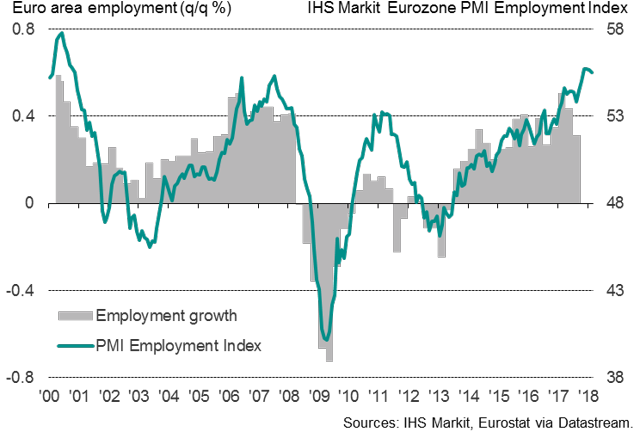
This in turn, continued to spur job growth across all nations covered in the survey with employment still rising at a record pace – its highest in the 20 years of the survey’s history. As shown in the graphic below, staffing levels continue to underline the expansionary mood of the broader economy.
While 2017 data showed that the Eurozone unemployment rate has fallen to 8.8% with, on average, over 7,000 jobs were added daily in 2017. Inflation remains low. Consumer confidence likewise remains high and leading indicators suggest economic momentum continues to build.
Source: IHS Markit, Eurostat
Despite these positive developments, we reiterate that not all news is good as the region continues to experience political fragmentation leading to unwieldy minority governments which require complex coalition-building just to enact policies.
As such, we believe that investors should be cautious in the near term given the strength of the Euro as well as the aforementioned political headwinds. Over the medium to longer term, we retain our bullish outlook for the region. Accordingly, the Platinum European Fund (PLA001AU) will remain held in the Fat Prophets Portfolio. We recommend the Fund as a buy for Members without exposure.
The Fund
Recapping some Fund details and Platinum European (PLA001AU) has the objective of providing capital growth over the long-term by identifying undervalued investments in the European region. The Fund primarily invests in the listed securities of European companies, although it may invest in companies not listed in Europe but conduct business predominantly in Europe.
The Fund is managed by Nikola Dvornak, who has been with Platinum for 10 years and a co-manager (50%) of the European Fund since June 2014. He has taken over full management of the European Fund as of 3rd February 2017.
The Fund’s Portfolio consists of 30 to 70 securities that Platinum believes to be undervalued by the market. As at 31 January (the latest update), the Fund held 50 stocks in the portfolio. Platinum (PLA001AU) may short sell securities that it considers overvalued and as at the end of February held a short position in 3 stocks. The Portfolio will typically have 50% or more in net equity exposure and the manager also has the ability to hedge exposures to the AUD.
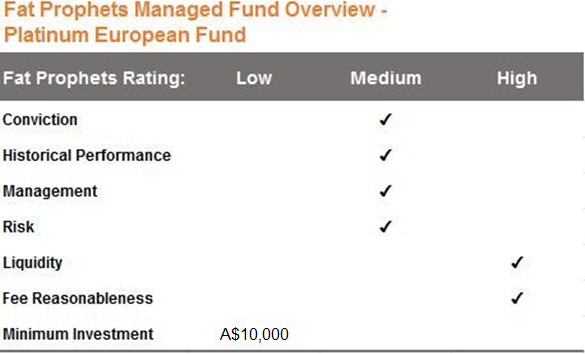
We think the holding costs of the Fund are reasonable with a management expense ratio of 1.35% for C Class shares, which includes administration and investment costs. There is also a buy/sell spread when entering/exiting the fund of 0.25% of NAV.
There is a minimum initial investment of A/NZ$10,000 with the option for implementing a Regular Investment Plan in A/NZ$5,000 plus A/NZ$200 on monthly/quarterly basis.
Performance
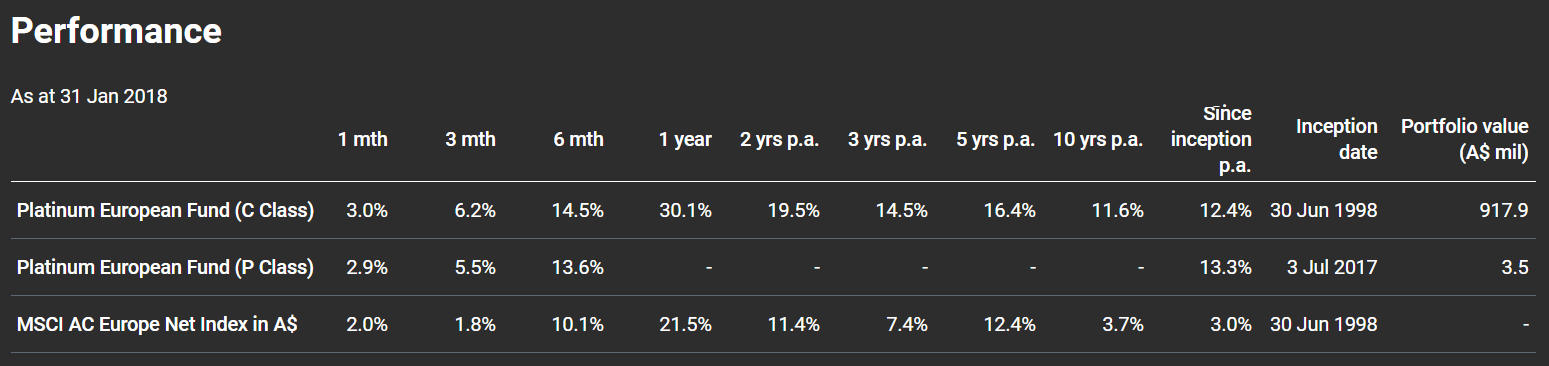
The Fund has a long history of delivering solid returns, long outperforming its benchmark (MSCI AC Europe) generating a return of 12.4% per annum since inception as at 31 January, compared to 3.0% per annum for the benchmark. The table below sets out the returns net of management fees as at 31 January 2018.
A closer look at the fund’s outperformance and we can attribute this to successful implementation of a bottom-up approach rather than any overarching thematic. Historically, the fund’s best performances were in a diverse mix of industrials, financials and consumer businesses.
We do note that fund has had different portfolio managers since inception with the current one having a tenure of around 3 years, while only having just passed 1 year of running it solo. As such, we believe that only the most recent returns can be attributed to the portfolio manager’s stock selection skills.
Source: Platinum Asset Management Fund website, 31 January
The fund manager explains that near term performance (<1-yr) seems to have narrowed relative to the benchmark as a handful of the fund’s new stock picks have underperformed due to business conditions deteriorating. The fund manager, in a note, assures that these were mainly value picks and that patient investors will be richly rewarded once conditions improve.
Over the longer 12-month period, legacy solid stock-picking ensured that the Fund outperformed its benchmark index by a substantial margin, notwithstanding the substantial cash holdings (average 15-20%) throughout that time period.

Source: Platinum Asset Management Fund update, 31 January
A $20,000 investment (previous minimum investment) in the Platinum European Fund (PLA001AU) at the funds inception date would now be edging close to $200k, compared to around $36,000 if the same investment was made in the comparable index, as seen in the above chart.
Platinum’s positioning
Since our last coverage of the fund back in October (reporting September) 2017, the fund manager has added Siemens, an industrial powerhouse, due to it being undervalued relative to its sector and the broader market. That aside, the fund has also added to existing positions such as Pandora and Technip as contrarian plays.
The fund has also been trimming positions in high performing picks such as Kering and Hypoport (which used to be part of the top 10) as well as reducing positions in the Financials sector. This has led to the cash position stabilising at a high 18% level, though on the plus side this allows the fund enough liquidity for bargain hunting.

Source: Platinum Asset Management Fund update, 31 January
Looking at the positioning of the fund’s assets, we note that Germany still tops the list at 23.7%
(previously 24.4%). It’s unsurprising that the fund has a larger exposure to the German economy given that it is Europe’s powerhouse and still in good shape.
This is followed by the UK (still officially part of Europe, at least until Brexit) which is the second largest country allocation at a 12.8% net long position on 31 January, which was up from 11.4% in our previous review. Going forward, we expect that once the UK exits Europe, that the fund may lighten the positions in the country as a defensive measure and reallocate to other undervalued regions.
Top Holdings
Turning to the holdings and the Fund remains well diversified at the stock level, with only one single investment exceeding 5% of the total fund value which is Raiffeisen Bank at 5.2%.
Looking at the industry breakdown, the Fund remains heavily weighted towards the financial services industry at 22.6% (previously 24.5%) though this has been reduced considerably since peaking at almost a third of the portfolio.
The fund has also been cutting consumer discretionary from the portfolio, which is now down to 11.5% compared to our previous coverage at 15.6%. Exposure to this sector has also been reduced since peaking at a circa one-fifth, with the fund now focussed more on opportunities in the automakers, oil & gas, and coal mining sectors which are facing bumpy rides of their own which is opening up opportunities.

Source: Platinum European Fund (PLA001AU) update, 31 January
Moving on to the Fund’s individual holdings and Austria’s third largest bank, Raiffeisen Bank International (RBI) is the Funds largest holding at 5.2%, down from 5.5% in September. The bank is involved in providing corporate and retail banking services that span from Central Europe to the former Commonwealth of Independent States and Russia.
Since our last coverage, the bank has disclosed its 2017 results showing the success of its turnaround efforts with net profit more than doubling (+115.4%) year-on-year to €1.12 billion. Looking briefly at its performance, the surge was possible due to a contribution from its former parent, Raiffeisen Zentralbank Oesterreich to strengthen its capital base and improving conditions in its Eastern European markets.
In our previous coverage, we noted that the bank is making steady progress in expanding in Europe’s emerging markets like Romania. To further that expansion initiative, the bank is collaborating with the European Investment Bank to finance SME projects in Bulgaria and committing €30 million.
Though at first glance, this figure is small considering the size and scope of the bank’s operations and capital, this mainly acts as their entry point in what is a relatively small market and part of a development initiative, which is cultivated well, will lead to long term rewards. Going forward, the bank forecasts Europe’s emerging markets to grow at a double-digit pace.
One of the Fund’s newest additions, the German industrial conglomerate, Siemens is now its 5th largest holding at 3.1% of the total. The company is a world leader in many of its end markets and, unlike many peers, continues to invest heavily in R&D, ensuring a rich pipeline of products for the future.
Given the sheer size of the company, we are narrowing our view on the most recent and salient development which is the planned spin-off of its health-care unit, Siemens Healthineers. The company is primarily a medical technology firm and is well known in the medical imaging and diagnostics space and is one of Siemens’ most profitable divisions accounting for 17% of revenues and 30% of earnings.
The spin-off has been long in the making as this was announced back in 2016 when CEO Joe Kaeser pushed for a broad overhaul of the conglomerate’s strategy and selling off underperforming units (telecommunication and appliances) while narrowing the focus to their more profitable businesses like healthcare. Mr Kaeser likens the developments to shifting from being a “single aircraft carrier to a nimble fleet of ships”.
Management are planning to sell off 15% of their stake and expect to raise a sum between €3.9 billion and €4.7 billion for investing in new areas such as molecular diagnostics and acquisitions, especially in the US.
Summary
With economic data continuing to improve, and notwithstanding political turmoil, we believe the outlook for European equities is still positive. The attraction is even more so given current earnings multiples and price to book values are low on an historical basis, and attractive when compared to the likes of the US.
We view the Platinum Europe Fund (PLA001AU) as providing strong exposure to the value on offer in the region, and we particularly like the Fund’s bottom-up value investing approach which is a robust strategy. Accordingly, the Fund has sustained a long period of out-performance, generating a return of 12.4% per annum since inception compared to 3.0% per annum for the benchmark index over a comparable period.
Platinum European Fund (PLA001AU) will remain held in the Fat Prophets Portfolio. We recommend the Fund as a buy for Members without exposure.
The APIR code for the fund is PLA001AU.

