
3Q18; things keep getting in the way
Newcrest Mining in announcing its third quarter results to 31 March 2018 delivered a mixed set of operational outcomes. Operations over the quarter were impacted by events that have kept the company on the back-foot. As a result, guidance for 2018 was downgraded. Furthermore, operating costs turned higher for the reported quarter, but the recent down trend remains intact.
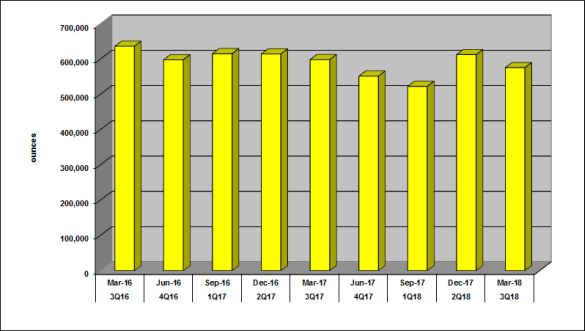
Gold production for the third quarter of 2018 printed a fall of 3.8% on the corresponding quarter for 2017, to 575,791 ounces. The following chart shows quarterly gold production:
Source: Newcrest Mining
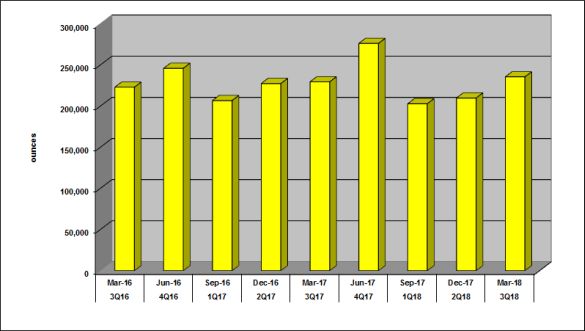
The company reported improved performances by three of its five operation mines, with the standout being the Lihir mine. We are especially pleased with the performance of the Lihir mine as the company has had trouble with this site since its acquisition in 2010. The company has been addressing Lihir’s operational parameters.
The Lihir mine reported a 2.6% increase in gold production compared to the corresponding quarter in 2017, to 235,626 ounces. The following chart shows quarterly gold production for Lihir:
Source: Newcrest Mining
The better performance by the Lihir mine was driven by an improved mining and mining efficiencies as the mine steps out from remedial work. Mining delivered 3.5 million tonnes of ore, representing a rise of 1.3% on the same quarter from a year ago. Milling compared to the same quarter in 2017 rose by 19.9%, to 3.7 million tonnes of ore. Acting as a headwind however, the milled gold grade slipped to 2.54 grams per tonne (g/t) from 2.85g/t from a year earlier, with gold recoveries also falling to 77.8% from 81% from a year earlier. Lihir guidance for 2018 is forecast to be in the range 900,000 to 940,000 ounces of gold. Guidance was upgraded from the previous 880,000 to 980,00o range.
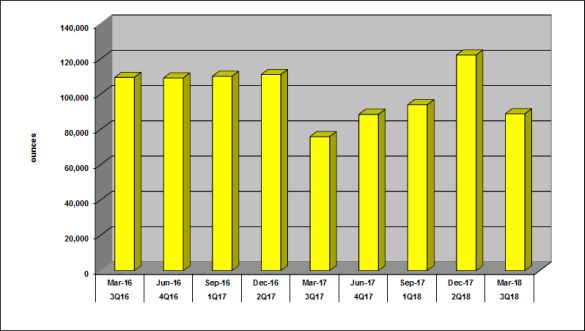
The Telfer mine delivered a good performance for the quarter as well. The following chart shows quarterly gold production for Telfer:
Source: Newcrest Mining
The mine delivered 89,005 ounces of gold for the reported quarter, which represents a rise of 17.1% compared to the same quarter in 2017. The Telfer mine reported improvements across all facets of its operations for the reported quarter. Mine production rose by 45% on the prior years’ result, to 9.8 million tonnes, and in turn milling production was 13.6% higher over the same comparative period as mining, to 5.1 million tonnes of ore.
The head grade improved to 0.66g/t gold from 0.65g/t gold for the same period in 2017, to add to the positive outcome. Gold recoveries also added to the tailwinds with the reporting of a 78.9% reported rate from 78.3% from a year earlier. Telfer guidance has however been downgraded, and is forecast to be in the range of 410,000 to 440,000 ounces of gold, from the previous 440,000 to 500,000 ounces of gold.
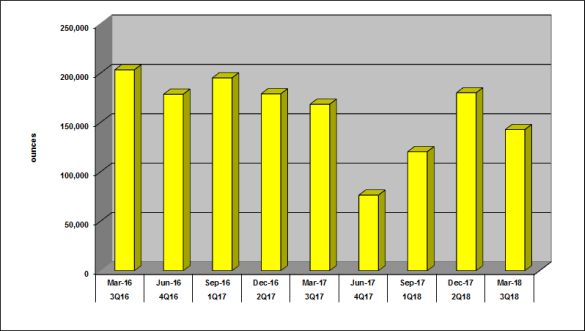
The Cadia mine was the fly in the ointment for the March quarter, following the reporting of a fall in gold production. The following chart shows quarterly gold production for Cadia:
Source: Newcrest Mining
Cadia reported a fall in production for the reported quarter, with the printing of a 15.2% on the same quarter in 2017, to 142,970 ounces of gold. The driver behind the lower result for Cadia was a tailings dam failure that shut-in operations during the quarter. Mining delivered only 5.1 million tonnes of ore and milling processed 5.0 million tonnes, reporting falls of 7.4% and 14.5% respectively and when compared to the same results from a year earlier.
The milled head grade for Cadia acted as a partial offset with the printing of an increase to 1.12g/t gold from the 1.04g/t gold from a year earlier. Gold recovers were not so obliging in the reported quarter, falling to 78.8% from the 83.7% gold recoveries record from a year earlier. Cadia guidance for 2018 has been downgraded to be in the range of 550,000 to 600,000 ounces of gold, from the previous 680,000 to 780,000 ounces of gold.
The remaining two mines in Gosowong (Newcrest’s interest 75%) and Bonikro (Newcrest’s interest 50%) mines reported divergent results. The Gosowong mine reported a lower March quarter output and Bonikro a higher number. Gosowong’s production fell by 23% on the same quarter for 2017, to 71,410 ounces of gold. Bonikro reported a rise of 17.6% compared to the March quarter 2017, to 36,780 ounces of gold.
Overall group guidance for 2018 was downgraded as a result of the March quarter 2018, and is forecast to be in the range of 2.35 million to 2.60 million ounces of gold.
The previous guidance was in the range of 2.4 million to 2.7 million ounces of gold. In 2017, the company produced 2.38 million ounces of gold.
Turning to the company’s by-product in copper, it reported a lower result for the quarter compared to the same quarter in 2017. Copper production fell by 14.6%, to 18,862 tonnes. The bulk of the company’s copper production was sourced from the Cadia mine. Guidance for copper production in 2018 was also downgraded and forecast to be in the range of 70,000 to 75,000 tonnes. The previous forecast was 80,000 to 90,000 tonnes of copper.
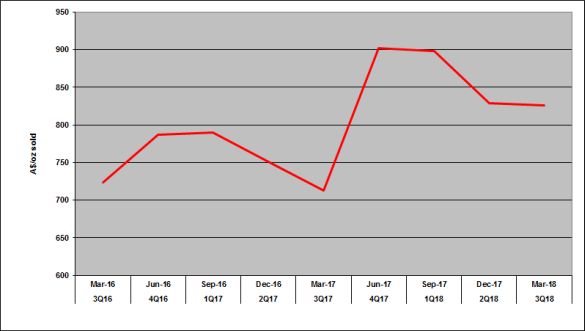
The company had been driving costs lower in recent quarters; a trend not continued in the March quarter, with all-in sustaining costs (AISC) breaking the trend with the reporting of a rise. The following chart shows quarterly AISC:
Source: Newcrest Mining
AISC deteriorated over the third quarter, with the reporting of a rise of 15.8% on the same quarter in 2017, to US$826 an ounce of gold sold. The Telfer mine was the principal driver of the higher AISC outcome for the March quarter, with the reporting of a higher adjusted operating cost of US$1,200 per ounce of gold sold, representing an increase of 13.9% on the same result from a year earlier. Higher mining and milling activities at the Telfer mine drove the rise in the site’s AISC.
The company is forecast an AISC of US$1,950 to US$2,050 per ounce of gold sold.
Reductions in ongoing operating costs continue to be a high priority for the company.
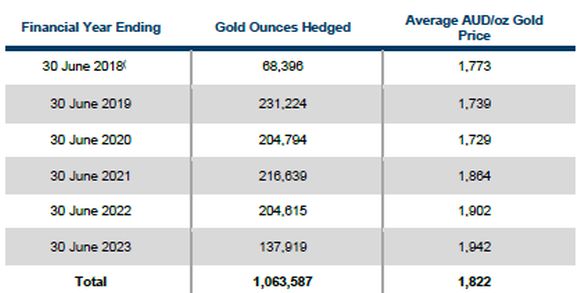
A higher realised gold price was reported for the March quarter, coming in at an average US$1,341 per ounce. The company reported an 8.7% increase in its realised gold price compared to the year earlier result. The company has hedged 1.1 million ounces of Telfer gold production out to 30 June 2023, at an average of A$1,822 an ounce and is shown in the following table:
Source: Newcrest Mining
We consider the position to be prudent, and at the time of writing the Australian Dollar price of gold was trading at A$1,749 an ounce, which places the position “in-the-money”.
We retain a positive outlook on the gold price for the year-end 31 December 2018 and expect the price to be in the range of US$1,550 to US$1,600 an ounce.
Expectations of higher inflation in the latter part of 2018 and going into 2019 will be a key tailwind for the gold price. An accommodating US Dollar on the gradualist approach by the US Federal Reserve in raising cash rates and rising competitive currencies will also push the gold price higher. Furthermore, the “safe haven” characteristic in gold cannot be ignored given the state of global events.
We believe the company’s suite of gold assets can deliver value to shareholders in the medium to long-term. Moreover, the potential to grow these assets is now being supported by a balance sheet that has a better structure. Add to the equation our positive view on the gold price, and it appears the value drivers are looking more positive.
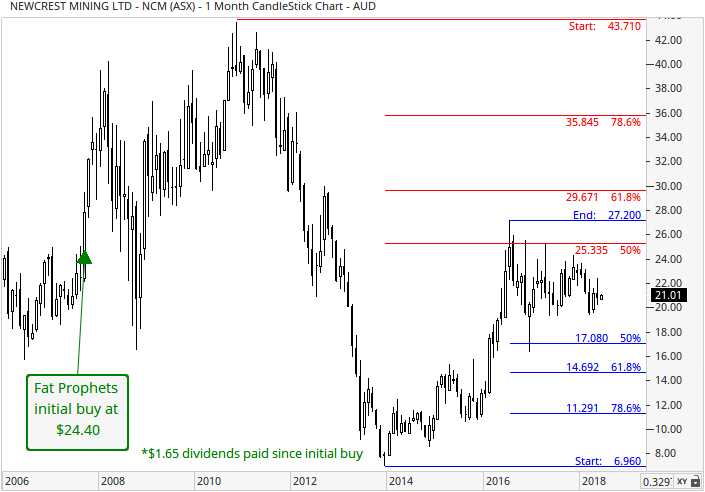
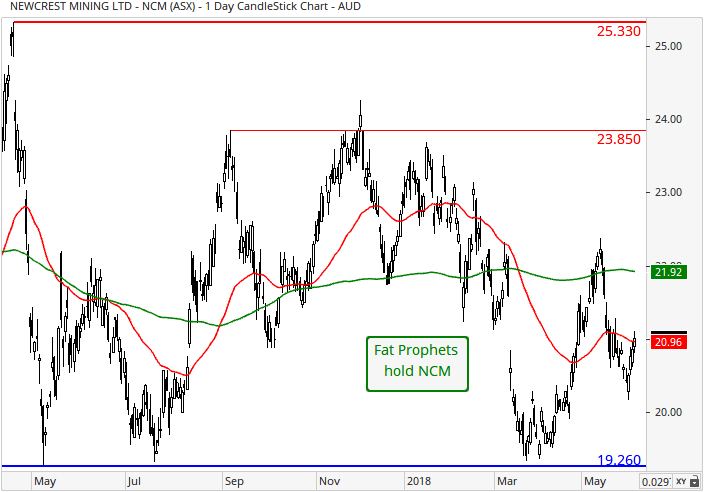
Furthermore, an extended period of relatively stable operational outcomes is now being well received by the market, albeit events have interrupted the flow to extend the recovery time.
We remain pleased with the progress the company has made, and we believe Newcrest Mining may now be moving in the right direction.
Consequently, Newcrest Mining will remain held in the Fat Prophets portfolio.
Disclosure: Newcrest Mining is held within the Fat Prophets Mining & Resources Portfolio.

