
Alan Joyce is quite the Pilot
Qantas Airways (ASX:QAN) recently released its third quarter (3Q) trading update which provides additional proof of the success of its turnaround efforts with revenue growth and expectations beating pre-tax profit. Today, we take a closer look at the recent trading updates and the progress the company has made thus far.
What’s new?
Back in late February (FAT-AUS-862) our coverage of Qantas (ASX:QAN) was focussed on its first half (1H) results which were quite impressive and proved to be further vindication of our stance on CEO Alan Joyce’s transformation programme. In addition to this report, our Head of Research, Greg Smith, provided more colour on this view on CNBC Asia. A link to the interview can be accessed here.
Since then, the airline has provided a few updates starting with Australian Competition and Consumer Commission’s (ACCC) stamp of approval with its alliance with Emirates which was announced last year in August. Following the announcement by the ACCC, it was decided to extend this partnership for another 5 years up to 31 March 2023.
Source: Qantas (ASX:QAN) Investor Relations
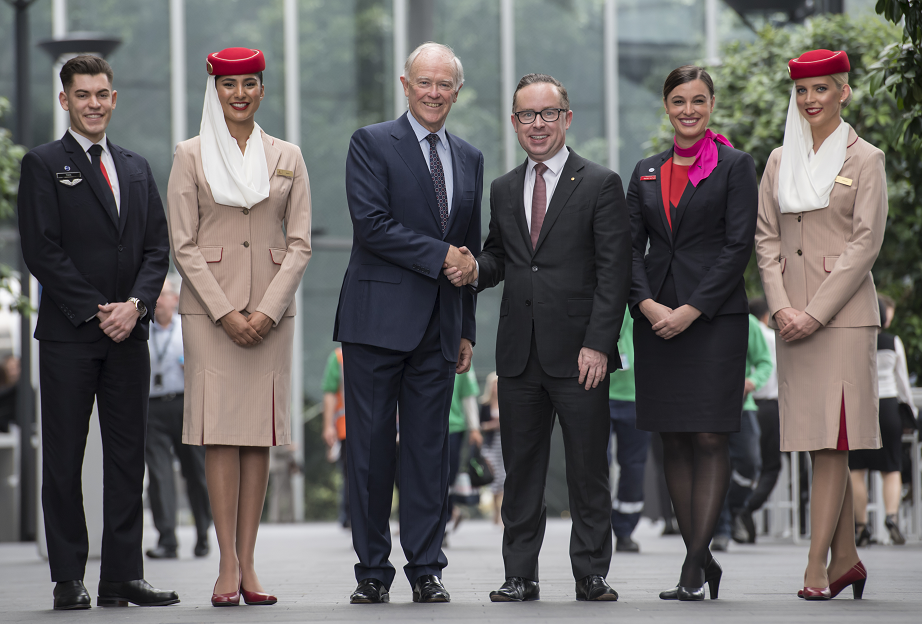
Pictured above is Emirates airline President Sir Tim Clark (middle left) shaking hands with Qantas CEO Alan Joyce (middle right).
Furthermore, the terms of the authorisation are largely unchanged and ACCC Commissioner, Roger Featherston, has provided some comments on this stamp of approval: “The continued coordination by Qantas and Emirates of their air passenger and cargo transport operations will likely lead to a range of public benefits such as improved connectivity and loyalty program benefits.”
Going forward, we believe this will continue to support Qantas’ International division from FY19 onwards as new routes are opened up, such as the Perth-London route as well as the switch from Dubai to Singapore as the hub for Qantas’ second London service.
Following that, in a bid to further focus on its core airline operations, Qantas has announced in mid-April its plan to sell its catering business to Emirates’ catering subsidiary, dnata (Dubai National Air Transport Association). The value of the sale, however, hasn’t been disclosed mainly due to the fact that the information was treated as “commercial-in-confidence”.
The transaction also involves Qantas’ catering businesses wholly-owned subsidiaries Q Catering, the full-service flight catering operations, and Snap Fresh, the frozen meal manufacturing operations based in Queensland. In addition, the transaction is still subject to regulatory approval from the ACCC, though we do expect that the details of the transaction will be reflected, once approved, in the subsequent earnings results.
Following the sale, dnata will then be supplying Qantas flights for an initial period of 10 years, and the airline will continue retain significant involvement in the design and development of the menu. This is not entirely the first time dnata will be supplying Qantas as it currently supplies catering for Qantas Group flights in Adelaide, Canberra, London and Johannesburg.
This move follows a string of asset sales in recent years and forms a significant part in cutting the “excess fat” as part of Mr Joyce’s turnaround efforts. Qantas Domestic CEO, Andrew David, also provide some perspective on management’s angle with the asset sale: “we’ve always said that we would explore the sale of certain assets where it makes sense, just as we’ve done before, including with the sale of our catering facility in Cairns and Qantas Defence Services.”
Since the airline has been tight-lipped on the details, our guestimate on its impact would include one-off gains as well as shedding some percentage off the expense line. Based on the International Air Transport Association, airlines spend some 2-3% a year of the total expenditure budget just on catering and it is understandable given the limitations of the supply chain.
That aside, another consideration with the sale is that catering can also be used as an avenue for incremental revenue by selling a limited selection of food and beverages to passengers while bundling that with onboard retailing can help the inflight catering mix. This means that the airline will lose out a bit on such revenue sources. However, less catering could also benefit the airline with less weight and better turnaround times and fuel consumption.
Ultimately though, the impact of the sale is still up in the air.
3Q Trading Update
Moving on, another development with a more concrete share price impact is the company’s latest trading update which has caused its shares to rise circa 10% following its release. In the filing, the airline reports positive market conditions that have aided the performance as the hikes in domestic fares, capacity discipline and strengthening global have all added up to the bottomline. A closer look reveals that the company is set for another record year of profits despite the rise in fuel costs.
The graphic below provides a summary of the trading update:

Source: 03 May 2018 Company Presentation – Macquarie Conference
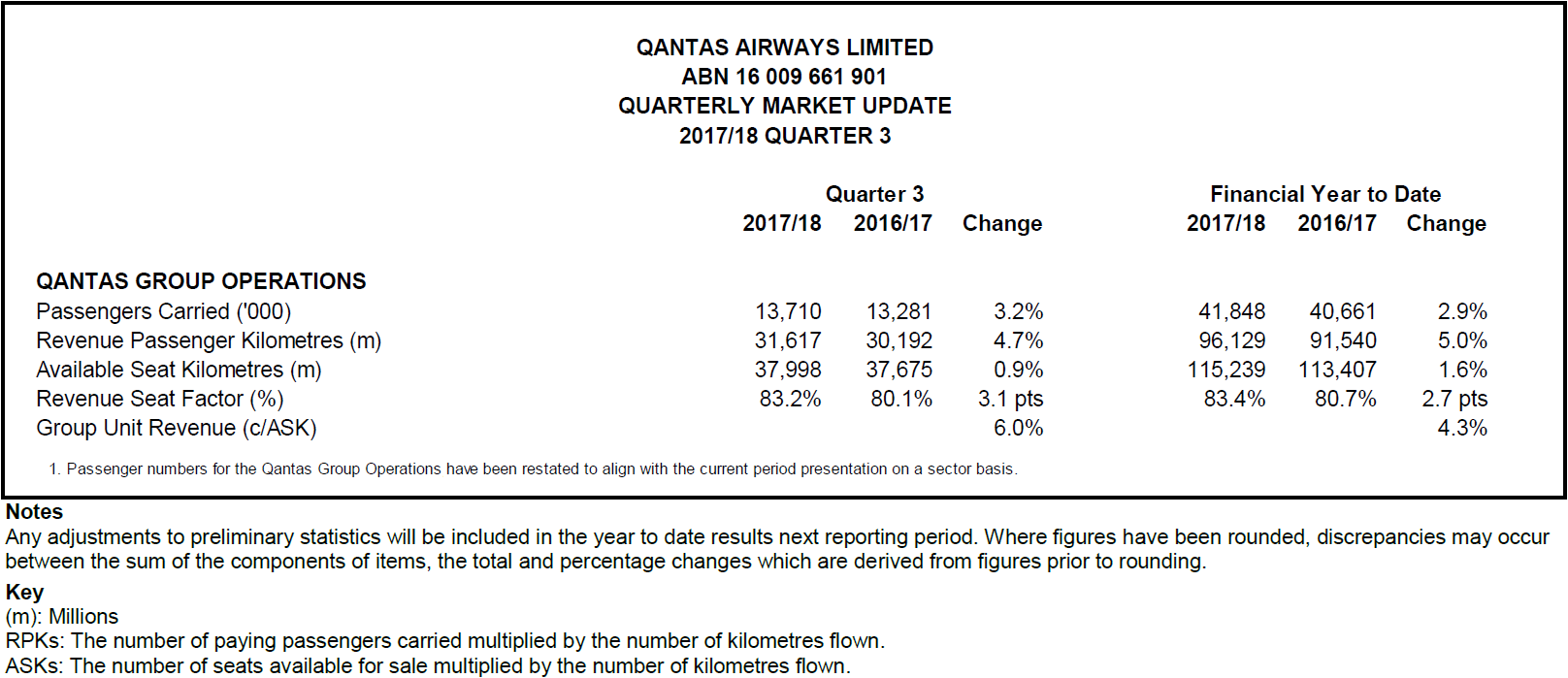
Revenue for the quarter also benefitted from the timing of Easter which mostly took place in the 3Q period and pushed demand for leisure travel compared to the prior corresponding period. Though the airline did not give precise dollar figures for each division, group revenue rose 7.5% to $4.25 billion for the quarter. Group Unit Revenue – measure that combines the fares paid and the percentage of seats filled – increased 6% year-on-year.
The graphic below provides the summary of operational results at the group level:
Source: Qantas (ASX:QAN) 02 May 2018 Company Filing
Breaking performance down geographically and Group Domestic (including both Qantas and Jetstar brands) Unit Revenue increased by 8% compared to the prior corresponding reflecting strong demand across key markets especially helped by some increased corporate travel due to the continued recovery of the resources sector and market share gains from the small-to-medium enterprise segment. This segment also benefitted from reduced capacity (more efficiency) and price hikes.
Group International
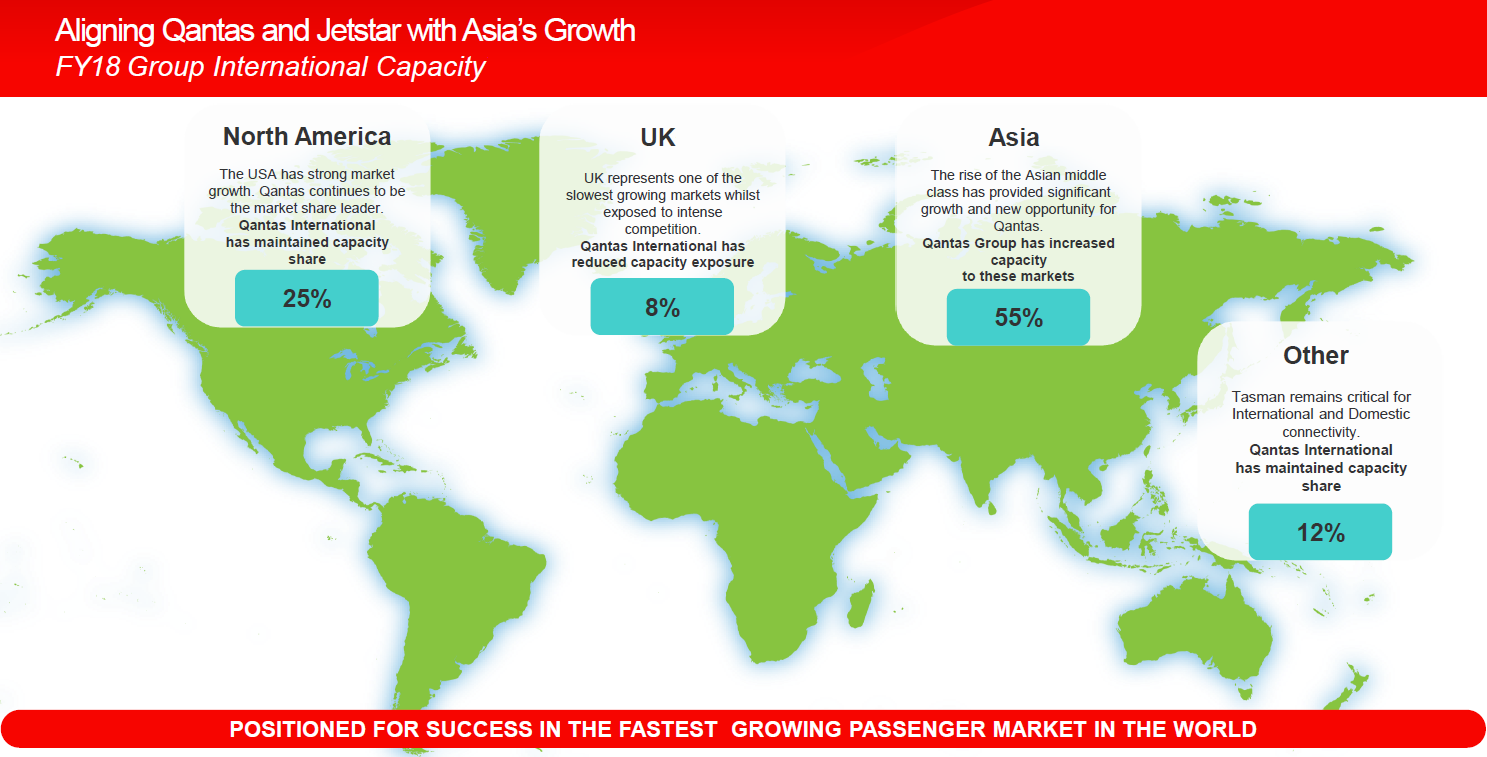
Qantas International, Jetstar International and Jetstar Asia, on the other hand, reported a slightly slower Unit Revenue growth of 5.2%. However, we do see that this progress is quite decent given that international operations across carriers in recent history have been quite weak due to increased competition and sluggish demand.
Source: Qantas (ASX:QAN) 03 May 2018 Company Presentation – Macquarie Conference
To sustain momentum for the international operations, management has also announced updates to its international fleet with the order of six additional Boeing 787-9s and to retire the aging Boeing 747s which have been in its fleet in various forms since 1971. The new 787-9 is around 20% more fuel efficient than the older 747s and has significantly lower maintenance costs on an Available Seat Kilometres-basis.
The first of these new 787-9s is expected to arrive in the 1H20 and as such there is no expected change to capital expenditure guidance for FY18 and FY19.
Qantas (ASX:QAN) Outlook for FY18 and Beyond
Going forward and in light of the solid progress made, management has reaffirmed its existing outlook on capacity, capital expenditures as well as transformation benefits in the 2H18. This is further support by Mr Joyce with his quote that “Qantas (ASX:QAN) is on track to deliver another record full year result even though we’re facing a $200 million increase in our total fuel bill in FY18”.
That said, management expects the underlying profit before tax to fall between $1.55 and $1.6 billion implying an increase of between 10.7% and 14.3% year-on-year making it par on course to beat market expectations as well as its all-time record results of $1.5 billion back in 2016.
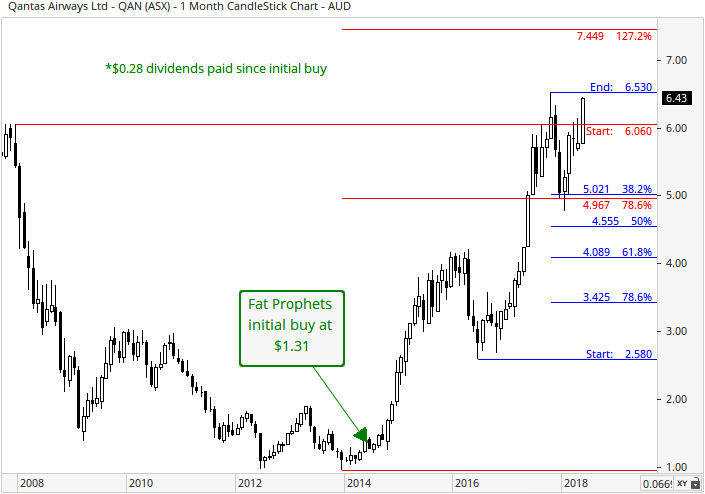
Turning to the charts, and on the daily, the underlying impulsive move north remains firmly intact. In the grand scheme of things, prices have cleared both the 50 (red line) and 200 (green line) day moving averages, which is suggestive of momentum to have swung north. Therefore, and over the medium-term time horizon, an eventual upward rotation towards resistance located at the October 2017 high of $6.53 is deemed to be the likely path, moving forward.

With reference to the monthly chart, support was respected at the 38.2% Fibonacci retracement of $5.02 (blue set of retracements) in January, which is deemed positive price-action. Our previous theory that a resumption of the broader uptrend would likely follow has since played out, with resistance at $6.00 surpassed. Next resistance is sighted at the October 2017 high of $6.53. A definitive clearance of this level would likely yield a longer-term advance towards the 127.2% Fibonacci extension of $7.45. This price level was triggered when prices closed (on a monthly-basis) above the 78.6% Fibonacci retracement of $4.97 in May 2017 (red set of retracements).
Summary
Progress with Qantas has been impressive ever since we backed the turnaround story by Qantas some 3 years and 8 months back with a buy on the stock at $1.31, and the latest trading update from the company further vindicates the tremendous transformation program instigated under CEO Alan Joyce.
On a valuation front, Qantas (ASX:QAN) is currently trading at 10.1 times earnings with a prospective yield of 2.2%. We like the direction management is taking the company and while we think that the shares can still go higher, the lowest hanging fruit has likely gone with the upward rerating, but the story has been an exceptionally good one. That said, we think that Members should stay seated a while yet.
Accordingly, Qantas (ASX:QAN) will remain firmly held in the Fat Prophets Portfolio.

