
Returning to the fold
In recent weeks we have surveyed the investment case for re-entering two former portfolio constituents in Vocus Group and TPG Telecom. Both were strong portfolio performers during their tenure, and in both cases our exit proved timely, with our concerns over each telco’s prospects (and share price direction) proving well founded.
In the case of Vocus (ASX:VOC) we have concluded that after a substantial fall in the valuation since our sell recommendation, the case exists for a re-rating. This is with a number of fundamental catalysts appearing on the horizon. New management should provide a fresh strategic focus, while there is a substantial reduction of the company’s debt pile on the horizon with an asset sale across the Tasman.
From a technical perspective further consolidation is possible near term, but on balance we are comfortable pre-empting the break-out that looks to be in the offing. There is some risk to this strategy, with a new permanent CEO not having been appointed to the company yet, and the divestment across the Tasman not concluded yet as to price and timing. However, a favourable outcome on both will likely see the market respond in kind.
Accordingly we are recommending Vocus (ASX:VOC) as a high risk buy to Members.
Please note that this recommendation of Vocus should be viewed as high risk. This classification may change in the event that the company is successful in paying down debt post an anticipated asset disposal.
Recap
We previously had exposure to Vocus Group not once, but twice as the company swallowed up both Amcom Telecommunications, and M2 Group. We originally entered both on ‘value’ grounds, and latterly became concerned that Vocus was becoming too big for its boots, with a premium multiple to match. With integration risks abounding, and the technical picture also showing signs of topping out, we finally exited the shares around $7.75 in March 2016.
As it turned out our fears proved well founded, with the integration of the various acquired businesses not going smoothly at all, with synergies over-estimated and financial estimates some way off the mark. This culminated in a series of profit warnings, and ultimately the recent departure of the company’s CEO, and Chairman.
We have confidence in the new management team that have been appointed. Taking over as Chairman is Bob Mansfield, who previously chaired Telstra, and was the founding CEO of Optus. So he certainly has the capacity to make some tough decisions in our view.
Michael Simmons has taken over as an interim basis as the CEO. He was previously the company’s Head of Wholesale & International, and certainly has been given the incentive to ‘step-up’
while a new permanent CEO is sought. Last week the company confirmed that Mr Simmons would have the potential to earn a short term incentive of up to $400,000 based on performance and at the Board’s discretion. This is in addition to a base of $1.1 million, and Mr Simmons may well be given the opportunity to make the seat his own permanently.
A change in management will of course not be the only catalyst needed to ensure an earnings recovery, with the company hampered at the interim by ‘higher than expected subscriber acquisition costs.’ This in our view is symptomatic of the highly competitive environment in which the company operates, and also large scale growth ambitions that were not that well timed.
We also stand by our view that Vocus (ASX:VOC) is very much a textbook example, in our view, of why an acquisition for acquisition’s sake is not a sure-fire recipe for success. In the past three years, the company has completed $5 billion in mergers with Amcom and M2, while also acquiring Nextgen for $807 million. The key as always is in the detail, and the realistic synergies and earnings drivers that will be gained as a result, and with due regard for the risks. This was sadly lacking in our view with respect to Vocus, and shareholders suffered the consequences.
Financial underperformance was clear to see in the half year results. Interim net profit fell 21% to $37.3 million. Management chose not to declare an interim dividend due to ‘competing demands and opportunities for capital investment’ and as a ‘more nimble’ approach to payouts is being sought. Understandably the market did not take this well.

Source: Vocus (ASX:VOC) Investor presentation
Underlying EBITDA (earnings before interest, tax, depreciation and amortisation) did rise 8% to $188.1 million with a plethora of adjustments following acquisitions, divestments and corporate restructuring. The board also chose to reduce full year EBITDA guidance to a range of $365 – $380 million (from $370 – $390 million). Full-year underlying profit was revised to between $125 million and $135 million, or about 10% below earlier forecasts. This also came on top of a 20% earnings downgrade in May last year.
At the interim, the company’s consumer broadband business performed well, but not as well as expected.
Revenues rose 5.7% to $409 million while EBITDA was flat at $48.9 million. NBN market share though rose to 7.7% from 7.3%, and there may well be scope to lift the performance further as Vocus changes its sales strategy to a lower-cost digital channel approach.

Source: Investor Presentation
Positively, the company’s enterprise and wholesale division did perform strongly, with EBITDA surging 11% to $205 million on revenue which was up 2.5% to $392 million.
Growth in data networks business was strong, with the company enjoying success in wins from the Federal government and on the East Coast. The bottom line here was boosted by margin expansion and strong cost control.

Source: Vocus (ASX:VOC) Investor presentation
The company’s balance sheet has also been an issue, with net debt ballooning to $1.05 billion following the spate of acquisitions. The company’s net leverage ratio is around 2.9 times, which doesn’t leave much headroom below threshold covenants of 3 times.
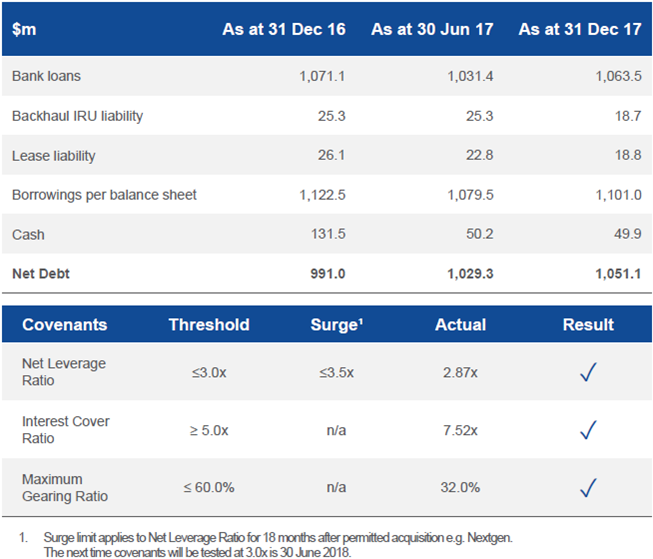
Source: Vocus (ASX:VOC) Investor presentation
However, some respite is in sight on the balance sheet front, with the company in the process of selling its New Zealand business (which owns the Slingshot and Orcon businesses). The unit delivered NZ$342 million revenue last year and N$60.9 million in underlying earnings. Vocus (ASX:VOC) is looking for around NZ$500 million for the business and has reportedly talked up a telco market which is arguably less competitive than Australia’s. In any event the proceeds will certainly go some way to alleviating balance sheet stress, with covenants being revisited in June. Also, a positive follow-on will be with debt servicing costs falling, after which management will also be able to revisit dividends in our view, boosting investor sentiment. This is also as the company’s significant Australia-Singapore cable project is on track to be in service by Q1 FY19.
Summary
Clearly Vocus’ share price has been through the wringer over the past eighteen months, and since our exit, but we believe the scenario for a turnaround may be starting to emerge. The company is one of only four major telecommunications carriers in Australia and certainly has an opportunity to benefit, albeit the market is competitive.
New management will not be biased by the mistakes of the past which is a good thing in our view, while divestments should help the balance sheet, and facilitate the return of dividends. The presence of activist shareholders such as Hong Kong-based investment group Janchor Partners will also ensure that new management are kept on their toes.
We have concluded that after a substantial fall in the valuation since our sell recommendation, the case exists for a re-rating. This is with a number of fundamental catalysts appear on the horizon. New management should provide a fresh strategic focus, while a substantial reduction of the company’s debt pile is on the horizon with an asset sale across the Tasman.
From a technical perspective further consolidation is possible near-term, but on balance we are comfortable pre-empting the break-out that looks to be in the offing. There is some risk to this strategy, with a new CEO not having been permanently appointed to the company yet, and the asset sale across the Tasman not concluded yet as to the price and timing. However, a favourable outcome on both will likely see the market respond in kind. It should also be noted that as of yesterday, Vocus (ASX:VOC) has been removed from the ASX100 in the quarterly rebalancing of the index, but this has been flagged and is likely now in the price.
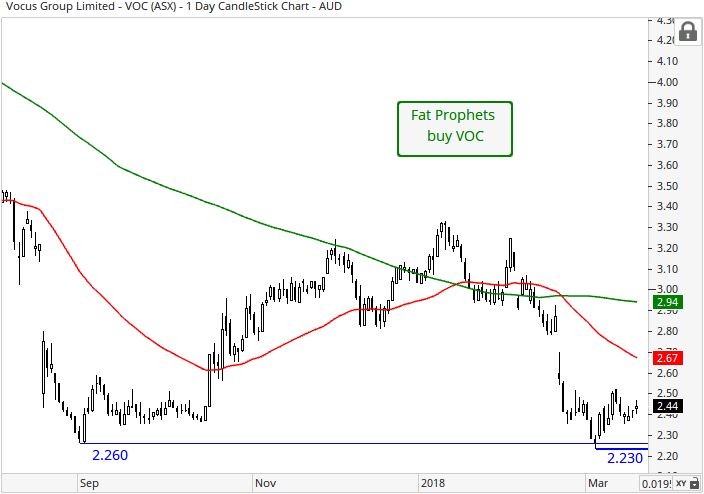
On the daily chart, the bearish moving average crossover present since late-February is suggestive of momentum to favour the downside. This occurs when the 50-day moving average (red line) crosses below the 200-day moving average (green line). At present, a zone of support is located between $2.23 and $2.26. This is made up of the March intra-month low (horizontal solid-blue line) and the September 2017 low (horizontal thin-blue line) respectively. A sustained break above the 50-day moving average (red line) of $2.80 is ideally required. If this was to occur, then this would shift momentum back in favour of the bull-camp.
With reference to the monthly chart, prices are in flirtation-mode with support sighted at the 78.6% Fibonacci retracement of $2.27. It is important that the bulls defend this level, otherwise, the risk of a deeper decline down to the December 2011 low of $1.29 could very well be on the cards. In order for a definitive bullish rotation to evolve, a sustained break above overhead resistance evident at the January high of $3.33 (as marked by the horizontal red line) is required.
It is also worth highlighting that Vocus (ASX:VOC) is now trading on around 11 times FY19 earnings. This is similar to the multiple on which the shares were trading when we first entered the stock, and some way from the 25 times at which we exited.
Accordingly, we are recommending Vocus (ASX:VOC) as a high risk buy to Members.
Please note that this recommendation should be viewed as high risk. This classification may change in the event that the company is successful in paying down debt post an anticipated asset disposal.

