
Trying to Strike “White Gold”
Today, we are taking a look at a niche player in the Infant Formula space, Bubs Australia (ASX:BUB). The company has seen a steady flow of positive developments in its business with distribution deals in China and a successful acquisition, making it a vertically integrated player which attracted our attention. However, at this juncture, there is still a lack of earnings visibility and clear demand for its products in China, making it difficult to justify setting up a position in the stock. Accordingly, we Traffic Light the stock.
Long-time Members would note that we have been closely eyeing opportunities in the Infant Formula (IF) market segment. We first touched on the sector in 2015 while also issuing a buy with some related players in Danone (Euro Equities) and Reckitt Benckiser (UK Equities). We revisited the sector again in 2017 recognising that the growth has been on an upward trajectory.
That view hasn’t changed, and industry reports from Nielsen and Allied Market Research indicate that the global infant food and formula market is worth some US$50 billion with an expected value of some $69-70 billion in 5 years while the IF segment alone accounts for 67% of the total. Looking deeper here, we expect substantial demand to come from Asia and a particular interest point is China, which we expect to account for a sizable 40% of the global IF market.
We’ve noted previously the rising income of the middle class as well a rising number of women in the workforce in addition to China’s new two-child policy as being primary drivers of this segment. In addition, repeated contamination (melamine, lead) in local products further supported this segment and gave rise to brand loyalty and a greater propensity to pay a premium price for trusted foreign brands.
Today, we take a look at a premium player in the segment, Bubs Australia (ASX:BUB), which has recently attracted our attention. The company is a vertically integrated specialist producer of goat’s milk used in IF and baby food snacks. The company’s products cover infant milk formula, organic baby food, cereals and its recently launched (September 2017) teething rusks.
Source: Bubs Australia (ASX:BUB) Company Website
With the overall market being highly competitive, Bubs has opted to compete in the premium segment. According to the company’s presentations, this rationale is due to the rapid growth in this segment in China over the last decade – from 5% to over 90% in segment value.
We like that the company pursues a differentiation strategy and uses goat milk, making it materially different from most competitors in the space. In fact, it is the only Australian made goat IF player in the retail grocery channel. This choice was also strategic considering the high rate of lactose intolerance in Asia and very low breast-feeding rates in China (<1%). Going forward, we expect the company to gain more market share in the space if it manages to secure Chinese Food and Drug Administration (CFDA) approval.
The company has also recently announced multiple new agreements with distributors in China as well as a CNCA-certified (Certification and Accreditation Administration) manufacturing facility, which we view as notable. The deal with Australia Deloraine Dairy is highly important as it is 1 of only 15 facilities in Australia licensed by the CNCA under the new regulatory requirements that were implemented in January.
Under the deal, after the registration the company will purchase a minimum volume of 500,000 tins in the first year, with annual increments throughout the term, reaching 1.5 million tins in the fifth year. This puts the company a step close to clinching the all-important CFDA approval.
That aside, the company has also inked deals with Alibaba via merchant services agreement where it allows the company to set up a store in the latter’s Tmall Global website.
The company has also inked a deal with a Chinese supply chain and service provider, New Times Asia, which committed to purchasing minimum volumes of Bubs products and starting with a A$17 million commitment next year. This represents a circa 100% increase in total sales revenue for the company and includes recently acquired NuLac’s offerings.
This arrangement is meant to open up the company’s distribution capabilities to other e-commerce platforms and supports its existing supply agreements with JD.com, Kaola.com, VIP.com, and RED.com as well. The arrangement also requires New Times Asia to increase their commitment to $24 million in second year (FY2020) and $37 million by 2021.
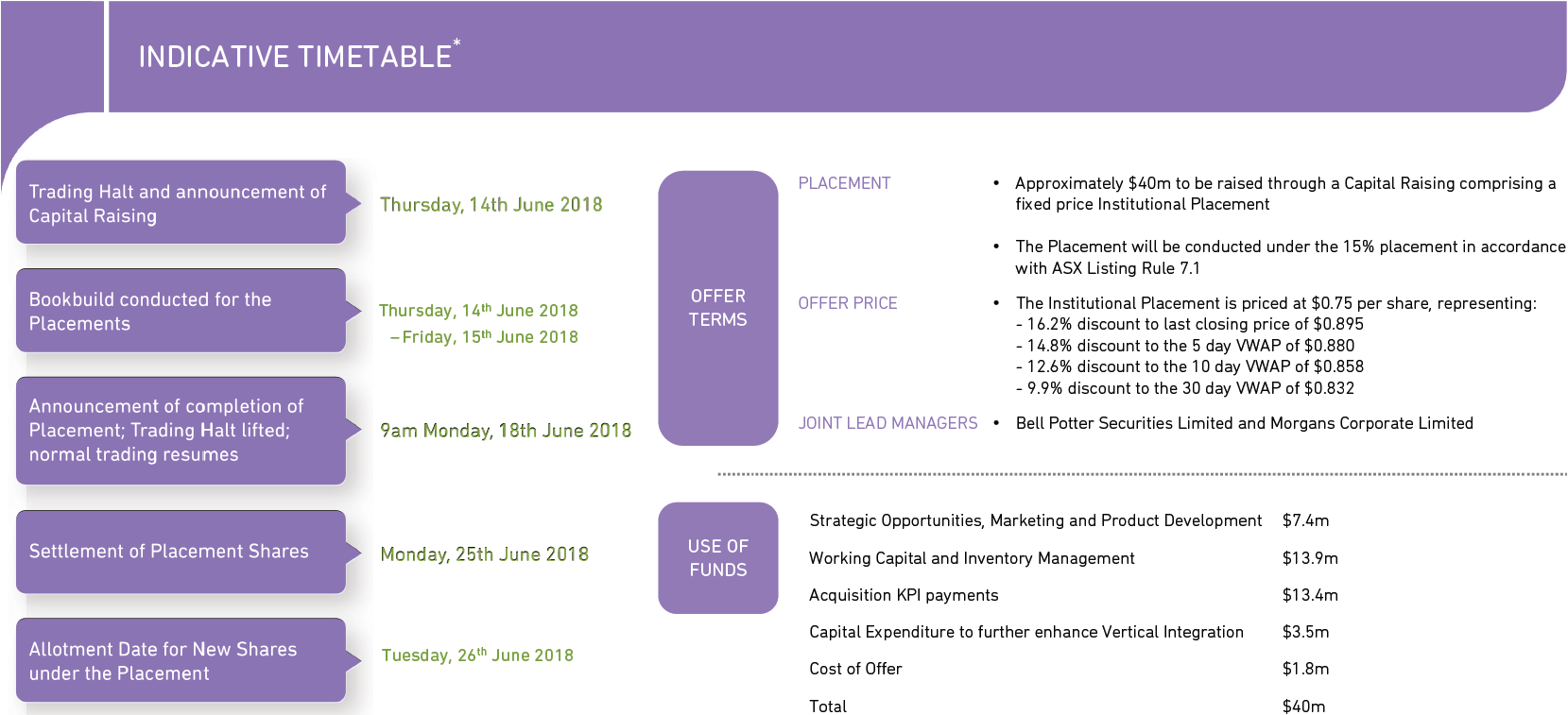
The company also hit our radar considering its recent capital raising activities. This is captured in a graphic below:
Source: Bubs Australia (ASX:BUB) 18 June 2018 Company Presentation
The company has raised A$40 million in order to support working capital, and growth momentum in China following recent deals with QianJiaWanPu, New Times Asia and Alibaba.
Other uses for the capital cover marketing, product development, KPI payments to vendors who meet their targets as well as capital expenditure to enhance the company’s push towards vertical integration (following the NuLac acquisition last year).
Before we give our verdict, we believe it prudent to take a brief look at the company’s history and recent financials to paint a clearer picture:
Company Overview
Bubs Australia (ASX:BUB) is a vertically integrated specialist producer of goat’s milk used in IF and baby food snacks. The company was founded by Sydney-based mum and for Cathay Pacific executive, Kristy-Lee Carr (pictured below) in her home kitchen when she was on maternity leave when she obsessed on the nutritional value and what to feed her daughter.
Recognising the potential and growing global demand for healthy and premium baby food, Ms Carr, along with Shakespeares Pies founder, Anthony Gualdi, invested $100,000 each to set up a commercial kitchen. The products were then distributed across the country via health food stores, independent grocers and David Jones Food Halls. The company then eventually branched into IF (in 2015) and as they say, “the rest is history”. Since then and circa 13 years later, the company has now become a $339.39 million-worth vertically integrated player.
The company is also now led by Nicholas Simms, also pictured below, who is a Fast-Moving Consumer Goods (FMCG) Specialist with management experience at Mars Inc., HJ Heinz, PZ Cussons and organic yoghurt company, five:am.
Founder and Managing Director Kristy Carr with current CEO Nicholas Simms:
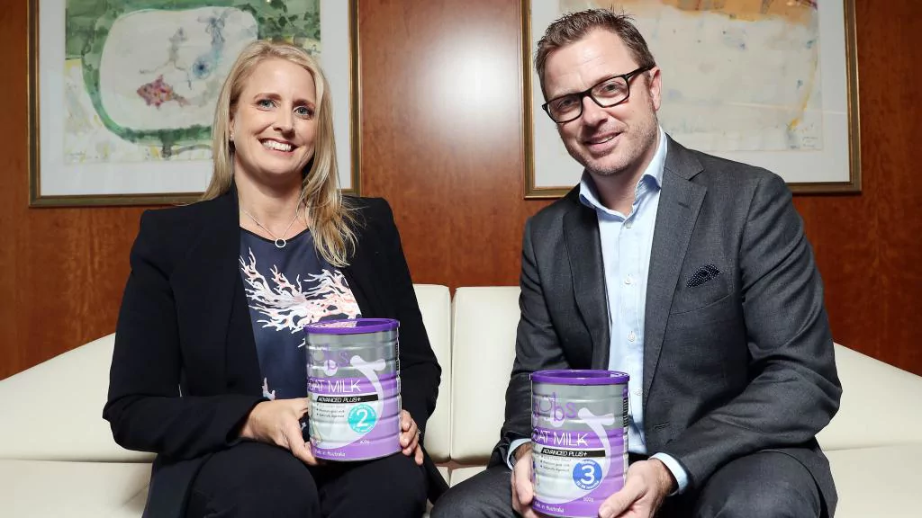
Image Credit: The Weekly Times
The company, then named “The Infant Food Holding Co” was listed in 03 January 2017 via a backdoor listing (reverse merger transaction) through Hillcrest Litigation Services. Following that, the company was renamed Bubs Australia.
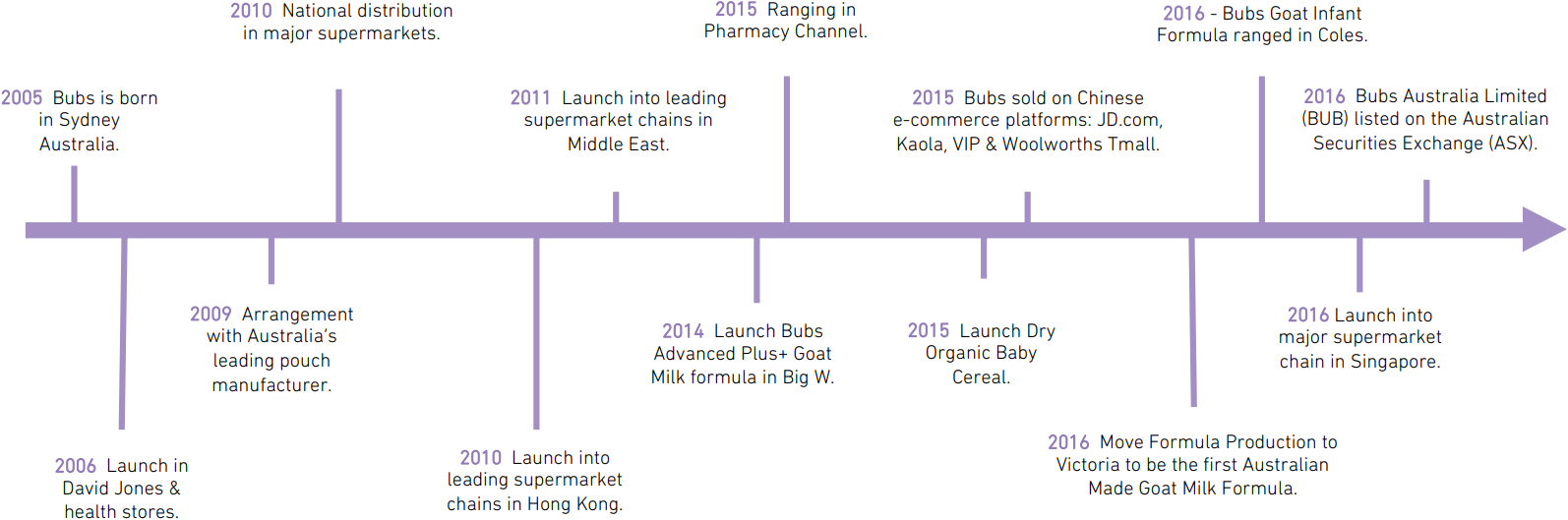
A brief timeline of the company’s history:
Source: Bubs Australia (ASX:BUB) 05 December 2016 Company Prospectus Presentation
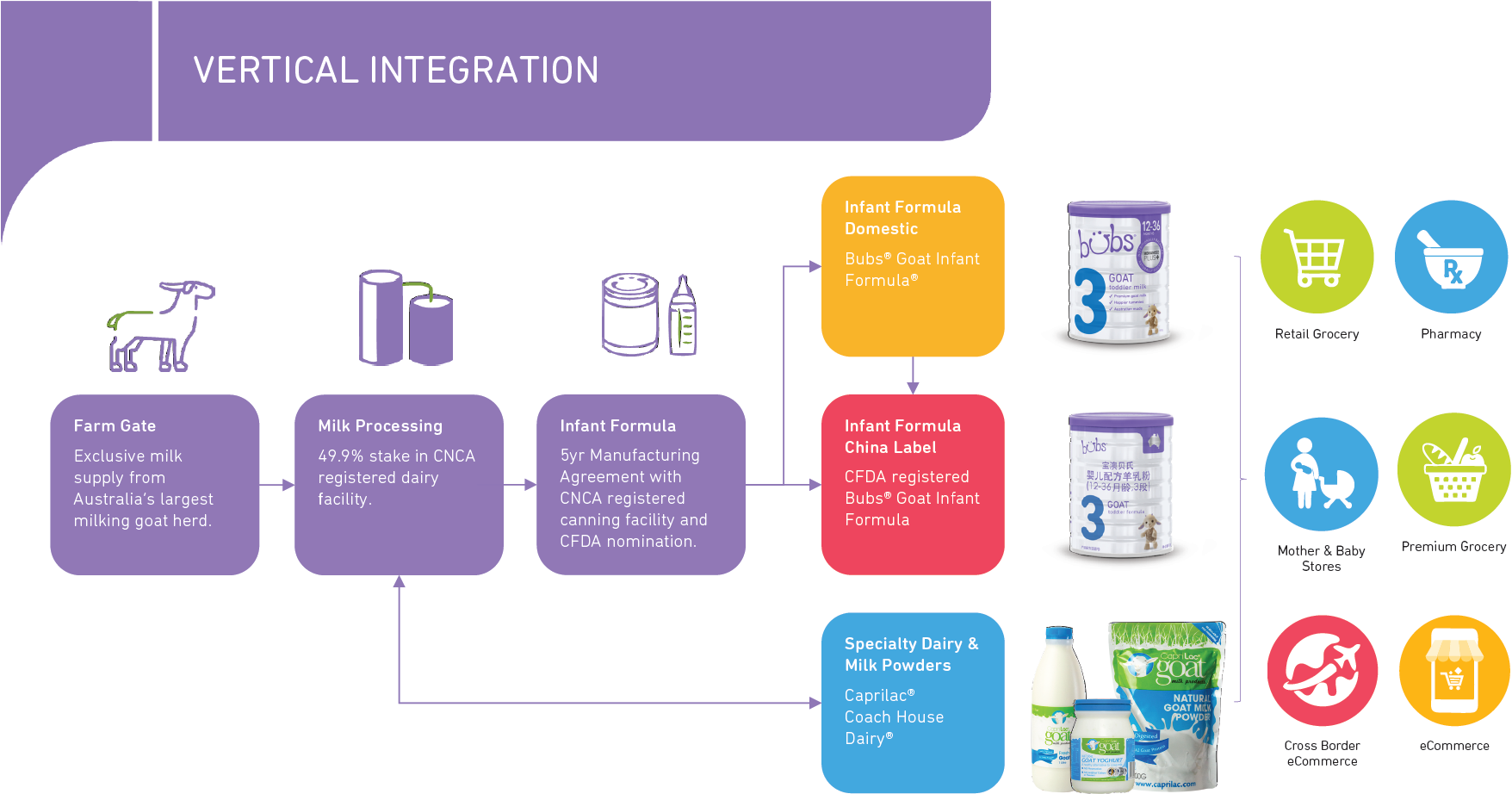
As noted, the company is a vertically integrated player, and following the recent acquisition of NuLac Foods. The company has ownership interests in processing and manufacturing facilities in Australia and New Zealand. As seen in the graphic below, the company also has a 49.9% interest in a Milk Processing Joint Venture (Uphamo) whilst having exclusive rights to 100% of the milk supply.
The facility is located in Keysborough, Victoria and also has a manufacturing operation in New Zealand. The facility is has received CNCA certifications for its adult milk for export to China and can produce 900 tonnes of spray dried powder or 3,000 tonnes of yoghurt pa or 6,600 tonnes of chilled milk per annum or any combination of these products.
NuLac also has a herd of 6,500 milking goats in Australia with a further 2,000 in New Zealand. The combined production capacity of the 8,500 milking goats is ~6.2 million litres per year.
NuLac has set plans to increase herd capacity over time which won’t take as long as cattle considering goats have higher fertility, producing 2-3 ‘kids’ per pregnancy. Note that the company does not own the farm but has only acquired exclusive rights, though there is a call option to acquire it. We believe that once the financials support, there will be an acquisition down the line.
Source: Bubs Australia (ASX:BUB) 18 June 2018 Company Presentation
NuLac Foods, produces a range of goat milk powder products, as well as fresh milk and yoghurts, under a variety of brands from CapriLac, NuLac, Coach House Dairy, No Udder and Alpine.
One of the company’s rationale for providing a unique offering is that cows’ milk comes with some challenges and may not sit well in the stomach due to allergies or intolerance. While others have also expressed positive outcomes such as: improved digestibility and having more minerals due to its higher ash content.
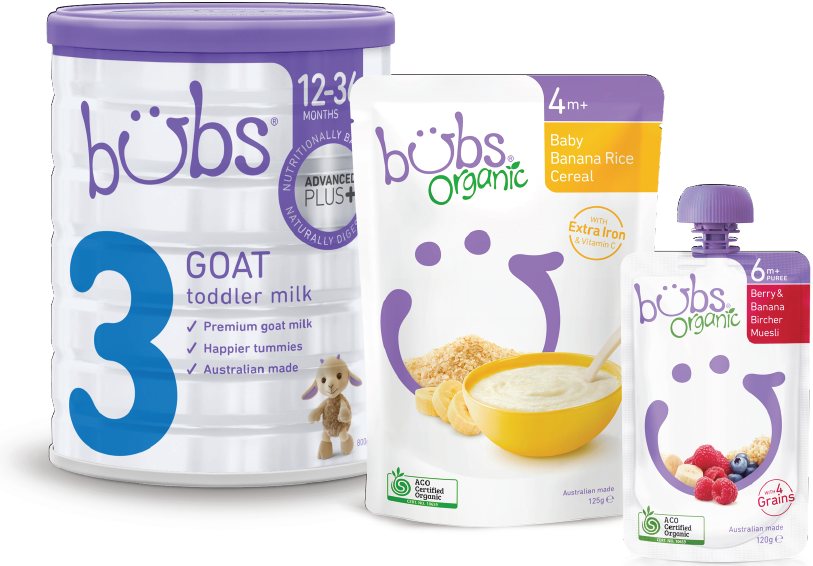
Its products cover infant milk formula, organic baby food, cereals and newly launched teething rusks. The company’s goat infant milk formula product, ‘Bubs Goat Milk Advanced Plus+’, comes in three different stages: Stage 1 (0-6 months), Stage 2 (6-12 months) and Stage 3 (12-36 months). It is made in Australia and blends goat whey protein with a balanced intake of essential fatty acids, vitamins, amino acids and prebiotics. Pricing is consistent across each of the three stages at A$34.95 per 800g tin. Similarly, the baby food and cereals are also differentiated based on stage of life and flavours as well and are all organic.
Pictured below are a sampling of the company’s current offerings from infant formula (below, left) to the pouches (below, right) which it is well known for and the newly launched (September 2017) baby cereals (below middle):
Source: Bubs Australia (ASX:BUB) 18 June 2018 Company Presentation
The company has a strong pipeline of new products and is looking to launch more, further particularly in organic cereal, both domestically and overseas. The company has said that the infant cereal market is considerably larger than the wet food market in China and presents an attractive growth opportunity.
Since listing, the company’s products have grown to be distributed by over 2,000 points of sale thanks to Wesfarmers via its Coles supermarkets, discount department store Big W, online pharmacist Chemist Warehouse, Costco Wholesalers, RED.com in China, leading pharmacy and healthcare distribution company HealthOne.
Early this year, the company has also entered into a supply agreement with JD.com. Note that this company is a goliath in the e-commerce space with over 266 million annual active users, 7 fulfilment centres and 405 warehouses. The company is a rival of e-commerce giant, Alibaba.
More recently (circa April – May), the company also has secured distribution with Woolworths covering all 3 stages of its Infant Formula and 2 varieties of its organic baby cereal offerings.
Around the same time, the company has also made more progress in China having signed up a distribution arrangement with QianJiaWanPu (China’s largest and fastest distributor of infant nutrition products) which supplies 80,000 specialist stores in China and covers 90% of all stores competing in that category.
Inclusive in the deal is that Bubs will export selected products (organic baby food pouches, cereals and snacks) which have already received the necessary regulatory approval, though this does not cover infant formula which still require CFDA approval. As noted above, this may change soon following the company’s ongoing application. The opening order is worth $1.1 million and will be supplied in instalments between June and December of this year.
NuLac’s products are also distributed in Australian supermarkets (Woolworths, Coles, 7 Eleven and Metcash) as well as via international wholesalers (Tmall Global).
The company competes against Karicare (a larger, NZ-based player); and Nuchev ‘Oli6’ (start-up, Australian-based) in the domestic goat milk market while also competing against Bellamy’s Australia and the a2 Milk Company in Australia’s broader premium Infant Milk category.
Its competitors in China, in the imported goat milk space are Kabrita (produced by Hyproca Nutrition, a Dutch dairy company owned by Ausnutria Hyproca) and Karihome (produced by New Zealand based Dairy Goat Co-operative). Though the list is not exhaustive as there are also Chinese domestic goat infant formula offerings.
Key Risks:
Before taking a look at financials, we also believe it prudent the risks involved in looking at new issues. First (i) notable risk we see is that the company’s share price has moved up in share price well ahead of fundamentals. Case in point is that FY17 sales were circa $3.945 million whereas the company’s market cap is already at $340 million making a substantial gap.
Note that the company is still in its early stages of its life cycle and the vicissitudes in the market may not always lead to strong quarters of growth, implying a high degree of volatility in the stock price.
Second (ii) is that the company operates in a highly competitive market with many large global competitors like Nestle and Mead Johnson which have tremendous branding power and large reservoirs of capital. The company currently has a relatively low brand awareness considering its recent 2015 entry into the Infant Formula market makes it relatively unknown, requiring substantial investment.
Nevertheless, the company has devoted resources via building up a strong social media presence. In fact, Bubs has the largest following on Instagram in its category with over 100,000 followers, its Facebook presence is also gaining traction now at the 2nd largest.
Next (iii), the company has also been quite unprofitable despite its almost 13-year tenure and no doubt a side effect of its entry in the low value organic baby food market. Its recent entry into the high margin infant formula market (and subsequent success) will be the primary determinant of its profitability in the near future. However, at this current juncture, we remain on the benches until it proves itself.
On that note, (iv) a key enable for its success in the infant formula market is regulatory approval with the CFDA required to distribute online as well as in traditional stores. On the plus side, its authorised distributor in China, Brilite Nutritionals is assisting the company with its application
Finally (v), the fact that it’s a niche player (goat milk) is a double-edged sword. We’ve noted the advantages up top, but we are also cognisant of supply side risks. Considering that most of its supply comes from a local farm, any unexpected headwinds (weather, etc.) could have a substantial impact on supply and could spike prices. Though the company offsets this via a pricing arrangement with NuLac Foods (inclusive of the acquisition) while also securing supply from the Netherlands (though this could be pricey considering the distance) though they only use circa 5% of the total capacity in the existing operations.
Recent Financials Review (1H18)
Moving on to financials, note that Bubs Australia (ASX:BUB) was only recently listed implying only little in the way of historical financial records. This limits our detailed analysis of performance. Nevertheless, we believe a look at the performance would be helpful towards building an investment case.
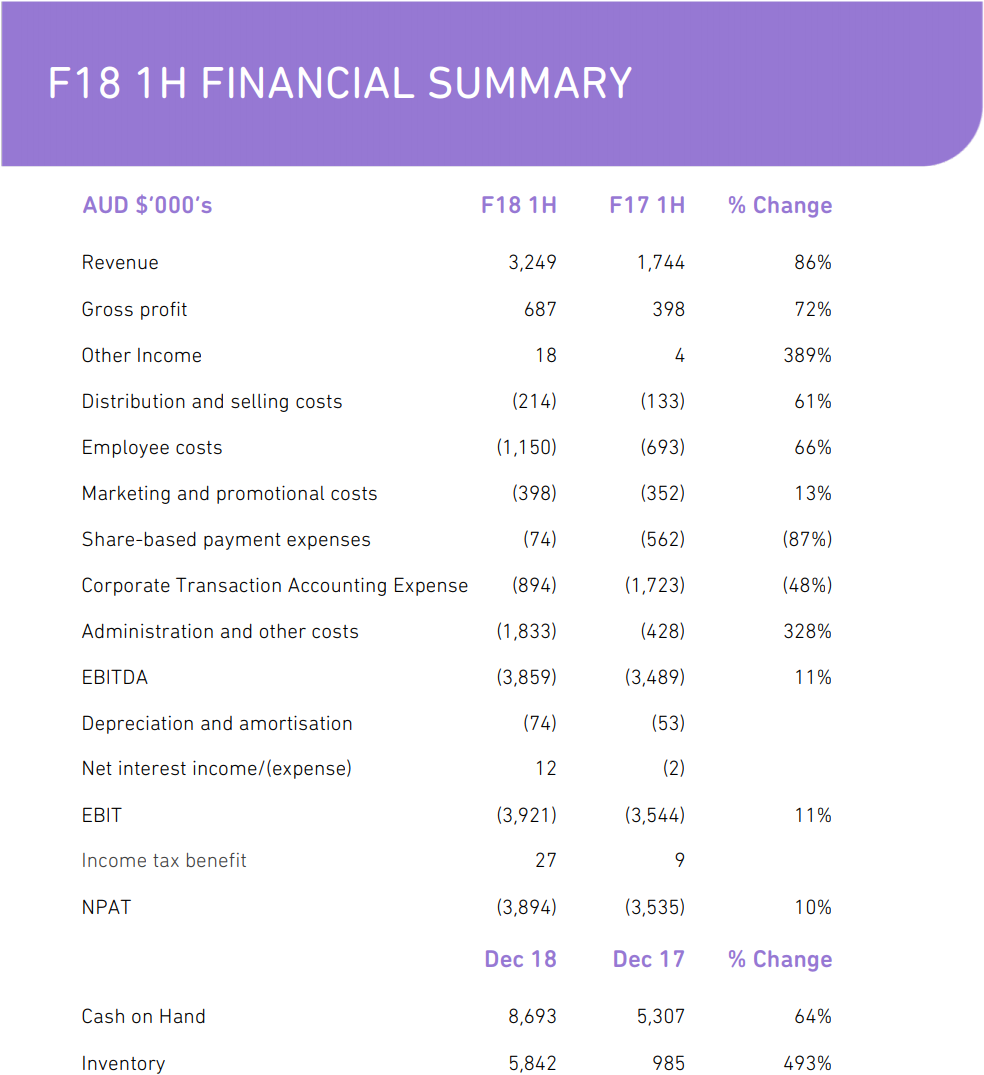
Starting from the top and the company’s revenues for the interim period were up a solid 86.3% year-on-year to $3.249 million on the back of strong market penetration in Australia and growth of the Infant Formula category, its fastest growing product.
Source: Bubs Australia (ASX:BUB) 28 February 2018 Company Presentation
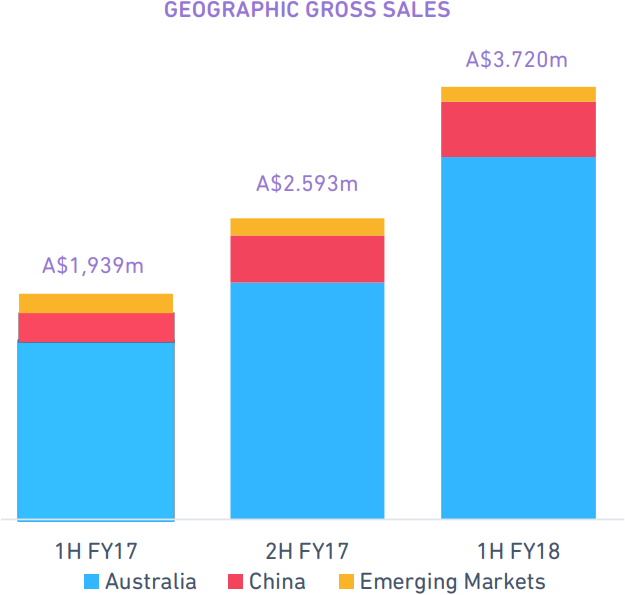
The graphic below shows that the company’s footprint in both Domestic and Chinese markets is accelerating. Domestic sales still account for a sizable portion at circa 82% and have grown 103% year-on-year while 13% of sales came from China (+96% yoy). Note that revenue in China was pushed ahead thanks to e-commerce platforms NetEast Kaola and VIP.com.
Source: Bubs Australia (ASX:BUB) 28 February 2018 Company Presentation
Going forward, management notes that they intend to strengthen domestic presence in order to support the expansion to China. The recent signing up with Woolworths will further this goal, though its impact will most likely be felt in the following fiscal year.
Gross profit increased at a similar pace, up some 72.6% year-on-year to $687 million, though much like other FMCG companies, increased promotional spend weighed on the results. Gross Profit Margins narrowed by 170 basis points year-on-year to a recent low of 21.1%.
Moving on to other costs, operating expenses have also risen at a fast pace, up 62.5% year-on-year to $3.669 million. Though a substantial portion of this comes from one-off cost relating to NuLac acquisition, though looking only at recurring (Distribution, Employee, & Marketing) we see that expenses rose 49.6% year-on-year to $1.762 million. Most of the increases come from employee costs (~78.3%) and followed by Marketing (~13.1%) which are not a surprise considering the rapid growth.
Considering that the company hasn’t reached scale yet, it thus ended the interim period with a statutory net loss of $3.921 million and a worse comparison on a year-on-year basis by 10.6% to last year’s $3.544 million loss. Even if we were to adjust out one-offs, the loss is still evident and scaling up is still highly necessary to achieve profitability.
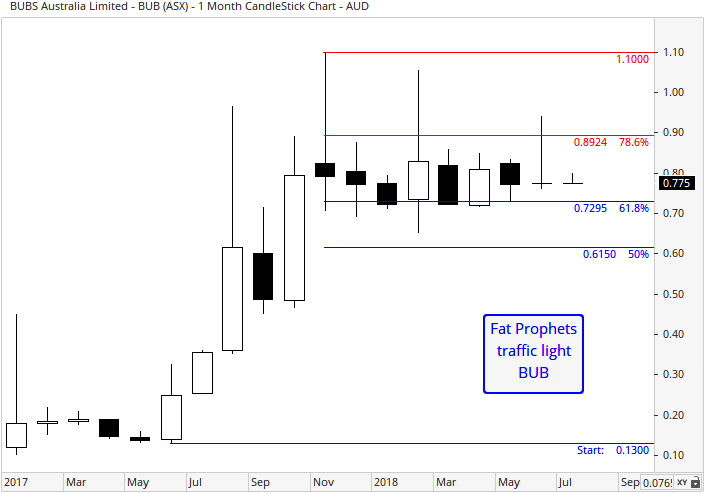
Summary and Investment Conclusion
Bubs Australia (ASX:BUB) occupies an interesting niche in what is otherwise one of the fastest growing consumer market segments. However, as evidenced by the financials and the company still waiting on its accreditation from the CFDA, we believe it prudent to sit on the side lines.
This is especially so considering the string of positive developments in the company’s pipeline pushing the market to price company much higher well ahead of actual results. This makes setting up a position now to be highly risky as any misses on expectations would likely lead to a severe share de-rating.
The fact that the company is also in its early stages of its life cycle make it particularly hard to make reliable estimates on earnings. We also want to see material improvements in the company’s sales and actual demand from China before we feel confident on the company’s prospects.
As such we believe that the most prudent move is to adopt a wait-and-see approach and Traffic Light Bubs Australia (ASX:BUB) until we see material improvements in its fundamentals, and before we initiate a buy recommendation.

