
Vintage year
Oil Search (ASX:OSH) has released its full year result for 2017, and in doing so has revealed a vintage year. Propelled by higher energy prices but a flat production profile and higher cost structure, the company reported a significant improvement across its key profit numbers for the year. Free operating cash flow received a rev-up, while the balance sheet got just that much better. The best for shareholders was left to the end however, with the interim dividend receiving a very serious boost. The following table shows a summary of the company’s full year result for 2017:

Source: Oil Search (ASX:OSH)
Overall, we consider the result to be an excellent outcome for the year.
The company was fully able to leverage stable production and a marginally higher cost structure into rising energy prices; which is fully reflected in the result. On tracking the quarterly operational results for the company, we became increasing more certain about the company having an outstanding year. We consider the result to be one of the better results for the season from our universe of companies.
First, to the recent news on the earthquake in the Papua New Guinea (PNG) Highlands; for a moment give a thought to the plight of the people in the region and we are pleased with the company’s community response to this event. The company has provided an update in that it has taken all the necessary precautions including some shut-ins and production has ceased for safety purposes and damage assessment. An assessment of all infrastructures is currently underway and the company will report to the market in the days ahead on action required. From an initial inspection by ExxoMobil, the operator of the PNG LNG infrastructure, a shut-down in production for eight weeks should be expected. The final assessment period is expected to take at least a week.
Back the full year result, and as Members can see from the above table, the company reported a 236% increase in net profit after taxation (NPAT) on the 2016 outcome, to US$302.1 million. The following waterfall chart shows the factors that impacted on the company’s result for the year (DD&A – depreciation, depletion and amortisation):

Source: Oil Search (ASX:OSH)
The positive revenue metric of US$210.1 million was a result of the company reporting higher energy prices on a flat operational result for the year. Operations delivered a record 30.3 million barrels of oil equivalent (boe) compared to 30.2 million boe from a year earlier.
Natural gas production came in at a record 116,038 million square feet for 2017, which represents a 5.0% increase on the 2016 result. Driving the result was the PNG LNG facility on better efficiencies. Liquids production reported a fall of 11.9% on 2016, to 7.6 million boe on lower oil production.
The company is guiding production in 2018 to be in the range between 28.5 million and 30.5 million boe.
Energy Pricing is where the company picked up the momentum for the year, with the reporting of higher realized prices for both its oil offering and natural gas and liquid natural gas (LNG) offerings. The company reported a 24% improvement in its realised oil price compared to the year earlier price, to US$55.68 per barrel. On the LNG front, the company reported a 21% increase in its realised LNG price compared to 2016, to US$7.67 per million British thermal units.
We have a positive outlook for energy prices in 2018.
We expected the Organization of the Petroleum Exporting Countries will remain compliant with its 32.5 million barrel of oil per day ceiling on oil production. We are cognisant, however, that US domestic oil production will breach beyond 10 million bopd production to act as a constant headwind.
On demand, we expect the synchronisation of global growth will bring with it higher demand for oil. We are forecasting West Texas Intermediate (WTI) to end the year in the range of US$70 to US$80 a barrel and Brent US$74 to US$84 a barrel. At the time of writing, WTI was trading at US$60.97 a barrel and Brent Oil US$64.19 barrel.
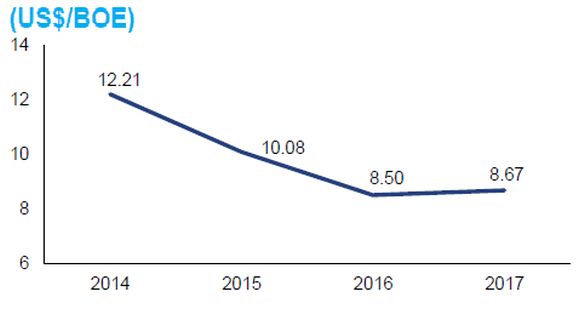
Overall, production costs remained stable at US$294.4 million, which was marginally lower than the US$296 million printed from a year earlier. Unit production costs for the year did however rise, with the reporting of a 2.0% rise from 2016, to US$8.67 per boe. The following chart shows annual unit production costs:
Source: Oil Search (ASX:OSH)
For each of the company’s reporting commodity offerings in PNG Oil & Gas and PNG LNG (Oil Search’s interest 29%) reported divergent unit operating costs. PNG Oil & Gas printed a significant deterioration in its unit cost of production of 32% on the 2016 outcome, to US$20.52. Pleasingly, PNG LNG over the same time period as PNG Oil & Gas printed a 9.5% improvement, to US$5.52 per boe. The weighting of oil to natural gas pushed the overall unit production costs higher.
The company is forecast 2018 guidance for unit production costs to be in the range of US$8.50 to US$9.50 per boe.
Net cash flow from operations was a major beneficiary with the printing of a 52% surge on 2016, to US$843.6 million. Better cash receipts and lower payments to suppliers and employees delivered the outstanding result.
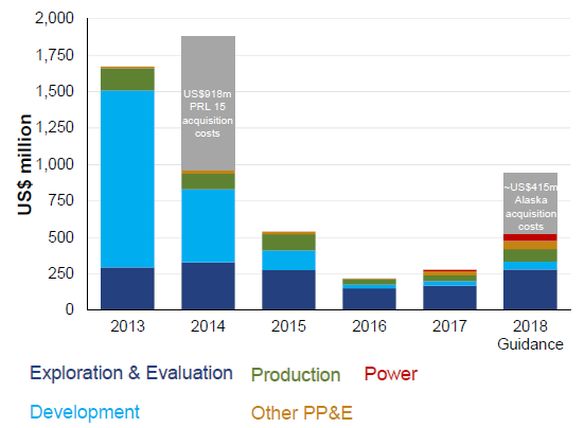
The company pushed to peak capital expenditure in 2014, with the completion of the PNG LNG facility during that year. In subsequent years, capital expenditure has printed seismic shifts lower until 2017, when capital expenditure rose. Capital expenditure rose by 28% on 2016, to US$277.6 million. The following chart shows capital expenditure and 2018 guidance by its constituent parts:
Source: Oil Search (ASX:OSH)
We are certainly pleased with the increase in the company’s efforts on the exploration and evaluation front, with it guiding to a US$250 million to US$310 million range for 2018. Overall, capital spending guidance for 2018 is in the range of US$475 million to US$575 million.
The balance sheet structure at 31 December 2017 improved. Net debt fell to US$2.6 billion from US$3.1 billion at 31 December 2016. The company’s overall debt position improved by US$313.9 million to US$3.6 billion over the same measured period as net debt. Cash holdings also improved US$1.0 billion at 31 December 2016 from US$862.7 million at 31 December 2016. We have no concerns around the structure of the company’s balance sheet.
The company’s gearing on a net-debt to net-debt-plus-equity basis improved to 25.8% at 31 December 2017 from 32.0% from a year earlier.
The company has prudently used the financial uplift from higher energy prices to deliver a strong balance sheet, post completion of the PNG LNG facilities in 2015. We consider that gearing is now at moderate levels, and with the financial capacity to sustain its debt, the company is now well placed to cope with the vagaries of cycle energy prices. To this end however, we expect to see further improvements made to the company’s balance sheet structure over the course of 2018.
We expressed some disappointment with the 2016 dividend but have no short comings with the 2017 dividend. The company declared a 2017 dividend of US9.5 cents per share compared to US3.5cents from a year earlier. The annual dividend is the product of the company paying out in the range of 35% to 50% of core profit in a year. The pay out in 2017 was set at the top end of the range at 48% and reflects the confidence the company has in its financial standing and in its future trading environment and capital requirements.
The 2017 result was a good outcome for the company as it has now we believed reached a rapid post PNG LNG development recovery. Oil Search holds a strategic asset in PNG LNG that can deliver long-term value and now has the capacity and ground to deliver. The company is focused on a region in PNG that is endowed with energy that offers “blue sky” potential, while utilizing existing infrastructure.
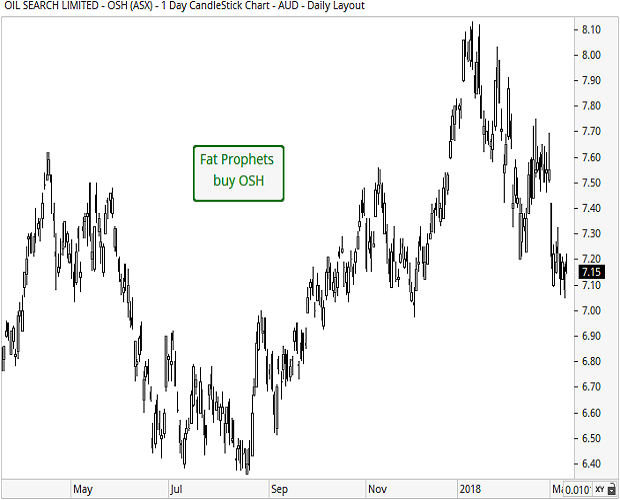
Consequently, our recommendation for Oil Search (ASX:OSH) as a buy for Members who hold no exposure to the stock remains unchanged.
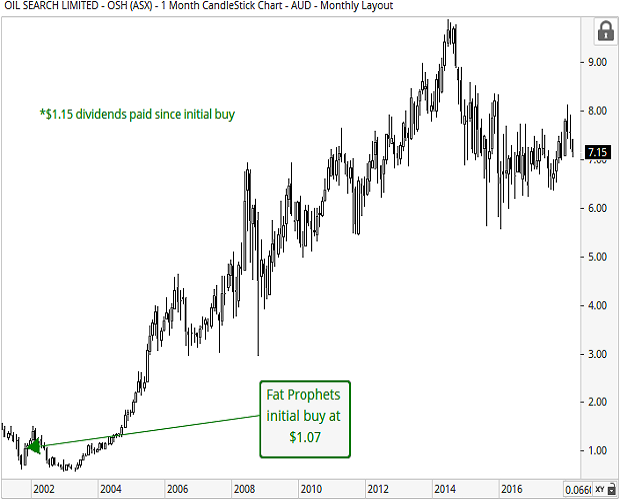
Disclosure: Oil Search (ASX:OSH) is held within the Fat Prophets Mining and Resources, Concentrated Australian Share and Global Opportunities portfolios.

