
Noticeable Improvements
Consumer Credit player FlexiGroup (ASX:FXL) recently released its interim performance numbers which point towards some noticeable improvements, especially in corporate debt load. We also see that the Certegy business is making progress with its return to growth while the consumer leasing business has recently brought to market a new brand to factor in new government regulations. Overall, we remain optimistic towards group over the longer term, though the short term may still be bumpy as management steers the business through some headwinds.
Recap and What’s New
A salient development since our last report on FlexiGroup (FAT-AUS-852) has been the announcement of a new consumer lease product by Mid-February 2018. This will be the first product in the market to include a range of government panel recommendations, which will also use digital channels and partner with a major retailer for distribution.
Pictured below is the company follow-up to the announcement which was included in the Interim Results:

Source: Flexigroup (ASX:FXL) 20 February 2018 Company Presentation
The move will lead to the winding down of the older FlexiRent brand which will impact financials with a post-tax write-off of circa $76.2 million and a capitalised software development cost of $12.9 million. Note that this will not have any impact on cash as management has retained Cash NPAT (Net Profit After Tax) guidance of $85-$90 million.
Following that announcement, it seems that the market has taken the initiative well as the share price have begun to trend up, gaining some 10% before the stock dipped ahead of interim results, likely due to investors pricing in the expected earnings decline based on the restructuring announcement.
Today, our main focus will be the first half (1H18) results and uncover the progress the company has made thus far.
1H18 Results Review
Starting from the top line, 1H18 company revenues (total portfolio income) were 2.6% lower year-on-year to $229.3 million, mainly due to lower volumes in the Consumer and NZ Leasing segments as well the adverse impact of forex movements (AU$/NZ$). Though this was partially offset by a robust performance in the Australia Cards business which reported significant growth.
According to management, the Australia Cards business had one of the strongest performances, mainly due to new customer acquisitions, along with increased spending from existing customers (+69% yoy). This in turn led to Volume growth of circa 51% to $358 million, pushing receivables up 48% year-on-year to $575 million. Going forward, we expect momentum to remain strong given the upcoming launch of a new card as well as continued increase in average spend.
The graphic below summarises the volume trends of the 6 business segments:

Source: Flexigroup (ASX:FXL) 20 February 2018 Company Presentation
The NZ Cards business also reported strong volume growth, up 12% year-on-year to $363 million which is twice as fast as the broader market’s pace from higher average spend. Receivables also had a slight (+3% yoy) improvement. Customer count, however, declined 2% year-on-year to 384,000, but management plans to counteract this decline by signing up more merchants while adjusting product packages to attract a broader group of customers.
Another focus for management in this segment is to reduce operating costs and so far they have been successful. Operating costs have fallen by 11% year-on-year to $19.8 million and the company is looking for further efficiencies by combining operations with the NZ Leasing business.
Next is the Certegy business, which based on our previous coverages (FAT-AUS-838) reported headwinds from margin pressure and mounting costs. As can be seen in the graphic above, Certegy volumes have been weak, but the most recent trend has seen improvements following a digitisation focus as well as improving operations in Ireland (Flexi-Fi) and Oxipay.
As such volumes were lower by 4% year-on-year at $267 million but are 7% higher from the preceding period. And management notes that segment Cash NPAT of $16 million is way ahead of the FY18 guidance of $7-$9 million.
Finally, we take a look at the Consumer Leasing business which is the hardest hit given the management thrust of closing down the older FlexiRent brand, causing volumes to decline 9% year-on-year to $52 million, with new government regulations reducing customer engagement.
Going forward, management notes that the new Lisa brand is expected to take up the slack given it has been first to market and has already received 3 times that applications compared to what the retired FlexiRent brand would usually get over a similar time period given that applications can be filed via laptops and phones.
Moving on to the cost side, Interest Expenses (a major input) were lower year-on-year by 6% to $48.2 million as a result of lower volumes in the Consumer and Commercial Leasing. The company also reported substantially lower financing needs at the group level with average net gearing down from 82% to 43%, with corporate debt expense falling by $1.3 million. Management notes that they will continue to deleverage for the FY18.

Source: Flexigroup (ASX:FXL) 20 February 2018 Company Presentation
Operating expenses, on the other hand, were 6% higher $84.2 million due to higher spending on restructuring and increased investments in digitisation. However, the largest drag was the impairment of goodwill and intangibles of $94.7 million which was already flagged in December following the retirement of FlexiRent.
All in all, this resulted in a statutory net profit after tax loss of $50 million, however, adjusting for the restructuring and other non-cash items, Underlying Cash NPAT for the 1H18 was only 11.3% lower year-on-year.

Source: Flexigroup (ASX:FXL) 20 February 2018 Company Presentation
Summary
FlexiGroup’s recently released first half 2018 results show that the company is taking the impact of new regulations in consumer leasing in its stride having brought to market the new Lisa brand well ahead of competitors. That aside, the company also reports strong performance in the credit card business with its continued push for growth.

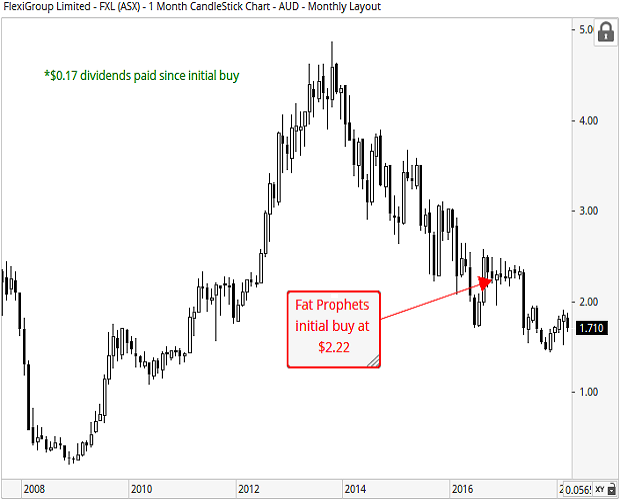
From a valuation perspective, the shares are very modestly priced in our view, at around 7.4 times FY18 earnings, with a prospective dividend yield of 4.7%. However, given that the business is currently undergoing restructuring which will inevitably lead to higher costs and bumpy earnings in the near term, FlexiGroup (ASX:FXL) will retain its HOLD rating and remain in the Fat Prophets Portfolio.
Disclosure: FlexiGroup (ASX:FXL) is held in the Fat Prophets Small & Mid-Cap managed account portfolio.

