
Quality on the Cheap
Stockland (ASX:SGP) delivered improvements in several key metrics in its recently reported interim results. The group is a leader in several areas and has a diversified portfolio that is being undervalued at current levels in our view. Accordingly, we rate the stock a buy.
Rising bond yields have seen a sell-off in many ‘yield’ plays, including Stockland with the view that a strong income stream is not as enticing as it was. However, demand for high yielding income stocks, and particularly those with strong earnings growth potential is not going to suddenly evaporate. Moreover, we believed this has created an opportunity to buy quality select opportunities which have been oversold, with Stockland a prime example, trading at below net tangible assets currently.
The company is one of the largest residential property groups in Australia, but is focussed at the right end in our view, selling land rather than apartments, and targeting affordable housing and owner/occupiers. In retail, Stockland’s shopping centre properties are well positioned, with strong occupancies. Stockland is leveraged to the current residential boom, selling vacant residential land ready to build on. Stockland can raise prices on land it is selling and settling, and benefit from the cycle promptly.
We continue to rate Stockland (ASX:SGP) as a buy for Members without exposure.
1H18 snapshot
For the six months ended 31 December 2017, revenue from ordinary activities increased 14.3% year-on-year to $1,337 million. The closely funds from operations (FFO) grew 18.2% to $436 million, while FFO per security was up 16.9% to 18.0 cents and adjusted FFO per security increased 16.4% to 15.6 cents.
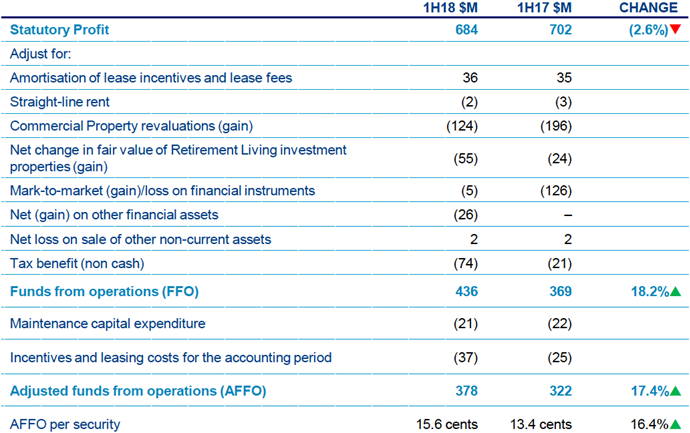
Statutory profit dipped 2.6% to $684 million. The following table shows the reconciliation for statutory profit to FFO, with some of the largest variances being commercial property revaluations and mark-to-market changes on financial instruments.
Source: Stockland 1H18 presentation
The half year distribution was 13.0 cents per security, as expected and up 3.2% from the prior year and placing the group on track for its targeted 26.5 cent full year distribution.
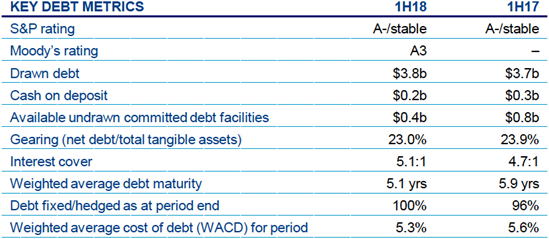
The return on equity climbed from 11.0% in 1H17 to 11.7% in 1H18, while net tangible assets per security ticked up 4.5% to $4.18. Gearing, as measured by Stockland, stood at 23.0% at the end of the period, down from 23.9% a year ago and towards the lower end of the target range of 20-30%. Interest cover increased from 4.7 times to 5.1 times and the weighted average cost of debt for the period compressed from 5.6% to 5.3%.
Source: Stockland 1H18 presentation
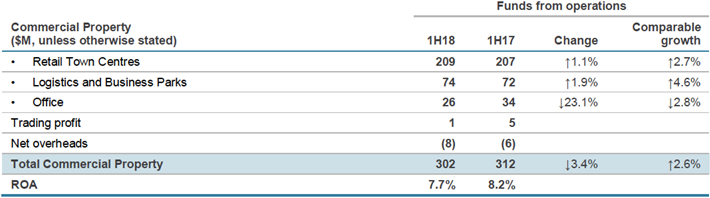
Looking at the components of the key FFO measure and commercial property continued to be a key driver.
It comprised retail town centres, logistics / business parks and office assets. There was comparable growth in FFO of 2.6% across the portfolio.
The retail environment is “subdued” but Stockland delivered comparable FFO growth of 2.7% for its retail town centres and funds from operations were up 1.1% on an absolute basis to $209 million.
The retail town centres segment represents about 50% of the Stockland portfolio. Occupancy remained at a high 99.5%.
Source: Stockland 1H18 half year report
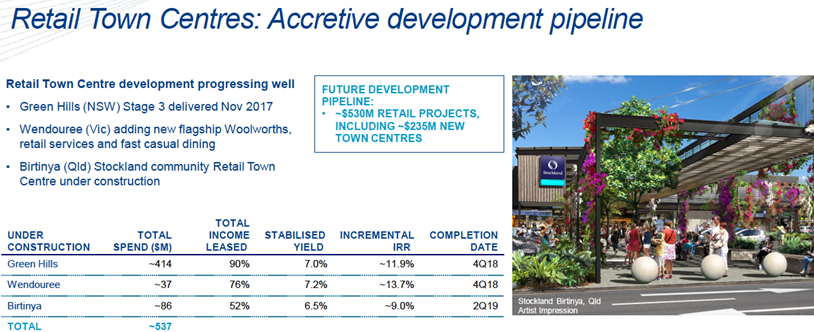
About 90% of the retail town centre portfolio comprises centres that lead their catchment area or are mixed use, CBD, or community neighbourhood centres. Following a flat start to the year, retail sales growth accelerated to 2% in 2Q18. Speciality retail sales of 10% in retail services and 2.8% in casual dining and food catering indicates the remixing strategy is proving successful. In addition to the $414 million redevelopment at Green Hills (NSW) and a pipeline of greenfield town centres, the group has 20 smaller upgrade and remixing projects in progress or recently completed.
Source: Stockland 1H18 presentation
The group is also seeking to optimise its retail town centre portfolio through selective divestments. In 2017 Stockland said it is aiming to divest approximately $300 million of retail town centres over the next 12 to 18 months and to date, around $70 million has been divested.
The logistics and business parks portfolio saw FFO grow 1.9% to $74 million, as comparable FFO grew 4.6% and occupancy was at 98.8%, up from 96.1% a year earlier. The group is on track to increase the weighting of this segment within the portfolio to 20.0% (currently 14%). Stockland currently has $176 million of projects under construction and an additional pipeline of $590 million targeting 7.0% yields focused on eastern seaboard capital cities. Stockland has lodged a submission for a $500 million state-of-the-art technology hub at its Macquarie Park logistics site, which would add to the pipeline materially.
The office portfolio FFO of $59 million was down 23.1% on an absolute basis and comparable FFO declined 2.8%, largely due to higher vacancies in Perth and ACT. The company said these assets are progressively being leased. Management is assessing development opportunities for the Sydney assets, some of which they believe have better use options and divestments are also on the table for optimised assets.
Stockland (ASX:SGP) is the largest residential land developer in Australia, with 58 communities across New South Wales, Queensland, Victoria and Western Australia. The focus is on master planned communities and medium density housing in growth areas.
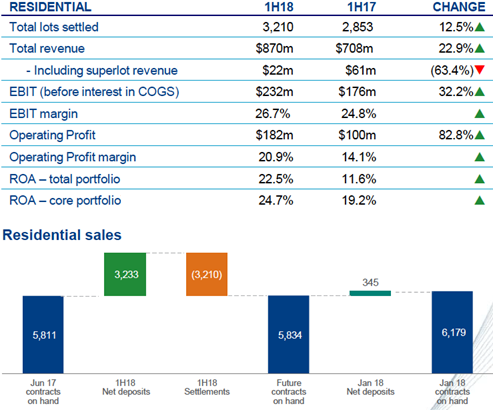
The residential business settled a record 3,210 lots, marking a 12.5% increase on 1H17. Operating profit (FFO) from this segment jumped 82.8% to $182 million as the operating profit margin expanded from 14.1% in 1H17 to 20.9% in 1H18. Stockland is on track for 6,500 settlements in FY18, with margins for the full year expected to moderate, but still be strong at 17% or so. Contracts on hand increased from 5,811 at June 2017 to 6,179 at January 2018.
Source: Stockland 1H18 presentation
Finally, the retirement living segment was a relative laggard in 1H18; so has some work to do in the second half if it is to continue its streak of growth. FY17 marked its fourth straight year of double-digit growth, with operating profit up 11.1% to $63 million, driven by strong sales, active management and improved margins.
In 1H18, operating profit (FFO) slumped 29.7% year-on-year to $18 million, as customer confidence was adversely impacted by increased media attention on the sector and lower volumes of new development stock due to project timing.
Outlook
Looking ahead, Stockland’s guidance is unchanged, with targeted FFO per security growth of 5.0% to 6.5% in FY18, with growth tilted towards the first half of the year due to the timing of residential settlements. Distribution growth is pinned at 4.0%, representing 26.5 cents per security.
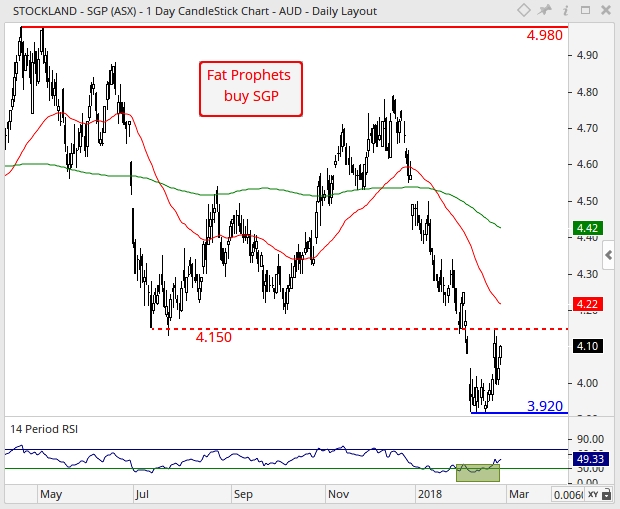
Turning to the charts, and on the daily, prices are trading below both the 50 day (red line) and 200 day (green line) moving averages which is suggestive of momentum to favour the downside. If the bears were to remain in control over the near-term, then support is sighted at the February intra-month low of $3.92 (horizontal blue line). On the plus side, from a relative strength (RSI) perspective, this indicator has strengthened from oversold territory. This suggests an exhaustion in short-term selling pressure, and so an interim low/turning point may be near. In order for the short-term technical landscape to improve, a sustained break above the 50-day moving average (red line) of $4.22 is required. Should this occur, then momentum would once again shift north.
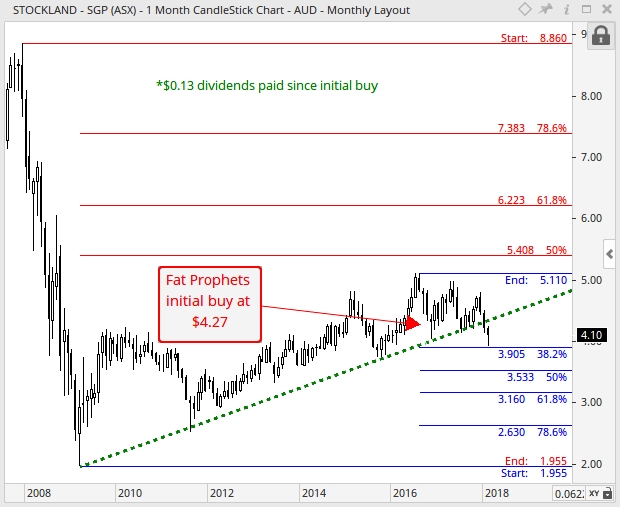
With reference to the monthly chart, support is indicated at the 38.2% Fibonacci retracement of $3.91 (blue set of retracements), should the bears remain in control over the near-term. In the grand scheme of things, the broader uptrend remains in play as evident from the series of higher lows and higher highs in formation since 2010, despite the recent spell of weakness in price-action. It should also be noted that the breach of the uptrend line (upward sloping green dashed-line) in January is suggestive that it is indeed weakening. Therefore, in order for the bull-camp to regain upward traction, prices would need to trade back above the long-term uptrend line of $4.38.
Summary
Stockland (ASX:SGP) trades on a forward earnings multiple of 12.2 times, and offers a yield of around 6.5%, with a history of steady dividends (which should also cap share price downside). Trading around $4.12 currently, the stock is also backed by net tangible assets of around $4.18 per share, with meaningful scope for earnings per share growth. Stockland is leveraged to the current residential boom.
We recommend Stockland (ASX:SGP) as a medium risk buy for Members with no exposure.
Disclosure: Stockland (ASX:SGP) is held in the Fat Prophets Income Model Portfolio.

