
In for a solid 2018
A recent report published by the World Bank is optimistic on 2018 with the global economy set to grow at a faster pace than year. In Asia, expectations are slightly muted due to expectations of a slowdown in China. Nevertheless, there are signs that a surprise to the upside is in the wind elsewhere in the region, with growth likely to impress on the back of robust domestic and international demand. Accordingly, we retain a
bullish view on the Asian region, and maintain our BUY recommendation for Members without exposure on the Platinum Asia Fund (APIR code: PLA0004AU).
The World Bank (WB), recently released an update titled “Global Economic Prospects”. According to the report, the world’s economic prospects look brighter with global growth to come in at 3% for 2017, up from an earlier forecast of 2.7% while 2018 is slated to grow at a faster pace of 3.1%. For the purpose of this report, we will focus on the Asia ex-Japan data.
On that note, according to the WB, growth in the region is expected to slip slightly in 2018 to 6.2% compared to an estimated 6.4% in 2017. This is mainly due to expectations of a structural slowdown in China which will offset the cyclical pickup in the rest of the region. Despite that, the WB did note that despite China’s growth being slower it will be more sustainable owing to the success of their reforms and continued fiscal support. We also noted in a previous report that the ADB expects growth in the Asia region to exceed 6%.
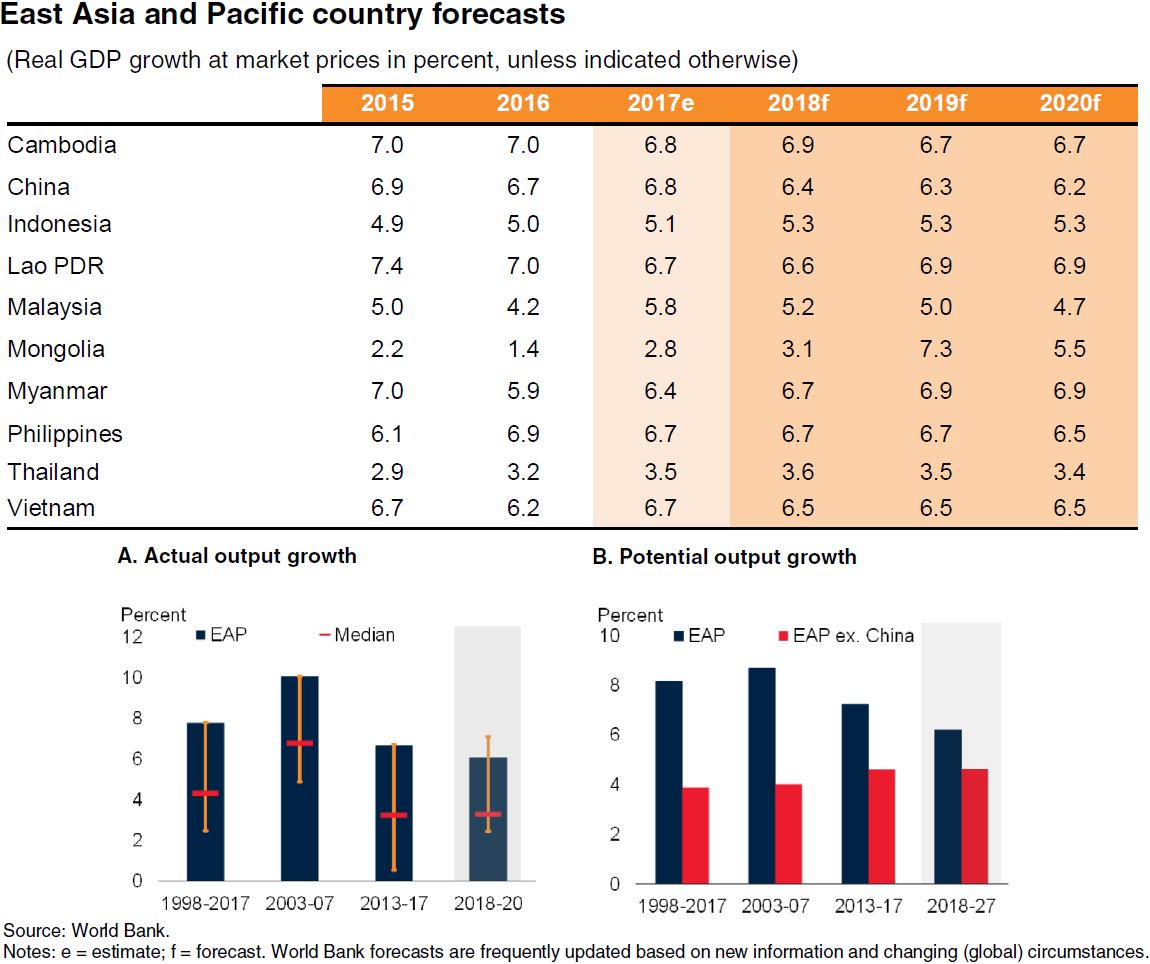
Source: World Bank
Despite the expected slowdown in China, the region is expected to continue to be a major driver of global growth and account for more than a third of global growth in the period between 2018-20, mainly because of China’s significant 30% contribution.
The region boasts strong domestic demand as it is supported by a burgeoning middle class and improving confidence. The region as a whole is also benefitting from accommodative policies and a reversal of capital outflows.
Though these estimates represent the aggregate growth in the region, there are individual differences across countries. We briefly provide an update on the countries with sizable representation in the Platinum Asia Fund.
China is the region’s, and indeed the world’s, largest growth engine. Though the WB notes that China’s growth will taper in 2018, this is mostly due to a large base (and rate) in 2017 which has been upgraded to 6.8%, marking a 20-basis point increase. In 2018, the WB expects China to deliver a more modest (but still strong) 6.4% pace.
According to Franziska Ohnsorge at the WB, “currently the growth slowdown in China is very well managed. It is very steady and gradual and the authorities have managed to calibrate it properly“.
Nevertheless, we believe there is substantial room for a surprise on the upside given that China’s property market is set for a rebound in 2018 following the tapering of their restrictive policies in 2017. Note that this sector alone contributes a sizable 7.8% chunk to the economy which amounts to circa $1.8 trillion.
This is supported by a boost in new construction starts as measured by floor area which surged circa 19% in November from a year ago, after falling 4.3% in October. It is also notable that China’s demand for property outweighs supply. Allied industries also show robust growth with building machinery and equipment sales jumping more than 100% year-on-year.
The broader manufacturing sector also reports continued strength based on data from IHS Markit’s Caixin China Composite PMI Output Index which rose to 51.5 in December, the highest level since August. According to the report, output and new orders have been on the uptick due to stronger domestic demand. It seems that things might turn out better than expected for China if this pace continues.
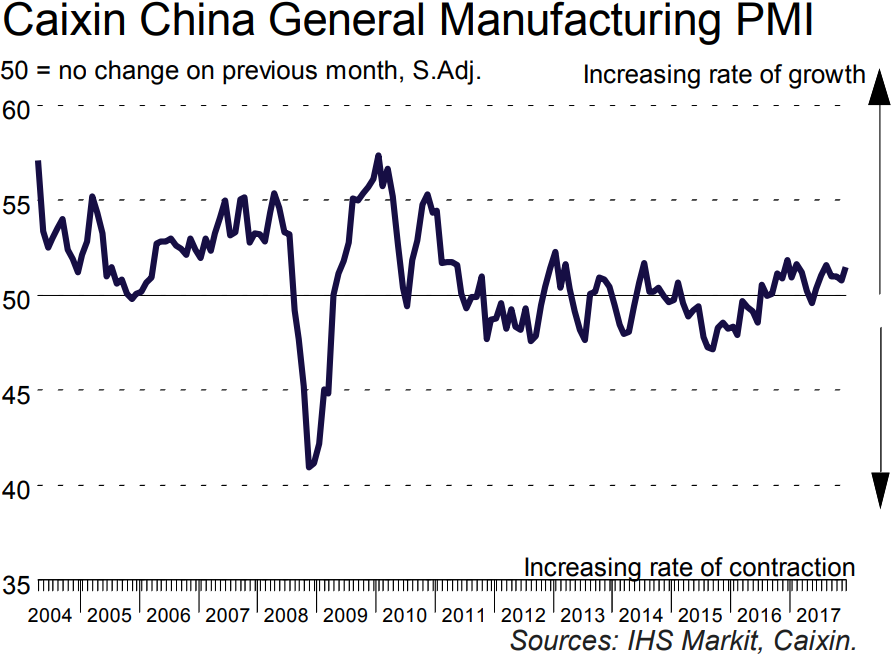
Source: IHS Markit, Caixin
Next up is India, which, according to the WB, is expected to accelerate at a faster pace. 2018 GDP expectations are set to hit 7.3% growth, faster than the 2017 estimate of 6.7%. This is expected to accelerate even more in two years to 7.5%.
According to the report, despite the initial setback from the Goods and Services Tax (GST) as well as the aggressive reform policies of Prime Minister Narendra Modi, India’s positive outlook is predicated on strong private consumption and private investment to support economic activity.
The GST benefits of fiscal sustainability by reducing the cost of complying with multiple state tax systems, drawing informal activity into the formal sector, and expanding the tax base are expected to kick in as well.
In addition, India’s PMI data according to Nikkei India and IHS Markit have reported a massive surge in manufacturing activity in December to 54.7, it’s strongest pace since 2012. According to the respondents, the surge in business activity was a result of greater demand from both domestic and international markets. It also helps that job creation has reached its highest peak since August 2012 leading to much higher consumer confidence.
In ASEAN the WB has also noted that the region is expected to grow at a pace of 6.0% in 2018, slightly above 2017’s 5.96% pace. The higher growth forecasts are expected to come from Cambodia (6.7%), Laos (6.8%), Myanmar (6.8%), and the Philippines (6.7%). The WB notes that the region is expected to benefit from the huge demographic base as well as rising export demand from major industrial economies.
On the other hand, PMIs were relatively weak in December hitting 49.9 as a sharp decline in Singapore (44.7) dragged down the average. Though notably, the region reported that most (4 of 7) countries increased manufacturing activity. The countries that continue to stand out are Vietnam, the Philippines, Myanmar, and Thailand.

Source: IHS Markit, Nikkei
The Platinum Asia Fund has a flexible mandate, which allows it to short stocks, and is very much an active Fund which can deviate significantly from its benchmark. The Fund has an impressive track record of outperformance over the medium-term and this, in our view, reflects its flexible mandate.
Accordingly, the Platinum Asia Fund will remain firmly held in the Fat Prophets Global Funds Portfolio and for Members without exposure we recommend it as a buy.

Fund Details
The Platinum Asia Fund is a very actively managed fund, although it is generally still classed as an equity fund. The objective of the Fund is to provide capital growth over the long-term through searching out undervalued listed (and unlisted) investments in the Asian region. Investors in the Fund can expect the portfolio to contain listed companies based in China, Hong Kong, Taiwan, South Korea, Malaysia, Singapore, India, Thailand, Indonesia, Philippines, Sri Lanka, Pakistan and Vietnam. The Manager suggests the Fund is appropriate for investors with a minimum time horizon of 5 years or more.
The Fund is managed by Joseph Lai who has been with Platinum since April 2004, and previously worked for Morgan Stanley in their Equities Research Department. After starting at Platinum, he worked on Greater China equities and has been co-manager of the Asia Fund since 2011.
Platinum Asia holds investments in the Asian region, with the portfolio ideally consisting of 75 to 150 securities that the Manager believes to be undervalued by the market. Cash may be held when undervalued securities cannot be found, and Platinum Asia may also short sell securities. The Fund’s management expense is 1.54% per annum. This includes GST, administration and investment costs. There is a buy/sell spread of 0.5%.
The minimum investment is A$10,000.
Applications and withdrawals may be made every Sydney business day.
The Platinum Asia Fund is an open-ended investment trust, and should not be confused with Platinum Asia Investments, a listed investment company (LIC) on the ASX. Platinum Asia Investments is the listed version of the Platinum Asia Fund.
Performance
The Platinum Asia Fund maintains an impressive track record of outperformance over the benchmark in the medium-term; reflecting its flexible mandate.

Source: Platinum Asia Website
Based on the portfolio manager’s recent commentary, the fund’s performance was led by Chinese equities given the stronger performance of companies serving the burgeoning Chinese middle-class consumers as well as Healthcare and Pharmaceutical stocks. Secondary contributors came from other Financials from across the Asian region.
This is evident with the fund’s short-term three-month return (C Class) hitting 9.5% compared to the benchmark’s (MSCI Asia ex Japan) 8.6%. As discussed in the previous section, it seems that the continuing strength and prospects in Asias economy are boosting expectations and bidding up asset prices.
Over a one-year period, the Fund also displays a substantial outperformance relative to the benchmark due to their substantial positioning in China and India, which both reported solid returns given the economic upturn in 2017. It is also worthy to note that Vietnam’s equity markets in the year returned an impressive 48%. However, over the three-year period, the relative underperformance to the benchmark was a result of the Fund’s higher cash position at the time, which hovered above 12% (14 – 18%) and inevitably dragged down returns.
Our reports that covered the December 2016 Fund update showed that the fund had a sizable 17.8% cash holding. On the flipside, having a sizable cash position allowed the fund more opportunities to capture undervalued stocks while simultaneously avoiding exposure to markets that performed poorly.
Over the longer term, on a five-year and ten-year basis, the Fund continues to outperform the benchmark, with the Fund returning 16.3%, and 8.3% respectively per annum, while the benchmark delivered 14.2% and 5.0% over the same periods. Beyond the ten-year period, the Fund continues to outperform with a 15.8% per annum return since inception versus the benchmark’s 10.9% return per annum. This is captured in the chart below.

Source: Platinum Asia
With regards to the Fund’s current positioning, we note that it maintains a highly diverse portfolio across the Asian region, though with a substantial difference in weighting relative to the benchmark.
As of December 2017, compared to the benchmark, the Fund is significantly underweight Hong Kong (-8.12%), Taiwan (-11.1%) and South Korea (-6.13%) while being substantially overweight in mainland China (+16.7%). The fund tracks India quite closely with only a marginal differential (+0.1%).
With a higher cash holding (~11%), the Fund also maintains a defensive position as a cushion following economic restructuring in other parts of the world, especially in a low growth environment and increasing volatility in global markets. Nevertheless, as Asia’s economic figures are improving, we expect the Fund Manager to deploy more capital to take advantage of opportunities.

Source: Platinum Asia
Since our last coverage of the fund in October 2017 (FAT-AUS-842) the fund has reduced their exposure in the ASEAN region from 14.4% to 11.0% and is also relatively underweight to the benchmark’s 13.57%. Though they did not explicitly provide commentary, we surmise that it is likely due to profit-taking activity given the strong run up in prices in the region and historically high valuations.
Top 10 Holdings
We will now look at a select few of the Fund’s top holdings. The manager notes that while some of the companies with strong market positions and robust growth are undervalued by the market, the Fund is well exposed to these positions.

Source: Platinum Asia
First off, we start with, Alibaba Group, China’s equivalent of eBay and currently the largest retail platform in the country with more than 10 million merchants and 440 million active users. The company also engages in other businesses such as cloud computing, mobile media and entertainment, and other innovative initiatives.
In our view, one key development stands out for the e-commerce behemoth. It seems that political favour really is fickle. Mr Jack Ma became the first major Chinese business leader to score a visit with US President Donald Trump, but the company’s efforts to then buy MoneyGram were stifled.
This was then followed with their Taobao platform being blacklisted by the US government with accusations of them peddling counterfeit product with the following statement “a high volume of infringing products reportedly continue to be offered for sale and sold on Taobao.com and stakeholders continue to report challenges and burdens associated with IP enforcement on the platform”
Alibaba then fired back with a “point by point rebuttal” with Alibaba Group President Michael Evans stating that they “went above and beyond each specific concern raised by the USTR (United States Trade Representative) last year.” The company has also lashed out that that the Trump administration is merely using them as a “scapegoat” with the their “trade protectionist” policies.
Still, the company continues to go from strength to strength in its home market and has ample global growth opportunities.
Ayala Land Corporation is the Philippines’ premier real estate company and part of one of the oldest and largest conglomerates in the Philippines. The company is well known for its residential development, shopping centres, business parks, hotels and resorts.
The company recently reported 9M17 results with net income hitting ₱17.81 billion, up 18.3% year-on-year on the back of higher sales of residential and office units which surged 11.7% year-on-year to ₱94.2 billion. This result is in-line with consensus estimates and accounts for 73.4% of the target. Note that last year’s income accounted for circa 70% of full-year estimates.
Going forward, with the recent passage of the Tax Reforms under the Duterte Administration, we expect the entire sector, specifically Ayala Land with its exposure to Business Process Outsourcing, to benefit greatly as it will provide tax incentives.
In addition to that, the company is also set to benefit from the growth of the country’s nascent Offshore Gaming (POGO) industry as their office building, Circuit Makati (271 sqm), has already reported a full occupancy rate with all leases coming from the POGO sector. Demand has been substantially robust that a second tower (under construction) may also be marketed to that sectort.
The residential side of the business is also seeing benefits as a large number of Chinese citizens are buying up condominium units to be near the gaming zones. Furthermore, management notes that for the first time that some of their buildings are reaching the 40% limit of foreign ownership with majority coming from the Chinese.
Other holdings within the top ten are held across financials, industrials, and information technology. We believe these to be quality large cap holdings in general, with strong exposure to the Asian thematic on which we remain bullish.
Summary
The prospects for GDP growth in Asia seem more muted in 2018 according to the World Bank due to an expected slowdown in China. Nevertheless, there are signs that a surprise to the upside is possible, especially with a possible upturn in the Chinese property sector.
Other areas in Asia are also reporting their own flavor of growth on the back of robust consumption along with rising international trade.
Over the long-term we remain positive on Asia’s investment story, with a rising and affluent middle class setting the stage for a large ‘demographic dividend’.
While growth in Asia will not be without its challenges, we believe that improvements in key countries like India as well as emerging markets including Indonesia, Thailand, Vietnam, and the Philippines will drive investment performance and opportunities for the Fund.
In reviewing fund options to gain a broad exposure to an Asian thematic, we view the Platinum Asia Fund as a strong play.
Accordingly, the Platinum Asia Fund will remain firmly held in the Fat Prophets Global Funds Portfolio and for Members without exposure we recommend it as a buy.
Disclosure: Interests associated with Fat Prophets declare a holding in Platinum Asia Fund, Baidu, Tencent and Samsung Electronics.

