
Banking after the commission.
Shares in NAB (ASX:NAB) has remained buoyant with current movements at the high end of the current price consolidation area as the bank emerges from the covid era and the royal commission into banking practices, that saw major reputational damage and a shakeup internally with the improving results now making their way onto the balance sheet.
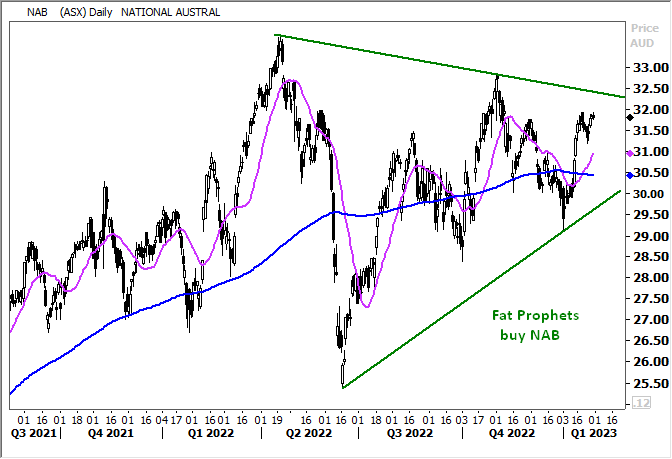
The Daily chart for NAB displays a multi quarter pennant pattern, this type of continuation pattern indicates the potential for higher prices following a breakout. The 20 period simple moving average has crossed the 200 day moving average with price remaining above both averages.
In recent commentary NAB has acknowledged the underlying market dynamics are changing with volume growth expected to slow in FY23, higher refinance activity as fixed rate loans mature coupled with intense price competition in a rising rate environment. This FY22 results outcome reflects continued execution of the banks strategy outlined in the 1H-22 results, including targeted volume growth and a disciplined approach to managing costs while investing for growth. The changing environment after 11 years of interest rate reductions, has resulted in earnings also benefiting in FY22 period from the new rising interest rate environment.
We review the FY2022 numbers and review our recommendation with 1H23 results due out in the coming month.
The FY 22 results show a net profit of A$6.89b an overall increase of 8.3% from FY2021, overall income increased 8.9% to A$18.296b for the full year.

Source: NAB (ASX:NAB)
Both sides of the business are growing with lending for home loans increasing 7.1%, however the bank has flagged some headwinds against a slowing property market and rising interest rates placing cost pressure onto households.
Ongoing process and technology improvements contributing to improved customer experience in FY22 has moved to more than 85% of digital-enabled loan modifications by customers being processed via self-service within the NAB App.
The simple home loan product (SHL) rollout across the broker channels remains on track for completion in FY24. About 90% of Retail flow now submitted via the simple home loan product guidelines featuring variable Loan to valuation pricing app. This is leading to over the counter transactions declining 32% from 2020 and inbound call also declining 23% with the digital chatbot interactions increasing 163% over the same period.
The business loan book remains robust with account openings up by 28% since 1H-22, with business loan growth of 13% in the small to medium enterprise lending, within the Australian business lending growth of 12% has been derived from an increased lending for the Agricultural by 16.4% followed by trade and manufacturing lending growth of 13.8%. With technology now playing a greater role the business unit, costs fell by 11% through simplification of the application process.
 Source: NAB (ASX:NAB)
With the increase in credit provision comes the risk of credit impairment, the bank has moved the credit impairment write back provision higher to A$125m, it is pleasing to note the ratio of 90+ day of overdue loans has decreased 28bps to represent 0.66% of the gross loans on the book.
Looking at the divisional performance the bank has returned a very strong across the board result with business & private Banking growing A$3,013b or 21.5%.
The strong earnings being driven by higher revenue and volume growth, with the result from the current interest rate cycle providing higher operating margins, combine this with lower credit impairment charges provides a strong start for 1H-23.
These results have been offset by higher inflationary pressures and by higher operating expenses, including the impact for the HICAPS integration of Lantern Pay healthcare by way of full acquisition.
Personal Banking declined to A$1,591b or 3.6% over FY21, earnings declined primarily reflecting the impact of home lending competition on margins. Excluding the impact of the Citi consumer business, the Citi consumer business, was down 4.4% revenue declined with lower margins more than offsetting lower operating costs. A lower level of credit impairment write-backs was also a key driver.
Corporate and institutional banking was the strongest driver with A$1,628b or 34.9 growth, with higher revenue mainly reflecting strong volume growth and higher margins, combined with lower credit impairment charges. New Zealand Banking added NZ$1,403b or 14.1, again revenue increasing due to growth in volumes and higher margins.
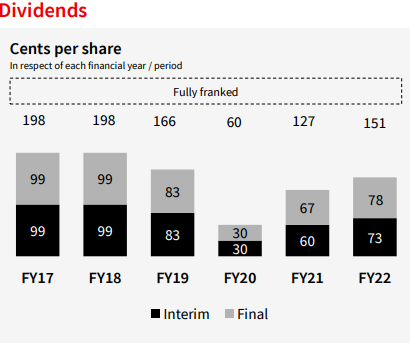
This solid improvement in the banks Net profit has supported a healthy increase in dividend back to $1.51 again, approaching the payout reminiscent of pre covid 2019 where the bank offered $1.98.
 Source: NAB (ASX:NAB)
NAB (ASX:NAB) will enter FY23 well positioned for what is likely to be a more challenging environment. The business has growth momentum to their reinvigorated strategy, but note retail spending has remained robust, but higher official interest rates are likely to put pressure on disposable income and lead to reduced spending, with the main impact on consumption growth expected across 2023.
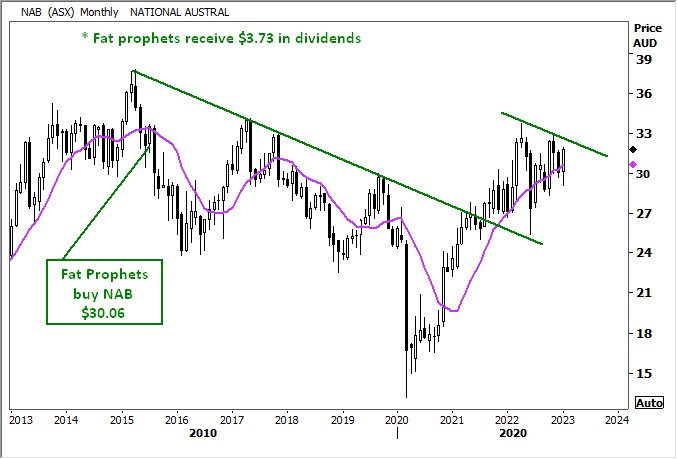
The monthly chart for NAB (ASX:NAB) shows the current price movements crossing the multi year down trend line and consolidating below the $33.00 level. Price remains above the 12 month moving average.
 Summary
Pent-up real estate and retail demand post COVID-19 now appears to be moderating across the industry. There is evidence customers are now prioritizing spending and ‘trading down’ purchases, with the trend of spending being directed towards services including travel rather than larger household items as the economy move through the interest rate and inflationary cycle.
We retain our Buy recommendation for members without exposure and a medium term outlook.

