
Back to its knitting
Although currently down modestly from 52-week highs, shares of Spark New Zealand (ASX:SPK) have advanced nicely over the past year in trading on both the Australian and New Zealand stock exchanges (SPK.AX, SPK.NZ). The stock has dipped from mid-December levels as Spark announced its impending exit from sports streaming in July 2023, but we ultimately view this as the correct business decision due to elevated content costs and the small size of the New Zealand market. By sticking to its knitting in core telco and adjacent areas, Spark will be more likely to deliver on its financial performance for shareholders and has guided for an increase in the total dividend in FY23. This would certainly be welcome, with the dividend yield a key attraction for many.
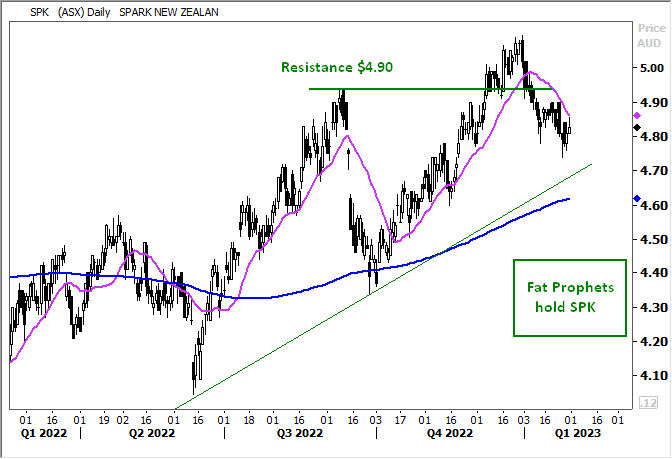
Viewing the daily chart for SPK the price has moved below the recent $4.90 resistance level towards the short-term trend line. Current movements remain below the 20-day moving average.
On 16 December 2022, Spark (ASX:SPK) announced that it will close its Spark Sport service this year, with free-to-air TVNZ to become the home to the majority of Spark Sport content from 1 July 2023. Spark CEO Jolie Hudson said of the decision, “it has been challenging to reach the scale we aspired to across the Spark Sport platform, with Covid causing major disruption to sporting codes globally just a year after launch. That slower than expected start, coupled with the escalating costs of content rights globally, makes it difficult to justify the type of investment Spark Sport requires when we have a wider range of investment opportunities across our broader business.”
When Spark Sport was established, the aim was to drive more customers to its broadband and mobile services by offering up content that New Zealand’s many sports fans were hungry for. The move stirred up competition, with pay-TV provider Sky Network Television, which had long effectively had a monopoly in the pay-for-sports area in New Zealand. Spark was hoping to follow in the footsteps of the likes of BT Group in the UK and in New Zealand at one stage held the rights to English Premier League games, Formula 1, and other sports, although last year, Sky won back the Premier League viewing rights in New Zealand. In addition, when Spark Sport’s Formula 1 rights expired at the end of 2022, Sky nabbed back the NZ rights, albeit non-exclusive.
Spark said it will make a NZ$52 million provision in FY23 to cover the ongoing obligations under content rights agreements extending through to 2028. Combined with the completion of Spark’s sale of 70% of its TowerCo business in October 2022 to the Ontario Teachers’ Pension Plan Board, the filing noted a resulting net gain of NZ$534 million “sits outside of FY23 EBITDAI guidance, which remains unchanged.”
In August last year, Spark confirmed FY23 EBITDAI guidance of NZ$1,185 million to NZ$1,225 million.
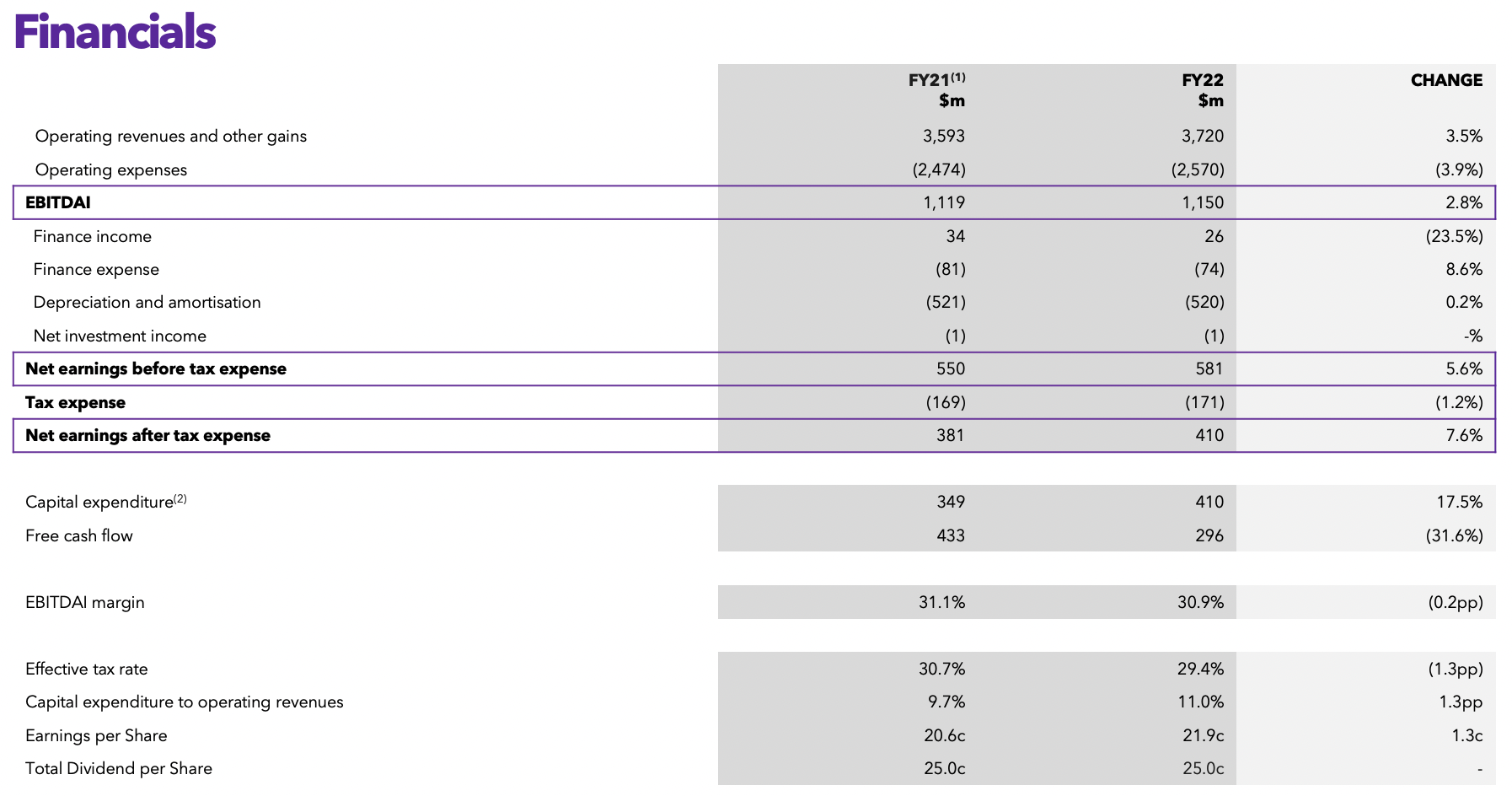
To recap, in FY22, Spark’s net profit increased 7.6% to NZ$410 million as revenues edged up 3.5% to NZ$3.72 billion, led by a strong mobile performance, growth in Spark IoT and wins in Spark Health. The final dividend of 12.5 New Zealand cents took the full year dividend to 25 cents, flat with a year earlier in line with guidance.
Source: Spark New Zealand (ASX:SPK)
Positively, mobile delivered a robust performance, with the highest revenue and connection growth in the market. Mobile service revenue rose 5.5% to NZ$899 million, supported by a $1.49, or 4.9% increase in total ARPU (average revenue per user) with this driven by the adoption of ‘Endless’ plans across the range and the more effective use of value-added services (VAS).
Broadband revenue declined on fierce market competition and voice revenues continued to be eroded as the legacy area fades in importance. Cloud revenue only edged higher as revenue and ARPU was impacted by a change in the sales mix to the public cloud and some lingering disruption to projects from Covid. Spark cited IoT and Health as material contributors to revenue and drivers for future growth, with IoT revenue up 22% as connections jumped 75% to 832,000 connections. Spark Health revenue surged 46% on continued growth in telco, IT services and health products.
Free cash flow did take a hefty hit, down 31.6% to NZ$296 million, impacted by the timing of working capital and supply chain impacts. Spark did guide for an FY23 free cash flow goal of NZ$460 million to NZ$500 million, with this to support an FY23 total dividend target of 27 cents. This would certainly be welcome and would mark the first dividend increase since 2016 if it eventuates.
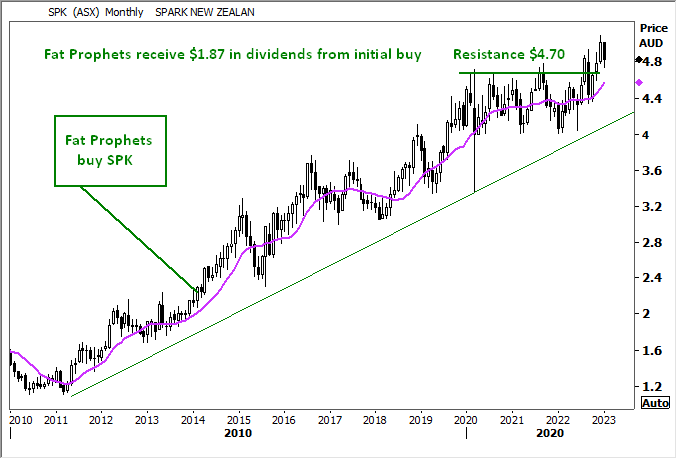
The monthly view of SPK shows the continuing primary up trend in place with the recent breakout above the $4.70 level. Current price movements are retesting this level as support. Current price movements also remain above the 12-month moving average.
Summary
Spark (ASX:SPK) delivered solid overall FY22 numbers, and we view the decision to exit Spark Sports as appropriate after the difficulty scaling the business and escalating costs. Scale and fierce competition more broadly continue to be challenges for the business, but we are encouraged by the strong performance in mobile and higher ARPU here. The IoT and Health units are becoming legitimate growth drivers.
Shareholders are likely to benefit from an on-market share buyback of up to NZ$350 million following the completion of the TowerCo stake sale. Spark provided the caveat that this will be dependent of market conditions and “may investigate alternative return conditions if required.”
A dividend increase would certainly be welcome, but we need to see Spark deliver on free cash flow guidance.
We maintain our hold recommendation on Spark New Zealand (ASX:SPK).
Disclosure: Interests associated with Fat Prophets hold shares in Spark New Zealand (ASX:SPK).

