
Building nicely
Legacy Archive of Australian Financial Research & Market Publications by Fat Prophets
This archive contains more than 4,000 legacy financial publications — including Australian stock reports, market analysis, market commentary, market predictions, special reports, and portfolio income reports — originally published under Fat Prophets’ flagship Australasian Equities Portfolio and prepared by Fat Prophets’ in-house equity analysts under the supervision of Fat Prophets Chief Investment Officer Angus Geddes.
These publications were originally released exclusively to Fat Prophets members between 2003 and 2017 and reflect the firm’s independent research process, including fundamental analysis, technical analysis, and contemporaneous market views at the time of publication.
Fat Prophets has made this historical research archive publicly accessible to promote transparency, preserve a documented record of past market analysis and investment thinking, and provide investors, researchers, and readers with valuable educational and historical financial content.
Please note: This archived material is provided strictly for educational and historical reference purposes only. It reflects market conditions, economic data, company information, forecasts, opinions, and analysis as they existed at the time of original publication and may no longer be current or applicable. This material does not constitute current investment advice, financial product advice, or a recommendation to buy, sell, or hold any financial product or security.
To explore more current insights and discover the benefits of full membership, including access to Fat Prophets’ latest research, model portfolios and investment recommendations, visit our Products page.
Legacy Content
As evidenced by Mirvac’s (MGR.ASX) 3Q15 operational update, the company is continuing to benefit from improved operational efficiencies and strong demand for residential property, with the latter being fuelled by record low interest rates and the weaker Australian dollar. With management having reaffirmed its FY15 guidance for operating earnings between 12.2 cents and 12.3 cents per stapled security, we retain our Buy rating on Mirvac.
What’s new?
Having discussed Mirvac’s 1H15 results in FAT-AUS-710, the focus of this report is on the company’s operational update for the three months ending 31 March 2015 (i.e. 3Q15). All said and done, we note that while Mirvac’s share price has lost some ground since releasing its 1H15 results, from an operational perspective the company has continued to gather momentum. Encouragingly for investors, the key drivers of this operational momentum have been broad based.
Looking first at Mirvac’s investment portfolio, we note that the company has continued to outperform the benchmark IPD index on a three and five year basis. Key metrics include an average occupancy of 97.4 percent, and a weighted average lease expiry (WALE) of 4.5 years. This comprises (i) Office occupancy of 95.5 percent and a WALE of 4.3 years, (ii) Retail occupancy of 99.1 percent and a WALE of 3.4 years, and (iii) Industrial occupancy of 99.6 percent and a WALE of 7.8 years.
In terms of Mirvac’s office portfolio, management has stated that it “continues to be well positioned, with an 82 percent overweight exposure towards the stronger markets of Sydney and Melbourne, and minimal near-term lease expiries in Brisbane, Perth, and Canberra”. Overall the office portfolio’s committed developments remain on track to deliver an average yield of around seven percent, with this committed pipeline currently 87 percent pre-let.
Similar to the office portfolio, Mirvac’s retail portfolio focussed on urban markets and is currently 67 percent weighted to Sydney. Management has noted that “the strong sales performance we achieved in the quarter demonstrates the benefit of our strategy to be overweight in metropolitan Sydney and urban markets, and we expect our retail assets in these areas to continue to outperform”.
While Mirvac’s industrial portfolio has continued to perform well and remains underpinned by its long lease expiry profile (i.e. WALE of 7.8 years), management has noted that tenant demand for new space remains relatively modest. However, this is expected to change once the New South Wales Government provides more certainty around its plans for future infrastructure spending in Sydney.
In contrast to the industrial portfolio, Mirvac’s residential business is currently experiencing high levels of demand, particularly in the hot spots of Sydney and Melbourne. Encouragingly for shareholders, Mirvac appears to be making the most of the strong demand, having recently accelerated the release of residential lots that is likely to result in the company delivering in excess of 2,700 lots from major projects in FY15.
However, it is not all plain sailing, with management having stated that “market conditions in the residential sector continue to be mixed across geography. A long period of undersupply and population growth in Sydney is sustaining demand, while population growth in Victoria is boosting demand for inner and middle ring product in Melbourne. Brisbane continues to record some positive signs of price growth, while activity levels in Perth have begun to moderate”.
Key takeaways
Having endured a period of lacklustre demand and asset devaluations, Mirvac’s 1H15 and 3Q15 results are indicative of a business on the rise. With demand evidently high and the development pipeline looking solid, we expect Mirvac’s earnings to expand further over the next 12 – 18 months. Adding to the company’s overall appeal is the recent improvement to its balance sheet following the 1H15 restructure of its syndicated bank facilities and recent interest rate cuts.
While Mirvac’s overweight exposure to the Sydney and Melbourne markets and even spread across product types suggests to us that the company’s near-to-medium-term outlook (i.e. due to the pipeline and pre-sale run rate) will remain positive, it remains difficult to predict if and when the housing bubble in Sydney and Melbourne will deflate, and if so by how much. Looking forward, a lot will depend on how effective Mirvac is at replenishing its lot supply and development pipeline.
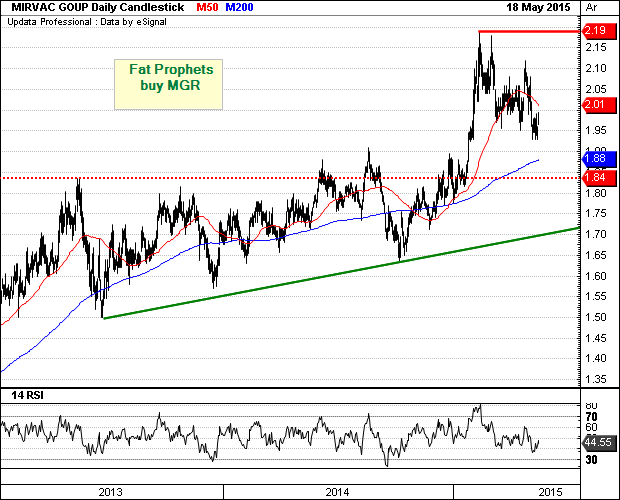
Turning to the charts, we note that Mirvac’s share price has drifted lower from its multi-year high of $2.19 that was set earlier in the year. With a potential breach below the 50-day moving average indicative of a reversal to the downside, it is critical for the support to hold at $1.84 in the event that the stock does pull back further.
Summary
We continue to regard Mirvac as one of the better risk-adjusted plays on the domestic residential market, with this growth potential backed by the Mirvac Property Trust’s high quality portfolio. The company has leverage to the structural trend towards higher density living (i.e. multi-dwelling), and is seeing strong demand from investors and offshore buyers. We expect these factors, in combination with the growing development pipeline to underpin medium-term earnings growth.
Mirvac is also reasonably priced in our view, trading on 16.1 times 2015 earnings estimates, falling to 15.1 times the next year and offering a projected yield of 4.7 percent, albeit on an unfranked basis. Notwithstanding the recent rally in Mirvac’s share price, the company continues to trade at a modest premium (i.e. 16 percent) to its net tangible asset value of $1.69 per share (as at 31 December 2014).
Accordingly, Mirvac will remain held in the Fat Prophets portfolio. For Members without exposure we recommend the stock as a buy around current levels.
Disclosure: Mirvac is held within the Fat Prophets Australian Share Income Model.
