
Takeover activity making Amcor look even better
Legacy Archive of Australian Financial Research & Market Publications by Fat Prophets
This archive contains more than 4,000 legacy financial publications — including Australian stock reports, market analysis, market commentary, market predictions, special reports, and portfolio income reports — originally published under Fat Prophets’ flagship Australasian Equities Portfolio and prepared by Fat Prophets’ in-house equity analysts under the supervision of Fat Prophets Chief Investment Officer Angus Geddes.
These publications were originally released exclusively to Fat Prophets members between 2003 and 2017 and reflect the firm’s independent research process, including fundamental analysis, technical analysis, and contemporaneous market views at the time of publication.
Fat Prophets has made this historical research archive publicly accessible to promote transparency, preserve a documented record of past market analysis and investment thinking, and provide investors, researchers, and readers with valuable educational and historical financial content.
Please note: This archived material is provided strictly for educational and historical reference purposes only. It reflects market conditions, economic data, company information, forecasts, opinions, and analysis as they existed at the time of original publication and may no longer be current or applicable. This material does not constitute current investment advice, financial product advice, or a recommendation to buy, sell, or hold any financial product or security.
To explore more current insights and discover the benefits of full membership, including access to Fat Prophets’ latest research, model portfolios and investment recommendations, visit our Products page.
Legacy Content
Recent activity in the global packaging sector has highlighted the extremely good value that Amcor achieved in its acquisitions of Alcan Packaging in 2009 and Ball Plastics Packaging in 2010.
“that should equate to very strong earnings per share growth averaging approximately 26% per annum for the next three years”
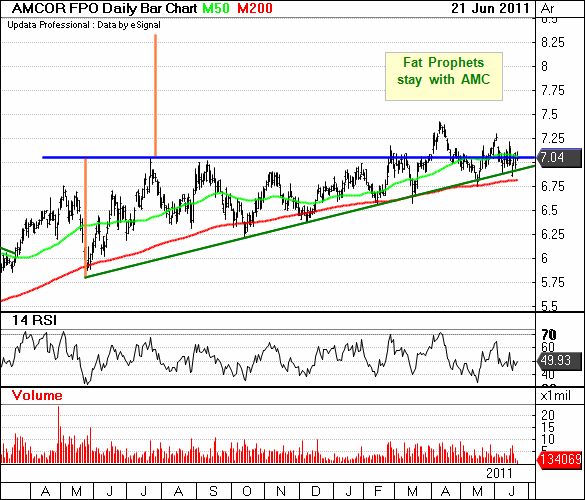
Since finding support at the 200 day moving average at $6.60 in March, Amcor has continued to drive higher. A significant break of the psychological $7 level has given rise to a completion of a broader term ascending triangle formation. The projected target level of this pattern is towards the $8.27 region as marked by the orange line. Should the psychological $7 level hold, we would expect further upside ahead.
Amcor’s US$1,945 million purchase of Alcan Packaging in 2009 represented a multiple of 5.1 times 2009 earnings. At the time, Amcor chief executive Ken MacKenzie said the acquisition was made “at the bottom of the cycle earnings and at a bottom of the cycle multiple”. His observation is beginning to bear out as several subsequent transactions are being made at much higher multiples.
The most recent takeover activity in the sector involves US packaging group, Graham Packaging. US listed company, Silgan Holdings, has offered US$1.45 billion in cash and shares representing a multiple of 7.0 times operating earnings for Graham Packaging. Silgan may be beaten to the target by Reynolds Group, owned by New Zealand’s Rank Group, which has topped the offer by 13% although Silgan has a chance to match that new price.
Rank Group has been among the most acquisitive players in the global packaging industry with several acquisitions in the last few years. It is now one of the largest packaging groups in the world alongside Amcor.
We note that Rank Group has been trying to sell its Australasian pulp, paper and packaging assets for some time. In the Australasian market it competes with Amcor and the privately owned Visy Group. Carter Holt’s 27% share of the Australasian carton packaging market would be an easy addition for either Amcor or Visy but would undoubtedly struggle to gain clearance from the Australian Competition and Consumer Commission.
Amcor sources the majority of its earnings overseas with perhaps as little as 12% of group earnings based in Australia. If further acquisitions are to be made, we would expect them to be overseas as Amcor has more opportunity in that regard. In the shorter term, we do not anticipate any major acquisitions by Amcor as it is fully focused on extracting the synergy benefits from the Alcan acquisition.
To remind Members, Amcor is seeking to gain synergy benefits on its operating earnings (EBITDA) of$200-$250 million per annum within three years of completing the Alcan acquisition. The company is spending $300 million as a once-off pre-tax restructuring cost to integrate the businesses.
For the 2011 financial year, Amcor is expecting synergy benefits in line with its initial target of $100-$120 million. Third year benefits of $200-$250 million are also unchanged but the achievement of that goal has been made more difficult by the 25% increase in the Australian dollar relative to the Euro since the original guidance was provided. As Amcor has not altered the targets, we can assume that the integration of the businesses is outperforming the objectives.
For the current financial year, like many other Australian companies, Amcor has been affected by the wet and cool weather as well as the flooding in Queensland. The direct cost of the floods is estimated at $20 million of damage to stock and plant with a one-off charge of $15-$25 million anticipated for the second half year result.
The cooler and wetter weather is a more difficult factor to quantify. Volumes are likely to have slipped this year and higher raw material and utility costs may squeeze margins a little.
The higher Australia dollar also poses problems from a translational perspective. We note that Amcor is more sensitive to increases in the Australian dollar against the euro than it is against the US dollar as slightly more than half of the company’s revenue is generated in Europe.
At the half year result, Amcor reported its net debt as $3,241 million and its equity as $3,827 million giving a gearing measure of 45.9%. Operating earnings to net interest of 7.1 times reflects a fairly robust balance sheet with the prospect of reasonably strong cash flow over the next few years likely to fortify it even further.
Amcor currently finds itself in a straightforward position of ensuring its execution is sharp and does not need to fuss over anything else. This sets up the next few years as an operationally leveraged play on steadily increasing market activity. All other things being equal, that should equate to very strong earnings per share growth averaging approximately 26% per annum for the next three years by our estimation.
This would suggest a PE ratio of 14.1 times our forecast 2011 earnings falling towards 10.6 times in FY13. The cash flow scenario we envisage also pushes the company’s enterprise value to operating earnings quickly back into quite cheap territory at under 6 times over the same timeframe. Again this emphasises Amcor’s appeal compared to acquisition multiples in the packaging market.
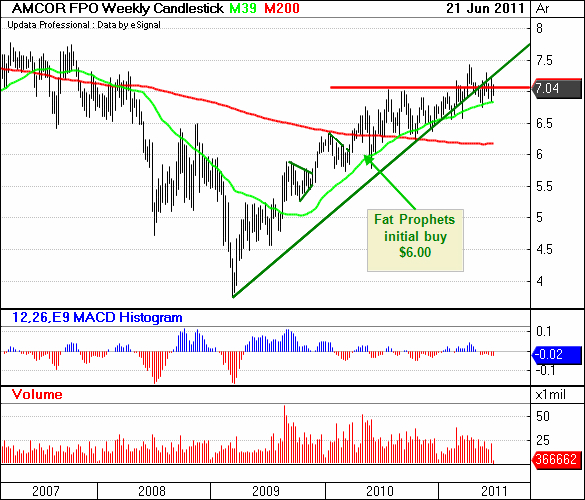
The weekly chart reveals the strong uptrend in place since early 2009. The bullish moving average cross and strengthening weekly MACD are suggestive of further gains over the longer term.
Relative to its international peers, Amcor is looking very robust and attractively priced.
For now, however, we will maintain our hold recommendation pending the full year financial result due in August.
