
Consumer thaw
Legacy Archive of Australian Financial Research & Market Publications by Fat Prophets
This archive contains more than 4,000 legacy financial publications — including Australian stock reports, market analysis, market commentary, market predictions, special reports, and portfolio income reports — originally published under Fat Prophets’ flagship Australasian Equities Portfolio and prepared by Fat Prophets’ in-house equity analysts under the supervision of Fat Prophets Chief Investment Officer Angus Geddes.
These publications were originally released exclusively to Fat Prophets members between 2003 and 2017 and reflect the firm’s independent research process, including fundamental analysis, technical analysis, and contemporaneous market views at the time of publication.
Fat Prophets has made this historical research archive publicly accessible to promote transparency, preserve a documented record of past market analysis and investment thinking, and provide investors, researchers, and readers with valuable educational and historical financial content.
Please note: This archived material is provided strictly for educational and historical reference purposes only. It reflects market conditions, economic data, company information, forecasts, opinions, and analysis as they existed at the time of original publication and may no longer be current or applicable. This material does not constitute current investment advice, financial product advice, or a recommendation to buy, sell, or hold any financial product or security.
To explore more current insights and discover the benefits of full membership, including access to Fat Prophets’ latest research, model portfolios and investment recommendations, visit our Products page.
Legacy Content
Subscriber growth is gaining momentum, albeit at a moderate pace. But this is not out of kilter with what is happening in the broader economy where consumers are spending cautiously. Austar’s earnings profile remains sturdy with the ability to lift prices gradually to compliment the customer growth. A strong balance sheet, ample cash flow and an over-reaction to the free TV competition means Austar is still misunderstood and undervalued by the market.
After the palpitations of the second quarter subscription growth that left the market less than impressed, Austar has squeezed out an improved third quarter. As we have noted in past comments on Austar, rather too much attention is paid to subscriber growth while other important factors such as marketing, price rises and operational leverage are overlooked.
This quarter, with the help of a few thousand orphaned SelecTV subscribers, Austar gained 14,771 net new subscribers to record a total base of 761,919 subscribers. The popularity of the MyStar HD product continues to drive new subscriptions as well as conversions from the original MyStar digital video recorder (DVR) with about 57,000 customers now enjoying the premium product.
The quarterly growth in subscribers was aided by strong growth in the mining industry where Austar sells bulk accommodation packages, categorised as commercial subscribers. This category increased by almost 6,400 in the period – the strongest for some time. Residential subscribers increased by 8,375 to 624,000 subscribers.
Encouragingly, more customers are also signing up for additional outlets (a second set top box) with this category now numbering over 205,000 or about 33% of all residential subscribers.
Churn has continued to improve by lowering to 1.24% on an average monthly basis. Fewer customers giving up their service is a good sign of less delinquent customers and more satisfied customers. It also suggests Austar is not overreaching its marketing and signing up customers who might be marginal in terms of their credit history.
About 29% of all residential customers now take the MyStar product (either HD or digital) which leaves ample upside for future conversions of existing customers and room for new ones. As we have seen in other subscription television businesses, this trend is inexorable as customers discover the added value that the DVR, combined with the clever functionality of the box, provide a compelling home entertainment service.
More importantly, Austar’s content sets it apart from the free TV alternative. As chief executive John Porter has noted in the past, the free TV offering is full of re-runs and leftovers. When customers see the content on offer at Austar in comparison, the decision to sign up is made easy.
As an aside, the acquisition of 3,500 of SelecTV’s 8,000 English language service customers was an unusual opportunity but provided a nice lift for the quarter. SelectTV was about to cease broadcasting its English language service but Austar saw the chance to sign up these customers and has quickly moved on this opening.
On the price front, the average monthly revenue per user increased by 4.3% over the prior comparable period. The company raised prices in February this year (by $3.60 per month) and has not spoilt the gain with an over-indulgence in promotional offers. Again, this demonstrates the company’s close control of its many operational levers.
As a consequence of the subscriber growth and the average revenue per user growth, total subscription revenue increased by 7.0% for the quarter to almost $178 million. Operating costs were flat on the second quarter leading to a small expansion in operating profit margin to 34.1%.
Capital expenditure in the quarter was typical of Austar’s profile. Most of the $24.9 million was spent on installation of new subscriber equipment, which directly leads to revenue growth. The company is likely to spend just under the guided $110 million for the full year ending 31 December. The higher cost of HD equipment is having a temporary impact on cash flow, but again this ultimately leads to higher revenue and earnings.
Austar’s capital management program remains a work in progress, depending on the cost of debt. The balance sheet therefore is still trending towards being under-geared with net leverage (net debt to annualised quarterly cash flow) of just 2.8 times. Austar has $850 million of senior bank debt with rates fixed at 7.8%.
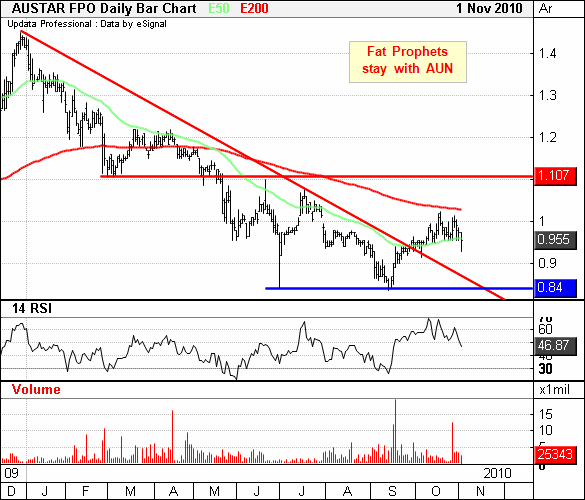
The weekly chart shows the trend has been down since the end of November 2009. After finding support at the $0.835 level the share price bounced higher but met resistance around the psychologically significant $1.00 level that corresponds closely with the 39 week/200 day moving average.
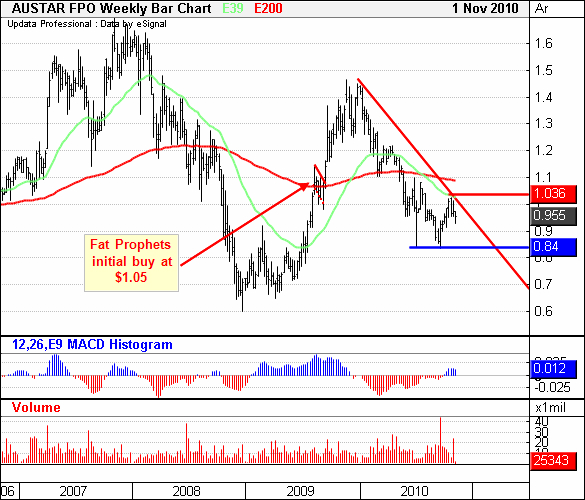
Since pulling back from the 200 day moving average, the 50 day moving average has been providing some near term support. The daily RSI has turned lower from overbought territory which is a little concerning.
We see the steady improvement in Austar’s earnings as evidence of a sound business.
The market is pre-occupied with the perceived threat of multi-channel free-to-air television. We argue there is a chasm between the quality of the content on offer. Free TV fills a void for those who accept dross on their screens, but Austar’s product is compelling in comparison.
We continue to recommend Austar as a buy for Members without exposure.
