
Still the quality play
Legacy Archive of Australian Financial Research & Market Publications by Fat Prophets
This archive contains more than 4,000 legacy financial publications — including Australian stock reports, market analysis, market commentary, market predictions, special reports, and portfolio income reports — originally published under Fat Prophets’ flagship Australasian Equities Portfolio and prepared by Fat Prophets’ in-house equity analysts under the supervision of Fat Prophets Chief Investment Officer Angus Geddes.
These publications were originally released exclusively to Fat Prophets members between 2003 and 2017 and reflect the firm’s independent research process, including fundamental analysis, technical analysis, and contemporaneous market views at the time of publication.
Fat Prophets has made this historical research archive publicly accessible to promote transparency, preserve a documented record of past market analysis and investment thinking, and provide investors, researchers, and readers with valuable educational and historical financial content.
Please note: This archived material is provided strictly for educational and historical reference purposes only. It reflects market conditions, economic data, company information, forecasts, opinions, and analysis as they existed at the time of original publication and may no longer be current or applicable. This material does not constitute current investment advice, financial product advice, or a recommendation to buy, sell, or hold any financial product or security.
To explore more current insights and discover the benefits of full membership, including access to Fat Prophets’ latest research, model portfolios and investment recommendations, visit our Products page.
Legacy Content
In our recent coverage we have consistently highlighted the relative strengths of the company against the background of ongoing turmoil in financial markets. The company has been very well positioned compared to the majority of its corporate heavyweight peers, due to its strong diversified cash flow and ultra-low debt levels. Last week BHP revealed its 2008/09 full-year results, which emphasised the company’s strengths and reinforced its ability to take full advantage of the inevitable world economic recovery.
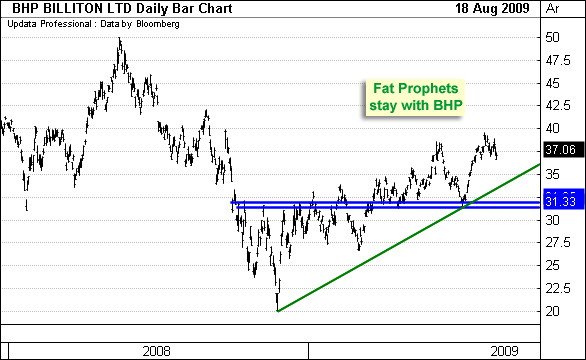
Since our last review, BHP Billiton has posted further gains, rising to its highest level since September 2008.
Currently, prices are consolidating just below the recent high. However, with upward momentum continuing to build, and little chart resistance overhead, we favour further gains over the coming weeks.
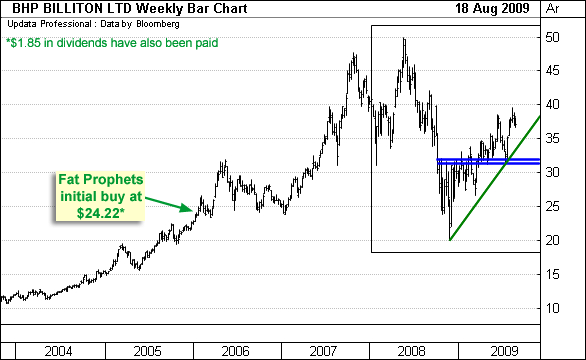
From a broader perspective, the weekly chart reveals the resilience of the longer-term upward trend. As such, we believe BHP offers considerable upside potential over the longer-term.
BHP last week announced a full-year financial result that was essentially in line with market expectations. The market had anticipated full-year underlying earnings before interest and tax (EBIT) of around $US17.9 billion, down 26% from $US24.145 billion last year, however BHP generated EBIT of US$18.2 billion, an actual fall of 20.5%.
With respect to net profit before exceptionals, the market had anticipated an outcome of around $US10.2 billion, down 34% from last year’s $US15.39 billion, however this figure actually came in at US$10.7 billion, a 30% fall. Elsewhere, BHP increased its full-year dividend by 17.1% to US 82 cents per share. The timetable in respect of this dividend will be Ex-dividend London Stock Exchange (LSE) 2 September 2009.
Finally, the market had anticipated big exceptional charges, like the $US4.6 billion write-down associated with the closure of the Ravensthorpe nickel mine in WA and the write-down on the Yabulu nickel refinery in Qld. Thus the market anticipate bottom-line profit of around $US5.7 billion; however BHP actually reported US$5.9 billion.
So whilst things were tough for BHP, the market had already priced in the bad news, and was pleasantly surprised that there were no hidden ‘nasties’ in the result. In fact, we took comfort from the fact that BHP had used record net operating cash flow to further pay down debt levels to an ultra-low gearing ratio of just 12%. And with such a huge cash accumulation, the company is magnificently placed to fund its huge pipeline of organic growth opportunities.
What the company’s financial results demonstrate is the value of the diversified resource model, which allows the company to generate strong outcomes even during the worst economic conditions in a lifetime. The company’s portfolio of long-life, low-cost and diversified assets continued to yield strong margins and cash flows, despite the pressures of the current economic environment.
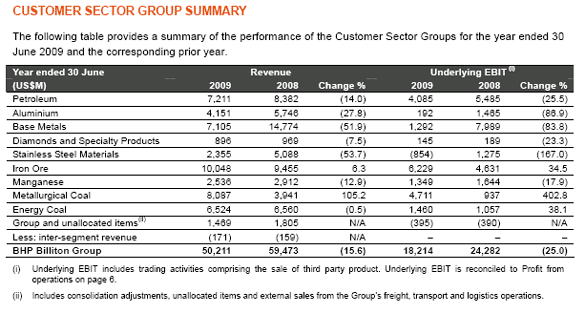
Importantly, the company’s Underlying EBIT margin and return on capital remained strong at 40.1% and 24.6% respectively, with net operating cash flow increasing by 6% to a record US$18.8 billion. The strong cash flow enabled BHP to reduce already modest net debt to US$5.5 billion and continue investment in capital and exploration programs to the tune of US$10.7 billion.
The company’s views on the global economic outlook and the immediate future with respect to commodity demand were also interesting and essentially an extension of the views expressed recently in the company’s June 2009 quarterly operations report. BHP has continued to talk in a cautiously optimistic tone, suggesting that China’s commodity demand will now be more reflective of actual demand, rather than merely restocking.
BHP commented that government-initiated economic stimulus packages had steadied financial markets in both developed and developing economies; however it believed the degree of support would be difficult to measure and there remains uncertainty about economic growth beyond the period of each specific program. The company also commented that structural economic problems would take time to correct and may hold back growth over the medium term.
With respect to China, BHP commented that the response has seen a sharp increase in investment that has accelerated a range of existing infrastructure and construction projects. In China in particular, re-stocking coupled with stimulus package spending, fuelled strong real demand in key commodity-intensive industries such as infrastructure, construction and real estate.
There is now caution that the commodity re-stocking phase in China appears largely complete, with substantial inventory build in specific commodities over the past three months at end-user level and in strategic stockpiles.
With respect to other key markets such as North America, Europe and Japan, BHP believes there is emerging evidence of an improvement in demand, although it believes it’s still too early to tell whether this improvement is driven by re-stocking alone, or a combination of re-stocking and real demand.
Encouragingly though, BHP in the long term expect to see strong growth in demand for its commodities, with long-term prices to be driven by the long-run marginal cost of supply. With reduced capital investment over the past year, supply may struggle to keep pace with demand in the medium-term when growth recovers.
As we have previously emphasised, BHP Billiton has a major advantage over its resource sector peers in terms of its balance sheet strength. This has allowed it to avoid many of the financing and asset-sale headaches currently occupying the minds of its peers. The company therefore remains in a position of financial resilience that most companies can only dream about.
We believe this is the reason the company continues to trade at a considerable premium to its peers, which currently reflects a strong price-earnings multiple of around 16 times consensus 2010 earnings estimates.
BHP Billiton remains a core resource holding and will remain firmly
held within the Fat Prophets Portfolio.
