
Bulking up the Buy-Back
Positive sentiment towards ANZ (ASX:ANZ) has increased over the past month supported by the doubling of the bank’s share repurchase program amid a continued strategic transformation. The recovery in the shares coincides with a time when the sector is still facing headwinds, and in the wake of the Royal Commission. We continue to regard the bank as one of the better equipped to withstand any turbulence.
ANZ (ASX:ANZ) has also found itself in the crosshairs of the Commonwealth Director of Public Prosecutions (CDPP) for its part in the handling of a placement in its shares undertaken back in 2015, along with investment banks Citigroup and Deutsche Bank. We covered this when the news broke in June of this year. All the defendants have denied wrongdoing, and the so-called and alleged ‘cartel’ conduct case is likely to prove a complex and technical one that will take a long time to play out.
The other investment bank involved, JP Morgan, was reportedly co-operating with authorities and is understood to have effectively been given immunity.
ANZ announced on 22 June 2018 that it will increase its current on-market share buy-back from $1.5 billion in size to $3 billion.
That followed on the heels of the announcement in early May that ANZ had received around $1 billion in reinsurance proceeds as part of the first tranche of the sale of its Australian Life Insurance business.
ANZ Chief Financial Officer Michelle Jablko stated that “The progress of our transformation means we are able to return this surplus capital to shareholders while retaining appropriate flexibility to invest in our business and maintain unquestionably strong capital levels.”
ANZ (ASX:ANZ) had reported a level 2 Common Equity Tier 1 capital (CET1) ratio as at 31 March 2018 of 11.04%. This is expected to increase by approximately 56 basis points on a pro-forma basis after adjusting for completion of the buy-back, receipt of the reinsurance proceeds and completion of announced asset sales. The following table provides the breakdown of how the various components are expected to influence the CET1 ratio.
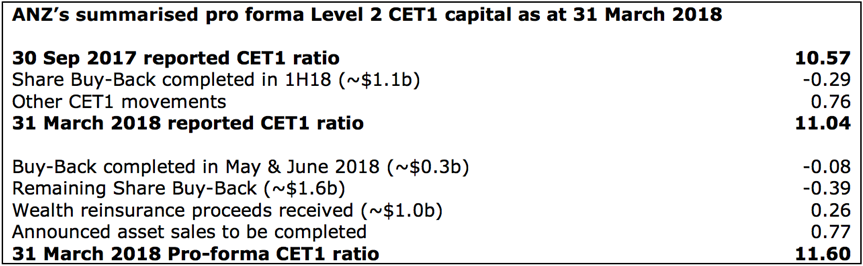
Source: ANZ (ASX:ANZ)
As a proxy for the financial strength of banks, the Australian Prudential Regulatory Authority (APRA) has pushed the big banks to have a 10.5% ‘unquestionably strong’ level by a 2020 deadline. ANZ is ahead of the curve on this.
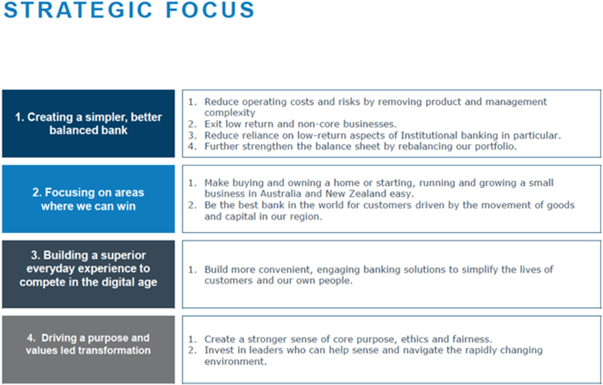
The announced asset sales referred to and yet to be completed are part of the bank’s plan to shrink and simplify the bank. ANZ has opted to focus on institutional banking business in Asia, where they remain a top-four corporate bank, rather than contest in the retail and wealth areas. Getting out of life insurance was a trend we have seen in the industry amid a challenging life insurance environment.
In the first half of the year, ANZ announced the sale of its share in the Philippines-based Metrobank Card Corporation joint venture and the separation of six retail and wealth businesses in Asia “on time and under budget.” It also completed the sale of its minority stake in Shanghai Rural Commercial Bank.
On 25 June 2018, the bank announced it had entered into an agreement to sell its Retail, Commercial and Small-Medium Sized Enterprise (SME) banking business in Papua New Guinea (PNG) to Kina Bank, a wholly-owned subsidiary of Kina Securities. The latter company is listed on the Australian and Port Moresby securities exchanges.
The sale includes all 15 ANZ branches and the businesses being sold serve 85,000 retail and 6,000 commercial and SME customers, with A$150 million in lending assets and A$450 million in deposits. Subject to approvals it is expected to close by late 2019. No price tag was disclosed but the sale is not material to ANZ. It is though in line with the announced simplification strategy and follows the sales of ANZ’s retail and wealth businesses in Singapore, Hong Kong, China, Taiwan, Indonesia and Vietnam, along with other asset sales yet to be completed.
Source: ANZ (ASX:ANZ)
In May 2018, ANZ announced the sale of its 55% stake in its Cambodian banking joint venture to J Trust, a diversified Japanese financial holding listed on the Tokyo Stock Exchange. ANZ did not disclose the value of the sale of its Cambodian stake, but said it expects to incur a loss of around A$30 million on completion. The deal has been approved by the joint venture partner, but remains subject to local regulatory approval. ANZ said it will continue to own its 55% stake and manage the business for up to 12 months to work closely with J Trust to ensure a smooth transition.
To briefly recap, ANZ’s statutory profit for the six months ended 31 March 2018 increased 14% year-on-year to $3.32 billion, while the more closely watched cash profit on a continuing basis edged up 4% to $3.49 billion in a challenging environment. The interim dividend of 80 cents per share fully franked was broadly in line with the targeted pay-out range of 60% to 65%. The credit environment was benign, with a provision charge of just $408 million, down from $720 million a year earlier.
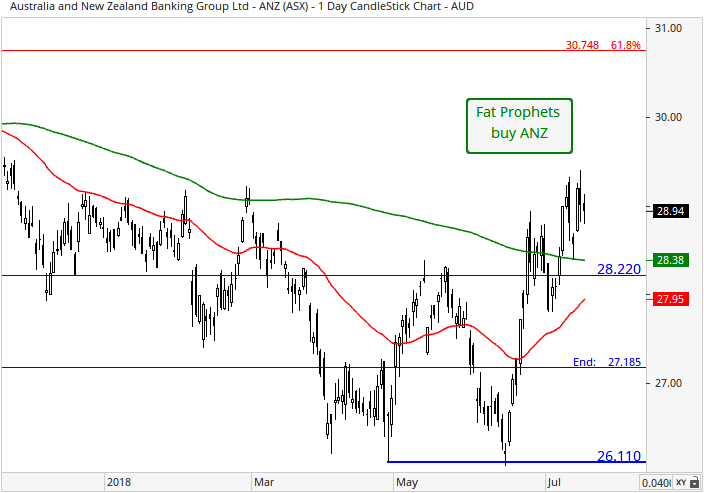
Turning to the charts, and on the daily, prices have moved above the 50-day (red line) and 200-day moving averages (blue line) which is a positive development. Previous support at the July 2017 low of $28.22 (horizontal blue line) has been re-taken, in additional to a further line of defence at the June low of $27.19. While some way off, attention can now turn to the 61.8% Fibonacci retracement of $30.75.
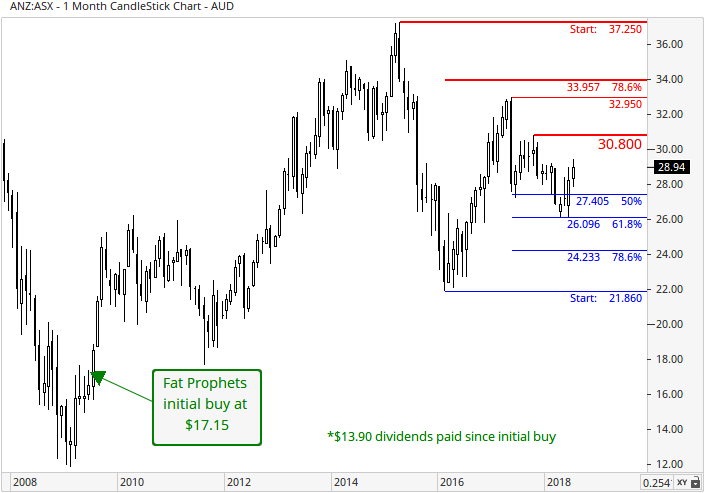
With reference to ANZ’s monthly chart, prices have resumed a more positive phase of the overall technical cycle after printing a recent high of $30.80 last October (horizontal red line). Downside support evident at the 61.8% Fibonacci retracement of $26.10 has been recaptured as has that at the 50% Fibonacci retracement of $27.41. In order for the broader uptrend to completely resume its path north, a sustained break above the aforementioned $30.80 resistance level is required.
Summary
Shares of ANZ have recovered some ground over the past month supported by the doubling of its share repurchase program amid a continued strategic transformation of the bank. The recovery in the shares coincides with a time when the sector is still facing headwinds and weak sentiment as the Royal Commission has revealed instances of alleged questionable conduct across the industry.
ANZ has also found itself in the crosshairs of the Commonwealth Director of Public Prosecutions (CDPP) for its part in the handling of a placement in its shares undertaken back in 2015, along with investment banks Citigroup and Deutsche Bank. The case is a complex and technical one and all defendants have denied wrongdoing.
The other investment bank involved, JP Morgan, was reportedly co-operating with authorities and is understood to have effectively been given immunity.
It is very early days though and much of any likely penalty and the uncertainty related to the outcome already seems to be largely reflected in the current valuation in our view. As we have noted in prior coverage, investors seem to be becoming more hardened to the bad press and any potential penalties for banks these days
ANZ shares (ASX:ANZ) are trading on around 14.1 times forecast FY18 earnings, falling to 12.9 times the following year, while the price-to-book value multiples are roughly 1.5 times and 1.4 times respectively. The projected dividend yield over the same time frame is 5.4% expanding to 5.55%.
ANZ’s restructuring is progressing well and we were content with the earlier reported FY17 and interim fiscal 2018 results.
We continue to recommend the shares as a buy to Members without exposure and with a medium term, or longer, investment horizon.
Disclosure: ANZ Banking Group (ASX:ANZ) is held in the Fat Prophets Concentrated Australian Share and Australian Share Income models.

