
Telstra2022
Telstra (ASX:TLS) management has outlined some big impending changes afoot at the telco, labelled Telstra2022.
This will see the company get more aggressive in its mobile game, accelerate a cost out programme and restructure its business significantly. Although the plan certainly saw management putting a bolder plan in front of investors than has been the case for some time, the shares fell on a weaker than expected financial outlook for next year.
Telstra (ASX:TLS) intends to split its infrastructure assets into a new business which will pave the way for a demerger or the entry of strategic investors. The telco has also accelerated its cost out programme, with a further $1 billion in savings targeted by FY22, taking the total to $2.5 billion in annual savings. This will see a net reduction in 8,000 employees, impacting about one in four middle-management roles. The sale of around $2 billion in assets will bolster the balance sheet.
Telstra’s latest vision has many parts, but at its core in our view is an aggressive bet on the mobile market, where Telstra already leads.
Telstra CEO Andy Penn has previously spoken of the importance of 5G technology and Telstra has arguably laid out plans for one of the most aggressive timelines of any major telecommunications company to rollout 5G.
Mr Penn spoke of the challenges the industry is facing and said, “It is time to take a bolder step and leave the past behind. We’re at a tipping point. A moment in time where we must be more ambitious to meet the challenges head-on. For Telstra, this means that we need to be more prepared to disrupt ourselves than ever before.”
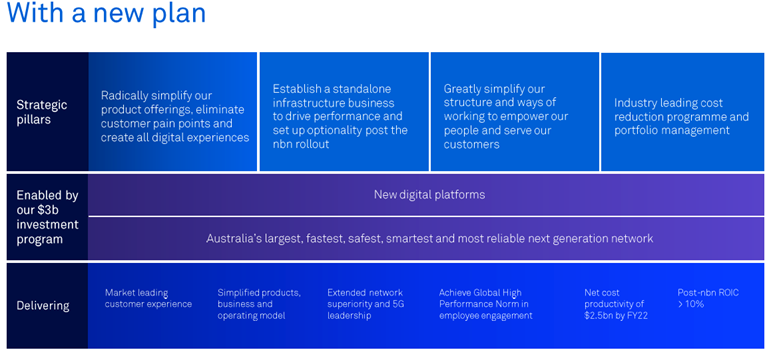
He outlined four pillars to the strategy, dubbed Telstra2022 because that is the “year in which the NBN will be rolled out, 5G will be at scale and the Internet of Things will be pervasive in our homes, in our businesses and in our communities.”
To win in the 5G market, Telstra expect to be network ready in the first half of FY19 with full rollout to capital cities, regional centres and other high demand areas by FY20 according to the CEO.
The four pillars essentially are to simplify product offerings and improve the customer experience, establish a standalone business, flatten the corporate structure, digitise and take even more costs out of the business. This is synopsised in the following page from a slide deck covering the new strategy.
Source: Telstra (ASX:TLS)
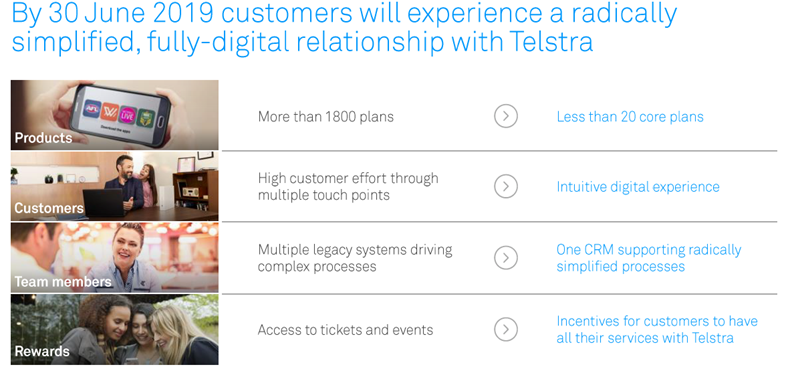
Looking at the four pillars briefly, the first will see Telstra offer some unlimited data on mobile plans, called “peace of mind data” packages. While this will undoubtedly be a key selling point, it will cost Telstra about $500 million in lost revenue over the next three years. A wide range of (often confusing) mobile plans will be reduced from around a staggering 1,800 to just 20. The roughly 1,800 plans for consumers and small businesses encompass about 400 currently on offer, while the rest are legacy plans in use, but not sold to new customers. Other intended changes are shown in the graphic below, with digitisation a major push:
Source: Telstra (ASX:TLS)
Frankly, it is a well overdue measure, with such levels of ‘complexity’ not good for customers or the business.
It is usually something that happens slowly over time, but by moving to a new technology Telstra will be able to dramatically simplify an area which had no good reason for getting so complex.
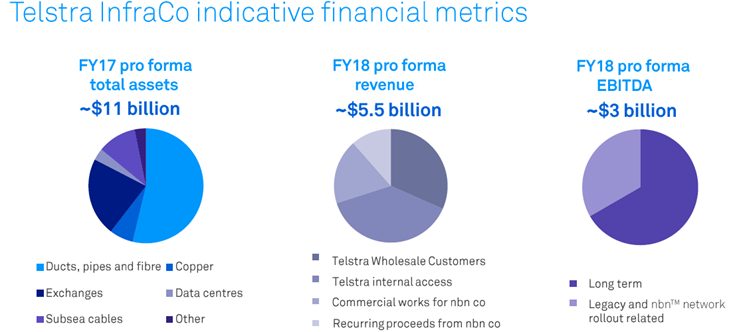
Telstra intends to establish a Telstra InfraCo to house its infrastructure assets to drive capital efficiency and performance, along with creating optionality. That could include a potential demerger or the entry of a strategic investors following the roll out of the NBN. Some are speculating that this could see a stake taken in NBN, although that would require the government at some stage accepting its valuation is overinflated and taking some heavy write downs.
Source: Telstra (ASX:TLS)
Pillar 3 of the company’s strategy will see a net reduction in about 8,000 employees and contractors. There will be around 9,500 jobs lost, but some 1,500 new ones created for the net reduction of 8,000. There will be an approximate 25% decline in middle-management roles, with this made possible by the drive for simplification across the business and better using technology. A flatter corporate structure is envisaged to see an improvement in reduced time to market for feature and product enhancements. To support the transition of employees, the company has earmarked $50 million in initial funding.
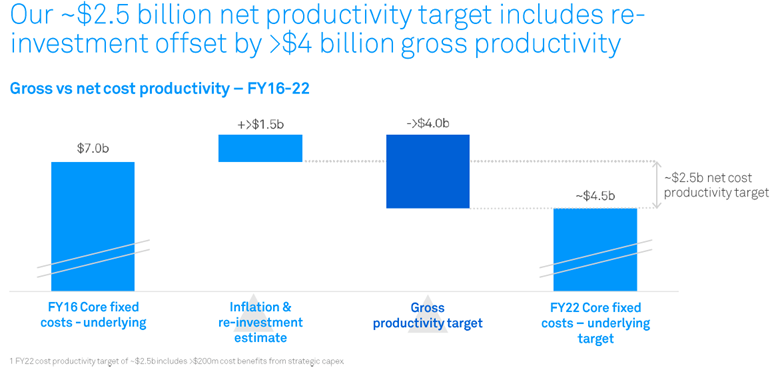
Pillar 4 is a more aggressive cost-out target and “portfolio management.” The target is to seek out another $1 billion in underlying core fixed costs by 2022, taking the total annualised core fixed cost savings to $2.5 billion.
Source: Telstra (ASX:TLS)
This is linked to the reduction in staff levels, simplification of products and services and better using technology. Total costs are expected to be about flat or decline slightly, excluding restructuring costs. FY19 restructuring costs are pinned at around $600 million.
Telstra (ASX:TLS) also intends to monetise up to $2 billion from asset sales to strengthen the balance sheet.
As noted in our previous coverage, we have been of the view that management needed to go more on the front foot, and lay out a definitive and robust plan to combat various operational and financial headwinds. While not a magic bullet, the splitting of the infrastructure assets is a positive move in our view, as is the acceleration of the cost out-programme and simplification of the business.
Telstra certainly has concrete plans in the works to become leaner, and we regard the monetisation of select assets as being a necessary and prudent move. The pursuit of further growth through digitisation also has much merit, even if the market remains sceptical.
The share price reaction in the wake of last week’s presentation has though been driven by a gloomy financial forecast for next year, rather than changes to the strategy. This is especially as it has cast some more doubt on the sustainability of the dividend.
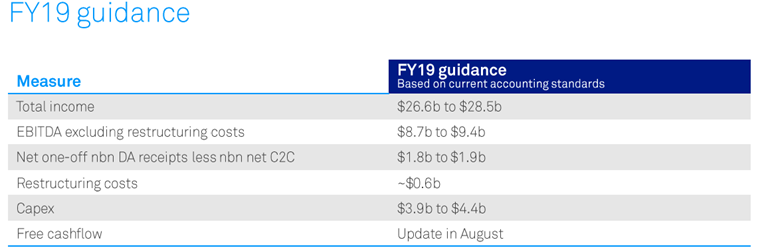
There was no change to FY18 guidance following the May trading update, but the NBN’s failure to hit roll out targets is likely to result in net NBN revenues to Telstra being $600 million to $700 million lower than the $2.5 billion the financial community was expected. Combine that with some $600 million in restructuring costs in FY19 and it is looking like an ugly year for Telstra with other key numbers below expectations.
Source: Telstra (ASX:TLS)
As shown in the table above, revenue (total income) is slated to be between $26.6 billion to $28.5 billion, while EBITDA excluding restructuring costs is pinned in the range of $8.7 billion to $9.4 billion. The latter compares poorly to the $10.1 billion to $10.6 billion EBITDA range provided for FY18. The company hasn’t announced what its next dividend will be yet, but given the trend of NBN revenues a decrease is likely given the relatively new policy of 70% to 90% of underlying earnings and 75% of net one-off NBN receipts over time.
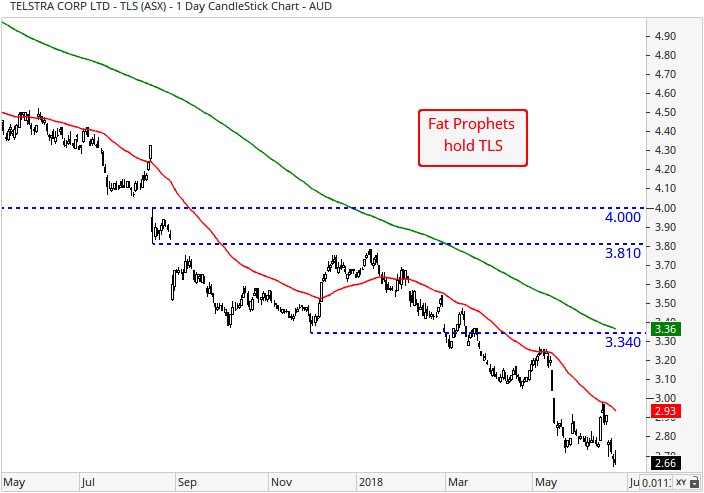
Turning to the charts, the picture is still very weak. Dynamic support sighted at the 50-day moving average (red line) of $3.55 has given way, as has that at $3.34. In order for the short-term technical outlook to strengthen, these need to be surmounted, and a decisive break above our aforementioned resistance range between $3.75 and $3.81 is required. Should this occur, then an eventual glide towards the psychological $4.00 level is deemed feasible. This though seems some way off at present. At the very least some base building is needed.
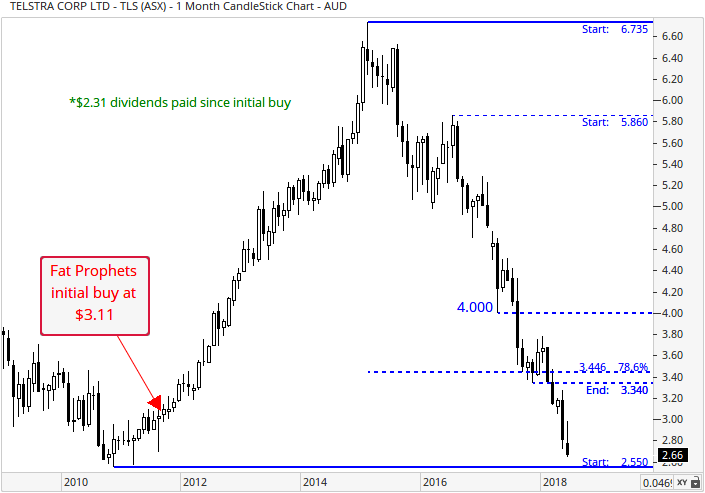
With reference to Telstra’s monthly chart, support at the 78.6% Fibonacci retracement of $3.45 (blue set of retracements) has not held. The next significant layer of support is at $2.55. The dominant long-term downtrend remains in play, and therefore, the climb north could be slow in coming. A breach of psychological support at $3 should also not to be ignored.
Summary
Telstra management has outlined some big impending changes afoot at the telco, labelled Telstra2022. This will see the company get more aggressive in its mobile game, accelerate a cost out programme and restructure its business significantly. Although the plan certainly saw management putting a bolder plan in front of investors than has been the case for some time, the shares fell on a weaker than expected financial outlook for next year.
As noted in our previous coverage, we have been of the view that management needed to go more on the front foot, and lay out a definitive and robust plan to combat various operational and financial headwinds. While not a magic bullet, the splitting of the infrastructure assets is a positive move in our view, as is the acceleration of the cost out-programme and simplification of the business.
Telstra (ASX:TLS) certainly has concrete plans in the works to become leaner, and we regard the monetisation of select assets as being a necessary and prudent move. The pursuit of further growth through digitisation also has much merit, even if the market remains sceptical.
The shares are trading on approximately 9.7 times forecast FY18 earnings and 12.0 times FY19 earnings. The projected dividend yield over the same time frame is 8.2% falling to 6.8%. Given the deterioration in the technical picture, we are of the view that a period of consolidation is likely.
Telstra (ASX:TLS) will remain held in the Fat Prophets portfolio.
Disclosure: Telstra (ASX:TLS) is held within the Fat Prophets Australian Share Income Model.

