
VOC

A change at the top
Vocus Communications’ (ASX:VOC) shares got a lift yesterday after the company named Kevin Russell, a former head of Optus, as its new CEO. We have held out new management as a potential value driver for the company, as a turnaround plan is put into motion. We expect Mr Russell to prove a good fit, and that he will work well alongside other executives, including Chairman Bob Mansfield, himself also a former Optus executive.
With the company’s shares trading on an undemanding earnings multiple we continue to rate Vocus as a high risk buy for Members without exposure.
Mr Russell certainly has a strong pedigree having formerly been CEO of Optus (departing in 2014), and a group executive at Telstra (April 16 – August 17). He has been backed by Vocus Chairman Bob Mansfield, who held the same seat at Optus.
While the ship at Vocus has gone off course, in our view the criteria for a turnaround does exist. Mr Russell is certainly no stranger to such situations, and led UK telco player Hutchison Three through a £1 billion bottom line revival. The company under his guide went from a £900 million loss in 2006 to a £100 million profit in 2010. He also has significant home-grown experience, having been Group Executive, Retail at Telstra, as well as heading up Optus.
As an industry veteran we believe that he has the right ingredients to help restore shareholder value at Vocus. As we have flagged previously Vocus’ problems have largely been of its own making (or at least previous management’s), with an overly ambitious acquisition spree, problematic integrations, and a burgeoning debt mountain. Given the company’s strong market position we see all these issues as fixable, with the right management team and the necessary focus. This won’t happen overnight, but we would expect to see some progress and decisive plans put into action in the months ahead.
Kevin Russell and Bob Mansfield – will the former Optus duo prove a dynamic one?

Another notable appointment was that of Vocus New Zealand CEO Mark Callander to the board. He should also be a strong addition to the management team, having been canvassed for the top job.
As we noted in our previous coverage, last month Vocus announced that it had ended discussions with interested parties for the sale of its New Zealand business. Management said that there were “multiple” offers but had it had not been able to get a price to quite ‘fit’ with its expectations. Management had been, we believe, looking for around NZ$500 million, and we can only surmise that there was an expectations gap too big to bridge or negotiate.
Vocus’ price expectations were based on their view of the quality of the NZ business, and some credence can be given for not engaging in a ‘fire sale’. The unit delivered NZ$342 million revenue last year and N$60.9 million in underlying earnings. The business also operates in a telco market which is arguably less competitive than Australia’s. The onus will now be to ensure the business reaches its full potential and that debt is paid down organically, with a divestment lump sum not forthcoming. Given the criticality here it also in our view makes sense that Vocus New Zealand CEO Mark Callander has been elevated to the board.
As part of our investment case we had been looking for a sale to go through so debt could be paid down, and pave the way for dividends to restart earlier. It would also enable the company to navigate an impending breach of debt covenants.
Vocus (ASX:VOC) has though said that an agreement has been reached with lenders on debt covenants which will ease some nerves, and refinancing plans are being progressed.
A full facility refinance with several banks is expected to be in place by the end of the current financial year. Management expects the net leverage ratio to peak in H1 FY19 and ‘organically reduce over subsequent periods’.
The company will now need to reduce debt ‘organically’ although a capital raise under the new CEO must be a possibility. A key point also remains that Vocus has the support of Janchor Partners, which has 18% of the register, and backed the turnaround plan and rights issue at Bellamys.
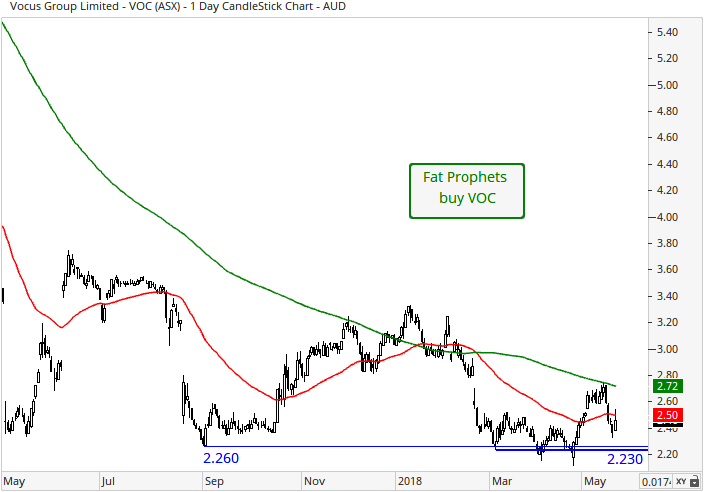
Turning to the charts, and on the daily, the bearish moving average crossover present since late-February is suggestive of momentum to favour the downside. This occurs when the 50-day moving average (red line) crosses below the 200-day moving average (green line). At present, a zone of support is located between $2.23 and $2.26. This is made up of the March intra-month low (horizontal solid-blue line) and the September 2017 low (horizontal thin-blue line) respectively. A sustained break above the 50-day moving average (red line) of $2.80 is ideally required. If this was to occur, then this would shift momentum back in favour of the bull-camp.
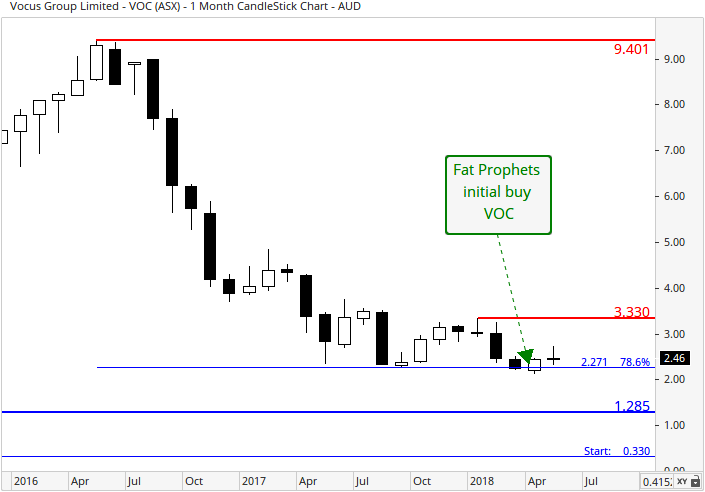
With reference to the monthly chart, prices are in flirtation-mode with support sighted at the 78.6% Fibonacci retracement of $2.27. It is important that the bulls defend this level, otherwise, the risk of a deeper decline down to the December 2011 low of $1.29 could very well be on the cards. In order for a definitive bullish rotation to evolve, a sustained break above overhead resistance evident at the January high of $3.33 (as marked by the horizontal red line) is required.
Summary
We re-added Vocus Communications (ASX:VOC) to the portfolio around six weeks ago, taking the view that an inflection point had been reached in the stock, with a senior management refresh underway, and a number of restructuring initiatives on the horizon.
While this has all not quite played out as we expected (with the sale of the assets across the Tasman having been shelved), we are very encouraged by the latest developments. Namely the appointment of the experienced Kevin Russell as CEO, and the elevation of Vocus New Zealand CEO Mark Callander to the board.
In addition to having a strong pedigree, new management will not be biased by the mistakes of the past which is a good thing in our view. The presence of activist shareholders such as Hong Kong-based investment group Janchor Partners will also ensure that new management are kept on their toes.
Vocus (ASX:VOC) trades on around 11 times FY19 earnings. This is similar to the multiple on which the shares were trading when we first entered the stock (in its previous time in the portfolio), and some way from the 25 times at which we exited.
Accordingly, we recommend Vocus (ASX:VOC) as a high risk buy to Members without exposure.
Fat Prophets has made every effort to ensure the reliability of the views and recommendations expressed in the reports published on its websites. Fat Prophets research is based upon information known to us or which was obtained from sources which we believed to be reliable and accurate at time of publication. However, like the markets, we are not perfect. This report is prepared for general information only, and as such, the specific needs, investment objectives or financial situation of any particular user have not been taken into consideration. Individuals should therefore discuss, with their financial planner or advisor, the merits of each recommendation for their own specific circumstances and realise that not all investments will be appropriate for all subscribers. To the extent permitted by law, Fat Prophets and its employees, agents and authorised representatives exclude all liability for any loss or damage (including indirect, special, or consequential loss or damage) arising from the use of, or reliance on, any information within the report whether or not caused by any negligent act or omission. If the law prohibits the exclusion of such liability, Fat Prophets hereby limits its liability, to the extent permitted by law, to the resupply of the said information or the cost of the said resupply.
Funds Management – In addition to the listed funds FPC, FPP and FATP, Fat Prophets Pty Ltd manages the separately managed accounts, namely Concentrated Australian Shares, Australian Shares Income, Small Midcap, Global Opportunities, Mining & resources, Asian Share, European Share and North American Share. These SMAs are managed under their own mandates by the fund managers, and this is independent to the research reports.
Staff trading – Fat Prophets Pty Ltd, its directors, employees and associates of Fat Prophets may hold interests in many ASX-listed Australian companies which may or may not be mentioned or recommended in the Fat Prophets newsletter. These positions may change at any time, without notice. To manage the conflict between personal dealing and newsletter recommendations the directors, employees, and associates of Fat Prophets Pty Ltd cannot knowingly trade in a stock 48 hours either side of a buy or sell recommendation being made in the Fat Prophets newsletter. Staff trades are pre-approved by an appointed staff trading compliance officer to ensure compliance with the staff trading policy.
For positions that directors and/or associates of the Fat Prophets group of companies currently hold in, please click here.
