
3Q18; good operational result
BHP Billiton (ASX:BHP) has released its third quarter operational activities to 31 March 2018, and in doing so has revealed a good set of operational numbers. The company reported better production numbers by three of its four key operations, and some excellent cameos by a number of its non-core product offerings. Going into the last quarter, the company narrowed some of its 2018 guidance ranges, to give the changes somewhat of a downgrade feeling in key product offerings.
The following table shows a summary of operations for the March quarter (yellow highlights – BHP’s four operational pillars):

Source: BHP Billiton (ASX:BHP)
We viewed the overall operational result for the March quarter as a good one, following what was a challenging first six months of 2018. We expect the company’s operations, based on the March quarter outcomes will however have a marginally positive impact on its 2018 financial result to 30 June 2018. We expect petroleum will be the only real headwind from an operational view. The company will announce its full year result for 2018 on 21 August 2018.
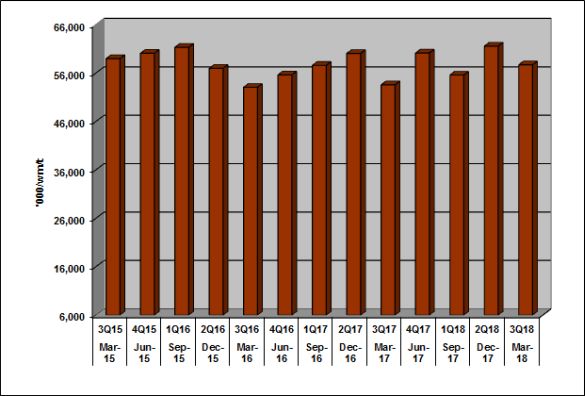
A key in the company’s four main product offerings is its iron ore operations, which for the March quarter reported better numbers. Iron ore production when compared to the same quarter in 2017 rose by 7.7%, to 57.7 million wet metric tonnes (wmts). The following chart shows quarterly production numbers for iron ore:
Source: BHP Billiton (ASX:BHP)
All but one of the company’s operations reported higher numbers for the March quarter, with the standout being the Area C joint venture (JV, BHP’s interest 85%). Compared to the March quarter 2017, the Area C JV delivered a record 12.8 million wmts of iron ore for the reported quarter, representing a 14.4% increase. Driving the better Area C JV result was improved logistics efficiencies.
The Wheelarra mine (BHP’s interest 85%) delivered a 20% increase in production compared to the same quarter 2017, to 8.0 million wmts. The mine continues to successfully ramp-up.
The fly in the ointment for the March quarter was the Jimblebar mine (BHP’s interest 85%), following the reporting of a 3.2% fall in production to 4.7 million wmts. Bottlenecking over the quarter drove the lower result.
Iron ore guidance for 2018 was downgraded and is forecast to be in the range of 236 million to 238 million wmts compared to the previous range of 239 million to 243 million wmts.
Western Australian Iron Ore is forecast to produce in the range of 272 million to 274 million wmts (100% basis) compared to the previous 275 million to 280 million wmts. In 2017, the company produced 231 million wmts of iron ore.
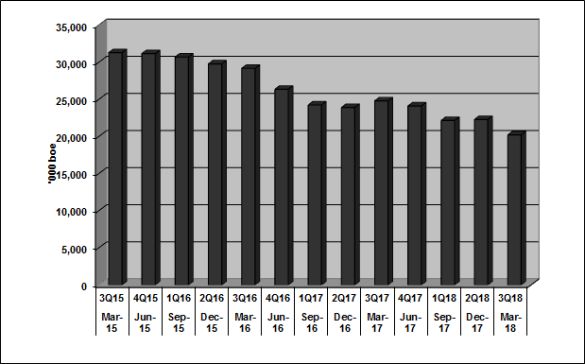
Petroleum is another key product offering for the company which has in recent times been in an entrenched down trend. Unfortunately, the March quarter result did nothing to change that trend. The following chart shows the company’s quarterly barrel of oil equivalent (boe) production numbers:

Source: BHP Billiton (ASX:BHP)
Overall production on a boe basis fell by 11.7% on the same quarter in 2017, to 44.7 million boe. Petroleum operates in two segments being liquids and natural gas, with both segments reporting lower operational numbers for the quarter to drive the overall result.
Liquids production reports the company’s oil, condensate and liquids natural gas production, and was the biggest contributor to the overall poor performance of the petroleum segment. The following chart shows quarterly liquids production:
Source: BHP Billiton (ASX:BHP)
For the March quarter, the production of liquids fell by 18.5% compared to the same result in 2017, to 20.2 million boe. Squarely, US onshore shale production played a major role, with the reporting of a 34% fall in production compared to the March quarter 2017, to 6.3 million boe. The company endured a number of weather events in the region of its fields that impacted production over the March quarter, to add to the natural field declines. An example is the Eagle Ford field which reported a 44% decline in production as a result of weather and natural field decline, to 4.4 million boe.
This was a disappointing result given that BHP purchased these assets for some US$20 billon back in to 2011. Higher energy prices recently have however restored some of the value, to the point where the company has placed a sale sign on some of the assets. The company has indicated that it is targeting calendar year-end to complete the sales.
The company’s conventional fields improved the overall negative result for liquids segment, with the reporting of a modest 9.2% fall in production compared to the March quarter 2017, to 14.0 million boe. The Gulf of Mexico fields were impacted by weather events, while overall natural field declines played a major role in the result. As an example, the Atlantis field (BHP interest 44%) reported an 11.2% fall in production compared to the March quarter 2017, to 3.7 million boe.
Bucking the liquids trend altogether was the company’s North West Shelf (NWS, BHP interest 16.6%) with the reporting of a 10.3% increase in production of liquids compared to the same quarter in 2017, to 1.6 million boe. Improved infrastructure availability and field efficiencies drove the better result.
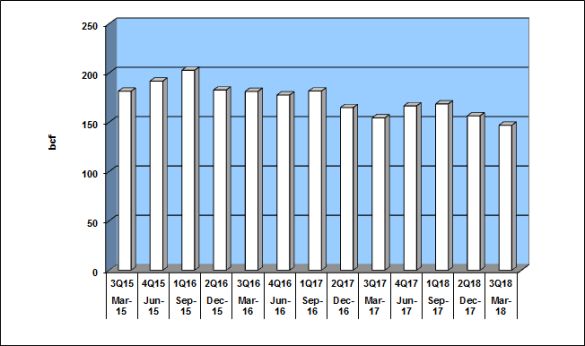
The production of natural gas fell by 4.9% when compared to the same quarter in 2017, to 147.0 billion cubic feet (bcf). The following chart shows quarterly natural gas production:
Source: BHP Billiton (ASX:BHP)
Both US onshore and conventional natural gas production reported lower results for the March quarter. US onshore natural gas production, for the same reasons as liquids prior, recorded a fall in production of 3.0% on the same quarter in 2017, to 64.1 bcf. Conventional natural gas production reported a fall of 6.2% on the same quarter in 2017, to 82.9 bcf. Natural field declines drove the fall.
Guidance for overall petroleum production in 2018 remains unchanged with a forecast in the range of 180 million to 190 million boe.
The constituent part will see onshore US deliver in the range of 61 million to 67 million boe (unchanged) and conventional 119 million to 123 million boe (unchanged). In 2017, the company’s petroleum segment produced a 208 million boe.
Copper production continues to recover with the March quarter confirming the trend. The following chart shows quarterly copper production:

Source: BHP Billiton (ASX:BHP)
The March quarter delivered a 101% surge in copper production when compared to the same quarter in 2017, to 456,800 tonnes. Driving the result was copper in concentrate which delivered a 189% surge compared to the March quarter 2017, to 280,100 tonnes. Copper cathode production over the same comparative period as concentrate rose by a modest 36%, to 176,700 tonnes.
The key driver was the Escondida mine (BHP’s interest 57.5%), following the reporting of a significant rise in copper production compared to the same result in 2017, to 314,300 tonnes. Availability of infrastructure in the reported quarter drove the result, with the March quarter 2017 outcome impacted by staffing issues.
The company enjoyed higher production across its remaining copper operations in Pampa Notre, Antamina (BHP’s interest 33.8%) and Olympic Dam. Pampa Notre saw a 700 tonnes increase on the March quarter 2017, to 66,800 tonnes of copper cathode, Antamina reported a 21% rise on the March quarter 2017, to 35,200 tonnes of copper concentrate and Olympic Dam reported a 10.1% increase over the same comparative period as Antamina, to 40,500 tonnes of copper cathode.
With the surge in copper production for the March quarter 2018, production guidance for 2018 was upgraded to be in the range of 1.7 million to 1.785 million tonnes of copper concentrate and cathode, from the previous 1.655 million to 1.79 million tonnes.
Escondida’s forecast was upgraded to be in the range of 1.18 million to 1.23 million tonnes of copper. Other copper was downgraded to be in the range of 520,000 tonnes to 555,000 tonnes, from the previous 525,000 tonnes to 560,000 tonnes of copper. In 2017, the company produced 1.3 million tonnes of copper.
Production of energy coal for the March quarter fell by 18% when compared to the corresponding quarter in 2017, to 6.1 million tonnes. The following chart shows quarterly production numbers for energy coal:

Source: BHP Billiton (ASX:BHP)
Weather events in New South Wales were behind the lower number, following a fall of 21% in energy coal production from the region when compared to the March quarter 2017, to 3.7 million tonnes. Columbian energy coal on mine sequencing and weather events, reported an 11.3% fall on the same quarter in 2017, to 2.8 million tonnes.
Production guidance for energy coal in 2018 remains unchanged and is forecast to be in the range of 29 million to 30 million tonnes.
In 2017, the company produced 29.6 million tonnes of energy coal.
Metallurgical (met) coal production for the reported quarter was marginally higher by 2.4% when compared to the March quarter 2017, to 10.4 million tonnes. The following chart shows quarterly production for met coal:

Source: BHP Billiton (ASX:BHP)
The company’s BHP Mitsui operations (BHP’s interest 80%) delivered a 12.1% increase in production when compared to the March quarter 2017, to 2.4 million tonnes. Driving the result was improved stripping and trucking. The BMA mines (BHP’s interest 50%) in Queensland reported a flat performance on the corresponding 2017 quarter, to 8.0 million tonnes. The company’s mines operated as expected during the quarter.
Production guidance for met coal in 2018 remained unchanged and was forecast to be in the range of 41 million to 43 million tonnes.
In 2017, the company produced 40 million tonnes of met coal.
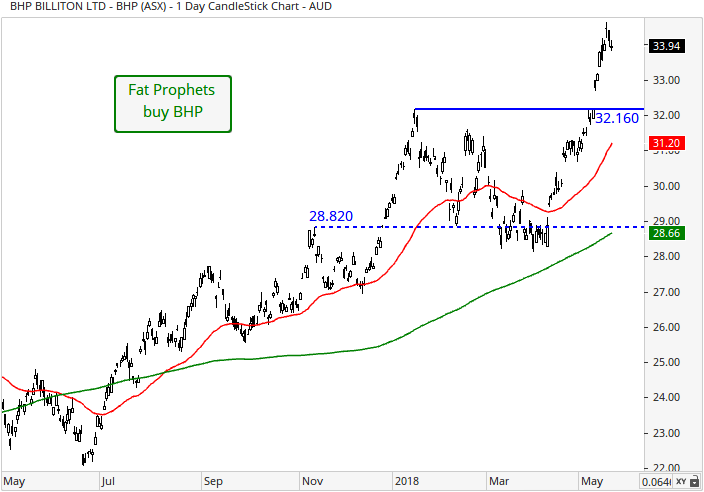
BHP Billiton (ASX:BHP) has delivered a sound third quarter operational result to 31 March 2018. The operational result reflects a settling in what had been a prolonged and turbulent market for commodities and commodity pricing uncertainty.
The company has, in announcing some key downgrades in 2018 guidance, deliver some concern around the momentum of operations in the third quarter flowing into the fourth quarter.
The company’s strategy of investing capital to develop long-term quality tier 1 projects from within its own portfolio remains a priority.
The advantages in developing brownfield projects deliver lower capital outlays and development times are substantially shorter. The company is now leveraging its operations into a period of improving commodity prices on a low operator cost status, to generate cash flow and earnings.
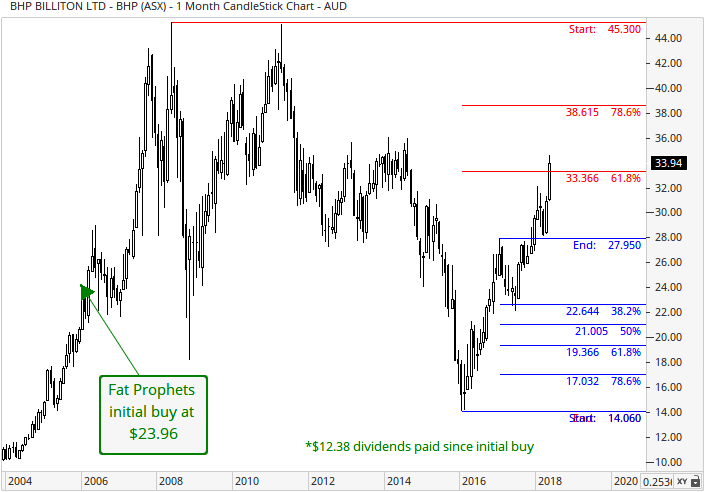
BHP Billiton (ASX:BHP) has, and our opinion remains unchanged, the financial capability to deliver shareholder value across commodity cycles. The third quarter 2018 operational result does, we believe, support our view.
Consequently, we continue to recommend BHP Billiton as a high conviction buy for Members with no exposure to the stock.
Disclosure: BHP Billiton (ASX:BHP) is held within the Fat Prophets Global Contrarian Fund, Mining and Resources, Concentrated Australian Share and Concentrated UK Share portfolios.

