
Holding onto InfraCo
The response to Telstra’s recent results has been modestly negative. This sentiment appears to stem from the company’s choice to retain the entire stake in the InfraCo Fixed business for the medium term and some cost challenges to the T25 strategy. Although the potential quick gains from selling a stake in InfraCo are off the table for now, we expect InfraCo’s value to appreciate further over time.
The FY23 report showcased several positive aspects, reaffirming our core investment case. We view the subsequent downturn as a buy-the-dip opportunity and rate Telstra a Buy.
A key element of our investment case is the improving backdrop for the core mobile segment. Telstra (ASX:TLS) has pushed through price hikes in mobile, with more on the way and there are all the signs of a more rational pricing market in the mobile market (postpaid ARPU grew nicely in FY23). The more rational environment should enable Telstra to continue leveraging the company’s leading position. The mobile segment delivered a strong result for FY23, as Telstra has also dramatically simplified its mobile plans (trimming complexity/costs).
Telecommunications has become an essential service (try to separate your kids from their mobiles) and thus should be resilient during any downturn. Meanwhile, there is secular growth in data usage and Telstra (ASX:TLS) has opportunities to grow revenue in newer areas like AI, IoT, cybersecurity and other digital services as we increasingly move to a digital world.
Telstra (ASX:TLS) enjoys a leading position in the oligopolistic Australian telecoms market given the heavy investment in its network. At the time of the recent FY23 report, Telstra’s 5G network had reached the FY23 target of 85% population coverage. Meanwhile, recently inked deals with OneWeb and Starlink to soon deliver improved services in remote Australia. On that note, Telstra recently decided against appealing the Australian Competition Tribunal’s decision to block the regional network-sharing agreement with TPG Telecom.
After years of bearing the brunt of the financial hole from the NBN and price wars in mobile, the environment is sunnier here for Telstra. The annuity cash flow from the infrastructure leasing deal (i.e., ducts, pits, exchanges) with NBN is indexed to inflation. Indeed, NBN recurring revenue grew 6.1% (to $987m) from FY22 thanks to a bumper 7.3% price increase from 1 January 2023. The NBN revenue is reported within the infrastructure segment.
The decision to retain the entire stake in InfraCo, at least for the medium term may have disappointed a short-term focused market but this is an exceptional asset that will grow in value. Although we would have been content with a partial sale at a good price, that price tag should head higher in the coming years due to earnings growth capacity and depending on timing, likely a higher ascribed multiple (i.e., should interest rates be a little lower).
Telstra (ASX:TLS) CEO Vicki Brady believes Telstra can optimize the outcome for shareholders by holding onto InfraCo for now. On the call with analysts, Ms Brady said, “We see the trends that are happening technology wise, the shift to the cloud, the rapid AI adoption. All of those things contribute to an optimistic view of long-term growth out of InfraCo Fixed.”
Telstra (ASX:TLS) continues to invest in infrastructure, with Ms Brady saying, “The infrastructure investments we are making, including our inter‐city fibre network and submarine cable network, will underpin a more digitised future and see us strategically positioned for growth.”
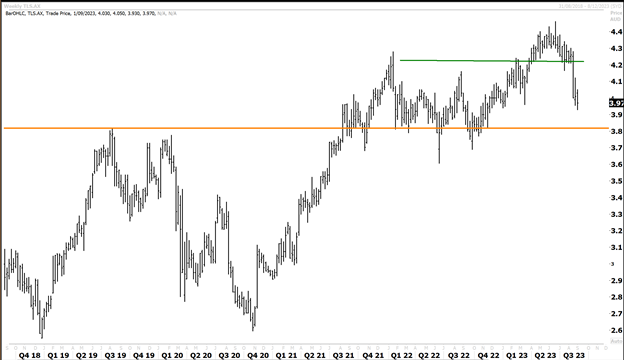
Moving on to the technical picture, with Telstra breaking near-term support on the 5-year weekly chart below at the $4.20 level, the stock has extended lower. The next major support level is at $3.80 which should prove significant and hold the shares. A good buying opportunity would potentially open in the low $3.80s.
FY23 snapshot
Telstra (ASX:TLS), generated revenue of $23.24 billion, up 5.4% largely thanks to higher mobile services and hardware sales, and more international revenue (including Digicel Pacific following the acquisition), with support from some other areas, including InfraCo Fixed. Growth in those segments more than offset declines in the legacy fixed areas.
Operating expenses increased by 4.1% to $15.36 billion, with that increase very respectable discipline considering the current inflationary environment. Management noted the T25 target of taking out $500 million in costs would be tough. Ms Brady said, “While our cost-reduction ambition is being challenged by high inflation, we still expect to achieve the large majority of this by FY25. We remain absolutely committed to delivering our FY25 underlying EBITDA and EPS growth ambitions.”
 Image credit: Telstra Full Year report
Underlying EBITDA hit $8.0 billion, marking an increase of 9.6%. That was a strong result, bolstered by the Digicel Pacific contribution. Excluding that, underlying EBITDA was still a robust 5% higher. Net finance costs surged 27% due to the higher interest rate environment and larger debt load but are still modest in the scheme of things at $529 million. NPAT for Telstra equity holders was 14.2% higher at $1.93 billion (while FY23 NPAT for Telstra was $2.05b). The final dividend was consistent with a year earlier, at 8.5 cents per share. However, this lifted the total dividend for the year to 17 cents per share. That is a modest, but welcome 3% increase and Telstra appears set to continue moderately increasing the dividend further in FY24 and FY25.
The mobile segment was the key driver as we anticipated. Mobile revenue rose 8.3% to $10.26 billion, as the postpaid handheld services revenue rose 6.9% to $5.39 billion with a 1.0% increase in customer accounts and a 5.4% ARPU (average revenue per user) growth. Price hikes have had little impact on subscriber churn. Telstra (ASX:TLS) saw 7.9% services revenue growth and 12.1% hardware growth. Growth in services revenue was broad-based across all mobile sub-products. Retail mobile SIOs increased by 1.7 million to 22.5 million. Telstra had 8.8 million postpaid handheld retail SIOs at the end of FY23, marking an increase of 86,000 over the year. Mobile EBITDA margins increased by 2.7 percentage points to 44.9% and EBITDA grew 15% to $4.6 billion.
We note the Enterprises segment was the weak spot, with EBITDA falling a hefty 38% to $411 million. Tough competition pressured data and connectivity revenue, while higher power and infrastructure costs squeezed margins. On the other hand, International EBITDA soared 84% to $713 million, bolstered by Digicel Pacific.
InfraCo EBITDAaL was a marginal $5 million higher at $1,584 million, while Amplitel (the towers business) EBITDAaL grew 9.2% to $259 million. EBITDAaL is earnings before interest, taxation, depreciation, amortisation and after leases, reported for these infrastructure businesses.
Looking forward, Telstra (ASX:TLS) projects an underlying EBITDA between A$8.2 billion and A$8.4 billion for FY24, with a total expected income between A$22.8 billion to A$24.8 billion.
In summary, Telstra’s FY23 results were largely in line with our expectations and along with guidance, reaffirmed our positive fundamental view. A key element of our investment case is the improving backdrop for the core mobile segment. Meanwhile, we expect the InfraCo business to grow in value and for this to ultimately be recognised by investors.
We view the downturn in the shares as a buy-the-dip opportunity and rate Telstra (ASX:TLS) a Buy.

