
A justifiable recovery
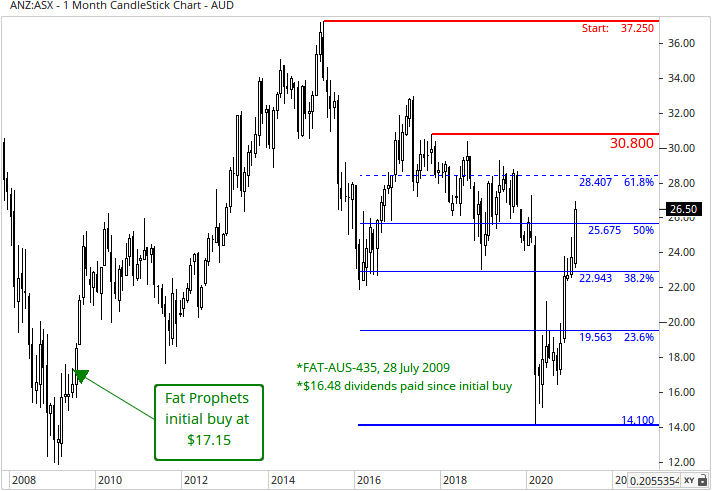
ANZ shares have staged a strong recovery since March lows, endured during the early stages of the pandemic. The solid rally over the past few months can be justified by the recent December trading update, showing an unaudited statutory profit after tax of $1.62 billion. The banks are benefiting from the economic recovery playing out in Australia and much ‘better than feared’ outcomes for many customers.
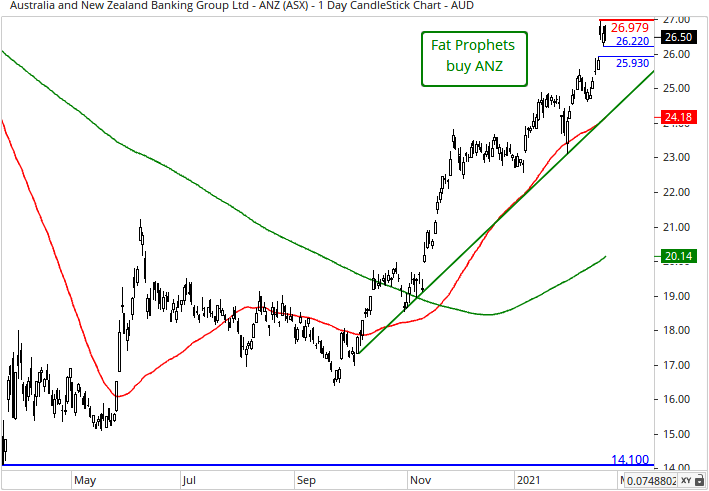
With long dated bond rates on the way north and a steepening yield curve, the backdrop is still improving for ANZ and its peers. While the complete fallout of the pandemic remains to be seen, ANZ has already taken huge provisions and we saw it release a net $150 million along with its December quarter result. Commenting on the move, ANZ CEO Shayne Elliott said in a statement released to the ASX: “The small release in the collective provision reflected improved economic conditions, particularly here in Australia. However, recent lockdowns in Perth, Brisbane, Melbourne and Auckland demonstrate how quickly things can change and we believe our current settings are both prudent and appropriate, given this uncertainty.”
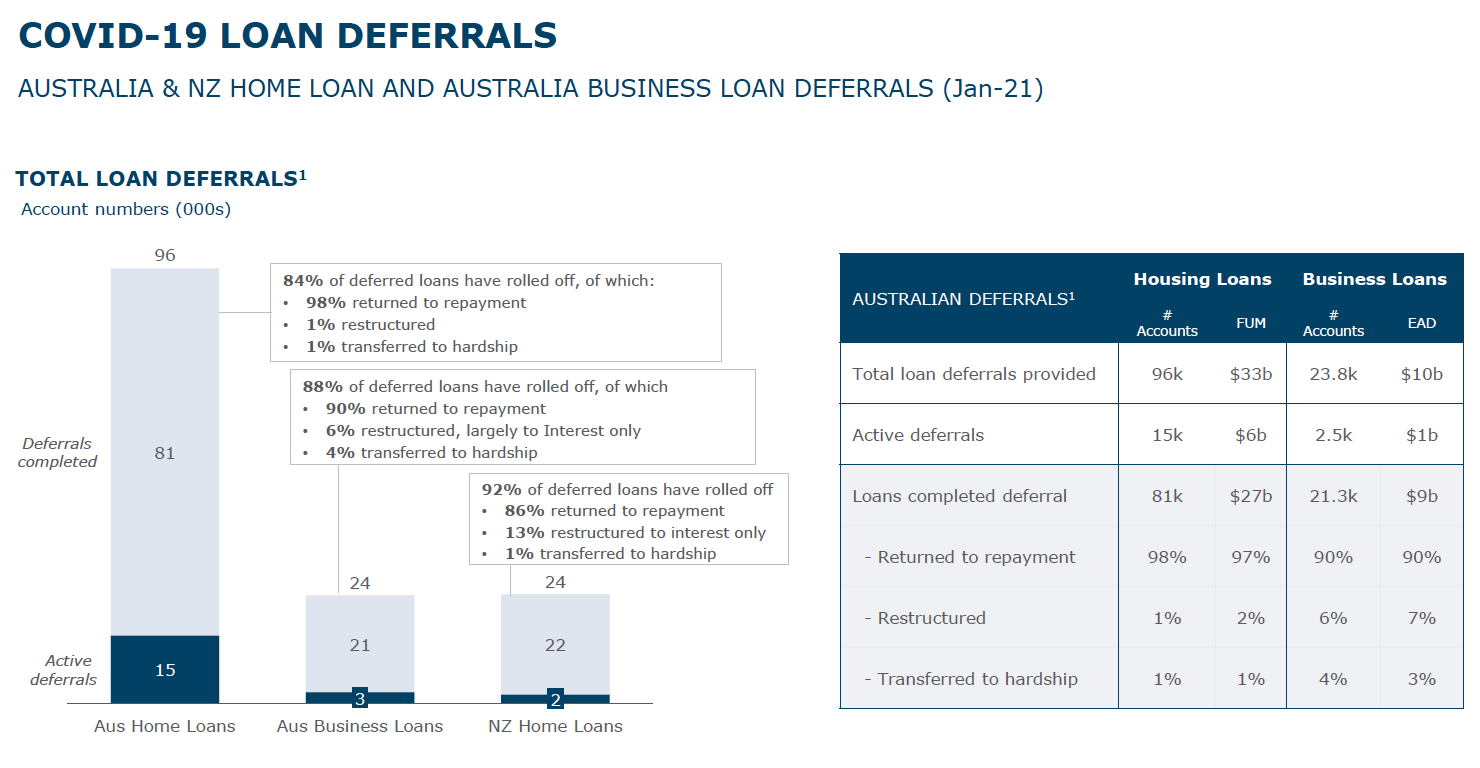
In addition, just 1% of the bank’s home loan customers in Australia and New Zealand are still receiving COVID support, boding well for lower than feared defaults compared to earlier expectations. In Australia, 84% of deferred loans have rolled off with 98% returning to repayments. Active deferrals now total $6 billion across 15,000 accounts, down from 96,000 and $33 billion previously.
Source: ANZ
In New Zealand, a greater 92% of loan deferrals have rolled off with 86% returning to repayments.
1Q21 snapshot
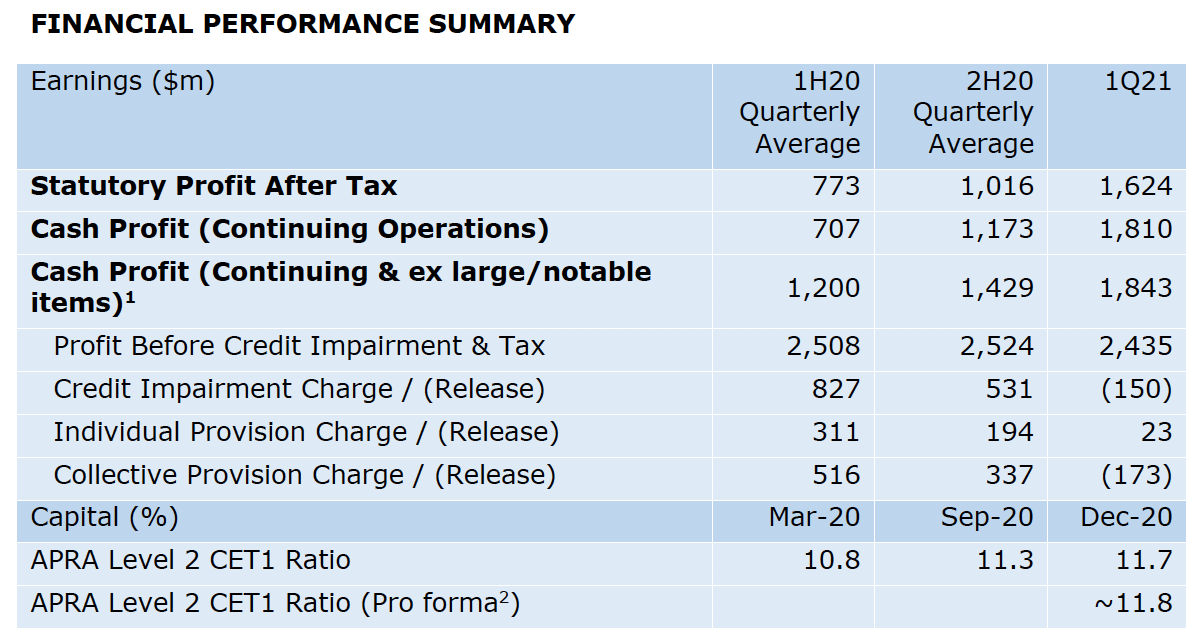
ANZ’s closely watched cash profit after tax from continuing operations came in at $1.81 billion in the first quarter, marking a 54% improvement over the average in the last two quarters of 2H20. The strong increase was underpinned by higher revenue, containing costs and the release of some credit provisions taken last year.
Source: ANZ
Group revenue increased 4% for the quarter, excluding the group’s Markets business. Management noted market share growth in the key home loans segment and record volumes in New Zealand target markets.
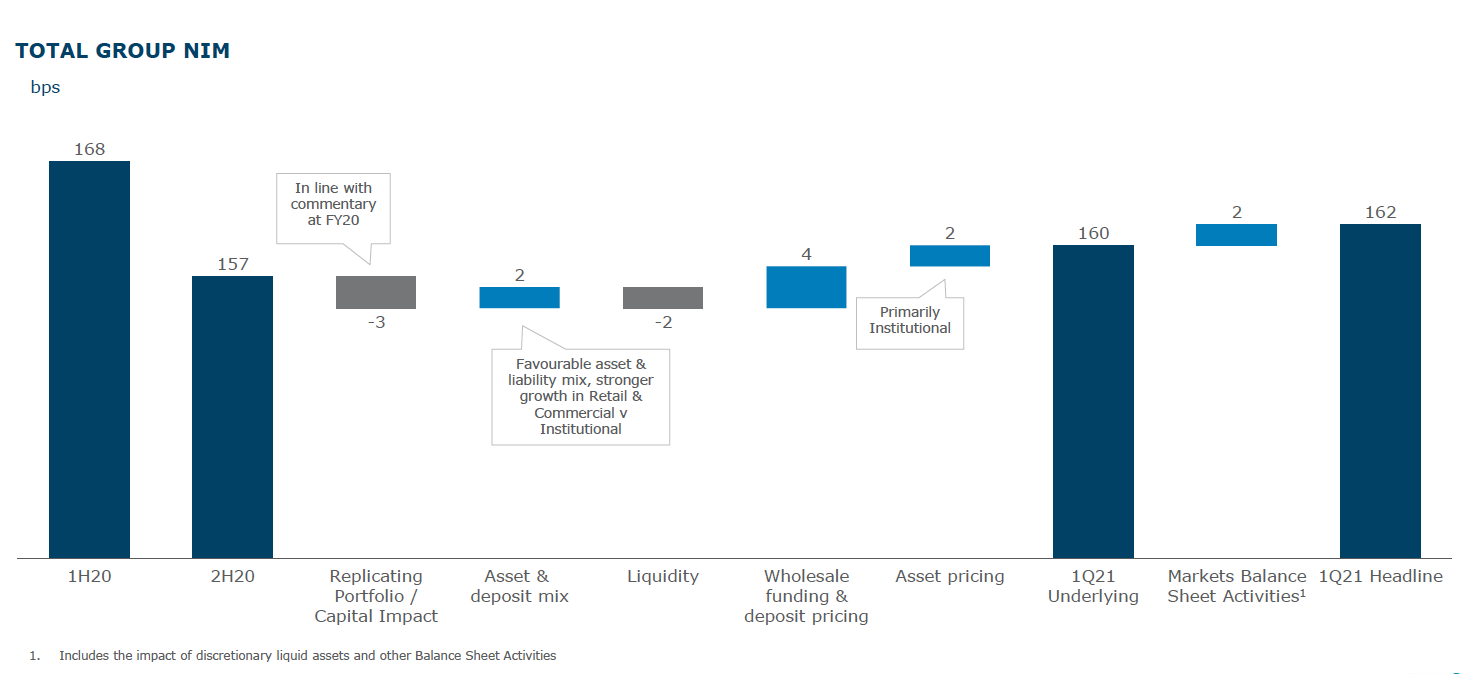
The group net interest margin (NIM) of 162 basis points in 1Q21 was 5 basis points higher than the 157 basis points in 2H20 but lower than the 168 basis points in 1H20. Excluding the impact of Markets balance sheet activities, the group NIM was 3 basis points higher. The following ‘waterfall’ chart highlights the various factors impacting NIM with the key factors benefiting ANZ in 1Q21 being an improved mix (both assets and liabilities), lower funding costs and higher institutional asset margins.
Source: ANZ
Net operating expenses were effectively flat compared to the quarterly average in 2H20 and down a little from the quarterly average in 1H20. The release of a net $150 million in credit provisions was a key swing factor, underlying the increase in cash operating profit.
ANZ’s level 2 common equity tier 1 (CET1) ratio at the end of December 2020 was 11.7%, up from 11.3% at the end of September 2020, and ANZ said it will be 11.8% after the conversion of a NZ$500 million capital note.
Summary
ANZ reported a strong improvement in cash profit in 1Q21, suggesting the toughest patch of the pandemic is in the rear-view mirror. Deferrals are down dramatically from earlier levels and although ANZ and its peers still have to be prepared for changes in JobKeeper and JobSeeker, ANZ took plenty of provisions in 2020. Even after the net release in the December quarter, the Collective Provisions (CP) balance at 31 December 2020 was $4.8 billion.
Credit quality was good leading into the crisis, and there are signs that the levels of soured loans will be lower than earlier anticipated. Accordingly, dividends could bounce back in the years ahead faster than the market has expected.
ANZ entered the pandemic with a simplified business model, after withdrawing from many Asian markets and is well placed to return to finding the right balance between a leaner operation and growth on the far side of the crisis. A strong balance sheet provides support.
We recommend ANZ as a buy to Members without exposure and a medium-term or longer investment time frame.
Disclosure: Interests associated with Fat Prophets hold shares in ANZ.

