
BHP

BHP Snapshot
| FY1 | FY2 | |
|---|---|---|
| Price to Earnings: | 7.61 | 9.91 |
| Dividend Yield (%): | 10.18 | 7.43 |
| Price to Book: | 2.72 | 2.56 |
| Return on Equity (%): | 35.51 | 26.03 |
| EV/EBITDA: | 3.91 | 4.70 |
1Q22; tough going
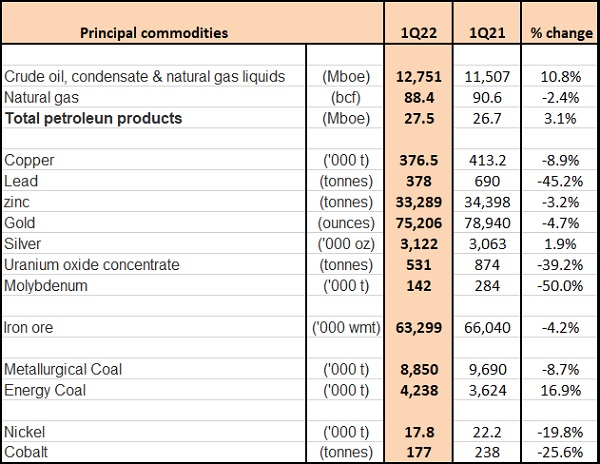
BHP (ASX:BHP) has released its first quarter operational activities and in doing so, has revealed softer production numbers across the majority of its key product offerings. All but one of BHP’s key product offerings reported lower production numbers for the September quarter, with the exception being petroleum. Good cameo performances by its minor product offers for the quarter were also thin on the ground, with energy coal and silver the exceptions. We take comfort in 2022 guidance numbers, across the board, being left unchanged. The following table shows a summary of operations for the September quarter (boe – barrels of oil equivalent, bcf – billion cubic feet):
Source: BHP (ASX:BHP)
Overall, we rate BHP’s September quarter as ordinary, with the performance of its key petroleum offering and its unchanged 2022 guidance numbers, across the board, holding up our rating. The unchanged 2022 guidance numbers provide some comfort, since the quarterly performances by many of BHP’s product offerings were impacted by maintenance.
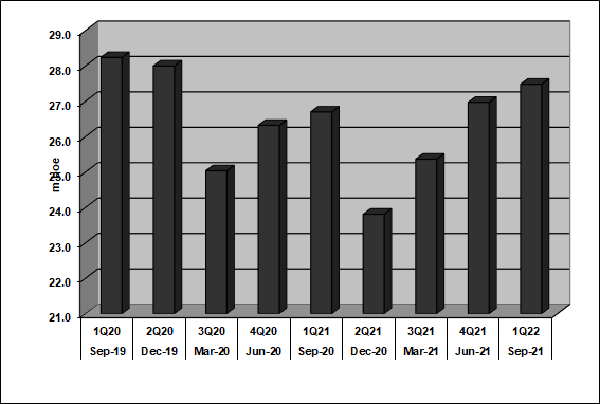
The highlight of the result was the performance of petroleum, a key product offering whose past quarterly performances have been challenging for BHP. The following chart shows quarterly barrel of oil equivalent (boe) production numbers:
Source: BHP (ASX:BHP)
Overall production on a boe basis rose by 3.1% year-on-year (yoy), to 27.5 million boe, with liquids delivering the positive momentum while natural gas production dragged. We have, with past quarterlies, lamented BHP’s inability to sustain stable to higher production for petroleum, given the margins it can generate. The September quarter brought with it higher production and higher energy prices, which bodes well for BHP when it reports its first half financial result to 31 December 2021, in February 2022. BHP remains in talks with Woodside to divest all of its petroleum assets and is on the front foot in this process with the current higher energy prices.
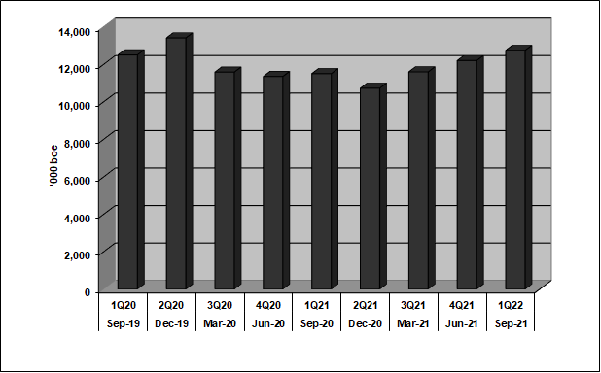
Liquids for the quarter were the standout (includes crude oil, condensate and natural gas liquids) with the reporting of a 10.8% yoy rise in the production, to 12.8 million boe. The following chart shows quarterly liquids production:
Source: BHP (ASX:BHP)
BHP cited fewer Gulf of Mexico weather events, an increase to a 28% working interest in the Shenzi field and improved volumes from its Ruby field, as drivers of the better performance for the quarter.
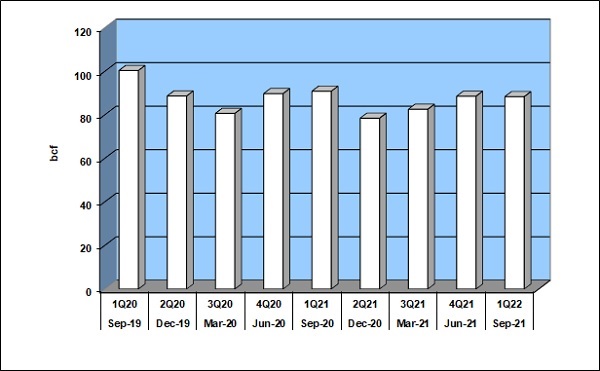
Natural gas production was a drag for the September quarter, following a 2.4% yoy fall, to 88.4 bcf. The following chart shows quarterly natural gas production:
Source: BHP (ASX:BHP)
The result was impacted by lower North West Shelf production and natural field declines across the portfolio. A partial offset was higher natural gas production from Bass Strait, due to improved third party demand.
Guidance for petroleum production for 2022 remained unchanged and is forecast to be in the range of 99 million to 106 million boe. In 2021, BHP produced 102.8 million boe.
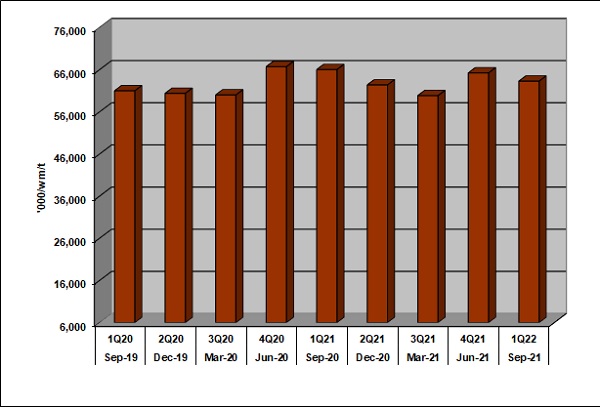
Iron ore is a key product offering and for once had to take a back seat, with the reporting of a 4.2% yoy fall in production, to 63.3 million tonnes. The following chart shows quarterly production numbers for iron ore (wmt – wet metric tonnes):
Source: BHP (ASX:BHP)
Driving the result were major maintenance activities across the iron ore portfolio and a shortage of rail staff, due to lingering COVID-19 restrictions. BHP has, post 30 September 2021, advised that these shortages have now eased. A feature, albeit a small one, in the September quarter for iron ore was the ramp-up of Samarco (BHP interest 50%) production after a long layoff. Samarco added 1.0 million tonnes of iron pellets to the overall September quarter performance, compared to a zero contribution for a year earlier.
Iron ore guidance for 2022 remained unchanged and is forecast to be in the range of 249 million to 259 million tonnes. For 2020, BHP produced 253.5 million tonnes of iron ore.
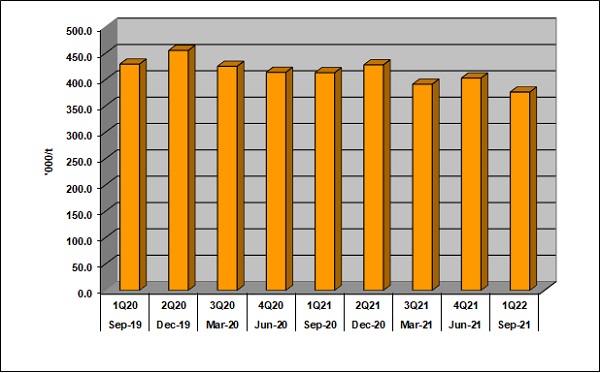
Copper is another key offering and was also a little disappointing, with a fall in production for the September quarter. The following chart shows quarterly copper production:
Source: BHP (ASX:BHP)
The September quarter delivered an 8.9% fall in copper production yoy, to 37,500 tonnes, with copper cathode and concentrate both contributing to the result.
Copper cathode production fell 15.7% yoy, to 119,600 tonnes and copper concentrate production fell 5.3% yoy, to 256,900 tonnes. Olympic Dam drove the cathode result, with the reporting of a 43% fall yoy, to 29,500 tonnes of copper cathode. Olympic Dam operations were shut-in for major planned maintenance.
Escondida (BHP’s interest 57.5%) was the key contributor on the concentrate side, reporting a 17.7% fall yoy, to 194,700 tonnes, on lower grades and lingering COVID-19 events. As a partial offset was the ramp-up of the Spence Growth facility that added 26,400 tonnes of new copper concentrate, compared to a zero contribution for the year earlier.
BHP reiterated 2022 copper production guidance in the range of 1.59 million to 1.76 million tonnes of copper concentrate and cathode combined. In 2020, BHP produced 1.6 million tonnes of copper.
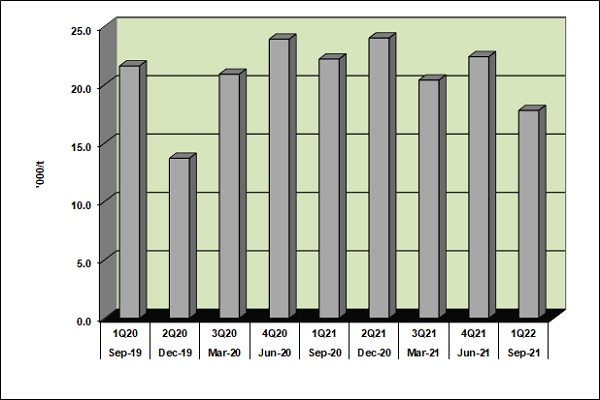
The September quarter brought with it a fall in nickel production, with the following chart showing quarterly production numbers:
Source: BHP (ASX:BHP)
We have included nickel, given we believe BHP may lift its efforts to increase the profile of this offering, given the sea change now underway in the auto industry to electric vehicles and their requirement for batteries. Nickel West is currently BHP’s sole nickel operation, and for the September quarter, it reported a fall in saleable nickel production. Production fell 19.8% yoy, to 17,800 tonnes. Production was impacted by a major planned maintenance shutdown of Nickel West facilities in the quarter.
Guidance for saleable nickel production for 2022 is forecast to be in the range of 85,000 tonnes to 95,000 tonnes. In 2021, Nickel West produced 89,000 tonnes of nickel.
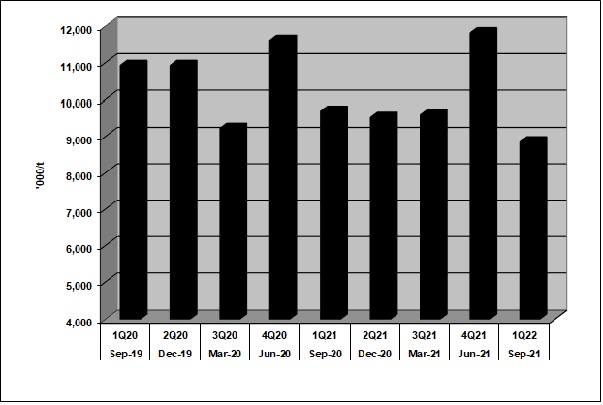
Metallurgical (met) coal production for the quarter fell by 8.7% yoy, to 8.9 million tonnes. The following chart shows quarterly production for met coal:
Source: BHP (ASX:BHP)
BHP’s main met coal producer BMA Coal (BHP interest 50%), delivered an 8.8% fall in production yoy, to 6.7 million tonnes. Driving this result were major maintenance works conducted during the September quarter. BHP Mitsui Coal reported an 8.2% fall yoy, to 2.1 million tonnes.
Production guidance for met coal in 2022 remained unchanged and was forecast to be in the range of 39 to 44 million tonnes. In 2020, BHP produced 40.6 million tonnes of met coal.
Production of energy coal for the September quarter was one of the few standouts, following the reporting of a 16.9% yoy rise, to 4.2 million tonnes. Mining efficiencies across NSW Energy Coal and reduced weather events compared to a year earlier drove the result. BHP has been actively selling down its energy coal exposure.
Energy coal production guidance for 2022 remained unchanged and is forecast to be in the range of 13 million to 15 million tonnes. For 2021 energy coal production was 19,290 tonnes, with the lower 2022 numbers reflecting asset sales.
Looking at BHP’s minor product offerings, there was only one standout in silver for the September quarter. Silver reported a 1.9% increase in production yoy, to 3.1 million ounces. The addition of 273,000 ounces of new silver production from the ramp-up of the Spence Growth facility was a key driver, compared to a zero contribution for the year earlier. A partial offset was Escondida, with it reporting a 0.8% yoy fall in silver production, to 1.3 million ounces.
Spending on exploration activities came in at US$143 million, with petroleum contributing US$87 million and minerals exploration US$56 million. We consider this to be a small allocation, given the financial size of BHP. We are, however, aware of the considerable brownfield development opportunities BHP hosts across its asset base. Given BHP Petroleum is under a sale notice, it is likely exploration by this segment has been scaled back.
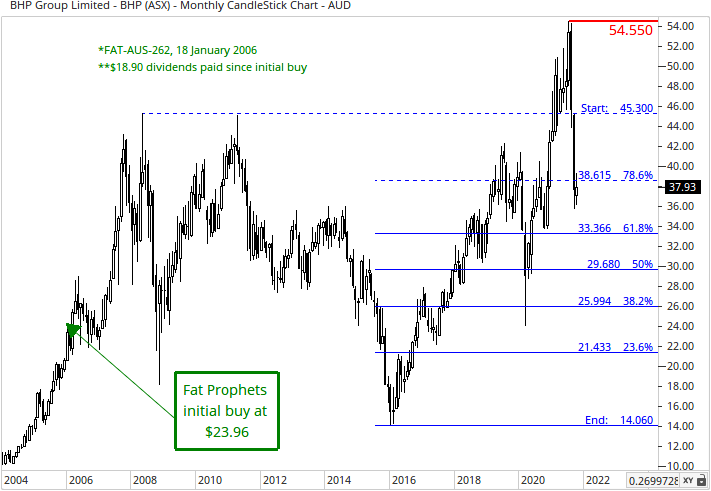
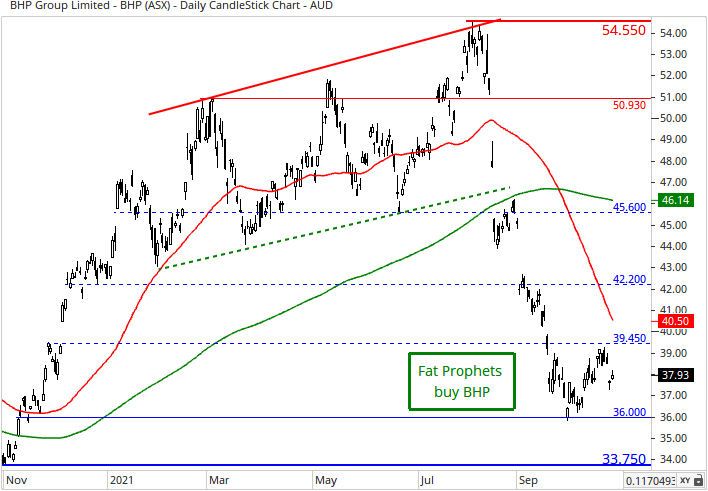
BHP (ASX:BHP) has delivered, in our view, an ordinary operational start its 2022, but we take comfort in guidance for 2022, across all its product offerings, remaining unchanged. On the financials, BHP is enjoying higher commodity prices across several of its production offerings which should continue to generate cash flow and should go some way to offsetting any operational impacts.
Given the current correction in BHP’s share price (ASX:BHP), we consider this price action provides an ideal entry into BHP. Consequently, we reiterate our buy recommendation for BHP Group for Members with no exposure to the stock.
Disclosure: Interests associated with Fat Prophets hold shares in BHP Group (ASX:BHP).
Fat Prophets has made every effort to ensure the reliability of the views and recommendations expressed in the reports published on its websites. Fat Prophets research is based upon information known to us or which was obtained from sources which we believed to be reliable and accurate at time of publication. However, like the markets, we are not perfect. This report is prepared for general information only, and as such, the specific needs, investment objectives or financial situation of any particular user have not been taken into consideration. Individuals should therefore discuss, with their financial planner or advisor, the merits of each recommendation for their own specific circumstances and realise that not all investments will be appropriate for all subscribers. To the extent permitted by law, Fat Prophets and its employees, agents and authorised representatives exclude all liability for any loss or damage (including indirect, special, or consequential loss or damage) arising from the use of, or reliance on, any information within the report whether or not caused by any negligent act or omission. If the law prohibits the exclusion of such liability, Fat Prophets hereby limits its liability, to the extent permitted by law, to the resupply of the said information or the cost of the said resupply.
Funds Management – In addition to the listed funds FPC, FPP and FATP, Fat Prophets Pty Ltd manages the separately managed accounts, namely Concentrated Australian Shares, Australian Shares Income, Small Midcap, Global Opportunities, Mining & resources, Asian Share, European Share and North American Share. These SMAs are managed under their own mandates by the fund managers, and this is independent to the research reports.
Staff trading – Fat Prophets Pty Ltd, its directors, employees and associates of Fat Prophets may hold interests in many ASX-listed Australian companies which may or may not be mentioned or recommended in the Fat Prophets newsletter. These positions may change at any time, without notice. To manage the conflict between personal dealing and newsletter recommendations the directors, employees, and associates of Fat Prophets Pty Ltd cannot knowingly trade in a stock 48 hours either side of a buy or sell recommendation being made in the Fat Prophets newsletter. Staff trades are pre-approved by an appointed staff trading compliance officer to ensure compliance with the staff trading policy.
For positions that directors and/or associates of the Fat Prophets group of companies currently hold in, please click here.
