
SKT

Stopping the sky from falling
Sky Network Television (NZX, ASX:SKT) has been, in our view, a textbook example of how value can be destroyed when a company is slow to react to challenges to its monopolistic position.
Having faced little, if any, competition for the best part of two decades, the largest pay TV provider in New Zealand has been complacent about the risks posed by disruptors such as Netflix and Spark New Zealand’s Lightbox. A failure to invest and ‘keep up with the times’ has also manifested itself in substantial subscriber churn, which has come at a significant cost to earnings.
We have been very critical of the way Sky has performed for some time, and indeed the company’s loss has been to Spark New Zealand’s gain, as it has pushed further into content provision and sports programming; once the sole bastion of Sky. Operating underperformance has also been reflected in Sky’s share price, which has arguably been one of the worst performing for a pay-TV company anywhere in the world, in recent years. Since a peak of $6.85 in mid-2014 the shares have lost around 65% in value.
We believe the tide may however finally be about to turn. Customer churn looks to be stabilising after the company finally ceded to pressure and has restructured its product price structure.
Management have also made another important concession to ‘move with the times’ and provide an internet accessible set-top box which can operate via the cloud (rather than having to have one of the company’s clunky aerials installed). We believe these changes will be the key to further arresting the decline in the company’s customer base, which still stands in excess of 750,000 (in a country with a total population under 5 million).
Often a key element of any turnaround is new management, and there is also something on the offer here. CEO John Fellet is retiring in the next few months after 17 years at the helm, and some 27 years in total at the company. While his replacement has not yet been appointed (incredible in itself!), we are at least encouraged by the prospect of the opportunity for new blood to come in with fresh and ‘evolving’ ideas – something which Sky has been badly in need of.
The handover will be facilitated initially by Mr Fellet staying on as CEO and the presence of long-standing Chairman Peter Macourt. We would not be surprised to see both exit once a changing of the guard is transitioned over the next year.
Sky also has a partnership with Vodafone which it can also leverage. The attempts by the two companies to merge was blocked by the regulators last year, but having accepted this, we are sure that management(s) will look to further leverage their relationship, with both under attack from disruptors.
From a valuation point of view, the expectations bar has been set very low, with Sky trading on just 7 times earnings (and offering a 7% yield). While the advertising sector clearly faces some challenges, Sky already has the ability, in our view, to leverage significant distribution and given a still superior content offering in the likes of sport.
Accordingly, we are issuing a High Risk buy recommendation for Members with a medium-term timeframe.
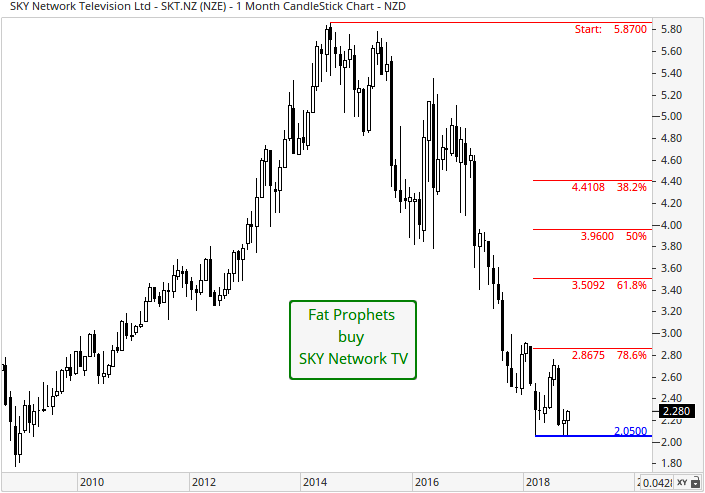
Turning to the charts, and on the monthly ‘Sky has clearly fallen’ consistently since early 2014. Successive Fibonacci retracement levels have been taken out since, with prices however appearing to stabilise after hitting a low of $2.05 this year. A move back towards the 78.6% Fibonacci retracement at $2.87 would be a boost to the technical outlook.
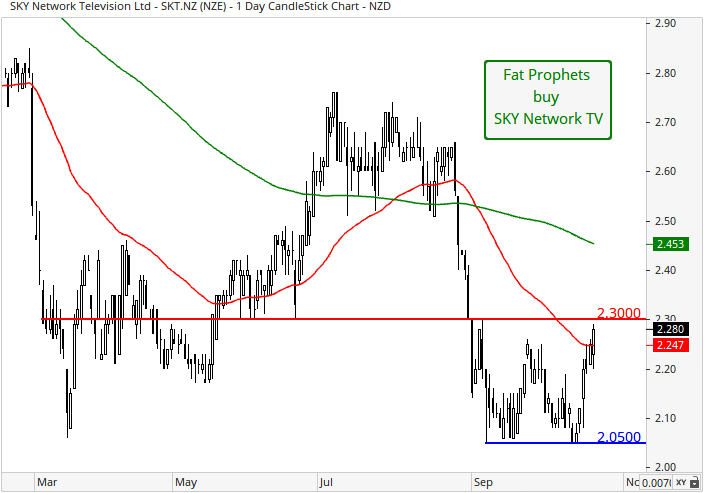
On the daily chart, resistance at $2.30 gave way again in August, but prices have since staged an encouraging bounce off the next buttress at $2.05, being this year’s low. Prices are also now above dynamic support at the 50 day moving average around $2.25, indicating that another test of the $2.30 mark is imminent.
Company History
Sky Network Television (or simply ‘Sky’ as it is known and branded) was founded in 1987 by Craig Heatley, originally with the aim of broadcasting sports into pubs and clubs using satellite dishes. The company subsequently became s pay television service after successfully bidding in 1990 for regional UHF frequencies. The company provided ‘decoders’ to unscramble satellite feeds, which are not a million miles away from the ‘set-top boxes’ still used by Sky today.
The company also added a free-to-air channel with the acquisition of Prime TV for $30 million in 2005. The company uses Prime TV to promote its pay-TV service to potential subscribers. The same year News Corp acquired a 44% stake in Sky through its merger with Independent Newspapers. This interest was sold by News Corp in 2013.
More recently, Sky attempted to merge with Vodafone NZ in a $1.25 billion deal. Both companies saw this as a means to extract strong synergies, and combat disruption being faced on a number of fronts. The kiwi regulator saw differently, with the Commerce Commission rejecting the tie-up. The status quo was therefore maintained with Sky as a wholesale content provider to Vodafone.
Recent results
Sky released full year results to 30 June 2018 in August and the numbers certainly weren’t flattering.
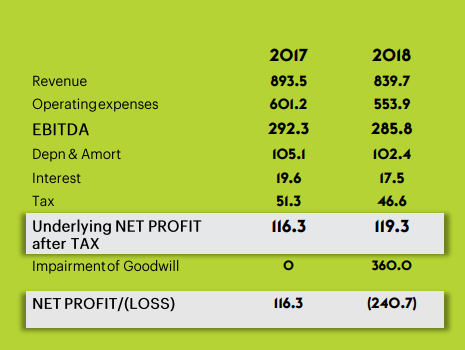
The company recorded a net loss for the year of $241 million versus the previous year’s profit of $116.3 million. The red ink came following a decision to take non-cash write-downs of some $360 million on the value of its business, dating back to a merger with INL more than a decade ago. Shareholders also took another hit, with the full year dividend almost halved to 15 cents per share, the lowest in eight years.
Source: Company AGM
We believe there is some evidence to suggest that these results may mark the nadir for Sky.
Underlying profit actually rose more than 2% to $119.3 million, helped by a cost out-programme, debt reduction, and as subscriber attrition slowed.
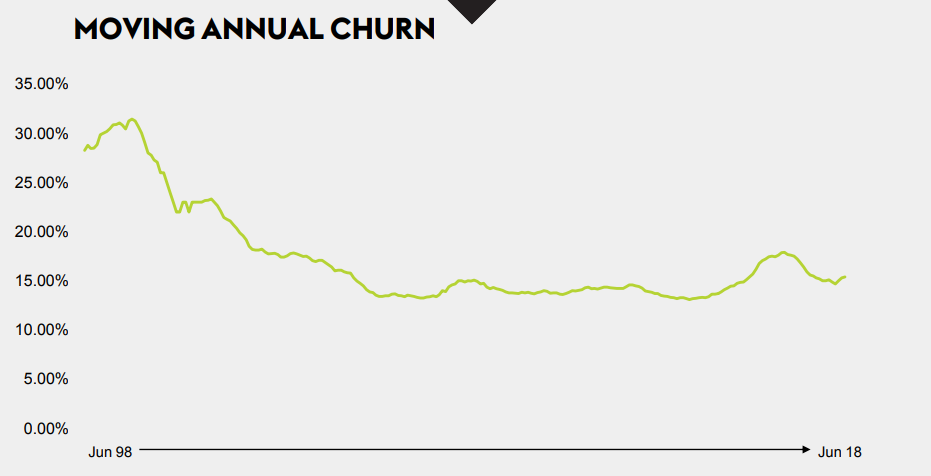
Revenues declined 6% with a similar decline in subscribers to 768,000. Management however noted a fall in churn following the company’s decision to revamp its range of packages and pricing in March this year. This was a long time coming, with Sky’s rigid approach to pricing, in our view, a reflection of entrenched complacency within the company, and starting at the top, permeating all the way down.
A move to having a lower price point package (less than $25 a month compared to more than $50 at a minimum previously) appears to have helped Sky compete with the likes of Netflix
and others. After losing 46.000 subscribers in the first half, defections slowed to around 11,000 in the six months since December 2017.
Source: AGM Presentation
After finally relenting on pricing, we believe another part of the turnaround could come from a major technological shift by the company.
Sky has embraced its set top box virtually since day one, with upgrades slow in coming, and more often than not these were botched. Management however signalled at the AGM the intention to roll out ‘internet friendly’ access via a new online TV box. If executed properly this would bring Sky into line with the likes of Netflix, Lightbox and Amazon Prime. As Chairman Macourt acknowledged, the sector is ‘moving increasingly towards internet based services and away from satellite.’
The company will however continue to provide satellite-delivered content to New Zealand households, with as management notes, the ability to “reach 100% of the country remains our competitive edge.” Many kiwis still don’t have access to streaming-capable internet (although this will change over time). Sky’s also has an advantage in its ability to convert online subscribers from its existing distribution footprint – Sky has market penetration of around 40%.
Shoring up the bottom line, while also investing in technology, will also provide Sky with the confidence it needs to help protect its moat in terms of sports broadcasting. The company has already this year lost the 2019 Rugby World Cup broadcasting rights to Spark/TVNZ, while also giving up to Spark the rights to English Premier League football for the next three years.
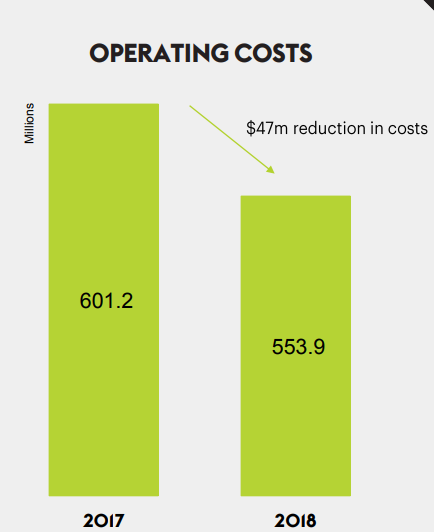
This may also mean near-term that operating expenses creep back up, but this will be less of an issue if growth is being achieved at the top line. Sky achieved a $47 million reduction in operating costs last year.
Source: AGM presentation
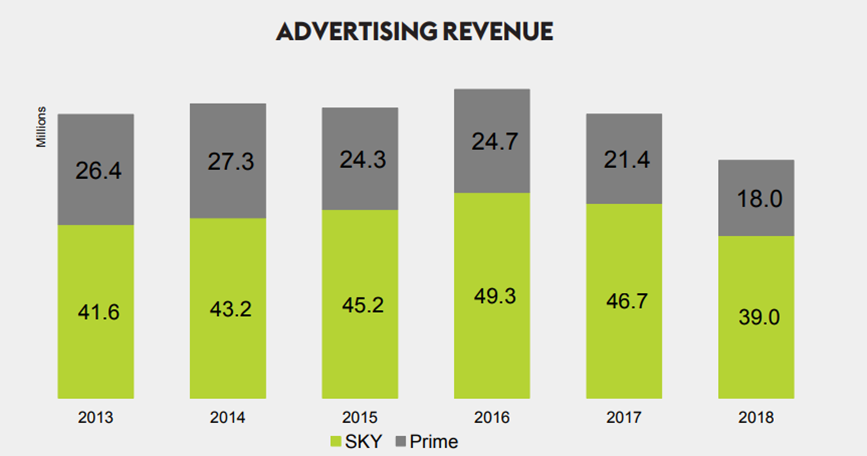
While the advertising market in Australasia, and indeed globally is undergoing challenges, Sky’s position, in our view, will be enhanced greatly if it can restore subscriber growth.
Source: AGM Presentation
The cost out programme and still solid underlying cash flows have also seen improvements made to Sky’s balance sheet. The company saw debt fall from $299 to $235 million during the year, with debt reduction remaining very much in focus.
There has clearly been substantial value lost at Sky in recent years, but we believe that the company’s market positioning, high level of penetration, and recent strategic moves could signal that a turnaround is at hand. Recent speculation also circulate that NBC Universal is looking at Sky as a potential takeover target. This would not be out of line, in our view, and given NBC’s parent Comcast has taken over Sky’s much bigger namesake in the UK. This however, is not a driver of our buy recommendation.
Summary
Sky Network Television (ASX:SKT) has been, in our view, a textbook example of how value can be destroyed when a company is slow to react to challenges to its monopolistic position. Having faced little if any competition for the best part of two decades, the largest pay TV provider in New Zealand has been complacent about the risks posed by disruptors such as Netflix and Spark New Zealand’s Lightbox. A failure to invest and ‘keep up with the times’ has also manifested itself in substantial subscriber churn, which has come at a significant cost to earnings.
We have been very critical of the way Sky has performed for some time, and indeed the company’s loss has been to Spark New Zealand’s gain, as it has pushed further into content provision, and sports programming, once the sole bastion of Sky. Operating underperformance has also been reflected in Sky’s share price, which has arguably been one of the worst performing for a pay-TV company anywhere in the world, in recent years. Since a peak of $6.85 in mid-2014 the shares have lost around 65% in value.
We believe the tide may however finally be about to turn. Customer churn looks to be stabilising, after the company finally ceded to pressure and has restructured its product price structure. Management have also made another important concession to ‘move with the times’ and provide an internet accessible set-top box which can operate via the cloud (rather than having to have one of the company’s clunky aerials installed). We believe these changes will be the key to further arresting the decline in the company’s customer base, which still stands in excess of 750,000 (in a country with a total population under 5 million).
Often a key element of any turnaround is new management, and there is also something on the offer here. CEO John Fellet is retiring in the next few months after 17 years at the helm, and some 27 years in total at the company. While his replacement has not yet been appointed we are at least encouraged by the prospect of the opportunity for new blood to come in with fresh and ‘evolving’ ideas – something which Sky has been badly in need of.
From a valuation point of view, the expectations bar has been set very low, with Sky (ASX:SKT) trading on just 7 times earnings (and offering a 7% yield). While the advertising sector clearly faces some challenges, Sky already has the ability in our view to leverage significant distribution, and given a still superior content offering in the likes of sport.
Accordingly, we are issuing a High Risk buy recommendation for Members with a medium-term timeframe.
Fat Prophets has made every effort to ensure the reliability of the views and recommendations expressed in the reports published on its websites. Fat Prophets research is based upon information known to us or which was obtained from sources which we believed to be reliable and accurate at time of publication. However, like the markets, we are not perfect. This report is prepared for general information only, and as such, the specific needs, investment objectives or financial situation of any particular user have not been taken into consideration. Individuals should therefore discuss, with their financial planner or advisor, the merits of each recommendation for their own specific circumstances and realise that not all investments will be appropriate for all subscribers. To the extent permitted by law, Fat Prophets and its employees, agents and authorised representatives exclude all liability for any loss or damage (including indirect, special, or consequential loss or damage) arising from the use of, or reliance on, any information within the report whether or not caused by any negligent act or omission. If the law prohibits the exclusion of such liability, Fat Prophets hereby limits its liability, to the extent permitted by law, to the resupply of the said information or the cost of the said resupply.
Funds Management – In addition to the listed funds FPC, FPP and FATP, Fat Prophets Pty Ltd manages the separately managed accounts, namely Concentrated Australian Shares, Australian Shares Income, Small Midcap, Global Opportunities, Mining & resources, Asian Share, European Share and North American Share. These SMAs are managed under their own mandates by the fund managers, and this is independent to the research reports.
Staff trading – Fat Prophets Pty Ltd, its directors, employees and associates of Fat Prophets may hold interests in many ASX-listed Australian companies which may or may not be mentioned or recommended in the Fat Prophets newsletter. These positions may change at any time, without notice. To manage the conflict between personal dealing and newsletter recommendations the directors, employees, and associates of Fat Prophets Pty Ltd cannot knowingly trade in a stock 48 hours either side of a buy or sell recommendation being made in the Fat Prophets newsletter. Staff trades are pre-approved by an appointed staff trading compliance officer to ensure compliance with the staff trading policy.
For positions that directors and/or associates of the Fat Prophets group of companies currently hold in, please click here.
