
BOQ

Getting out of Life
Bank of Queensland (ASX:BOQ) released half year numbers today which missed expectations, but saw another round of growth, with both the retail and business banking reporting year-on-year improvements in income, loan portfolio and asset quality. The bank also announced that it’s getting out of the life business for strategic reasons. The shares were weaker today, and have been trending down in 2018, but we believe the market is missing the point.
Cash profit increased 4% year-on-year to $184 million and we view the exit from the life insurance business positively.
We are optimistic on the prospects for the Queensland economy, and particularly the Gold Coast, given its appeal to migrants, tourism on the up and the Commonwealth games just around the corner.
In the Roy Morgan banking customer satisfaction survey released late January, of the 10 largest consumer banks, Bank of Queensland (ASX:BOQ) scored 86.0% (+0.8%) second highest after Bendigo Bank.
Given the regulatory and political pressure on large banks, the regional, more nimble players should be able to pick up market share as the ‘playing field’ is levelled somewhat.
We remain encouraged by BOQ’s ability to deliver growth through other niche business channels as well, including the Specialist medical business, Virgin Money and Business Banking.
These factors, combined with an undemanding valuation lead us to retain our buy rating on the stock for Members without exposure.
What’s New
Before moving on to the interim results, we look at the bank’s exit from its life insurance business (St. Andrew’s Insurance), which is being sold to the Freedom Insurance Group (FIG). This follows the trend in the sector with peers like ANZ Bank, National Australia Bank, and the Commonwealth bank all selling off their respective life insurance arms to reduce exposure in an ailing sector where its profits have been eroded from rising claim costs among other headwinds.
BOQ chief executive Jon Sutton had this to say about the exit: “St. Andrew’s has made a strong contribution to the BOQ Group since its acquisition in 2010, but industry and business dynamics have changed dramatically in recent years” and that “These changing conditions now mean St Andrew’s is a better long-term strategic fit for Freedom.”
The sale is valued at circa $65 million which we find to be a fair price given that (as at 31 August 2017) St. Andrews has an in-force book value of $70 million with circa 147,000 customers. The deal structure splits the payment in $30 million cash from FIG and the remaining $35 million in the form of a quota reinsurance arrangement with an unnamed major global reinsurer – essentially passing a portion of the portfolio to the reinsurer in exchange for profits.
The deal is expected to close in the 2H18 subject to finalisation of the reinsurance arrangement, and the standard regulatory approvals. According to management, the sale of the subsidiary would provide an estimated post-tax gain of circa $8 million and improve the bank’s Common Equity Tier 1 ratio (CET1) by some 20 basis points.
1H18 Performance Review
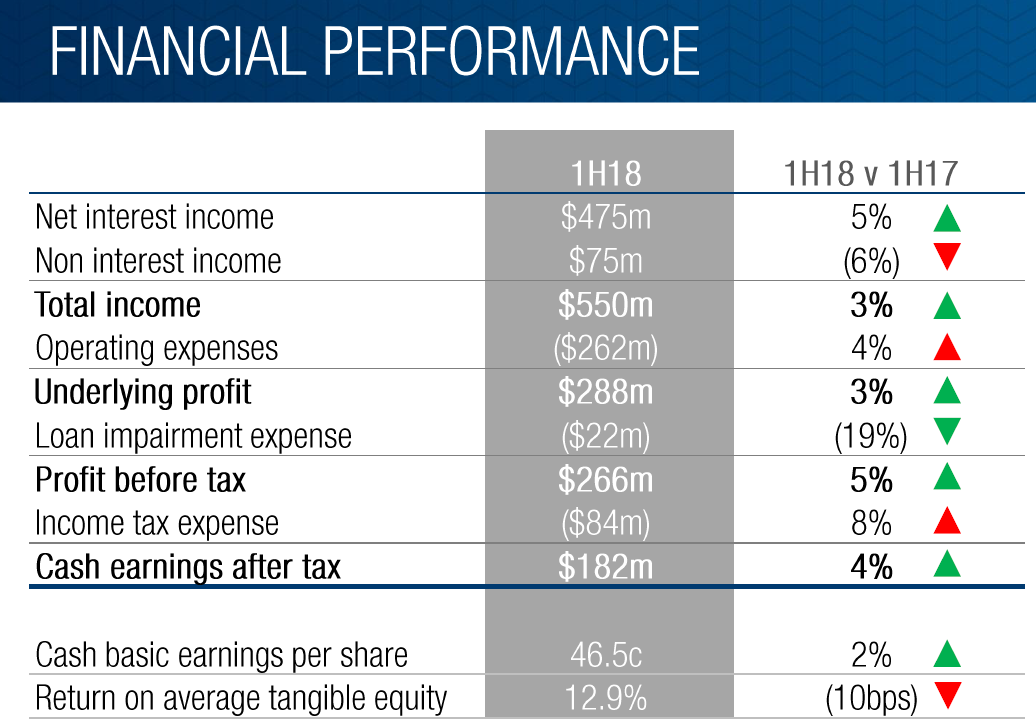
Moving on and starting from the headline numbers, Bank of Queensland’s total income (revenue) was 3.3% higher year-on-year at $550 million. This was mainly due to higher net interest income of $475 million (+5% yoy) as both retail and business banking reported healthy loan growth and slightly higher margins.
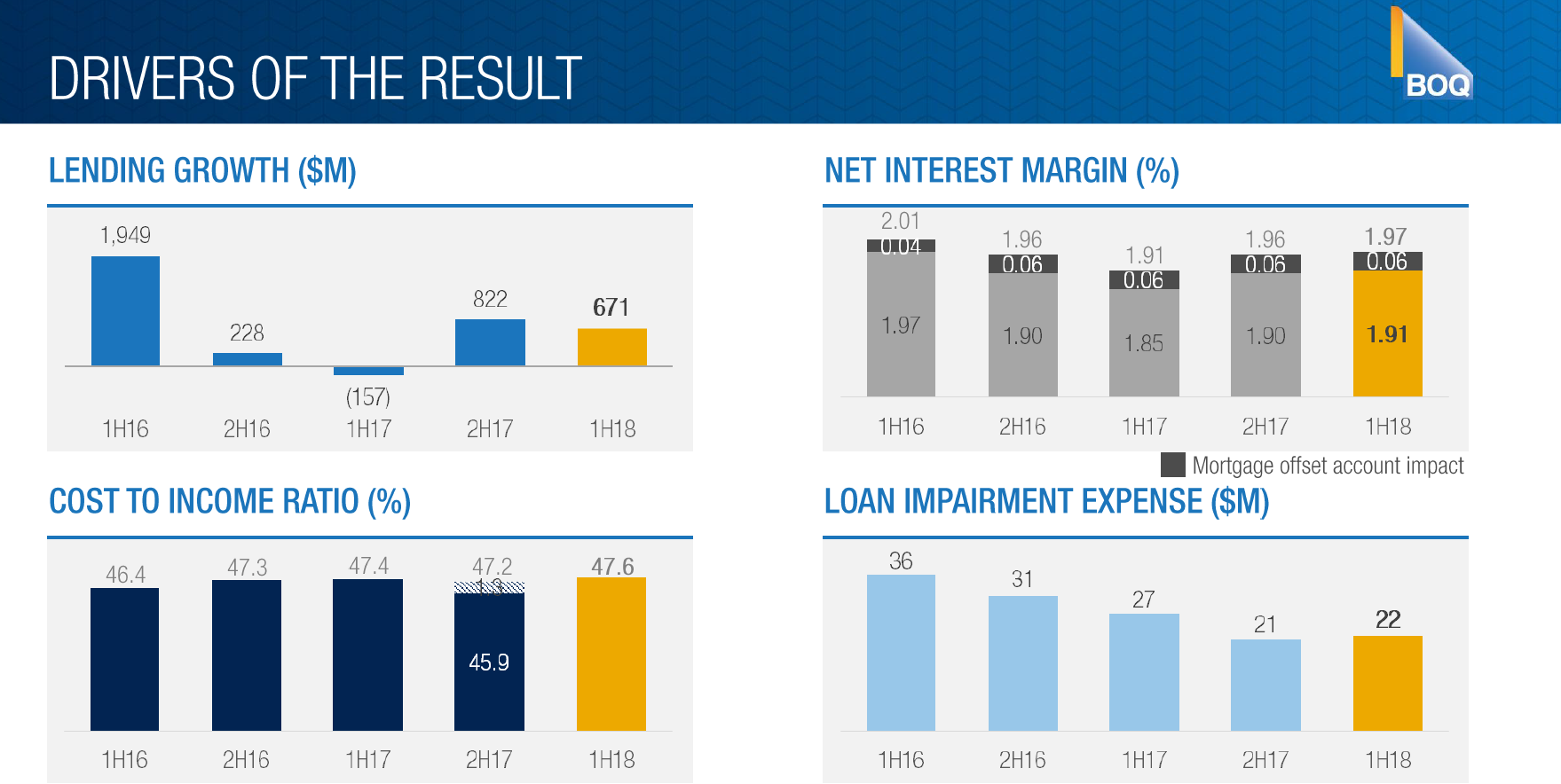
Regarding margins, the net interest margin (NIM) at the group level was up 6 basis points year-on-year to 1.97%. According to management’s filing, this was mainly due to lower funding costs and benefits from the interest-only mortgage repricing from August 2017, though was partially offset by intensifying competition in the mortgage market.
Source: 17 April 2018 Presentation
Aside from margins, we see a notable improvement in lending growth and continuing the momentum from the 2H17. That is summarised in the graphic below as well. In the period, total lending growth came in at $671 million, representing a significant (~$828 mln) uplift from the contraction last year. This was due to improvements in both housing loan growth (+$382 million) as well as commercial loan growth (+$292 million).
Non-interest income, on the other hand, was down some 6.3% year-on-year due to significantly fewer trading opportunities in the period (-60% yoy) as well as pressure on banking fees with most customers are switching to lower or no fee products. BOQ Finance Equipment sales were also lower (-$2mln) year-on-year due to lower contract volumes as well as the impact of the previously disposed vendor finance subsidiary.
Source: 17 April 2018 Presentation
Moving on to the cost side and as can be seen in the graphic above, the bank’s cost-to-income ratio deteriorated by 20 basis points to 47.6% as operating expenses went up 4% year-on-year to $262 million. A closer look shows that this was the result of higher wage costs (+3.2% yoy), with a 4.8% (+93) increase in headcount to 2,046 employees as well as higher IT spend (+7.3% yoy) from the investment in new technologies to digitize operations.
Over the longer term, though, we believe that investments in IT will pay off in increased efficiencies.
Despite operating expenses outpacing revenue growth, improvements in asset quality as evidenced by a much lower impaired asset amount (-17.6% yoy) of $173 million saw impairment expenses drop 18.5% year-on-year to $22 million. This in turn helped profitability with statutory net profit after tax (NPAT) up 8.1% year-on-year to $174 million. Basic EPS was up 6% to A42.7cents.
The closely watched cash profit figure was up roughly 4% year-on-year to $182 million.
Capital Management
Aside from improving asset quality, the bank has also worked on improving its capital management by suspending the dividend reinvestment plan as well as implementing a new collective provisioning model reducing the need for higher reserves from credit losses.
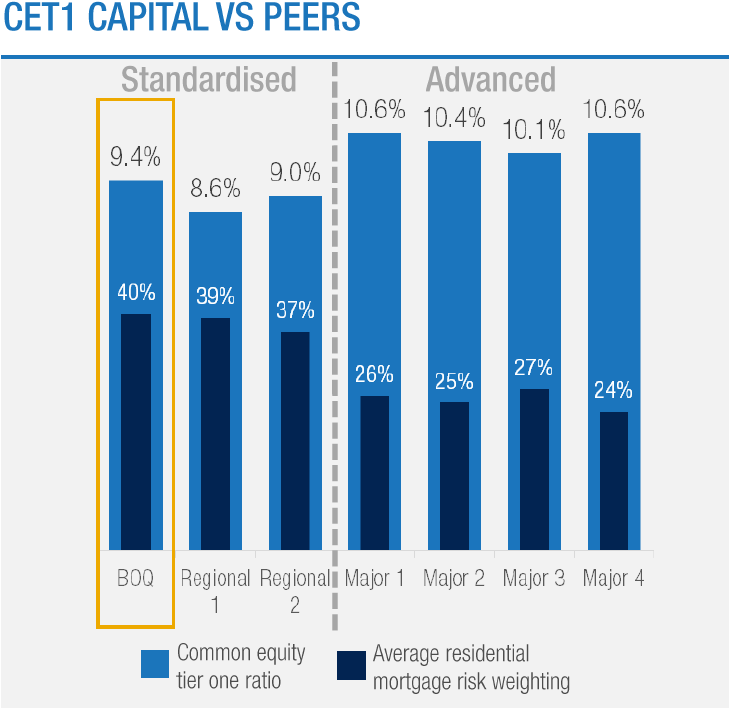
The bank’s capital strength has improved, shown by the 13-basis point improvement year-on-year in the Common Equity Tier 1 ratio (CET1) to 9.42%. As per the graphic below, this is well ahead of regional peers.
Source: 17 April 2018 Presentation
Summary
Despite a challenging environment for banks, the Bank of Queensland (ASX:BOQ) delivered another solid result for 1H18 with higher NPAT based on stronger lending growth across both retail and wholesale channels, lower bad debt charges, and slightly stronger margins.
Going forward, we remain confident in the bank’s ability to deliver growth through niche business channels, including the Specialist medical business, Virgin Money and Business Banking.
We are optimistic on the prospects for the Queensland economy, and particularly the Gold Coast, given its appeal to migrants, tourism on the up and the Commonwealth games just around the corner.
In the Roy Morgan banking customer satisfaction survey released late January, of the 10 largest consumer banks, Bank of Queensland scored 86.0% (+0.8%) second highest after Bendigo Bank.
Given the regulatory and political pressure on large banks, the regional, more nimble players should be able to pick up market share as the ‘playing field’ is levelled somewhat.
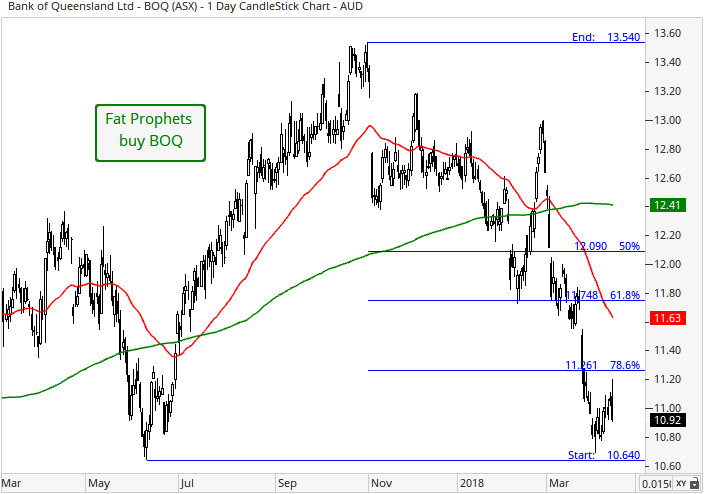
Accordingly, and with Bank of Queensland (ASX:BOQ) trading on a modest earnings multiple of 11.3 times, and offering an attractive yield of around 7.2%, we continue to rate the shares as a Buy for Members without exposure.
Disclosure: Bank of Queensland (ASX:BOQ) is held within the Fat Prophets Concentrated Australian Share, Australian Share Income and Small & Mid cap models.
Fat Prophets has made every effort to ensure the reliability of the views and recommendations expressed in the reports published on its websites. Fat Prophets research is based upon information known to us or which was obtained from sources which we believed to be reliable and accurate at time of publication. However, like the markets, we are not perfect. This report is prepared for general information only, and as such, the specific needs, investment objectives or financial situation of any particular user have not been taken into consideration. Individuals should therefore discuss, with their financial planner or advisor, the merits of each recommendation for their own specific circumstances and realise that not all investments will be appropriate for all subscribers. To the extent permitted by law, Fat Prophets and its employees, agents and authorised representatives exclude all liability for any loss or damage (including indirect, special, or consequential loss or damage) arising from the use of, or reliance on, any information within the report whether or not caused by any negligent act or omission. If the law prohibits the exclusion of such liability, Fat Prophets hereby limits its liability, to the extent permitted by law, to the resupply of the said information or the cost of the said resupply.
Funds Management – In addition to the listed funds FPC, FPP and FATP, Fat Prophets Pty Ltd manages the separately managed accounts, namely Concentrated Australian Shares, Australian Shares Income, Small Midcap, Global Opportunities, Mining & resources, Asian Share, European Share and North American Share. These SMAs are managed under their own mandates by the fund managers, and this is independent to the research reports.
Staff trading – Fat Prophets Pty Ltd, its directors, employees and associates of Fat Prophets may hold interests in many ASX-listed Australian companies which may or may not be mentioned or recommended in the Fat Prophets newsletter. These positions may change at any time, without notice. To manage the conflict between personal dealing and newsletter recommendations the directors, employees, and associates of Fat Prophets Pty Ltd cannot knowingly trade in a stock 48 hours either side of a buy or sell recommendation being made in the Fat Prophets newsletter. Staff trades are pre-approved by an appointed staff trading compliance officer to ensure compliance with the staff trading policy.
For positions that directors and/or associates of the Fat Prophets group of companies currently hold in, please click here.
