
Restructuring should lead to re-rating ahead
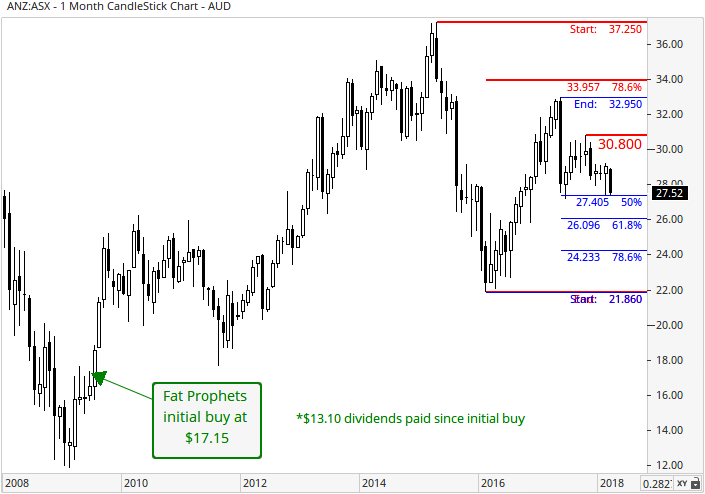
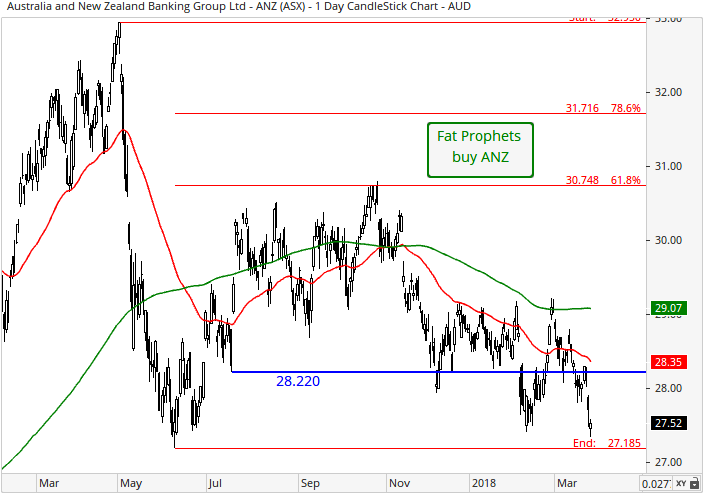
Some headwinds have seen ANZ’s share price lag the broader market over the past year. However, the restructuring of the business has advanced well, with the bank’s capital position already topping regulators “unquestionably strong” threshold well ahead of schedule. The bank has already kicked off a share buyback program and with the shares trading at undemanding levels and offering an attractive dividend, we rate them as a buy.
ANZ (ASX:ANZ) delivered an 18% year-on-year increase in cash profit for the 2017 fiscal year and showed an improvement in several other key metrics.
Management are executing proficiently on the bank’s restructuring, shedding capital intensive assets and improving return on equity.
We believe the impact of the Royal Commission on local banks, including ANZ is likely to be overshadowed by our expectation of rising bond yields over the next year or two. This should lift the sector globally.
In the meantime, ANZ (ASX:ANZ) is continuing with its restructure and announced it will explore an IPO as a strategic option for its New Zealand asset finance company UDC. The company is a wholly-owned subsidiary of ANZ New Zealand and funds plant equipment, vehicles and machinery for range of customers.
ANZ New Zealand CEO David Hisco said, “While UDC is continuing to perform well and there is no immediate requirement to make decisions, after last year’s planned sale to HNA did not proceed it makes send to keep examining a broad range of options for UDC’s future.”
The sale of UDC to Chinese HNA Group for $660 million was effectively blocked by New Zealand’s Overseas Investment Office.
Given more levers for management to pull on shareholder’s behalf and the relative pessimism towards the stock and sector, combined with an undemanding valuation, we remain positive on ANZ for those with a medium term or longer investment horizon.
1Q18 trading update
ANZ (ASX:ANZ) has opted to cease reporting group quarterly profit figures, so ahead of its interim numbers due in May 2018, the information to be gleaned from its update for the three months to 31 December 2017 included an update on its Australian housing exposure and growth, credit quality and capital position.
Beginning with its Australian housing business and the bank built up its mortgage book portfolio significantly in the December quarter, focusing on the Owner-Occupied segment.
ANZ’s home lending portfolio grew at 1.2 times the growth rate of the broader banking sector (system) in the quarter, with owner-occupied growth of approximately 1.4 times system pace, equivalent to 10% annualised.
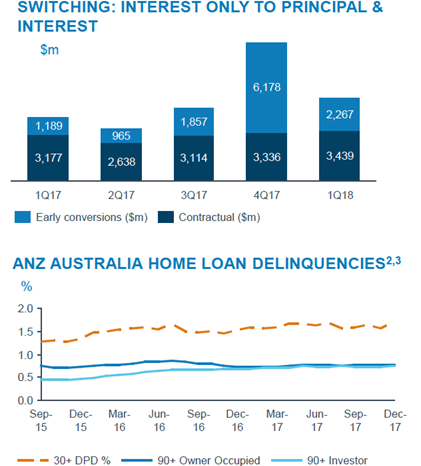
Interest-only new business in the quarter represented just 14.3% of total new business flows. These interest-only loans are considered riskier and the Australian Prudential Regulation Authority (APRA) last year told banks to limit interest-only lending to 30% of business.
Regulators worry that investors encouraged to hold Interest-only loans due to tax incentives pose a bigger risk to the financial system, due to the large proportion of these loans due to expire over the next 4-5 years. The big banks are intentionally shifting their mix away from interest-only home borrowers.
At ANZ roughly $5.7 billion of interest-only loans switched to principal and interest in 1Q18, which was well below the $9.5 billion figure in 4Q17, but still above the average of $3.4 billion in switches per quarter on average from 1Q17 to 3Q17. About $2.27 billion were early conversions and the other $3.44 billion were contractual.
Source: ANZ (ASX:ANZ)
Credit quality remains strong in ANZ’s mortgage business, although it has deteriorated slightly over the past couple of years.
The percentage of residential borrowers more than three months overdue on their mortgage repayments ticked up just 1 basis point from the September 2017 quarter to 0.6% of residential exposure. Still, that figure has increased from 0.48% at the end of September 2015.
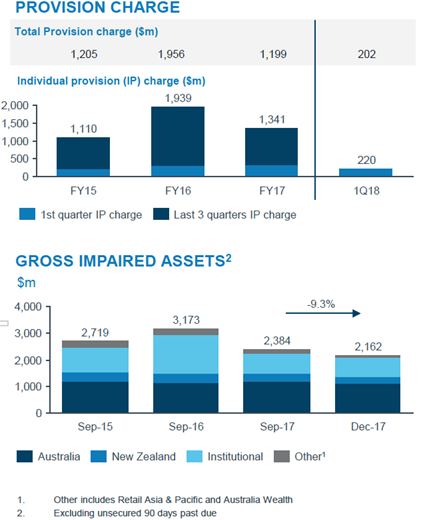
At the group level, gross impaired assets declined 9.3% from September 2017 to $2.16 billion, It was a broad-based decline, including a 6% reduction in the Australia divisions, 7% decline in the Institutional business and an 11% fall in the New Zealand division. The total provision charge for 1Q18 was just $202 million.
Source: ANZ (ASX:ANZ)
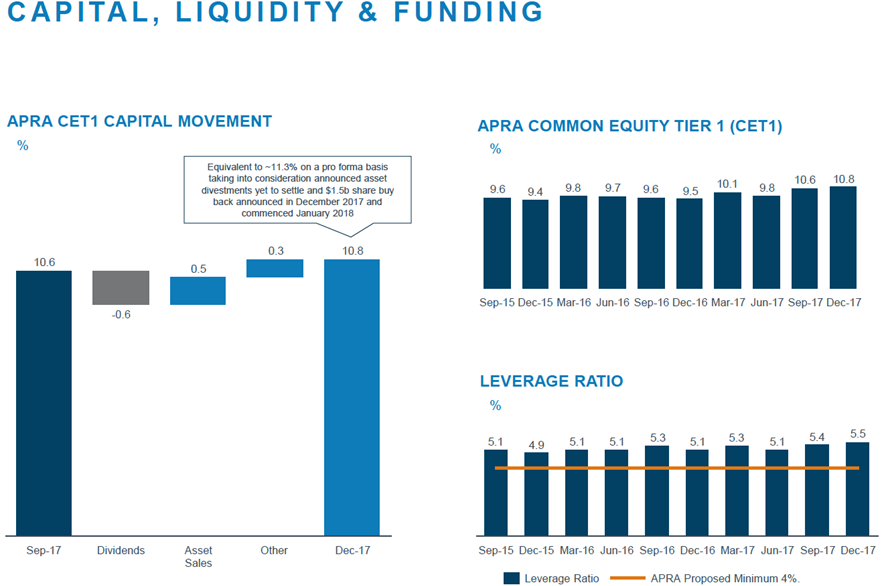
Turning to the capital position and ANZ is generally ahead of peers on this front, with its common equity tier 1 (CET1) ratio at a strong 10.82% at the end of 2017.
This figure was bolstered by the proceeds of its Shanghai Rural Commercial Bank stake and a small benefit from the sale of the Asian retail and wealth businesses, with the Taiwan and Vietnam settlements falling in the December quarter.
Source: ANZ (ASX:ANZ)
The 10.82% figure marked a 25-basis point increase from the September 2017 quarter. That places it well above APRA’s 10.5% “unquestionably strong” capital requirement well before the 2020 deadline, providing the option for capital return initiatives. APRA last year told the banks to raise their CET1 ratios to 10.5% by 2020 to act as a buffer against financial shocks.
ANZ began a $1.5 billion buyback of its shares last month and we expect this program to expand in the future. In mid-February, ANZ reported that the previously announced sale of six retail and wealth businesses in Asia had been finalised (that includes the Taiwan and Vietnam settlements referred to above).
ANZ chief executive, International, Farhan Faruqui stated: “With the sale of these retail businesses in Asia now finalised, we can further strengthen our focus on supporting large corporate and institutional customers moving goods and capital across the region.”
ANZ has been trimming its retail presence in Asia as part of its strategic restructuring, instead focusing on institutional banking in the region.
ANZ (ASX:ANZ) states it is ranked as a top four corporate bank in Asia, with a significant presence in 15 countries in the region. ANZ announced the sale of their retail and wealth businesses in Singapore, Hong Kong, China, Taiwan and Indonesia to DBS Bank in late October 2016 for US$80 million. Extending this strategy of exiting capital intensive businesses in the region, ANZ stated in early November 2017 that it was closing its Philippines’ retail banking business to focus on institutional banking in the country. Retail banking in the country ceased February 2018.
We note that although ANZ’s quarterly trading update did not provide group profit figures, a separate filing showed that the New Zealand division’s profits for the quarter came in at NZ$501 million, up roughly 30% year-on-year. Lower provisions and improved conditions in the agricultural and dairy sectors supported the result.
Summary
Shares in ANZ Banking Group have lagged the broader market over the past year as the bank (and sector) have faced a few headwinds. The government’s decision to plug the budget deficit with a ‘big bank’ levy set the ball rolling and the announced Royal Commission (RC) into the banking, superannuation and financial services industry has also dampened sentiment lately. We expect the banks, including ANZ, to ultimately pass most of the costs of these onto customers. We also expect the RC to fade into obscurity.
The heated housing market in some areas is a material risk, but ANZ is strong financially and well placed to withstand a measured correction. We certainly do not anticipate a GFC-style crash with the general structure of lending not as perilous (thanks to APRA’s strict oversight), and domestic interest rates not set to escalate dramatically overnight.
ANZ’s restructuring is progressing well and we were content with the earlier reported FY17 results. With ANZ trading on a modest earnings FY18 multiple of 11.8 times, and offering an attractive yield of 5.9%, we continue to recommend the shares as a buy to Members without exposure and with a medium term, or longer, investment horizon.
Disclosure: ANZ Banking Group (ASX:ANZ) is held in the Fat Prophets Concentrated Australian Share and Australian Share Income models.

