
EHE

Aging Well
Although pulling back from 52-week highs, shares of residential facility aged care provider Estia Health (ASX:EHE) have advanced modestly over the past year. At the time of its well-received interim results announcement in February, the company declared its first interim dividend in two years and a mid-single digit increase in EBITDA. Estia appears be advancing its turnaround under new senior management and should be a beneficiary of industry tailwinds.
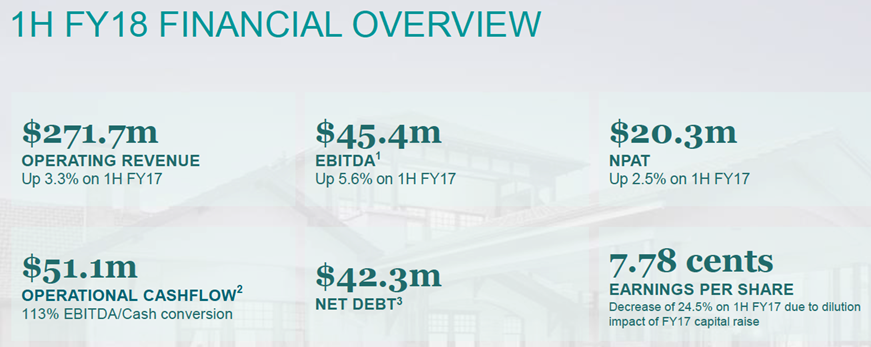
Recapping the interim results and total revenues edged up 3.3% to $271.7 million, while the full year net profit after tax (NPAT) to 31 December 2017 increased 2.5% to $20.26 million. A non-cash one-off impairment charge associated with the Southport home demolition and rebuild decreased NPAT in the period.
Source: Estia Health (ASX:EHE)
Basic earnings per share of 7.78 cents though was down 24.5% year-on-year due to the dilution from the FY17 capital raising. The company announced a fully franked interim dividend payment of 7.8 cents compared to no dividend a year earlier. EBITDA before gains on sale of assets held for sale was up 5.7% to $45.4 million. The non-cash one-off impairment charge associated with the Southport home demolition and rebuild is not included in the EBITDA calculation.
Morgan Stanley conference Update
Ahead of the company’s full year results due out in August, Estia Health’s presentation at the Morgan Stanley conference earlier in June provided an update on its property portfolio.
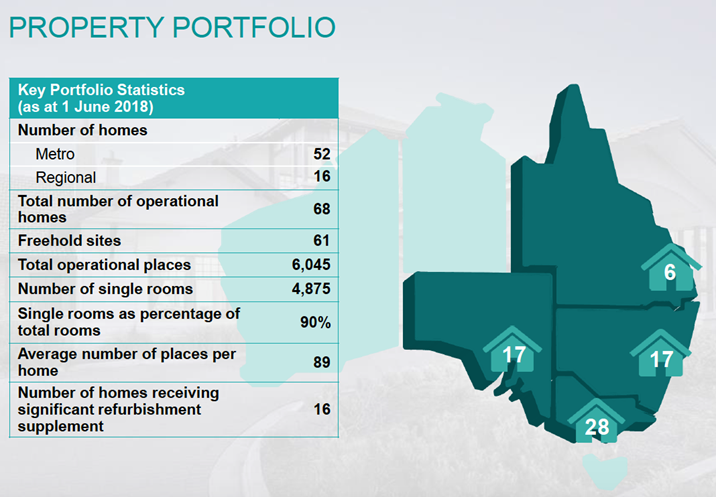
The company is the owner and operator of aged care facilities in Australia, and had 6,045 operational places as at 1 June 2018, marking a marginal increase due to the completion in March of its 72-bed facility (22 additional beds) in Kogarah, some 14 kilometres south of the Sydney CBD. The facility adds some new beds and accommodates the residents transferred from Estia’s Blakehurst property, which is being rebuilt.
At 1 June 2018 Estia’s property portfolio consisted of 68 operational homes, with 52 of these in metro areas and 16 in regional areas. Some 61 of these sites are freehold. Single rooms dominate (~90%) the total room mix at the facilities, with an average of 89 places per home.
Source: Estia Health (ASX:EHE)
Estia (ASX:EHE) has a wide geographical spread across the eastern states, with no presence in WA (and no plans to expand there) at present. Estia has a deliberate strategy of targeting higher income social economic metro areas. The company is therefore targeting its product at customers who are after a ‘higher’ level of service.
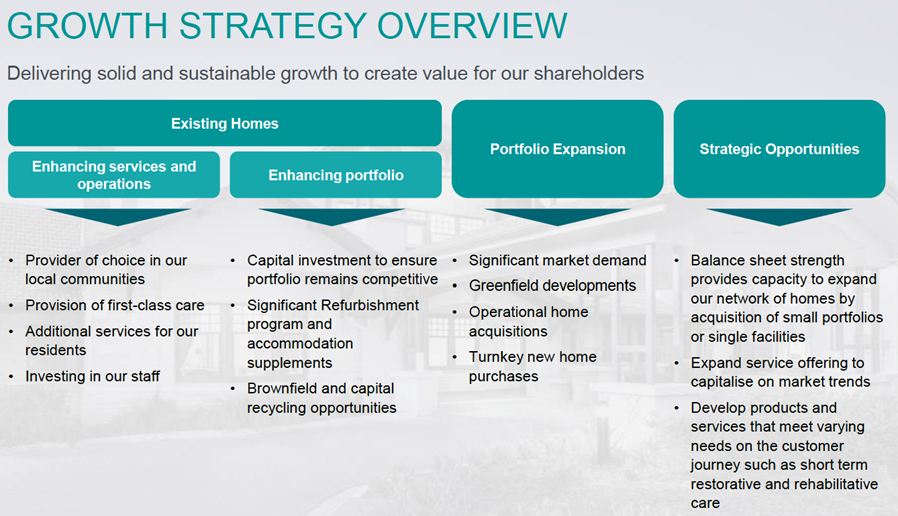
The company is seeking to grow through a mix of enhancing its existing portfolio and new projects. Acquisitions are another option for Estia over the medium-term, especially as the company bolstered its balance sheet in FY17 around the same time as making senior management changes.
Estia’s strategic growth options:
Source: Estia Health (ASX:EHE)
In prior coverage, we wrote of our high regard for the current CEO Norah Barlow, who moved into the role after being a director. She was previously the boss at NZ focussed Summerset Group, one of the most respected retirement village operators in Australasia.
Dr Gary Weiss was also elevated to the role of Chairman over a year ago, and we believe this has significantly strengthened the company’s management and oversight.
To enhance the existing portfolio, Estia is seeking to utilise land adjacent to operational homes when possible and making strategic refurbishments. This optimisation has seen 16 homes (1,631 beds) currently receiving a higher accommodation supplement and another 15 homes (1,310 beds) approved and underway. Stage 1 sustainability projects of $5 million are nearing completion.
These types of initiatives are key to eking out more revenue from the existing portfolio, which is necessary to combat cost inflation, particularly in wages.
A need to maintain a quality service and wage pressures pose a challenge to wringing out efficiencies on this front.
Positively, 1H18 occupancy in existing homes was 94.0%, up from 93.0% in 1H17. Total revenue per operating bed day edged up from $260.2 in 1H17 to $265.1 in 1H18. The facilities upgrade should also be pivotal in lifting margins in our view.
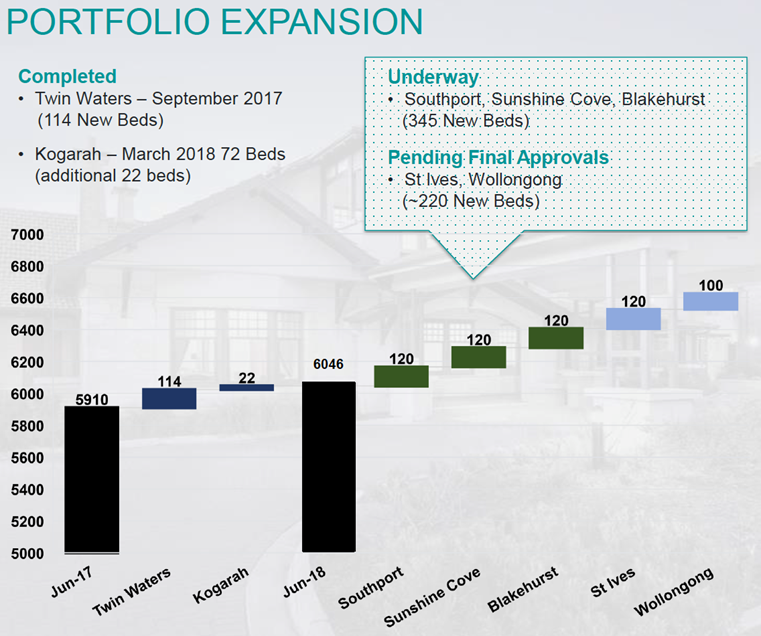
Regarding portfolio expansion and the Kogarah project was completed in March, coming on the heels of Twin Waters (114 new beds) in Queensland in September 2017. Underway are Southport, Sunshine Cove and Blakehurst, which combined will bolster the portfolio by 345 new beds. St. Ives and Wollongon were pending final approvals with the ability to add 220 new beds.
Source: Estia Health (ASX:EHE)
Management provided some criteria for acquisitions, which include network proximity, existing resident population, demographic and competitive environment, RAD (refundable accommodation deposit) balance and the outlook for RAD residents, among a raft of other considerations such as price and return on investment. The company will look at existing operational homes or turnkey new homes and they need to be earnings accretive, either on a stand-alone basis or as part of a ‘recycling’ plan for the portfolio.
Acquisitions were off the table more than a year ago, but via the combination of a $136.8 million capital raising in FY17, strong operating cash and RAD inflows, Estia’s balance sheet stood transformed at the end of 2017.
At just $42.3 million, Estia’s net debt was less than a quarter of what it was 12 months earlier ($181.1 million) and less than half of the $102.3 million it was at 30 June 2017. The company’s gearing range had fallen to around 0.5 times, well below the target range of 1.5 – 1.8 times. Undrawn debt facilities were in place to the tune of approximately $270 million.
At 30 June Estia (ASX:EHE) was funded roughly 48.5% through equity, 3% percent through net debt and 48.5 percent through RADs.
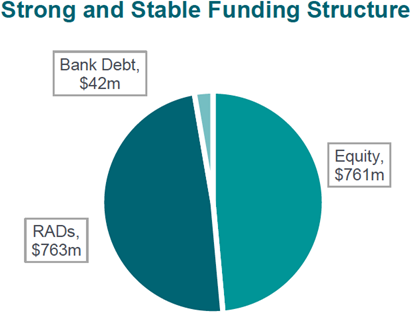
Source: Estia Health (ASX:EHE)
Still, even with a much-improved financial position, with acquisitions likely to command high price tags in this environment we expect the focus to continue to be on refurbishment, greenfield and brownfield developments.
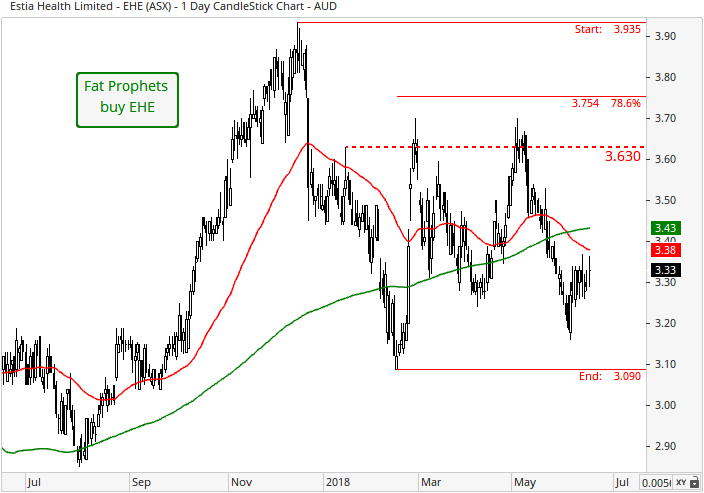
Turning to the charts, and on the daily, prices have dipped below both the 50 day (red line) and 200 day (green line) moving averages, which is suggestive of momentum to have swung south. This however needs to be placed in context of a strong share price rally that unfolded from the middle of last year. Resistance located at the May high of $3.63 remains in close focus, while support exists at this year’s low of $3.09. A move above the May high and/or moving averages would improve the technical picture.
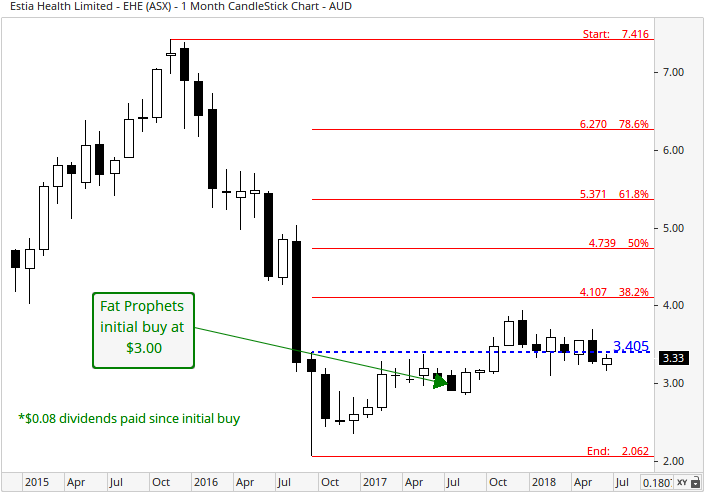
On the monthly, the share price touched an all-time low of $2.06 in September 2016 to form a ‘bullish doji’ candlestick formation. Positively, the highest price of this candle of $3.41 was surpassed in October 2017. This is a bullish development and signals a medium-term upward shift in momentum. Prices are currently just below this level. The probability now swings towards an eventual ascent in share price towards the next band of resistance evident between $4.11 and $4.74. This is made up of the 38.2% and 50% Fibonacci retracement levels respectively.
Summary
Regulatory risks are a factor given the industry and there have been incidents of bad behaviour that Estia has not been immune to in the past, as we have highlighted in prior coverage. The company though has made it clear it doesn’t condone any such behaviour though, and these are likely isolated, albeit sad incidents, rather than any problem with Estia’s culture in our view.
Indeed, Estia CEO Norah Barlow has called for a national register of aged care workers so employers can better screen for workers. As with other industries, most workers are doing the job to the best of their ability and those workers are appalled when there is so-called ‘rough handling’ by some staff of our aged community in care.
Overall, the underlying thematic remains a compelling one. Australians are living longer, and many baby boomers are set to retire over the next two decades, increasing the demand for high quality aged care services. This is particularly as studies show that most retirees will need to cash up equity in their own homes, and move into care to sustain themselves in their golden years.
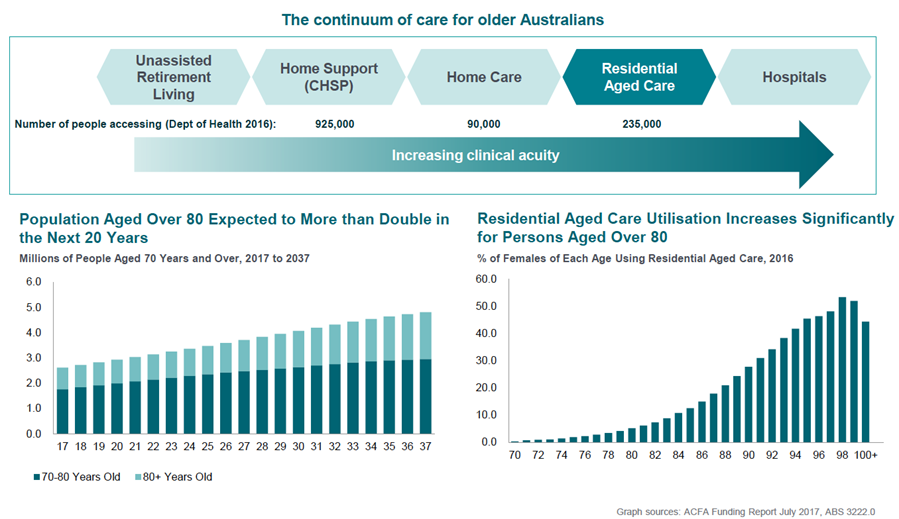
Source: Estia Health (ASX:EHE)
We believe that the turnaround at Estia is progressing and the company is well placed to lift value for shareholders under new senior management, with a stronger balance sheet and supportive industry tailwinds, despite some regulatory uncertainty and adverse press from time to time.
Estia Health (ASX:EHE) shares are trading on a FY18 earnings multiple of approximately 19 times, falling to 17.9 times the following year. The projected yield over the same time frame is 4.5%, expanding to 4.8%.
Estia Health (ASX:EHE) will remain in the Fat Prophets portfolio. For Members without exposure we recommend the shares as a buy around current levels.
Disclosure: We hold Estia (ASX:EHE) in the Concentrated Australian, and Small & Mid-cap managed account portfolios.
Fat Prophets has made every effort to ensure the reliability of the views and recommendations expressed in the reports published on its websites. Fat Prophets research is based upon information known to us or which was obtained from sources which we believed to be reliable and accurate at time of publication. However, like the markets, we are not perfect. This report is prepared for general information only, and as such, the specific needs, investment objectives or financial situation of any particular user have not been taken into consideration. Individuals should therefore discuss, with their financial planner or advisor, the merits of each recommendation for their own specific circumstances and realise that not all investments will be appropriate for all subscribers. To the extent permitted by law, Fat Prophets and its employees, agents and authorised representatives exclude all liability for any loss or damage (including indirect, special, or consequential loss or damage) arising from the use of, or reliance on, any information within the report whether or not caused by any negligent act or omission. If the law prohibits the exclusion of such liability, Fat Prophets hereby limits its liability, to the extent permitted by law, to the resupply of the said information or the cost of the said resupply.
Funds Management – In addition to the listed funds FPC, FPP and FATP, Fat Prophets Pty Ltd manages the separately managed accounts, namely Concentrated Australian Shares, Australian Shares Income, Small Midcap, Global Opportunities, Mining & resources, Asian Share, European Share and North American Share. These SMAs are managed under their own mandates by the fund managers, and this is independent to the research reports.
Staff trading – Fat Prophets Pty Ltd, its directors, employees and associates of Fat Prophets may hold interests in many ASX-listed Australian companies which may or may not be mentioned or recommended in the Fat Prophets newsletter. These positions may change at any time, without notice. To manage the conflict between personal dealing and newsletter recommendations the directors, employees, and associates of Fat Prophets Pty Ltd cannot knowingly trade in a stock 48 hours either side of a buy or sell recommendation being made in the Fat Prophets newsletter. Staff trades are pre-approved by an appointed staff trading compliance officer to ensure compliance with the staff trading policy.
For positions that directors and/or associates of the Fat Prophets group of companies currently hold in, please click here.
