
A cheaper package
Shares of packaging giant Amcor (ASX:AMC) have endured a relatively rare period of underperformance over the past year, as the company faced headwinds from higher input costs that curtailed earnings in fiscal 2018 and rising bond yields. The company’s major acquisition of US peer Bemis has also added some risk. We believe the decline in price relative to the market has been overdone though, and that the prospects from current levels are solid.
The proposed merger with Bemis will create the world’s biggest manufacturer of flexible plastic packaging products. While this deal is not without its risks, we believe it has significant strategic merit, and will make the combined entity a very strong player in an industry with attractive characteristics. The drop in the share price of Amcor has reduced the valuation it is effectively paying for Bemis significantly on an absolute basis, although due to the fixed share ratio nature of the deal, Amcor and Bemis shareholders will still receive the same split of the combined entity assuming completion.
Meanwhile, management has reported that Amcor is away to a good start in fiscal 2019 and is passing through higher raw material costs. The company’s business model has stood the test of time and delivered solid returns for shareholders through the cycle. Its business is relatively defensive and we consider that as a positive, given the late stages of the current bull market in the United States. The stock held up well during last week’s market jitters, reflecting the relatively steady nature of demand for its products.
After the underperformance of the shares in 2018, Amcor (ASX:AMC) is trading on approximately 17.1 times forecast FY19 earnings, falling to 14.7 times the following year; we view the current valuation as attractive for patient investors and continue to recommend holding the stock.
The projected dividend yield over the same time frame is 4.1% expanding to 5.1%.
1Q19 update from the AGM
Amcor’s trading update provided at the company AGM in mid-October was positive, with CEO Ron Delia reporting the company’s fiscal first quarter has provided a “good start” to the year; as expected by management.
Back in August when the company reported fiscal 2018 results, management had said there were early indications that the challenges the company faced in fiscal 2018 had begun to stabilise and added further that these “encouraging signs continued through the balance of the first quarter.”
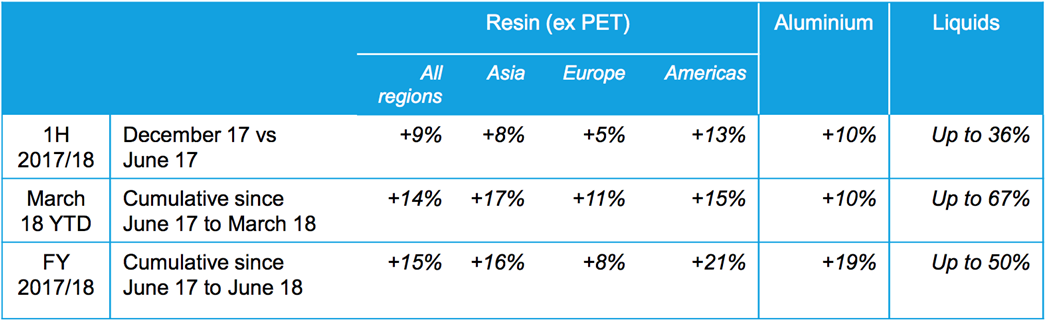
In the Flexible segment, management said the company has made progress in recovering higher raw material costs during the quarter. Typically, Amcor can pass on higher input costs to customers, but there is a delay between when the costs go up and passing those costs on. In the fiscal 2018 year there was significant raw material input inflation (as shown in the table below) so the recouping of this in fiscal 2019 would be welcome.
Key inputs saw price rises in FY18:
Source: Amcor (ASX:AMC)
Management said, given the traction in recovering these in the first quarter, the company only expects a modest impact from higher input costs on the first half of fiscal 2019 results and no impact over the full year. While management has good visibility in this area, we will be keeping an eye on the oil price going forward. It rose sharply since August, before pulling back amid the recent market jitters, but remains higher than where it was a couple of months ago. As oil prices rise, often so does resin and other input costs.
In terms of the Rigid Plastics segment, management reported modest volume growth occurring in the important North American beverage market. Regarding emerging markets across the broader business, the company reported continued “good” growth in the first quarter, building on the momentum from the second half of fiscal 2018. The Rigid Plastics business in Latin America, Flexibles in Asia and Specialty Cartons in Eastern Europe all got specific mentions for getting away to a solid start in fiscal 2019.
In addition, management also said cost reduction initiatives “remain on track.” They include the final stages of the Flexibles restructuring programme and beginning stages in the Rigid Plastics business that were kicked off after seeing the success from the cost trimming initiatives in the Flexibles business.
Given the state of play at the time of the AGM (mid-October) and traction in the first quarter, Amcor management stuck with their earlier guidance for earnings growth at the group level in constant currency terms, with the growth weighted towards the second half of the year. Both the Flexibles and Rigid Plastics segments are expected to contribute higher operating profits compared to FY18. Free cash flow generation is anticipated to be in the range of US$200 million to US$300 million, compared to US$194.1 million in FY18.
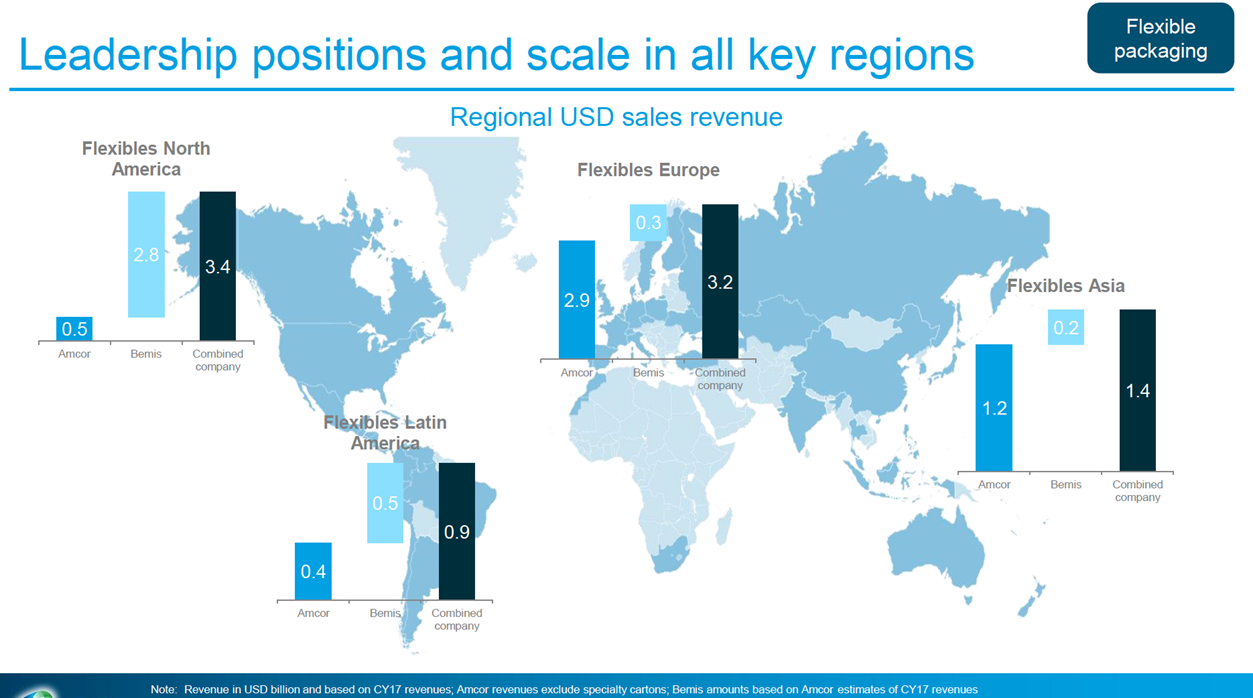
Amcor CEO Ron Delia also touched upon the Bemis deal, saying the combination of the two companies will create the global leader in consumer packaging with sales of US$13 billion, EBITDA of around US$2.2 billion and annual cash flow after capital expenditure (but before dividends) in excess of US$1 billion. Strategic merits include a global footprint, greater scale, increased exposure to attractive markets and products, along with best-in-class operating capabilities.
Source: Amcor (ASX:AMC)
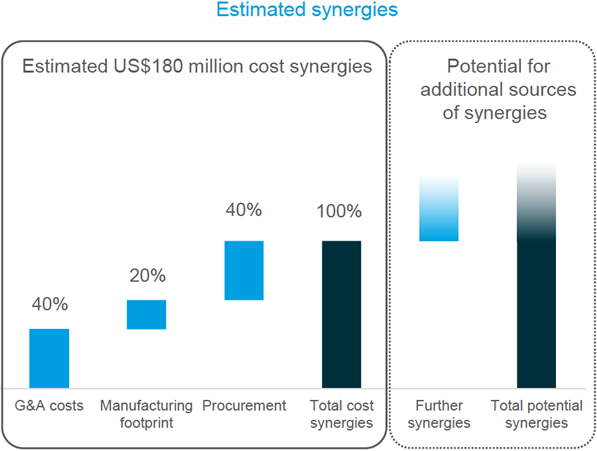
The merger is expected to have pre-tax cost synergies between the two companies of US$180 million per annum by the end of year 3, after the deal is concluded, and be accretive to earnings per share by a double-digit percentage assuming the full cost synergies are achieved. Potential revenue synergies offer further upside.
Source: Amcor (ASX:AMC)
The transaction is an all stock deal at a fixed ratio of 5.1 Amcor (ASX:AMC) shares for each Bemis share, resulting in Amcor and Bemis shareholders owning approximately 71% and 29% of the combined entity, respectively. Given the fixed share ratio, movements in the value of Amcor shares and exchange rate between the Australian dollar and greenback (US$) have seen the share price of Bemis fall sharply since the initial offer, which reflected a premium of 25% in early August.
Indeed, the fall in the Bemis share price is such that the shares are currently trading below the closing price prior to the deal announcement, and at a discount to the implied offer value, indicating some market doubt over the deal being completed. The deal was originally slated for completion by the end of the first quarter in calendar 2019 subject to all the usual conditions.
Regulatory approval is likely to be forthcoming in our view, but shareholder approvals are less certain, with the valuation for Bemis shareholders very different now from early August. On the other hand, the share price of Bemis is still above levels it was trading prior to the merger speculation in 2018 and that is after the recent volatility in markets.
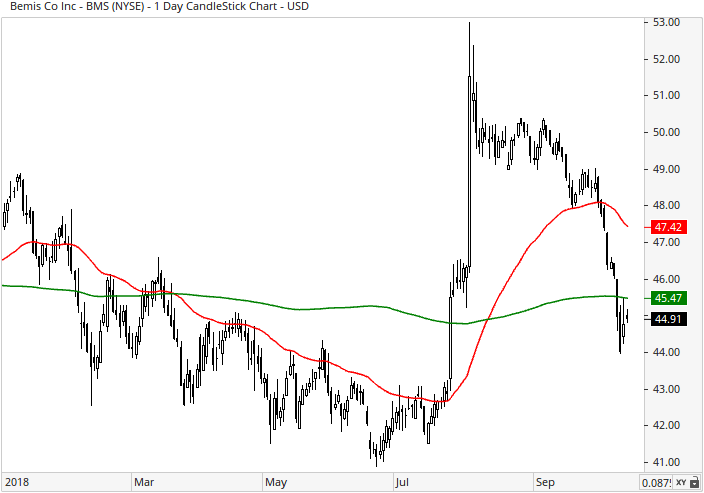
In addition, a rebuttal of the deal could trigger a further decline in the Bemis stock. Management of both companies are moving full steam ahead on the deal.
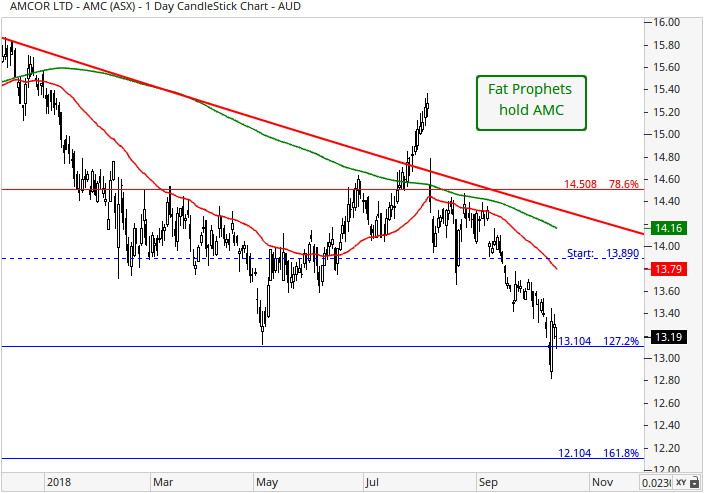
Turning to the technical picture, and the on daily chart, the shares have tracked lower since our last review. Support at the 78.6% Fibonacci retracement of $14.51 has given way, as has that at $13.89. Near term it is important that support holds at the 127.2% Fibonacci retracement around $13.10.
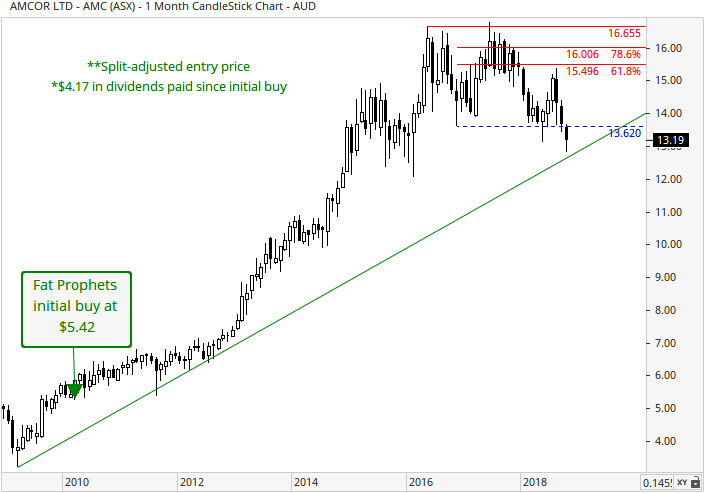
On the monthly chart the picture is more positive. While prices have pulled back below multiple layers of support, the upward sloping green trend-line remains in place.
Summary
Amcor (ASX:AMC) shares are currently trading on circa 17.1 times forecast FY19 earnings, falling to 14.7 times the following year. The projected dividend yield over the same time frame is 4.1% expanding to 5.1%.
Amcor’s FY18 numbers were a little softer than expected, but management were relatively upbeat that some of the short-term challenges were abating and commentary from the AGM regarding the first quarter was relatively upbeat. The company is away to a good start in fiscal 2019 and passing through higher raw material costs. The outlook for higher earnings in FY19 on constant currency terms is unchanged.
Amcor (ASX:AMC) has a strong track record of integrating acquisitions, giving us some comfort that the Bemis integration will be handled capably.
Nonetheless, with a deal of this size there is likely to be a few hiccups. Still, given the scale it will give the business in the fragmented industry, we believe the deal is worthwhile. The drop in the share price of Amcor has reduced the valuation it is effectively paying for Bemis significantly on an absolute basis, although due to the fixed share ratio nature of the deal, Amcor and Bemis shareholders will still receive the same split of the combined entity; assuming completion.
Amcor’s business is relatively defensive and we consider that as a positive, given the late stages of the current bull market in the United States. The stock held up well during last week’s market jitters, reflecting the relatively steady natural demand for its products.
Amcor (ASX:AMC) will remain held in the Fat Prophets portfolio.

