
BHP

BHP Snapshot
A good year bar one
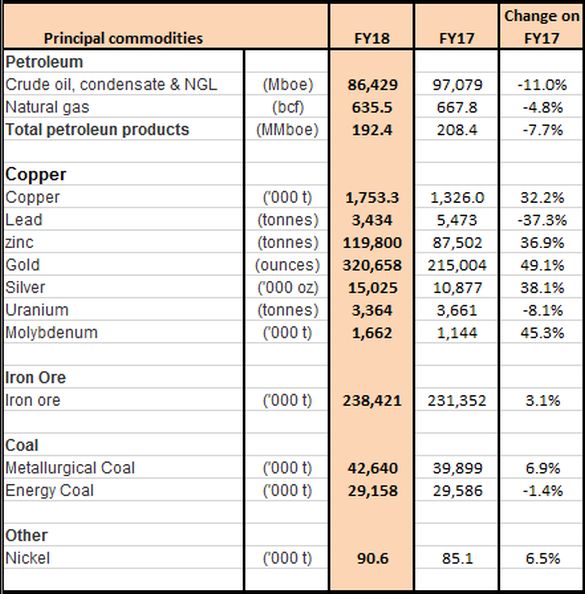
BHP Billiton (ASX:BHP) has released its operational results for the full year to 30 June 2018, and in doing so has revealed another Western Australian Iron Ore (WAIO) record. The company reported a bunch of other good results but there was one exception. Production guidance for 2018 was met across all the company’s key product offerings, with one coming in ahead of its target. Moreover, some of the lesser product offerings produced solid cameo performances for the year. The following table shows a summary of the company’s 2018 operational results (NGL – natural gas liquids):
Source: BHP Billiton (ASX:BHP)
Trading conditions over the course of 2018 proved to be robust, with the company reporting production well within 2018 guidance across all four of its key product offerings. WAIO was again the standout for the company delivering a new record for 2018 and copper finally showed some life at last. Petroleum was the key laggard, with the reporting of a fall in production for 2018, but the number did come in ahead of guidance. Overall, we are of the view that the operational results for 2018 were very good and will have a positive impact on the company’s 2018 full year financial result.
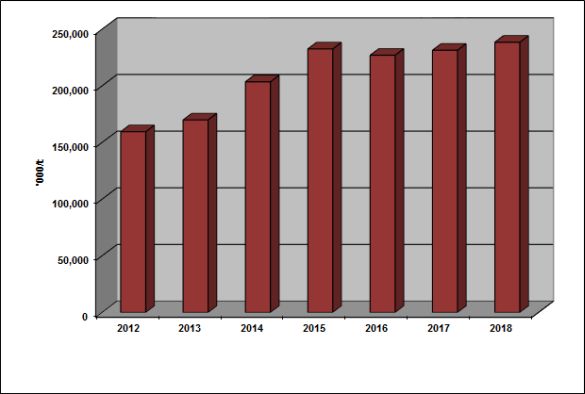
Iron ore reported a good rise in 2018 production compared to the year ago result of 3.1%, to a record 238.4 million tonnes. For the year, production came in at the top-end of guidance which was in the range of 236 million to 238 million tonnes. The following chart shows annual production numbers for iron ore:
Source: BHP Billiton (ASX:BHP)
The solid showing by the company’s iron ore operations was again driven by WAIO.
The standout operation was the Jimblebar mine (BHP’s interest 85%) following the reporting of a 103% jump in production compared to 2017, to 30.6 million tonnes. Jimblebar continues to successfully ramp-up. Operations at the Samarco site (BHP’s interest 50%) in Brazil remain suspended.
Guidance for iron ore production in 2019 is forecast to be in the range of 241 million to 250 million tonnes. On a 100% basis WAIO’s contribution is forecast to be in the range of 273 million to 283 million tonnes.
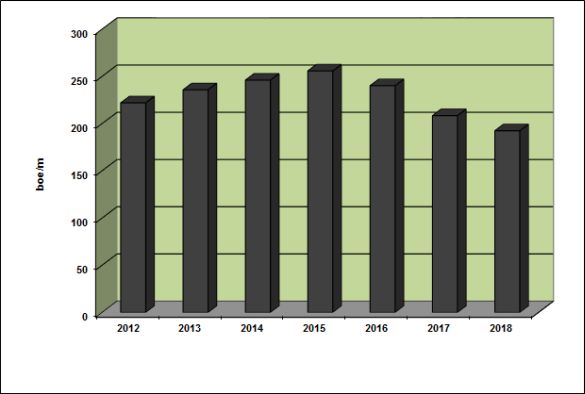
Petroleum operations reported a second soft year in 2018, although guidance in the range of 180 million to 190 million barrels of oil equivalent (boe) for the year was exceeded. Petroleum production came in at 192.4 million boe, which represents a 7.7% decline on the 2017 result. The following chart shows annual boe production:
Source: BHP Billiton (ASX:BHP)
Behind the segments’ result for 2018 were falls in production for both oil and natural gas, with oil being the main culprit. Petroleum continues to be the company’s Achilles heel, as Members can see poor performances have been reported for the past three years. BHP dived into the onshore US shale fields in 2011, forking out US$20 billion to do so. Returns in the latter years on falling energy prices have been disappointing. The company is selling its onshore US oil and natural gas assets.
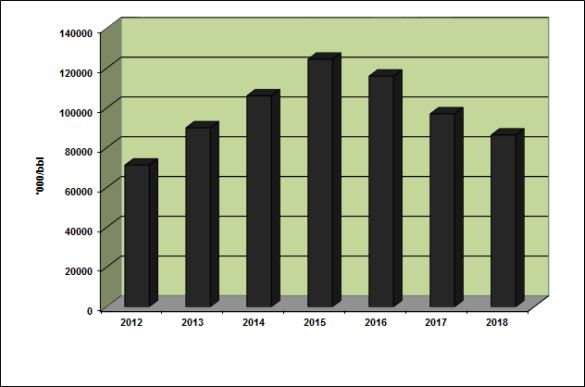
For 2018, production of oil and condensate fell by 11.0% on 2017, to 86.4 million boe. The following chart shows annual crude oil production:
Source: BHP Billiton (ASX:BHP)
The two operating components within oil and condensates are onshore US and conventional; both contributed to the overall softer production outcome in 2018. Onshore US (shale fields) reported a fall of 15.6% on 2017, to 29 million boe, while conventional reported a modest 7.7% fall over the same comparative period as oil, to 57.4 million boe. Weather events and natural field declines drove both results.
Production guidance for 2019 has been provided by the company for its conventional oil fields, with production forecast to be in the range of 113 million to 118 million boe.
Onshore US fields are slated for sale with a completion date yet to be finalised, so tentative guidance is for a run rate consistent with the second half 2018 rate of 14.5 million boe. The company is targeting a sale prior to the close of 2018.
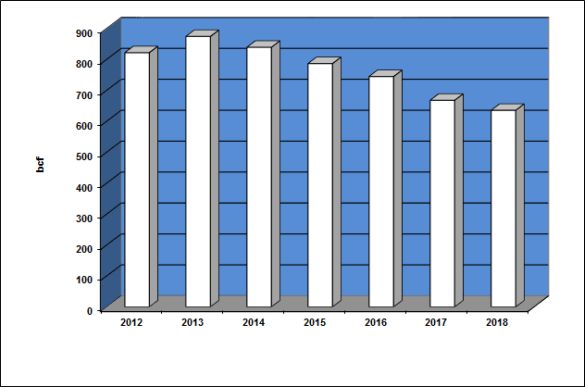
Production of natural gas was also throttled back in 2018, being reflected in the softer production number. Natural gas production fell by 4.8% on 2017, to 635.5 billion cubic feet (bcf). The following chart shows annual natural gas production:
Source: BHP Billiton (ASX:BHP)
The result was driven by both the onshore US and conventional fields which both reported falls in production for 2018. Onshore US natural gas production fell by 6.0% compared to 2017, to 258.5 bcf, with conventional recording a 4.0% decline over the same comparative period as onshore US, to 377.0 bcf. Both results were impacted by weather events and natural field declines. Guidance on natural gas output is not provided.
Due to the pending sale of the onshore US fields, the company has not provided overall guidance for 2019 petroleum production.
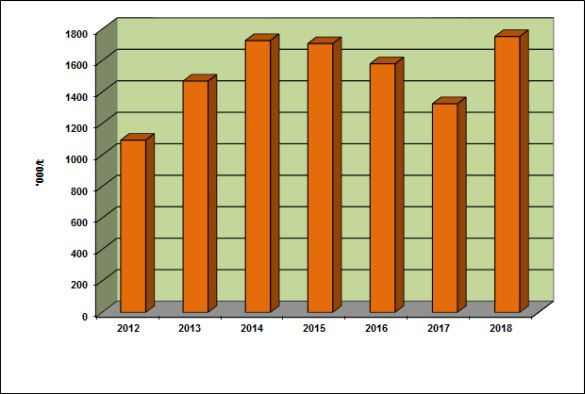
Copper is one of the company’s four key commodity offerings and has over the past three years proven to be problematic for a variety of reasons. The following chart shows annual copper production:
Source: BHP Billiton (ASX:BHP)
For the year, the company reported a significant 32% increase in copper production compared to 2017, to 1.75 million tonnes. Copper production hit 2018 guidance which was in the range of 1.7 million to 1.785 million tonnes.
The company’s Escondida (BHP’s interest 57.5%) mine in Chile was the largest contributor and reported better numbers for 2018, following the printing of a 57% rise on 2017, to 1.2 million tonnes of copper. Operational issues, weather and a prolonged strike drove the poor result for 2017. Escondida is forecast to contribute in the range of 1.12 million to 1.18 million tonnes of copper in 2019.
Olympic Dam dragged on the copper result, following the printing of an 17.8% fall on 2017, to 136,700 tonnes of copper cathode. Scheduled maintenance negatively impacted plant availability. The Pampa Notre operation lifted production by 3.7% on 2017, to 263,800 tonnes. Higher recoveries and plant utilisation were behind the result. Antamina (Rio’s interest 33.8%) also lifted copper production by 4.3% on 2017, to 139,500 tonnes, on higher copper grades.
Olympic Dam, Pampa Notre and Antamina are classified as other copper, and are forecast to produce in the range of 555,000 tonnes to 590,000 tonnes of copper.
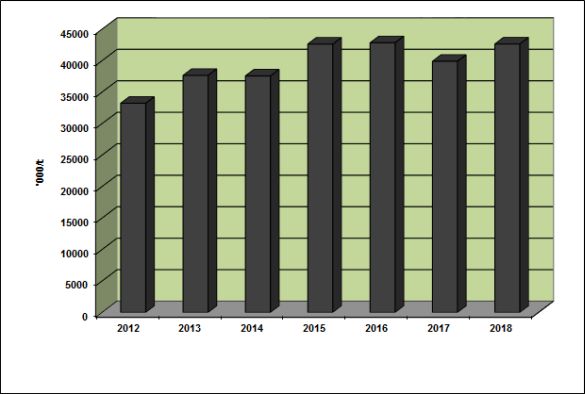
The company separates its coal operations between the two main coal types in metallurgical (met) and energy coals. Production of met coal rose by 6.9% on 2017, to a record 42.6 million tonnes. The following chart shows annual met coal production:
Source: BHP Billiton (ASX:BHP)
Met coal production came in toward the top of 2018 guidance which was in the range of 41 million to 43 million tonnes.
Met coal is used in the manufacturing of steel, so demand will likely mimic iron ore movements, another steel manufacturing ingredient.
The company’s BMA Queensland (BHP’s interest 50%) met coal operations lifted met coal production by 4.6% on 2017, to a record 32.9 million tonnes. Better third-party demand drove operational efficiencies. Guidance for 2019 has been forecast to be in the range of 43 million to 46 million tonnes of met coal.
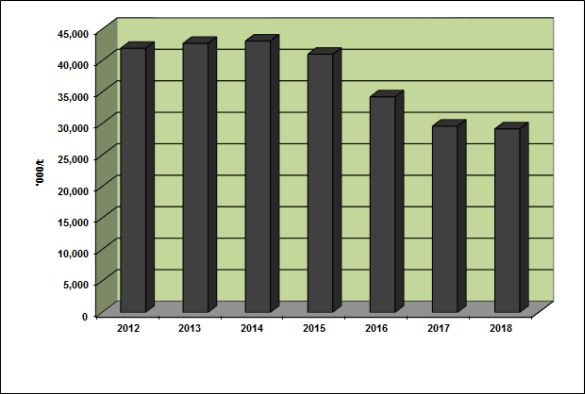
Met coals’ cousin in energy coal saw a small fall in production in 2018, of 1.4% on 2017, to 29.2 million tonnes. Guidance for 2018 was given as 29 million to 30 million tonnes, with the company hitting the 2018 mark. The following chart shows annual energy coal production:
Source: BHP Billiton (ASX:BHP)
Operational improvements by the Australian operations were behind the better result, following a 2.0% increase on 2018, to 18.5 million tonnes. Guidance for 2019 has been forecast to be in the range of 28 million to 29 million tonnes of energy coal.
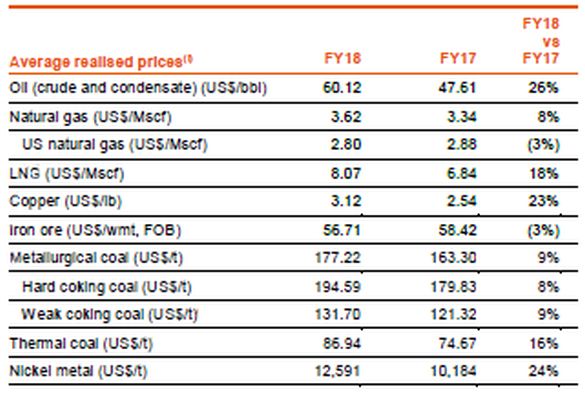
The company provided data on its average realised commodity prices for 2018, which broadly speaking showed a positive trend for the year and are shown in the table below (bbl – barrel, Mscf – million square cubic feet, lb – pound, wmt – wet metric tonne, FOB – free on board t – tonne):
Source: BHP Billiton (ASX:BHP)
This commodity price strength will be a major feature in the company’s 2018 financial result, and it will be very positive. The positive commodity pricing impact will swell the positive impact caused by the firmer operational performance. The company will report its 2018 profit result on 21 August 2018, when it will provide greater clarity on its financial position.
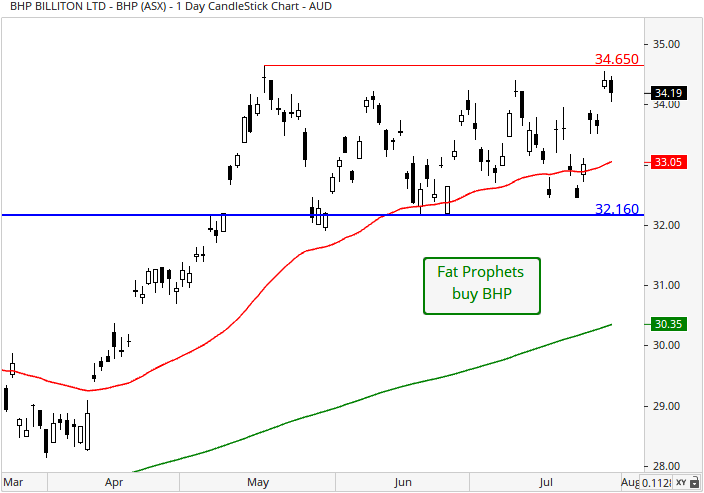
Turning to the charts, on the daily view, the technical outlook has improved significantly since the April lows. An upward rotation in the share price towards resistance sighted between $31.60 and $32.16 has occurred. This was made up of the mid-February (horizontal thin-red line) and mid-January high (horizontal solid-red line) respectively. Prices have since been in a sideways trading pattern, with resistance having been respected at the May high of $34.65.
On the exploration front, the company continues to constrain spending, with US$165 million spent on mineral exploration in 2018. The company increased spending by 1.2% in 2018 when compared to 2017. The long-life tier 1 assets provide the company with upside growth through brownfield development opportunities, rather than more expensive greenfield exploration. We are not concerned with the near-term rationing of capital in this activity.
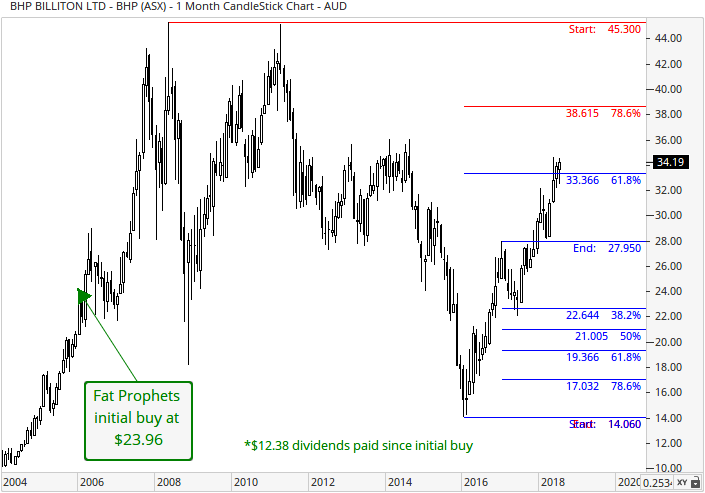
With reference to the monthly chart, after printing a low of $14.06 in January 2016, prices have spent the remainder of 2016 until now in a mode of bullish-rotation. Moving forward, and over the broader term, we could expect prices to gravitate towards resistance at $38.62, being the 78.6% Fibonacci retracement.
BHP Billiton (ASX:BHP), we believe, has the financial and management capability to deliver shareholder value across commodity cycles. The 2018 operational result has nothing untoward to be concerned over when BHP Billiton reports its 2018 results. The operational result reinforces our view on the quality of the company’s asset base.
Consequently, we continue to recommend BHP Billiton (ASX:BHP) as a high conviction buy for Members with no exposure to the stock.
Disclosure: BHP Billiton (ASX:BHP) is held within the Fat Prophets Global Contrarian Fund, Mining and Resources, Concentrated Australian Share and Concentrated UK Share portfolios.
Fat Prophets has made every effort to ensure the reliability of the views and recommendations expressed in the reports published on its websites. Fat Prophets research is based upon information known to us or which was obtained from sources which we believed to be reliable and accurate at time of publication. However, like the markets, we are not perfect. This report is prepared for general information only, and as such, the specific needs, investment objectives or financial situation of any particular user have not been taken into consideration. Individuals should therefore discuss, with their financial planner or advisor, the merits of each recommendation for their own specific circumstances and realise that not all investments will be appropriate for all subscribers. To the extent permitted by law, Fat Prophets and its employees, agents and authorised representatives exclude all liability for any loss or damage (including indirect, special, or consequential loss or damage) arising from the use of, or reliance on, any information within the report whether or not caused by any negligent act or omission. If the law prohibits the exclusion of such liability, Fat Prophets hereby limits its liability, to the extent permitted by law, to the resupply of the said information or the cost of the said resupply.
Funds Management – In addition to the listed funds FPC, FPP and FATP, Fat Prophets Pty Ltd manages the separately managed accounts, namely Concentrated Australian Shares, Australian Shares Income, Small Midcap, Global Opportunities, Mining & resources, Asian Share, European Share and North American Share. These SMAs are managed under their own mandates by the fund managers, and this is independent to the research reports.
Staff trading – Fat Prophets Pty Ltd, its directors, employees and associates of Fat Prophets may hold interests in many ASX-listed Australian companies which may or may not be mentioned or recommended in the Fat Prophets newsletter. These positions may change at any time, without notice. To manage the conflict between personal dealing and newsletter recommendations the directors, employees, and associates of Fat Prophets Pty Ltd cannot knowingly trade in a stock 48 hours either side of a buy or sell recommendation being made in the Fat Prophets newsletter. Staff trades are pre-approved by an appointed staff trading compliance officer to ensure compliance with the staff trading policy.
For positions that directors and/or associates of the Fat Prophets group of companies currently hold in, please click here.
